
Study Strategy
How to Prepare for Casper
You cannot memorize Casper answers, but you can prepare. Here is a phase-by-phase plan built around timed scenario practice, typing speed, and a repeatable ethical-reasoning framework.
The most common mistake with Casper is treating it like a test you can either ignore or cram for. Neither works. There is no content to memorize, so cramming has nothing to grab onto. But the skills Casper measures, reading a scenario accurately and responding with clear judgment under a tight clock, absolutely respond to practice. Applicants we work with who prepare deliberately tend to land in a stronger quartile than they would have cold, not because they learned the answers, but because they learned the moves.
So the plan below is built around a simple idea: you are not studying facts, you are rehearsing a process until it runs on its own under pressure.
Why you cannot memorize your way through
Casper, built by Acuity Insights, presents scenarios about ethics, communication, and professionalism, then asks human raters to judge the quality of your reasoning. There is no answer key. That has two consequences for how you prep.
First, rehearsed responses backfire. A canned, generic answer that you try to bend onto every scenario reads as hollow, and raters notice. Second, and more encouraging, the thing you are actually building is transferable. Once you can reliably identify a dilemma, weigh perspectives, and commit to a defensible action, you can apply that to any scenario the test throws at you. You are training a skill, not stockpiling responses.
A three-phase preparation plan
Order matters. Drilling timed scenarios before you understand the format or have a framework just teaches you to produce shallow answers faster. Build the foundation first.
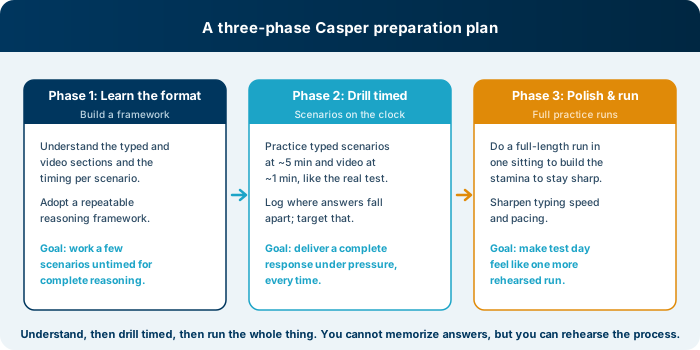
Phase 1: Learn the format and build a framework. Before you touch a timer, understand exactly what the Casper test is: the typed and video sections, the timing per scenario, and the kinds of dilemmas you will face. Then adopt a repeatable reasoning framework so you are not inventing an approach from scratch under time pressure. For the full method with many worked examples, our free Casper study guide walks through it end to end. Work a few scenarios slowly, with no clock, focusing only on producing complete, well-structured reasoning. Your goal here is quality, not speed.
Phase 2: Drill scenarios under realistic timing. Now bring in the clock. Practice typed scenarios with about 3.5 minutes each (two questions) and video scenarios with about one minute to speak, matching the real constraints. The point is to feel the pressure and learn to deliver a complete response anyway. Keep a short log of where your answers fall apart, whether you are running out of time, considering only one perspective, or failing to commit to a decision, and target that specific weakness next.
Phase 3: Polish typing and timing with full runs. Finally, rehearse under conditions as close to test day as you can manage. Do a full-length practice run in one sitting so you build the stamina to stay sharp across all the scenarios, not just the first few. This is also where typing speed pays off, because the smoother your typing, the more of your thinking you can actually get on the page in the time allowed.
These phases are a template, not a law. Compress or stretch them to fit your timeline, but keep the sequence: understand, then drill timed, then run the whole thing.
Three habits that quietly decide your score
The biggest score leaks on Casper are rarely about ethics. They are mechanical, and that makes them fixable.
Build typing speed and accuracy. The typed section gives you a fixed window per scenario. If you type slowly, you simply cannot get as much reasoning down, and a thin response scores lower than a developed one even when your underlying judgment is identical. You do not need to be a professional typist, but a few sessions of focused typing practice is some of the highest-return prep you can do. Practice typing your actual reasoning, not random text, so you get fast at the kind of writing the test demands.
Manage the clock deliberately. A common failure is spending most of your 3.5 minutes on the first question and leaving the second half-answered. Rehearse pacing so you give each question its share of the time. A complete-but-imperfect response across both questions beats a polished answer to one and nothing for the other.
Make your framework automatic. Under time pressure, you do not want to be deciding how to approach a scenario. You want the structure already in your hands so all your attention goes to the specifics of this dilemma. That only happens through repetition, which is the whole point of phase two.
Practice the way you will be tested
A few principles separate productive practice from busywork:
- Time every drill. Untimed practice builds reasoning, but it hides your real bottleneck. Most people are fine when given unlimited time and fall apart under the clock, so the clock has to be part of practice.
- Do full runs, not just single scenarios. Stamina is real. The judgment you bring to scenario one needs to survive to the last scenario, and you can only build that by simulating the full experience.
- Review honestly. After each run, reread your responses and ask whether each one named the dilemma, weighed more than one perspective, committed to an action, and acknowledged consequences. Patterns in what you skip become your study list.
- Use realistic scenarios. Practice with material that mirrors the format and timing of the real test. Acuity Insights offers official preparation resources, and you should verify the current format and any sample materials with them so you are rehearsing the test as it exists now, not an outdated version.
Common preparation mistakes
It is worth naming the ways applicants we work with waste their prep time, because avoiding them is half the battle.
Trying to memorize model answers. People find a sample response they like and try to reverse-engineer a template they can paste onto every scenario. It does not work. A canned answer that ignores the specifics of the situation in front of you reads as generic, and raters are trained to notice. Internalize the framework, not the wording.
Practicing untimed and assuming it transfers. Untimed practice feels productive because your answers come out polished. But the real test is timed, and the bottleneck for most people is not the quality of their thinking, it is getting that thinking down before the clock runs out. If every practice rep is untimed, you never confront your actual problem.
Ignoring the mechanics. Applicants spend hours debating the ethics of a scenario and zero minutes on typing speed or pacing, even though the mechanics are where the easy points are. A slow typist with great judgment can still land a mediocre quartile simply because they could not get enough reasoning onto the page. Treat typing and pacing as part of prep, not an afterthought.
Over-preparing the content, under-preparing the process. There is no syllabus to master, so reading more about ethics has sharply diminishing returns. Your time is better spent running the framework on real scenarios under time until it is automatic. The skill is in the doing, not the reading.
When outside feedback helps
You can prepare for Casper on your own with a framework, a timer, and honest review. Where a second set of eyes earns its keep is in the blind spot you cannot see from inside your own response: the perspective you consistently miss, the way you hedge instead of deciding, the tone that reads as cold when you meant it as professional. Those patterns are obvious to a reader and nearly invisible to the writer.
That is the kind of support our Casper coaches are being set up to provide. For now, get the format down, build your framework, and drill under the clock. If you are also preparing for medical school admissions and weighing AAMC PREview, note that it rewards a different format, which we explain in Casper vs. PREview and from the med-school angle in AAMC PREview vs. Casper.
Learn the format, build a framework, drill it under realistic timing, and fix the mechanical leaks. Do that consistently and your judgment shows up clearly on test day. Explore Casper prep for a full Casper plan, timed scenario drills, and human-scored practice exams.
Frequently asked questions
Can you study for the Casper test?
Yes, though not by memorizing answers, because Casper has none. Effective preparation means learning the format, drilling timed practice scenarios, building typing speed, and rehearsing a consistent ethical-reasoning framework so you respond clearly under time pressure.
How long should I prepare for Casper?
Most applicants need a few focused weeks rather than months. Casper tests reasoning and communication habits, not a body of content, so the goal is to make a framework automatic and to get comfortable with the timing and typing demands through full practice runs.
Do I need to be a fast typist for Casper?
The typed section gives you a fixed amount of time per scenario, so slow typing limits how much reasoning you can get down. You do not need to be a professional typist, but practicing your typing speed and accuracy is one of the simplest ways to protect your score.
What is the best way to practice for Casper?
Do full, timed practice scenarios under realistic conditions, then review your responses against a clear framework. Strict timing and honest review matter more than the sheer number of scenarios you attempt.
Should I memorize answers for Casper?
No. There are no right or wrong answers to memorize, and rehearsed, generic responses tend to read as hollow. Internalize a reasoning framework instead, so you can apply it to any scenario you are given.
Prepping for the Casper?
Start with the Casper prep options available today, or join the update list for new releases.