
Comparisons
Casper vs. PREview: How Do They Compare?
Casper and AAMC PREview both assess professional judgment, but they differ in format and scoring. Here is how open-ended quartile-based Casper compares to multiple-choice scaled-score PREview.
If you are applying to medical school, you may run into two situational judgment tests, Casper and AAMC PREview, and it is easy to assume they are interchangeable. They are not. Both are trying to measure the same broad thing, your professional and people skills, but they do it in formats so different that prepping for one as if it were the other will cost you. Here is how they actually compare, and how to prepare for each without blurring the two.
The same goal, two very different tests
Casper, built by Acuity Insights (formerly Altus), and AAMC PREview, built by the AAMC, both exist for the same reason: grades and admissions-test scores do not tell a school how you communicate, how you handle an ethical bind, or how you treat people. Both tests put you in scenarios and ask you to engage with them.
That shared purpose is where the similarity ends. The way you respond, and the way you are scored, diverge sharply.
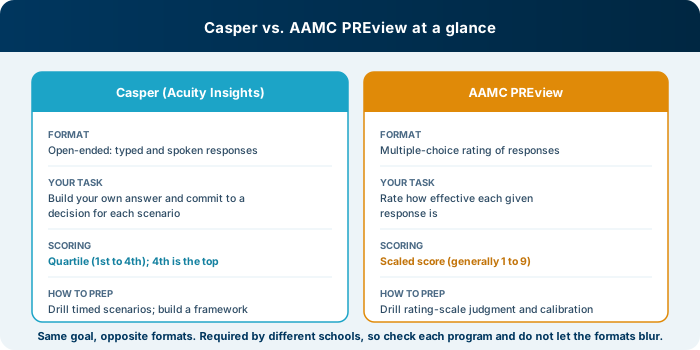
How they differ in format
The format gap is the difference that matters most for how you prepare.
Casper is open-ended. You generate your own responses. In the typed section you write your answers to scenarios; in the video section you speak them. Nothing is provided for you to choose from. That means structure, clarity, decisiveness, and speed all matter, including, in the typed section, how fast you can type. You are building a response from nothing, under a tight clock. We break the format down fully in what the Casper test is.
PREview is multiple-choice. Instead of writing anything, you are shown a scenario and a set of possible responses to it, and you rate how effective each one is. The skill is judgment and calibration: you are not deciding what you would do, you are evaluating how good each given option is. There is no typing, no writing, no speaking, just rating.
That single difference reshapes everything. Casper rewards the ability to produce good reasoning. PREview rewards the ability to recognize and rank the quality of reasoning that is handed to you.
How they differ in scoring
The scores are not the same scale, and they are not interchangeable.
- Casper reports a quartile. Your performance is placed in one of four bands relative to other applicants to your profession, with the 4th quartile being the top group. You do not receive a number. We explain this in detail in what is a good Casper score.
- PREview reports a scaled score. You receive a number, generally on a 1 to 9 range, that reflects how well your effectiveness ratings aligned with the assessment’s scoring. It is a point score, not a quartile.
Because the scales differ, there is no clean way to translate a Casper quartile into a PREview score or the other way around. Schools that use each test read it on its own terms.
One subtle consequence of the scoring difference is worth flagging. Because Casper is reported as a quartile relative to your applicant pool, your result depends partly on how the rest of the field performs, not on a fixed standard. PREview, as a scaled score, behaves more like a conventional test result you can compare against published distributions. Neither approach is better; they simply mean a “strong” result is framed differently. On Casper you are asking “where did I land relative to other applicants,” while on PREview you are asking “what number did I earn.” Keep that distinction in mind when you read your scores, because it changes what counts as good. We unpack the quartile side of this in what is a good Casper score.
Which one is harder?
Applicants we work with ask this constantly, and the honest answer is that neither is uniformly harder. They are demanding in different ways, and which one feels harder depends on your own strengths.
Casper is harder if you struggle to produce structured writing quickly. You are generating a complete, reasoned response from a blank screen, organizing your thoughts, committing to a decision, and typing it all inside a tight window. If you are a slow typist or you tend to hedge rather than decide, Casper will expose that. The video section adds the separate challenge of speaking a coherent answer on camera in about a minute.
PREview is harder if you struggle with fine-grained calibration. Rating responses sounds easier than writing them, but the difficulty is that several options can all look reasonable, and the test rewards you for distinguishing the genuinely effective response from the merely acceptable one. The classic trap is rating everything that is not obviously wrong as highly effective. If your instinct is to be generous, PREview will punish it.
So if you are a fast, decisive writer, Casper may play to your strengths. If you are a careful, discriminating reader of behavior, PREview may suit you better. Most applicants do not get to choose, since the requirement is set by their schools, but knowing your own tendency tells you where to put your prep hours.
The logistics also differ
Beyond format and scoring, the two tests differ in how you take them. Casper and PREview are administered by different organizations, on different platforms, on different dates, with their own registration and fees. You schedule and pay for each separately, and your results are distributed to schools through each test maker’s own system.
The practical takeaway is to plan ahead. If your school list requires both, you are looking at two separate test sittings to schedule around the rest of your application timeline, plus two preparation tracks. Build that into your calendar early rather than discovering a deadline late. And because dates, fees, and distribution details change, confirm the current logistics with AAMC for PREview and Acuity Insights for Casper as you plan.
They are required by different schools
This is the practical part. Some medical schools require Casper, some require AAMC PREview, some accept or require both, and some require neither. The requirement is school-specific, and it can change between cycles.
The action item is simple: build your school list, then check each program’s stated requirements directly rather than assuming. Do not take one because a forum said to; take what your target schools actually ask for. Requirements and policies shift, so verify the current details with each school and with the test makers, AAMC for PREview and Acuity Insights for Casper.
How to prepare for each
The encouraging news is that both tests rest on the same foundation: sound professional judgment. The reasoning habits that serve you on one serve you on the other. For both, practice identifying the conflict in a scenario, naming the stakeholders, separating facts from assumptions, communicating with respect, and taking responsibility. Those habits pay off on Casper, on PREview, in interviews, and in your secondary essays.
But the formats demand different drilling, and keeping that line bright is the key to preparing for both at once.
- For Casper, build and deliver your own response. Drill timed scenarios where you write or speak a complete, decisive answer using a repeatable framework. Practice your typing speed, because it quietly caps your typed-section score. The full plan is in how to prepare for Casper.
- For PREview, rate response quality. Drill the skill of judging how effective each given response is, resisting the common trap of rating every reasonable option as highly effective. PREview rewards finer distinctions than that.
The mistake to avoid is letting one format bleed into the other. If you practice Casper by ranking options, you never build the muscle of producing a response. If you practice PREview by writing essays, you never sharpen the calibration it actually tests. For the medical-school-specific take on keeping these distinct, see our companion piece, AAMC PREview vs. Casper.
Casper and PREview are cousins, not twins. They share a goal and an underlying skill, but they ask for it in opposite ways, open-ended responses scored in quartiles versus multiple-choice ratings scored on a scale. Prepare for the format your schools require, build the shared judgment underneath both, and keep the two from blurring together. Explore Casper prep for current Casper practice options.
Frequently asked questions
What is the difference between Casper and AAMC PREview?
Both assess professional and people skills, but the format differs. Casper, by Acuity Insights, uses open-ended typed and spoken responses and reports a quartile relative to your applicant pool. AAMC PREview is multiple-choice, asking you to rate the effectiveness of responses, and reports a scaled score, generally from 1 to 9. They are required by different schools.
Is Casper or PREview harder?
Neither is uniformly harder; they are hard in different ways. Casper demands that you generate clear reasoning under time, including typing speed, while PREview demands fine-grained judgment about how effective each given response is. Your stronger format depends on your skills.
Do I need to take both Casper and PREview?
It depends on your school list. Some medical schools require Casper, some require AAMC PREview, some accept or require both, and some require neither. Check each program's requirements directly, since they vary and can change between cycles.
How is Casper scored compared to PREview?
Casper reports a quartile, first through fourth, comparing you to other applicants in your profession, with the fourth quartile being the top. AAMC PREview reports a scaled score, generally on a 1 to 9 range. They are not interchangeable scales.
Can I prepare for Casper and PREview at the same time?
Yes, because both rest on the same underlying skill of sound professional judgment. But keep the formats separate in practice: for Casper, build and write or speak your own response, and for PREview, rate how effective each given response is.
Prepping for the Casper?
Start with the Casper prep options available today, or join the update list for new releases.