
Test Basics
Schools That Require Casper: A Program Guide
Casper is required across medicine, dentistry, nursing, pharmacy, PA, and veterinary programs. Here is a profession-by-profession guide to who uses it, with how to confirm your exact schools.
If you are building a school list, one of the first practical questions is simple: which of these programs actually make me take Casper? The honest answer is that it depends on the profession, the specific program, and the cycle, because Casper adoption has spread well beyond medicine and the list shifts every year. This guide gives you a realistic, profession-by-profession picture of who uses Casper, so you know what to expect, paired with the one step that actually settles it for your list.
A note up front, because accuracy matters more than a tidy list: what follows is a representative overview, not a complete or guaranteed roster. Programs add and drop Casper between cycles, and the only authoritative source is the official Casper program list maintained by Acuity Insights. Use this article to understand the landscape, then verify your exact schools there.
Why so many programs use Casper
Casper is a situational judgment test built by Acuity Insights (formerly Altus) and offered as part of the Altus Suite. Its purpose is to measure the professional and people skills that a transcript and an admissions test cannot: how you communicate, how you handle an ethical bind, how you treat people under pressure. If you want the full mechanics, we cover them in what the Casper test is.
The reason adoption keeps spreading is that every health profession cares about those same human skills. A future dentist, nurse, pharmacist, or veterinarian needs sound judgment and clear communication just as much as a future physician. So once Casper proved useful in medical admissions, it was a short step for other professions to adopt the same screen. That is why the list of participating programs has grown year over year across fields.
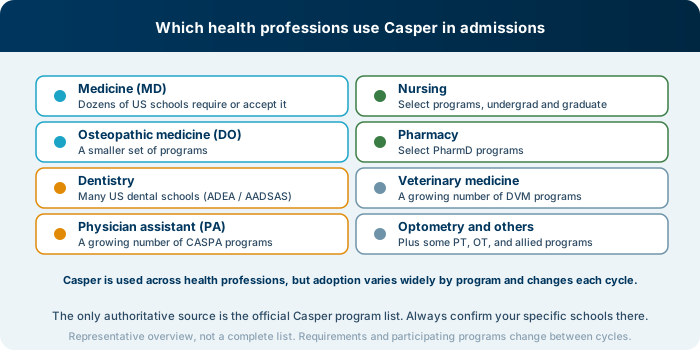
Casper by profession: a representative guide
The table below summarizes how widely Casper is used in each major health profession, along with the centralized application service it usually runs through. Treat the “how common” column as a general sense of the landscape, not a precise count, and confirm individual programs on the official list.
| Profession | Application service | How common is Casper | Notes |
|---|---|---|---|
| Medicine (MD) | AMCAS / TMDSAS | Dozens of US schools require, recommend, or accept it | The most established user; the list fluctuates each cycle |
| Osteopathic medicine (DO) | AACOMAS | A smaller but real set of programs | Some DO schools require it; many do not |
| Dentistry | AADSAS (ADEA) | Many US dental schools | Common enough that dental applicants should expect it |
| Physician assistant (PA) | CASPA | A growing number of programs | Adoption is rising; check each program |
| Nursing | NursingCAS / direct | Select programs, undergrad and graduate | Less universal; verify individually |
| Pharmacy | PharmCAS | Select PharmD programs | Used by some, not most |
| Veterinary medicine | VMCAS | A growing number of DVM programs | Adoption expanding; confirm per school |
| Optometry and allied health | Varies | Some programs | Includes select optometry, PT, OT, and similar fields |
A few honest caveats about this table. The counts are deliberately qualitative because exact numbers change between cycles and even mid-cycle. A program that required Casper last year may not this year, and vice versa. And “accepts” is not the same as “requires”: some schools require Casper, some merely recommend or accept it, and that distinction matters for how you prioritize it. The table tells you where to expect Casper; the official list tells you where you actually need it.
Medicine: the most established user
Medical schools were among the earliest and remain the most common users of Casper. Dozens of US MD programs require, recommend, or accept it, alongside a smaller set of DO programs. Because medicine is where Casper started, it is also where the requirement is most visible in admissions guidance.
The wrinkle for medical applicants is that Casper is not the only situational judgment test in the space. The AAMC offers its own assessment, PREview, and the two are not interchangeable. Some medical schools require Casper, some require PREview, some require or accept both, and some require neither. We compare them in Casper vs. PREview, and there is a medical-school-specific take in AAMC PREview vs. Casper. The practical point: do not assume a school wants Casper just because it wants a judgment test. Check which one.
Dentistry, PA, and the growing fields
Dentistry is the next most established user after medicine. Many US dental schools require or recommend Casper through the AADSAS application, so dental applicants should generally plan on it unless their specific programs say otherwise.
Physician assistant and veterinary programs are where adoption has been growing most visibly. A rising number of PA programs require Casper through CASPA, and a growing set of veterinary programs require it through VMCAS. Because these fields are still expanding their use of the test, the cycle-to-cycle change is larger here than in medicine, which makes verifying your specific programs especially important.
Nursing, pharmacy, optometry, and some allied health programs use Casper more selectively. If you are applying in one of these fields, do not assume either way: a meaningful minority of programs use it, so check each one rather than guessing from the field as a whole.
The one step that actually settles it
All of the above is context. The decision for your list comes down to a single reliable move: look up each program on the official Casper program list, then confirm against the program’s own admissions page. Acuity Insights maintains the authoritative list of participating programs, and individual schools publish their own requirements. When those two agree, you have your answer.
Do this early, for two reasons. First, requirements change, and discovering a Casper requirement a week before a deadline is a stressful, avoidable scramble. Second, Casper has limited test dates and a results turnaround, so a late discovery can genuinely jeopardize an application timeline. Build the check into the same session where you finalize your school list.
While you are at it, note how each program weights Casper, because that varies as much as whether they require it. We cover what counts as a strong result and how schools read it in what is a good Casper score. And as you plan the budget and calendar, see what Casper costs, since the base fee covers only a set number of program distributions and extra schools add up.
Once you know you need it
If your list includes Casper-requiring programs, the next move is preparation, and the good news is that Casper rewards a learnable process rather than memorized content. Start with a repeatable framework for working any scenario in how to answer Casper scenarios, rehearse on full examples in our Casper practice questions, and build a realistic timeline in how to prepare for Casper.
Knowing who requires Casper is step one of a sane application plan. Confirm your exact programs on the official list, note how each weighs the test, then turn your attention to preparing well. Explore Casper prep for timed practice exams, human scoring, and school-list-aware preparation.
Frequently asked questions
What schools require the Casper test?
Casper is required or accepted by programs across medicine (MD and DO), dentistry, physician assistant studies, nursing, pharmacy, veterinary medicine, optometry, and some allied health fields. Dozens of US medical schools use it, along with many dental and a growing number of PA and veterinary programs. The exact list changes every cycle, so confirm your specific schools on the official Casper program list.
Do all medical schools require Casper?
No. Only a subset of US medical schools require, recommend, or accept Casper, and the list fluctuates each year. Some schools require AAMC PREview instead, some require both, and some require neither. Always check each program's stated requirement directly.
How do I know if my school requires Casper?
Check the official Casper program list maintained by Acuity Insights and confirm against each program's own admissions page. Requirements change between cycles, so do not rely on a forum thread or an older list. The program list is the only authoritative source.
Do dental schools require Casper?
Many US dental schools require or recommend Casper as part of the AADSAS application, though not all do. Because participation changes each cycle, verify your specific dental programs on the official Casper program list and on each school's admissions page.
Is Casper required for PA or nursing programs?
A growing number of physician assistant programs require Casper through CASPA, and some nursing programs use it as well. Adoption is less universal than in medicine and dentistry, so confirm each program individually rather than assuming.
Prepping for the Casper?
Start with the Casper prep options available today, or join the update list for new releases.