
Scores
CPA Exam Pass Rates: How Hard Each Section Is and What the Rates Mean
How hard is the CPA Exam? Pass rates run roughly in the 40s to high 50s percent by section, but because the exam is criterion-referenced and not curved, what the rates mean for difficulty is subtler than it looks.
“How hard is the CPA Exam?” is the question behind almost every search for CPA pass rates. Candidates find the numbers, see that a section passes “only” around 45 percent of takers, and read it as proof the exam is stacked against them or that half of all candidates are doomed. Neither reading is right, and the gap between what a pass rate looks like it means and what it actually measures is the most useful thing to understand about CPA difficulty.
So this article does double duty. It answers how hard the exam really is, and it shows you what the section pass rates do and do not tell you about that difficulty. The two questions are the same question once you understand one fact about how the exam is scored. Let’s start with the honest answer on difficulty, then the numbers, then the fact that reframes all of them.
So how hard is the CPA Exam, really?
Plainly: it is hard, but in a specific and beatable way. The difficulty comes from three things working together. First, volume, the exam covers a large body of accounting content across four sections, and FAR in particular carries an enormous amount of detail. Second, cognitive level, the exam tests mostly at application and analysis rather than rote recall, so memorizing facts is not enough; you have to use them, as the section-by-section skill breakdown shows. Third, endurance, it is four separate four-hour sections passed over months, often around a full-time job, so it rewards stamina and consistency as much as intelligence.
What the difficulty is not is a competition. This is the crucial part, and it is where the pass rates get misread. The CPA Exam is not curved against other candidates, which means “hard” here means “a high fixed bar,” not “only so many people are allowed through.” That distinction changes how you should read every pass rate, so let’s look at the numbers with it in mind.
What the pass rates look like
Across sections, cumulative CPA Exam pass rates generally run roughly in the 40s to the high 50s percent, and they vary meaningfully from one section to another and from quarter to quarter.
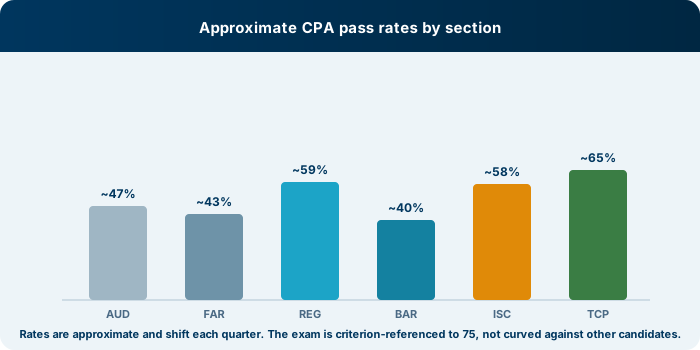
A few honest caveats about that chart. The numbers shown are approximate and meant to give you a feel for the landscape, not to memorize. Pass rates are published by the AICPA and they move every quarter as the candidate pool and the questions shift. The heavier-content Core sections often sit toward the lower end of the range, while some Discipline sections can run higher, but the specific ordering changes over time. Before you rely on any single figure, check the current published rates directly with the AICPA. Treat the chart as a map of the terrain, not a precise measurement.
What you should take from it is the general shape: this is a hard exam where a large share of well-intentioned candidates do not pass on a given attempt, and the difficulty is not uniform across sections. That is useful context. But it becomes genuinely useful only once you understand the next point.
The fact that reframes every pass rate: the exam is not curved
Here is the single most important thing to understand about CPA pass rates: the exam is not curved against other candidates.
The CPA Exam is criterion-referenced. You are scored against a fixed standard of competency, a scaled 75, and not ranked against the people who happened to sit the section the same quarter you did. We explain how that 75 is built in what a passing CPA score really is. The crucial consequence here is this: there is no cap on how many candidates can pass. If every single person who sat a section demonstrated the required competency, in principle every single one of them would pass. The pass rate would be 100 percent and nothing would be wrong.
That reframes the low numbers entirely. A pass rate in the 40s does not mean a curve failed more than half the room. It means that, of the people who took the section, roughly that share met a fixed bar. The rate is a description of how a population performed, not a competition you have to win against your peers. On a curved exam, a strong cohort can pull the line up and beat you even if you performed well. On the CPA Exam, that cannot happen. Your performance against the standard is the only thing that determines your result.
So when you see a 45 percent pass rate, do not read it as “I have a 45 percent chance.” Read it as “of everyone who sat this, fewer than half cleared the bar, and many of them were under-prepared, rushed, or sitting it before they were ready.” Your job is simply to be one of the prepared ones.
What the pass rates do tell you
The numbers are not useless. Used carefully, they tell you a few real things:
- The exam is genuinely demanding. A criterion-referenced bar that only around half of candidates clear is a hard bar. The pass rates are a fair warning that this exam rewards serious, sustained preparation and punishes cramming. That should inform how many hours you budget, which we cover in how to study for the CPA Exam.
- Sections differ in difficulty. The variation across sections is real and reflects how much content each carries and how applied it is. This is helpful for planning your sequence and your hours, since you now know not to treat all four sections as equal.
- Preparation moves you up the distribution. Because there is no curve, every bit of competency you build translates directly toward a pass. You are not fighting for a limited number of slots. You are clearing a fixed line, and thorough preparation is what gets you over it.
What the pass rates do not tell you
Just as important is what you should refuse to read into them:
- They are not your personal odds. The aggregate rate lumps together fully prepared candidates and barely prepared ones. A candidate who has put in the hours, drilled the multiple-choice, and practiced the simulations is in a very different position than the average implies.
- They are not a reason to pick a Discipline. Some candidates try to choose their Discipline section by hunting for the highest pass rate. This is a mistake. Pass rates shift quarter to quarter and reflect who is taking each section as much as its inherent difficulty, and a section that fits your strengths will serve you far better than one with a marginally friendlier number. Choose your Discipline by strengths and goals instead, exactly as we lay out in how to choose your CPA Discipline.
- They are not a verdict on you. Plenty of capable people do not pass a section on the first attempt, retake it, and pass. The exam allows retakes, and a single result is a snapshot of one attempt, not a measure of whether you can become a CPA.
Why pass rates vary so much by section
It is worth understanding why the numbers differ across sections, because the reasons are not what most candidates assume. The variation is driven by two things working together.
The first is content load and difficulty. A section that covers a vast amount of detailed material gives candidates more places to be under-prepared, which tends to pull its pass rate down. The heavier Core sections often sit lower for exactly this reason. The second, and more overlooked, is who is sitting each section. Pass rates are not measured against a single uniform group; the candidates taking one section are not the same people, in the same state of preparation, as those taking another. A Discipline that attracts candidates already working in that field may show a higher rate partly because its test-takers walk in with relevant experience, not only because the material is easier in some absolute sense.
That second factor is why ranking sections purely by pass rate is so misleading. A higher rate can reflect a more prepared or more specialized pool as much as an easier exam. So when you compare section pass rates, resist the urge to read them as a clean difficulty ranking. They are the combined result of content and population, and the population part is invisible in the raw number.
A per-section difficulty breakdown
With both caveats in mind, the approximate rate plus the reasons for it, the population effect and the content, here is a section-by-section read on difficulty. The pass rates below are approximate, change quarterly, and should be confirmed with the AICPA; the “what makes it hard” column is the part that actually helps you plan.
| Section | Approximate pass rate | What makes it hard | Study implication |
|---|---|---|---|
| FAR (Core) | low 40s% | The most content of any section, heavy on application and analysis; many places to be under-prepared | Budget the most hours here (~120 to 140); usually the section that takes the longest |
| AUD (Core) | mid to high 40s% | Rewards professional judgment over memorization; the only section reaching the Evaluation skill level | Focus on the logic of the audit, not flashcards; understand why each step exists |
| REG (Core) | mid to high 50s% | A broad set of tax and business law rules to both know and apply | Steady memorization plus applied practice; faster if you have a tax background |
| BAR (Discipline) | low 40s% | Analysis-forward, complex reporting and data; often a tougher elective | A good fit only if you were strong on FAR; otherwise expect a grind |
| ISC (Discipline) | high 50s% | More recall-and-application than analysis, but unfamiliar IT and controls content if you lack exposure | Suits tech-comfortable candidates; the more MCQ-weighted format rewards broad coverage |
| TCP (Discipline) | low to mid 60s% | Application-heavy tax work; higher rate partly reflects tax-experienced candidates choosing it | Natural extension of REG strengths; the rate is flattering because of who self-selects in |
Read this table for the “what makes it hard” and “study implication” columns, not the percentages. The single most reliable rule it illustrates: the hardest section for you is the one furthest from your background, which is why two candidates can rank the difficulty completely differently. FAR is the consensus hardest by content volume, but a career tax preparer may find REG and TCP almost easy while a pure-tax background struggles with AUD. Plan your hours and your section order around your own profile, which is exactly what which CPA exam to take first helps you do.
How to actually use them
So what should you do with pass rates? Use them as motivation to prepare seriously and as a rough planning input for where to spend your hours, then set them aside. The number that determines your outcome is not the population pass rate. It is whether you, individually, clear the 75 standard on the section in front of you. That is entirely a function of your preparation, and it is fully within your control.
The pass rates describe the crowd. Your result is about you. Prepare like the prepared half, give the harder sections the extra hours they deserve, and the aggregate statistic stops being about you the moment you walk out having passed.
So is the CPA Exam hard? Yes, in the way a high fixed bar is hard, not in the way a competition is. The content is heavy, the questions are mostly applied, and the marathon of four sections tests your endurance. But there is no curve to beat and no cap on passes, so every hour of preparation moves you directly toward the line. That is the most hopeful thing the pass rates have to say: difficulty here is something you out-prepare, not something you out-compete.
Pass rates are published and updated by the AICPA and change every quarter, so always confirm current figures and section-level data directly with them rather than relying on approximate ranges. To turn this into a plan, see how long to study for the CPA Exam and how to study for the CPA Exam. When you want a study plan built to put you safely on the passing side of the line, join the early-access list and our CPA instructors will help you build one when prep opens.
Frequently asked questions
How hard is the CPA Exam?
The CPA Exam is genuinely demanding: it covers a large body of accounting content across four sections, tests mostly at application and analysis levels rather than recall, and only around half of candidates pass a given section on a given attempt. But it is not curved, so difficulty is about clearing a fixed competency bar with serious preparation, not beating other candidates.
What is the pass rate for the CPA Exam?
Cumulative pass rates run roughly in the 40s to high 50s percent and vary by section and by quarter. These are approximate and change quarterly; confirm current published figures with the AICPA before relying on a specific number.
Is the CPA Exam curved?
No. The CPA Exam is criterion-referenced, meaning you are scored against a fixed competency standard of 75, not ranked against other candidates. A low pass rate does not mean a curve is working against you.
Which CPA section is the hardest?
FAR is widely considered the hardest because of its sheer content volume, and it often sits near the lowest pass rate among the Core sections. But difficulty is personal: the hardest section for you is the one furthest from your background. Treat any ranking as approximate and confirm current figures with the AICPA.
Should I choose my CPA Discipline based on pass rates?
No. Pass rates move quarter to quarter and reflect who is taking each section as much as its difficulty. Choose your Discipline by your strengths and career goals instead, and treat pass rates as background context only.
Prepping for the CPA?
Join the early-access list to be first when CPA prep opens.