Volume I: Foundations · Chapter 6
This is a reference chapter. You will come back to it often, so do not try to memorize it in one sitting. Read it once to learn the families and the way the test disguises each flaw, then return to it whenever you work Flaw questions (Chapter 17), Method and Parallel questions, or any argument where the reasoning feels off but you cannot yet name why.
A flaw is a defect in the reasoning: the leap from the premises to the conclusion does not hold up. It is not a false premise. On the LSAT you accept the premises as given and you almost never get to challenge whether they are true. The error lives in the move the author makes, the assumption buried in the arrow from premise to conclusion.
Hold on to that distinction, because it is the single most common reason students pick wrong answers on Flaw questions. If an answer choice says the argument “relies on a claim that is false” or “depends on an inaccurate statistic,” that answer is almost always wrong. The argument’s premises are not the problem. The author’s use of those premises is the problem.
Here is the catch. The LSAT rarely describes a flaw in plain words. Instead it hands you abstract, formal answer-choice language: “takes a condition that is sufficient to guarantee an outcome to be one that is required for that outcome.” That sentence describes a single, simple mistake (treating sufficient as necessary), but it is dressed up so you cannot recognize it at a glance. So your job is two skills at once:
This chapter trains both. For every flaw you get a plain-English name, a one-line “what the author did,” the abstract answer-choice language the LSAT uses to dress it up, and a short original micro-example so the pattern sticks.
The flaws are organized into three families. Most LSAT flaws are causal or evidentiary. A large second group is about conditional logic and scope. The rest are classic argumentative or source errors. Learn the families and you will know where to look first.
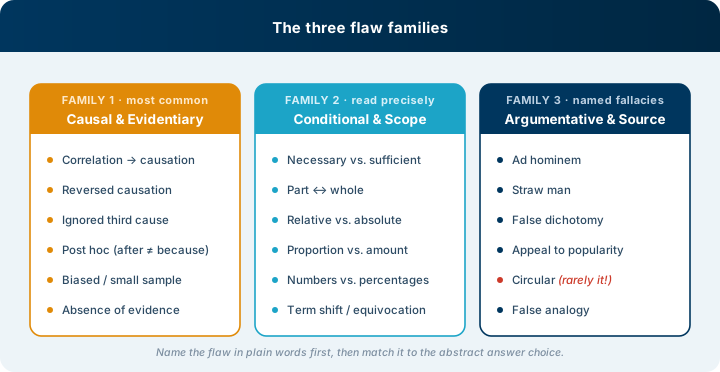
This family is the heart of the test. Whenever an author concludes that one thing produced, caused, or explains another, treat the reasoning as suspect and run through this list. (For the full causal toolkit, see Chapter 5, Causal Reasoning.)
What the author did: Saw two things occur together and concluded that one causes the other.
Abstract answer language: “infers a causal relationship from the mere fact that two phenomena are correlated”; “concludes that one event causes another from evidence that they are associated.”
Micro-example: Towns with more public libraries report higher average incomes, so building a library raises a town’s income. (Wealthier towns can simply afford more libraries.)
What the author did: Concluded A causes B when the evidence equally supports B causing A.
Abstract answer language: “fails to consider that the causal relationship it describes might be reversed”; “overlooks the possibility that the supposed effect is actually the cause.”
Micro-example: People who exercise sleep better, so exercise must improve sleep. (Maybe people who sleep well have the energy to exercise.)
What the author did: Concluded A causes B while overlooking a separate factor that produces both.
Abstract answer language: “fails to consider that both phenomena may be effects of a common underlying cause”; “ignores the possibility that a third factor is responsible for the correlation.”
Micro-example: Cities with more ice cream sales have more drownings, so eating ice cream makes people more likely to drown. (Hot weather drives both.)
What the author did: Treated a one-time sequence or pairing as proof of a causal link when it could be chance.
Abstract answer language: “treats what may be a coincidence as though it established a causal connection”; “assumes that because one event followed another, the first brought about the second.”
Micro-example: The new mayor took office in March, and tourism rose that summer, so her policies caused the increase. (One sequence proves nothing.)
What the author did: Treated a single possible cause as if it were the sole cause, ruling out every other explanation without warrant.
Abstract answer language: “presumes, without justification, that the cause it identifies is the only possible explanation for the effect.”
Micro-example: Sales fell after the price increase, so the price increase is why sales fell. (A competitor’s new product could be the real driver.)
What the author did: Drew a broad conclusion from a sample there is reason to think is skewed, self-selected, or too narrow.
Abstract answer language: “draws a general conclusion about a population on the basis of a sample that is unlikely to be representative of that population.”
Micro-example: A magazine’s online poll of its own readers found 90 percent favor stricter zoning, so most residents of the city favor it. (The readers are not the city.)
What the author did: Settled on one explanation for a result while ignoring other explanations the evidence fits equally well. This is the evidentiary cousin of “one cause as only cause,” broader than strict causation.
Abstract answer language: “fails to consider explanations for the evidence other than the one it endorses”; “overlooks the possibility that the result could be accounted for in another way.”
Micro-example: No customers ordered the eggplant special, so customers must dislike eggplant. (Maybe no one noticed it on the menu.)
What the author did: Concluded a claim is false because it has not been proven, or true because it has not been disproven.
Abstract answer language: “treats the failure to prove a claim as though it established that the claim is false”; “takes the lack of evidence against a position to constitute evidence for it.”
Micro-example: No study has shown that the additive is harmful, so the additive is safe. (Not yet studied is not the same as shown to be safe.)
What the author did: Reached a conclusion while ignoring readily available evidence that cuts the other way.
Abstract answer language: “ignores relevant evidence that would tend to undermine its conclusion”; “bases its conclusion on a selective presentation of the relevant data.”
Micro-example: The clinic cites three patients who improved on the new therapy and concludes it works, saying nothing about the seven who got worse.
What the author did: Treated a single safe instance as proof that repeated or prolonged exposure is safe.
Abstract answer language: “infers from the safety of a single exposure that repeated exposure over time is also safe”; “fails to distinguish the effect of one instance from the effect of many.”
Micro-example: One short flight exposes a passenger to harmless radiation, so a pilot flying daily for thirty years faces no radiation risk. (The doses add up.)
This family is about the precise meaning of words: what guarantees what, what part of a thing tells you about the whole, and the difference between a share and a count. The flaws here are quieter than causal flaws, so they reward careful reading. (For the underlying logic, see Chapter 3 on conditional reasoning.)
What the author did: Used a key word in two different senses, or quietly swapped one concept for a similar-sounding one between premise and conclusion.
Abstract answer language: “relies on the term ‘X’ in two distinct senses”; “treats two distinct concepts as though they were equivalent.”
Micro-example: Good policies serve the public, and this proposal is good for the economy, so it serves the public. (“Good” shifted from morally sound to economically beneficial.)
What the author did: Treated a condition that merely guarantees an outcome as one that is required for it, or treated a required condition as though it were enough. This shows up as an illegal reversal (N → S from S → N) or an illegal negation (¬S → ¬N).
Abstract answer language: “takes a condition sufficient to bring about a result to be one that is required for it”; “confuses a condition necessary for an outcome with one that guarantees it”; “infers from the fact that something is required that it is sufficient.”
Micro-example: To pass the bar you must study, and Mara studied, so Mara will pass. (Studying is necessary, not sufficient.)
What the author did: Assumed that what is true of the parts must be true of the whole they compose.
Abstract answer language: “presumes that what is true of each member of a group is also true of the group taken as a whole.”
Micro-example: Every player on the team is excellent, so the team is excellent. (A roster of stars can still play badly together.)
What the author did: Assumed that what is true of the whole must be true of each part.
Abstract answer language: “presumes that what is true of a group as a whole must be true of each of its members.”
Micro-example: This orchestra is world-class, so the second oboist is a world-class musician. (The group’s quality does not transfer to every individual.)
What the author did: Treated a comparison as though it were an absolute claim.
Abstract answer language: “treats a claim that one thing is better than another as though it established that the first thing is good in absolute terms.”
Micro-example: This sedan is safer than that one, so this sedan is safe. (Safer than a dangerous car can still be dangerous.)
What the author did: Confused a share or percentage with an absolute quantity.
Abstract answer language: “confuses a proportion or percentage with an actual quantity”; “infers a conclusion about absolute numbers from premises about relative shares.”
Micro-example: The bakery’s share of the dessert market fell last year, so the bakery sold fewer desserts. (Its share can shrink while its sales grow, if the whole market grew faster.)
What the author did: Confused how likely something is per case with the total number of cases.
Abstract answer language: “confuses the rate at which an event occurs with the total number of times it occurs.”
Micro-example: Procedure A has a higher complication rate than Procedure B, so more patients are harmed by A. (If B is performed far more often, B may harm more people.)
What the author did: Inferred a percentage from a raw count, or a count from a percentage, with no information about the total.
Abstract answer language: “draws a conclusion about a percentage from evidence that concerns only raw numbers” (or the reverse).
Micro-example: The clinic treated more uninsured patients this year than last, so a larger percentage of its patients were uninsured. (Total patient volume could have grown even faster.)
This family is about how the author argues against opponents and what kinds of support the author leans on. Many of these are the classic named fallacies. Read the warning on circular reasoning carefully, because it is the most over-picked wrong answer on the test.
What the author did: Rejected a claim by attacking the person who made it or their motives, rather than addressing the claim itself.
Abstract answer language: “rejects a position by criticizing its proponent rather than by addressing the position itself”; “treats the fact that a source has a motive as sufficient to show its claim is false.”
Micro-example: The senator’s argument for the bridge should be ignored because she owns property nearby. (Her motive does not show her argument is wrong.)
What the author did: Distorted an opponent’s view into a weaker or more extreme version, then refuted that version instead of the real one.
Abstract answer language: “refutes a distorted version of an opponent’s position rather than the position the opponent actually holds.”
Micro-example: My opponent wants to trim the parks budget, but a city with no parks would be miserable, so her plan is wrong. (She never proposed eliminating parks.)
What the author did: Supported a claim by citing an authority who has no relevant expertise on the matter.
Abstract answer language: “appeals to the opinion of an authority whose expertise is not relevant to the issue at hand.”
Micro-example: A famous astronomer endorses this diet, so it must be effective. (Astronomy says nothing about nutrition.)
What the author did: Treated the fact that many people believe or do something as proof that it is true or correct.
Abstract answer language: “takes the widespread acceptance of a claim to be evidence of its truth.”
Micro-example: Most people believe the remedy works, so it works. (Popularity is not evidence.)
What the author did: Pushed acceptance of a conclusion by stirring fear or other emotion instead of giving reasons.
Abstract answer language: “attempts to persuade by evoking an emotional response rather than by offering relevant evidence.”
Micro-example: If you do not buy this alarm system, imagine your family unprotected at night, so you should buy it. (Fear is not an argument that the system is worth buying.)
What the author did: Assumed the very thing it set out to prove; the conclusion merely restates a premise.
Abstract answer language: “assumes what it sets out to prove”; “presupposes the truth of the conclusion it is attempting to establish”; “the conclusion restates a premise.”
Micro-example: The book is the best on the subject because no other book is as good. (The premise just says the conclusion again.)
A strong warning. Circular reasoning truly occurs in fewer than one in twenty flawed arguments, yet “assumes what it sets out to prove” is one of the most frequently offered wrong answers on the test. The LSAT knows it sounds plausible, so it dangles it constantly. Apply a strong presumption against picking it. Only choose it when the conclusion genuinely says the same thing as a premise in slightly different words and you can point to exactly where. If the argument actually moves from one idea to a different idea, even a flawed move, it is not circular.
What the author did: Treated two options as the only possibilities, or as mutually exclusive, when they are not.
Abstract answer language: “presumes, without warrant, that two alternatives are exhaustive when other options exist”; “treats two positions as mutually exclusive without establishing that they are.”
Micro-example: Either we cut the research budget or we go bankrupt, so we must cut research. (There may be a dozen other ways to balance the books.)
What the author did: Relied on premises that conflict with each other, or reached a conclusion that contradicts its own premise.
Abstract answer language: “relies on premises that cannot all be true together”; “draws a conclusion that is inconsistent with one of its own premises.”
Micro-example: No general rule holds in every case, and that itself is a rule that holds in every case. (The claim undercuts itself.)
What the author did: Conflated two distinct goals, or assumed that because a method serves one goal it serves a different one.
Abstract answer language: “conflates the goal of preventing a harm with the goal of remedying it”; “assumes that a means effective for one objective will be effective for another.”
Micro-example: This drug reverses the damage caused by the disease, so giving it to healthy people will prevent the disease. (Reversing harm and preventing it are different goals.)
What the author did: Assumed that what was true in the past, or true now, will remain true, or that a trend will simply continue.
Abstract answer language: “assumes that conditions that held in the past will continue to hold in the future”; “treats what is currently the case as though it were permanently fixed.”
Micro-example: This region’s population has grown every decade for a century, so it will keep growing next decade. (Past trends do not guarantee future ones.)
What the author did: Drew a conclusion about one case from another case that differs in a way relevant to the conclusion.
Abstract answer language: “draws a conclusion about one situation on the basis of an analogy to another situation that differs in relevant respects.”
Micro-example: A city budget should be run like a household budget, so the city should never borrow money. (Cities and households differ in ways that matter to borrowing.)
The hardest Flaw questions do not fool you with abstract language alone. They fool you by describing a real reasoning move and inviting you to assume it must be a defect. It is not. Some answer choices describe perfectly legitimate reasoning dressed up to sound like a flaw.
Watch for these.
So the rule is simple. Only pick a flaw you genuinely agree the argument committed. Read the answer choice and ask: did the author really do this, and is doing it really an error? If you cannot point to where in the argument the flaw occurs, or if the described move is just normal reasoning, eliminate the answer no matter how sophisticated it sounds.
This is the same discipline that governs every reasoning question on the test. Stand your ground on what the argument actually did. The abstract language is designed to make you doubt your own plain reading. Trust the plain reading first, then find the answer that names it.
