Volume I: Foundations · Chapter 3
Conditional logic is the formal-logic engine of the LSAT. Once you can translate a sentence into an arrow and run the one valid transformation on it, a whole category of questions stops being a guessing game and becomes arithmetic. The same skill reappears constantly: in Must Be True inferences, in Necessary and Sufficient Assumption questions, in Parallel Reasoning, in Principle questions, and even inside Reading Comprehension passages that argue from a rule. Learn this chapter cold. Everything in Part II leans on it.
Two warnings before you start. First, accuracy here is not optional. A contrapositive you run sloppily produces a confidently wrong answer, and the test is built to reward exactly that overconfidence. Second, your everyday instincts about words like only, unless, and or are often backwards. The test makers know this and bait it. We will fix each instinct as we reach it.
A conditional statement is a guarantee: if one thing is true, another thing must be true. The triggering condition is the sufficient condition. The guaranteed condition is the necessary condition.
Hold onto these two definitions, because students mix them up constantly:
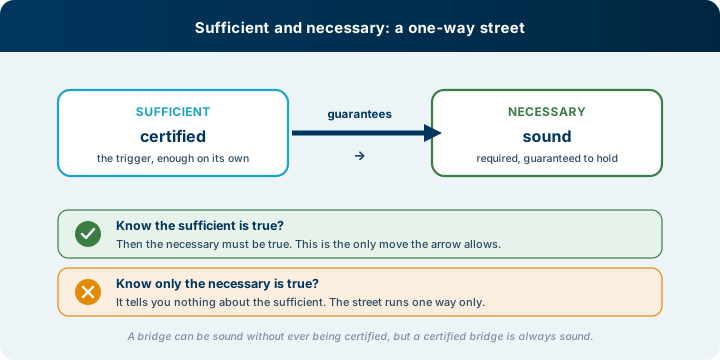
Take this statement: Every bridge that the inspector certified is structurally sound. Being certified is sufficient: knowing a bridge was certified is enough to guarantee it is sound. Being sound is necessary: a bridge could not have been certified unless it was sound. We diagram the sufficient on the left, the necessary on the right, with an arrow showing the guarantee runs one way:
certified → sound
Read the arrow as “guarantees” or “is enough for.” If a bridge is certified, it is sound.
Three things this statement does not say, and you must train yourself not to add them:
That last point is the heart of the whole chapter. The arrow is a one-way street. Knowing the sufficient lets you conclude the necessary. Knowing the necessary tells you nothing about the sufficient.
We use a small, fixed notation throughout the book. Pick a short, memorable letter or abbreviation for each term and use it consistently.
→ is the conditional arrow (“guarantees”).¬ means “not.” So ¬sound means “not structurally sound.”Negation is just the absence of the condition. ¬certified covers every bridge that was not certified, whether it was rejected, never inspected, or still on the waiting list. There is no middle category. Either a term holds or its negation holds.
When you abbreviate, keep the underlying meaning straight. If a sentence says a project “lacks funding,” diagram it as ¬funded so the logic stays honest when you negate again later.
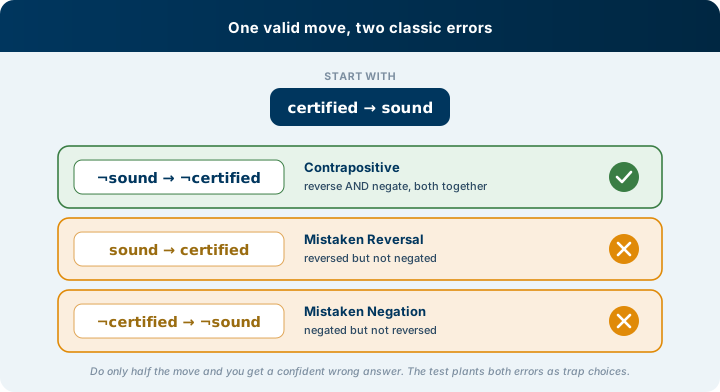
From any conditional you can draw exactly one new valid conclusion: its contrapositive. You form it by doing two things together, reverse and negate.
Start with:
certified → sound
Reverse the terms (swap the two sides) and negate both:
¬sound → ¬certified
Read it back: if a bridge is not sound, it was not certified. That is plainly true, and it says the same thing as the original from the other direction. The original and its contrapositive are logically equivalent: they are two ways of stating one fact. Anytime you write a conditional, you get its contrapositive for free, and you should train yourself to write both.
Why does reverse-and-negate work? The original promised that certification guarantees soundness. So if soundness is missing, certification could not have been present, or the guarantee would have been broken. The contrapositive is the only transformation that preserves the truth of a conditional. One valid move, and it is reverse and negate, both, together.
There are two famous ways to misuse a conditional, and the LSAT plants them as wrong answers and as the flaws inside flawed arguments. Both come from doing only half of the contrapositive.
Mistaken Reversal: you reverse the terms but forget to negate.
From certified → sound you wrongly write sound → certified. This claims that any sound bridge must have been certified. False. A bridge can be perfectly sound and never have gone near an inspector. You took the necessary condition and treated it as if it were sufficient.
Mistaken Negation: you negate the terms but forget to reverse.
From certified → sound you wrongly write ¬certified → ¬sound. This claims that an uncertified bridge must be unsound. False, for the same reason. Skipping certification does not condemn a bridge to collapse.
Notice two facts about these errors. First, both are invalid; neither tells you anything true. Second, a Mistaken Reversal and a Mistaken Negation of the same statement are contrapositives of each other: sound → certified and ¬certified → ¬sound reverse-and-negate into one another. They are a matched pair of wrong moves. When a test writer wants a trap answer, these are the first two they reach for, so learn to spot them on sight. (You will name these as flaws in Chapter 6, the flaw catalog.)
You rarely get a clean “if… then.” The test buries conditionals inside ordinary sentences, and your job is to find which term is sufficient and which is necessary. Indicator words tell you. The order the terms appear in the sentence does not matter; only the indicators do.
Words that introduce the sufficient condition (the trigger goes on the left of the arrow):
if, when, whenever, all, any, every, people who, in order to
Words that introduce the necessary condition (the guaranteed term goes on the right of the arrow):
then, only, only if, must, requires, needs, essential, unless, until, without
So “All licensed pilots have passed a medical exam” becomes licensed pilot → passed medical exam. The word all marks “licensed pilot” as the sufficient term, no matter that it appears first. And “A permit requires a site survey” becomes permit → site survey, because requires marks “site survey” as necessary.
Two of these necessary-side words flip your natural reading so hard that they each get their own section: only / only if, and unless. They are the most-tested and most-missed translations on the LSAT. Slow down every single time you see them.
The word only introduces the necessary condition. This reverses the naive reading, and it catches almost everyone the first time.
Consider: Only the brave win the prize. Your instinct says “brave people win,” diagrammed brave → win. That is wrong, and it is a Mistaken Reversal. The sentence does not promise that bravery gets you the prize; plenty of brave people lose. It promises the reverse guarantee: winning the prize tells you the winner was brave. Bravery is required to win, not enough to win. Diagram it:
win → brave
The term right after only (“the brave”) is the necessary condition, so it goes on the right. Whenever you see only, your first instinct will point the arrow the wrong way. Stop and ask which term is genuinely required, and put that one on the right.
The phrase only if works the same way and points the same direction. A only if B becomes:
A → B
Here B (the term after only if) is necessary. Example: The grant is renewed only if the lab publishes. The renewal cannot happen without publishing, so publishing is necessary: renewed → published. Note how different that is from plain if. “The grant is renewed if the lab publishes” would be published → renewed, the opposite arrow. The single word only flips everything. This is why if and only if must be read as separate, opposite instructions.
Finally, if and only if is a biconditional: it combines both directions. A if and only if B means both A → B and B → A. The guarantee runs both ways, so the two terms always travel together: you have both or neither. Watch for the equivalent phrasings “when and only when” and “all and only.” Biconditionals are less common, but when you have one, remember to use both arrows and both contrapositives.
Unless (and its cousins except, until, and without) introduces the necessary condition. But the other term needs handling too, so there is a clean two-step rule. Get this exactly right; it is among the most missed translations on the test.
The unless rule: The term modified by unless (or except, until, without) becomes the necessary condition. Take the other term and negate it to form the sufficient condition.
Worked example. Translate: The trail stays open unless it snows.
¬open. That becomes the sufficient condition, on the left.Result:
¬open → snows
Read it back to check: if the trail is not open, then it snowed. That captures the original promise (the only thing that closes the trail is snow). And its contrapositive, by reverse-and-negate, is ¬snows → open: if it does not snow, the trail stays open. Both readings match your intuition about the sentence, which is your confirmation that the translation is right.
One caution. Unless tells you what is required for the normal state; it does not promise the reverse. “The trail stays open unless it snows” does not guarantee that snow closes the trail. Maybe the trail stays open in light snow. The conditional only forbids the one combination “open and snowing as the cause of closure”; do not over-read it into a two-way guarantee. When in doubt, translate mechanically with the rule and trust the arrow, not your paraphrase.
Conditions can be compound: a sufficient or necessary side can hold two terms joined by and or or. The contrapositive still works, but “and” and “or” swap places when you reverse and negate. This swap is mandatory, and forgetting it produces a subtle wrong answer.
First, LSAT or is inclusive: “B or C” means at least one of them, and possibly both. It does not mean “one but not the other.” Keep that in mind throughout.
Here are the two forms you will see most, each with its correct contrapositive:
“And” in the necessary condition.
A → (B and C)
To satisfy A’s guarantee, you need both B and C. The contrapositive reverses and negates, and the and becomes or:
(¬B or ¬C) → ¬A
That reads correctly: if you are missing either B or C (or both), then A cannot hold, because A demanded both.
“And” in the sufficient condition.
(A and B) → C
Here you need both A and B together to trigger C. The contrapositive reverses and negates, and again and becomes or:
¬C → (¬A or ¬B)
That reads: if C is absent, then at least one of A or B must be absent, because if both had been present, C would have followed.
The same swap runs the other way: an or in the original becomes an and in the contrapositive.
Some compound conditionals can be broken into two independent arrows. Others cannot, and trying to split them is a serious error.
You can split these:
A → (B and C) splits into A → B and A → C. If A guarantees both, then A guarantees each one separately. Both are independently true.(A or B) → C splits into A → C and B → C. If either trigger alone forces C, then each one does.You cannot split these:
A → (B or C) does not give you A → B or A → C. A only promises that at least one of B and C holds; it never commits to which. Splitting it claims a specific guarantee the statement never made.(A and B) → C does not give you A → C or B → C. C is triggered only when A and B occur together. Neither one alone is enough.A quick way to remember the splittable cases: you can split when the and is on the necessary side or the or is on the sufficient side. You cannot split when the or is on the necessary side or the and is on the sufficient side. When you cannot split, leave the compound intact and run its contrapositive as a whole, with the and/or flip.
Conditionals link end to end. When the necessary term of one statement is the sufficient term of another, you can connect them into a chain and read straight through.
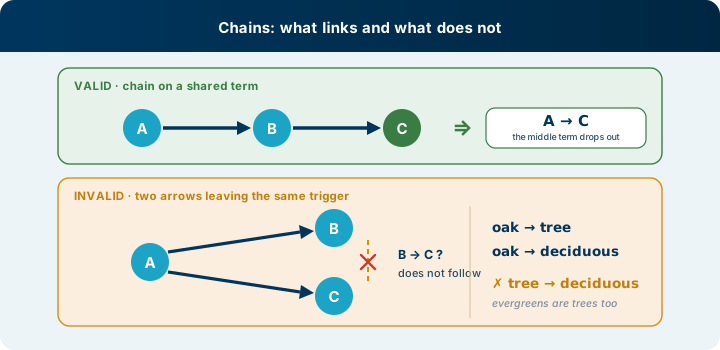
A → B and B → C link on the shared term B:
A → B → C
From the chain you may infer the endpoints: A → C (and its contrapositive ¬C → ¬A). The middle term drops out; the guarantee carries all the way through. You chain like this in everyday life without noticing: if it rains the game is canceled, and if the game is canceled you get a refund, so if it rains you get a refund. The middle step, the cancellation, drops out, and the guarantee runs straight from rain to refund.
Sometimes the shared term does not line up as written, and you fix it with a contrapositive. Suppose you have A → B and C → ¬B. These do not chain directly. But take the contrapositive of the second statement: C → ¬B becomes B → ¬C. Now B is the necessary term of the first and the sufficient term of the aligned second:
A → B → ¬C
So A → ¬C. Whenever a shared term appears once positive and once negated, or sits on the wrong side, reach for a contrapositive to align it before you chain.
Here is a chain that does not exist, and the LSAT loves it. Suppose you have A → B and A → C. Two arrows leave from A. It is tempting to conclude B → C. You cannot. There is no shared term in the right position; A is sufficient in both, not the link between B and C.
Concretely: every oak is a tree (oak → tree) and every oak is deciduous (oak → deciduous). It does not follow that every tree is deciduous. Evergreens exist. Two things guaranteed by the same trigger are not thereby guaranteed by each other. No contrapositive rescues this either; check it yourself and you will find the terms never align. When you see two arrows sharing a sufficient term, resist the urge to connect their other ends.
One last subtlety that surfaces in inference and parallel questions. A conditional describes a category as a whole; it does not distribute a property to every individual within it. If “all members of the committee, taken together, represent a wide range of professions,” that does not mean any single member represents a wide range of professions; one person has one profession. The arrow governs the group-level claim it actually made. Do not push a statement about a set down onto its individual members.
Try these before reading the answers. For items 1 through 3, translate the statement into an arrow and give its contrapositive. For items 4 and 5, decide whether the reasoning is valid, and if not, name the error.
1. Any application submitted after the deadline is rejected. The word any marks the sufficient term.
Translation: submitted late → rejected
Contrapositive: ¬rejected → ¬submitted late (if an application was not rejected, it was not submitted late).
2. The reactor shuts down only if the core temperature exceeds the limit. The phrase only if marks the term after it as necessary. The reactor shutting down cannot happen without the temperature exceeding the limit.
Translation: shuts down → temp exceeds limit
Contrapositive: ¬temp exceeds limit → ¬shuts down (if the temperature is within the limit, the reactor does not shut down).
Watch the trap: this does not say high temperature shuts the reactor down. That would be a Mistaken Reversal.
3. The festival will proceed unless the permit is denied. Apply the unless rule. The term modified by unless is “the permit is denied,” so that is necessary. The other term, “the festival will proceed,” gets negated to form the sufficient condition.
Translation: ¬proceed → permit denied
Contrapositive: ¬permit denied → proceed (if the permit is not denied, the festival proceeds).
4. Invalid: Mistaken Reversal. The policy is on display → authenticated. The visitor reverses it to authenticated → on display without negating. Authentication is necessary for display, not sufficient; an authenticated vase could sit in storage. The reasoning treats a necessary condition as though it were sufficient.
5. Valid. The rule is endorsed → (qualified and funded). Its contrapositive reverses and negates with the and/or flip: (¬qualified or ¬funded) → ¬endorsed. The reporter observes ¬funded, which satisfies the “¬qualified or ¬funded” trigger (at least one is missing), so ¬endorsed follows. This is a correct use of the contrapositive of a compound statement.
