Each pyruvate produced by glycolysis has three possible fates, depending on the presence of oxygen and the cell type. This is the branch point where glucose metabolism splits into “aerobic with full oxidation” or “anaerobic with fermentation.”
Fate 1: Acetyl-CoA (Aerobic) - The Main Pipeline
If oxygen is available, pyruvate enters the mitochondrial matrix and is oxidatively decarboxylated by the pyruvate dehydrogenase (PDH) complex:
Pyruvate + CoA + NAD+→Acetyl-CoA + CO2+NADH
Each glucose produces 2 pyruvate → 2 acetyl-CoA + 2 CO2 + 2 NADH (in the mitochondrial matrix). Acetyl-CoA then enters the TCA cycle (also called the citric acid cycle or Krebs cycle) for full oxidation. The TCA cycle strips more electrons as NADH and FADH2, which feed the electron transport chain (ETC). The ETC pumps protons, and ATP synthase uses the proton gradient to make ATP. This is the main energy pipeline of aerobic respiration, covered in Chapter 10.
PDH requires 5 coenzymes: TPP (B1), FAD (B2), NAD+ (B3), CoA (B5), and lipoic acid. Mnemonic: “Tender Loving Care For Nancy” = TPP, Lipoic acid, CoA, FAD, NAD.
Fate 2: Lactate (Anaerobic in Animals)
When O2 is scarce or mitochondria are absent (red blood cells have no mitochondria), pyruvate is reduced to lactate:
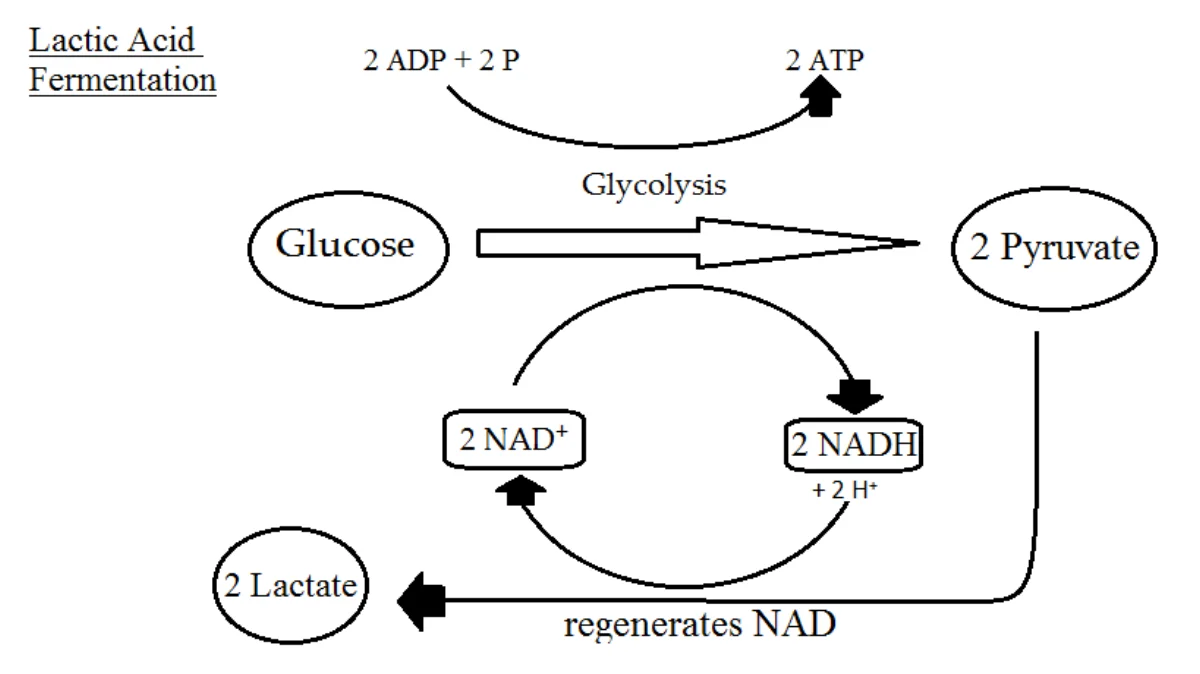
Why bother? Glycolysis requires NAD+ to keep going (step 6, GAPDH). Without the ETC to recycle NADH back to NAD+, the NAD+ pool would run out. Making lactate regenerates NAD+ so glycolysis can continue (~2 ATP per glucose, slow but oxygen-independent).
Lactic acid fermentation. Pyruvate + NADH → lactate + NAD+. The NAD+ is recycled back to glycolysis, allowing continued ATP production when oxygen is unavailable. Credit: Wikimedia Commons, CC BY-SA
Fate 3: Ethanol (Yeast Fermentation)
In yeast, pyruvate is decarboxylated to acetaldehyde, then reduced to ethanol:
Pyruvate→Acetaldehyde + CO2→Ethanol
The second step uses NADH, regenerating NAD+ just like lactic acid fermentation. This is how beer, wine, and bread dough are made - yeast ferment sugar, producing CO2 (bubbles) and ethanol (alcohol).
Why must pyruvate be converted to lactate (or ethanol + CO2) under anaerobic conditions?
Click to reveal answer
Glycolysis requires NAD+ at step 6 (GAPDH). Without oxygen, the electron transport chain cannot regenerate NAD+ from NADH. Converting pyruvate to lactate uses NADH and regenerates NAD+, allowing glycolysis to continue. Without this fermentation step, glycolysis would stop after consuming its small NAD+ pool.
How many coenzymes does the pyruvate dehydrogenase complex require, and what is the mnemonic?
Click to reveal answer
Five. "Tender Loving Care For Nancy" = TPP (B1, thiamine), Lipoic acid, CoA (B5, pantothenate), FAD (B2, riboflavin), NAD+ (B3, niacin). Thiamine deficiency (B1) impairs PDH and other decarboxylase enzymes, causing beriberi and Wernicke-Korsakoff syndrome.
Why do red blood cells produce lactate even at rest?
Click to reveal answer
RBCs lack mitochondria, so they cannot perform the TCA cycle or oxidative phosphorylation. They rely entirely on glycolysis for ATP, producing pyruvate that must be converted to lactate to regenerate NAD+. This produces a continuous basal lactate output into the blood, which is cleared by the liver.