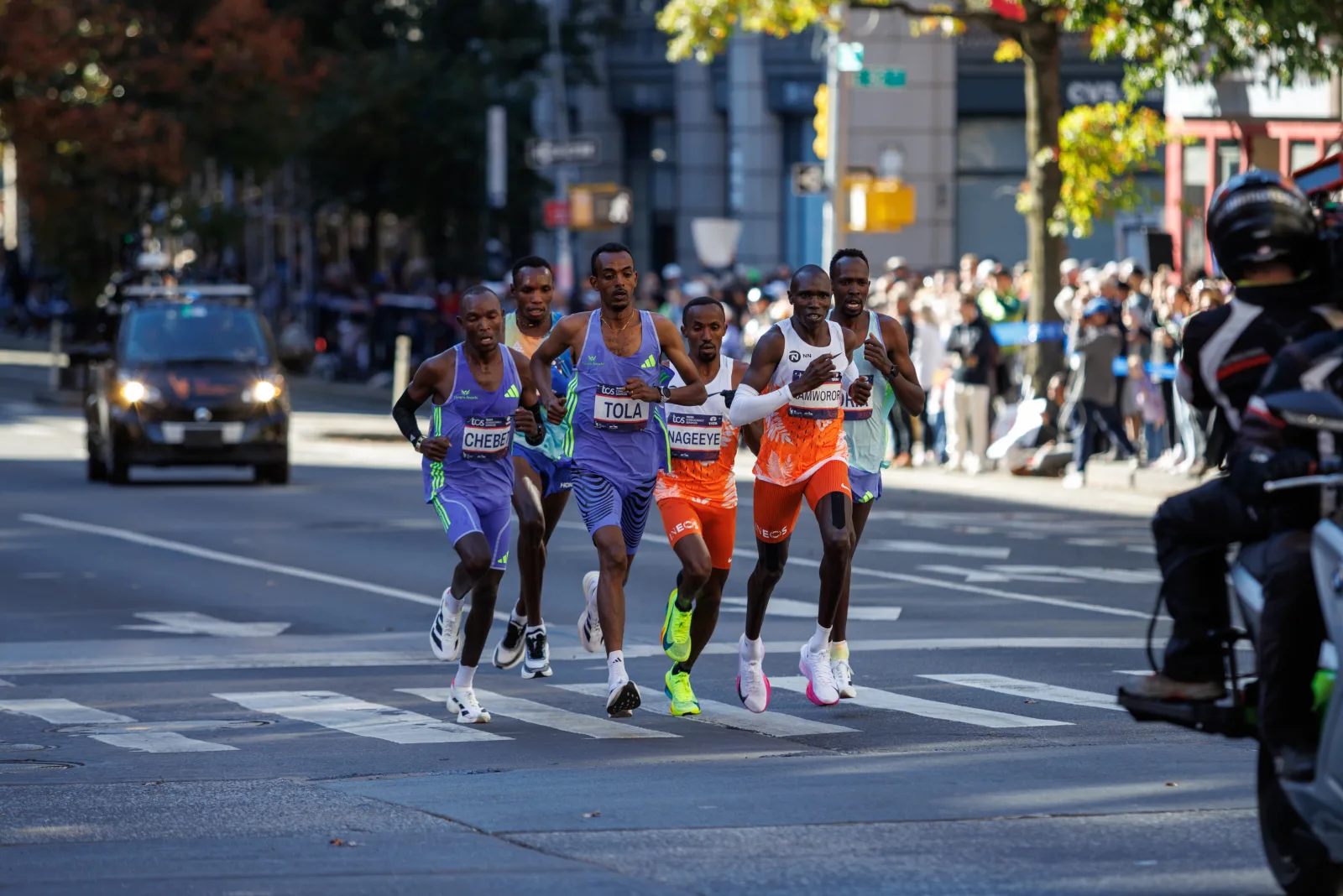
Elite marathon runners mid-race. Sustained exercise like marathon running demands aerobic respiration - glycogen and fatty acids feeding the TCA cycle for hours. Three overlapping energy systems (creatine phosphate, anaerobic glycolysis, aerobic respiration) layer by duration and intensity. Credit: Wikimedia Commons, CC BY-SA
Muscle uses three energy systems that layer on top of each other as exercise continues. Their relative contributions depend on duration and intensity.
System 1: Immediate (0-15 seconds)
Source: stored ATP + creatine phosphate.
Duration: seconds.
Creatine kinase transfers phosphate from creatine-P to ADP, regenerating ATP instantly. No oxygen needed.
Used in: sprints, power lifts, very brief efforts.
System 2: Anaerobic Glycolysis (10 seconds to 2 minutes)
Produces 2 ATP per glucose; pyruvate → lactate (regenerates NAD+, no O2 needed).
Lactate accumulation eventually limits this system - the “lactate threshold.”
Used in: 400-800 meter runs, 100m swim, hard cycling intervals.
System 3: Aerobic Respiration (2 minutes to hours)
Source: glucose, fatty acids, eventually ketones.
Duration: sustainable as long as fuel and O2 are present.
Full oxidation: glucose gives ~30-32 ATP, palmitate ~106 ATP.
Used in: 5K, marathon, long bike rides.
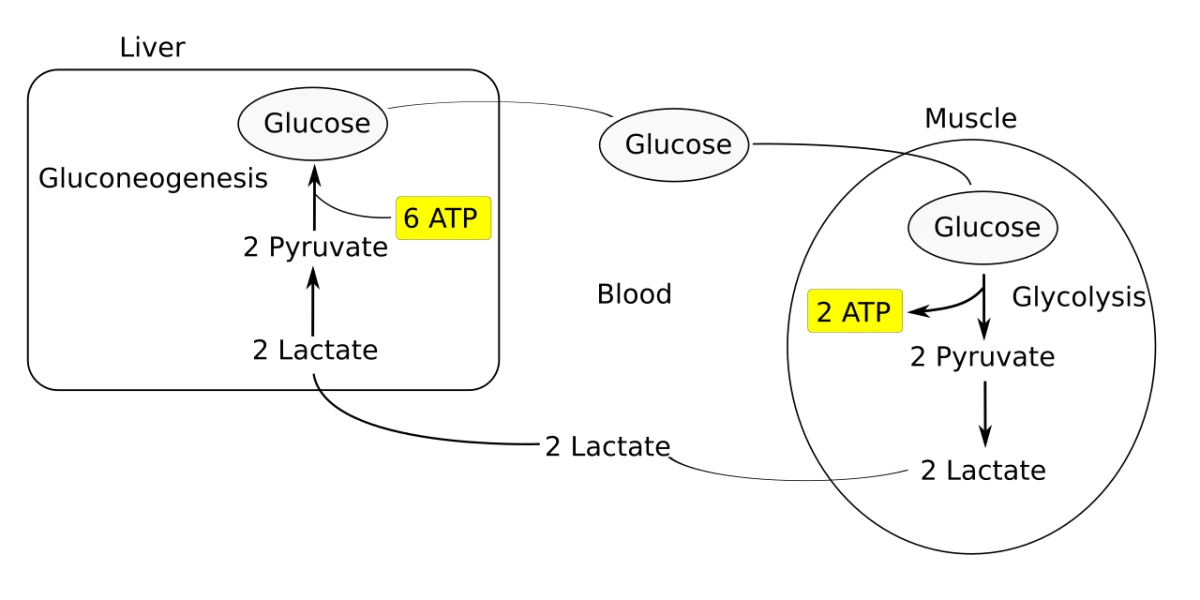
The Cori cycle during exercise. Muscle produces lactate anaerobically; liver converts it back to glucose via gluconeogenesis. Muscle keeps running while the liver pays the ATP cost. Credit: Wikimedia Commons, CC BY-SA
The Marathon Wall
Marathoners “hit the wall” around mile 18-22. Why? Muscle glycogen is depleted. The runner must transition to fat oxidation, which is slower and cannot sustain the same pace. Brain glucose also drops, causing hypoglycemia-like symptoms (dizziness, tunnel vision). Training (more mitochondria, better fat oxidation) and carbohydrate loading push this wall farther.
Lactate Fate
Lactate from working muscle travels to liver (Cori cycle) and to oxidative muscle fibers (that can reconvert it to pyruvate and oxidize it). Lactate is not purely waste; it is a mobile fuel. Blood lactate rises during exercise then falls after, as liver and muscle consume it.
What fuel does creatine phosphate provide, and for how long?
Click to reveal answer
Creatine phosphate donates its phosphate to ADP (catalyzed by creatine kinase), regenerating ATP instantly. This is the "immediate" energy system, used in the first 5-15 seconds of intense effort (sprints, lifts). It needs no oxygen and no glycolysis. When creatine-P is depleted, the muscle shifts to anaerobic glycolysis.
Why do marathoners "hit the wall" around mile 20?
Click to reveal answer
Muscle glycogen runs out. The runner must transition to fat oxidation, which is slower (fatty acids produce ATP more slowly than glucose and require more oxygen per ATP). Brain glucose also drops, adding hypoglycemia-like symptoms. Training and pre-race carbohydrate loading increase glycogen stores, pushing the wall farther. The wall is a real biochemical transition from fast to slow metabolism.
What is the lactate threshold?
Click to reveal answer
The exercise intensity at which lactate begins to accumulate rapidly in blood because muscle cells are running anaerobic glycolysis faster than oxidative capacity can consume the pyruvate. Above this threshold, fatigue accelerates. Below it, the aerobic system can handle the pace indefinitely. Training raises the lactate threshold - a primary aim of endurance conditioning.