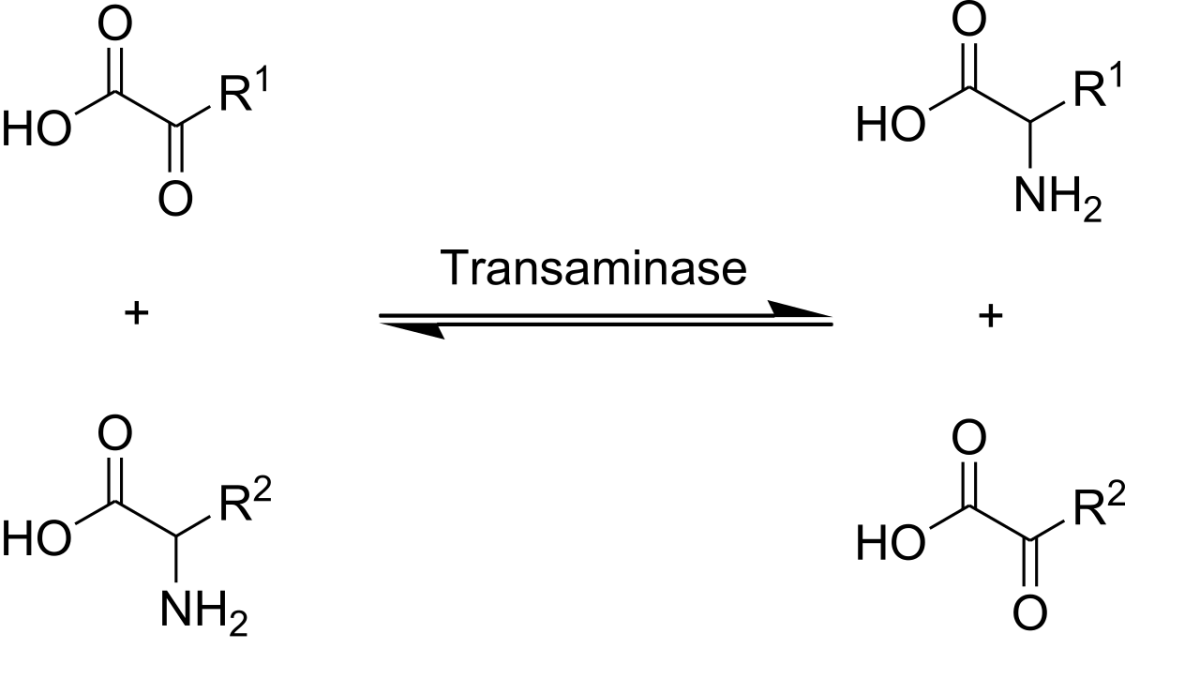
To oxidize an amino acid, the cell must first dispose of its nitrogen. The -NH2 is removed via transamination (shuttled to glutamate) or oxidative deamination (released as ammonia). The remaining carbon skeleton (alpha-keto acid) can enter central metabolism.
The “central metabolism” it enters is always the familiar pipeline: pyruvate or a TCA cycle intermediate or acetyl-CoA. From there, the amino acid’s carbons are oxidized in the TCA cycle (citric acid cycle / Krebs cycle), the resulting NADH and FADH2 feed the electron transport chain, and ATP is made. Exactly the same downstream flow as glucose or fatty acid oxidation - amino acids just enter at different points. Nitrogen is handled separately by the urea cycle (next section) because free ammonia is toxic.
Transamination. An amino acid transfers its -NH2 to alpha-ketoglutarate, producing glutamate and a new alpha-keto acid. PLP (vitamin B6) is the cofactor. Credit: Wikimedia Commons, CC BY-SA
Transamination
The amino group is moved from an amino acid to alpha-ketoglutarate, forming glutamate. The original amino acid becomes an alpha-keto acid. The enzyme family is aminotransferases (or transaminases), and all require pyridoxal phosphate (PLP), the active form of vitamin B6.
Amino acid + α-KG⇌α-keto acid + Glutamate
Two clinically famous aminotransferases:
ALT (alanine aminotransferase): alanine ↔ pyruvate. High in liver. Released in liver damage.
AST (aspartate aminotransferase): aspartate ↔ oxaloacetate. High in liver, heart, muscle. Less liver-specific than ALT.
Oxidative Deamination
Once nitrogen is collected onto glutamate, it can be released as free ammonia by glutamate dehydrogenase in liver mitochondria:
Glutamate + NAD(P)+→α-KG + NH4++NAD(P)H
The ammonia enters the urea cycle (next section) for conversion to urea, which the kidney excretes.
Why Glutamate Is the Nitrogen Hub
Most amino acids transaminate onto alpha-KG (producing glutamate). Glutamate is the single molecule that collects all the nitrogen, so oxidative deamination at just one enzyme (glutamate dehydrogenase) releases free NH3 - and feeds the urea cycle. Simple, elegant architecture.
What is the common acceptor of the amino group in transamination reactions, and what cofactor do all aminotransferases require?
Click to reveal answer
Alpha-ketoglutarate is the universal amino group acceptor, producing glutamate. All aminotransferases require pyridoxal phosphate (PLP), the active form of vitamin B6. PLP forms a Schiff base intermediate with the amino acid to facilitate amino group transfer. B6 deficiency impairs all transamination.
What enzyme performs oxidative deamination of glutamate, and what does it produce?
Click to reveal answer
Glutamate dehydrogenase (GDH). It converts glutamate + NAD(P)+ → alpha-ketoglutarate + NH4+ + NAD(P)H. The ammonia enters the urea cycle in hepatocytes. GDH uniquely uses either NAD+ or NADP+ and is allosterically regulated by ATP (inhibits) and ADP (activates).
Why is glutamate the nitrogen hub of amino acid catabolism?
Click to reveal answer
Most amino acids use alpha-ketoglutarate as their transamination partner, converting it to glutamate. The nitrogen from many different amino acids thus collects on a single carrier, glutamate. One enzyme (glutamate dehydrogenase) can then oxidatively deaminate glutamate to release ammonia for the urea cycle. Glutamate is the funnel that simplifies nitrogen disposal.