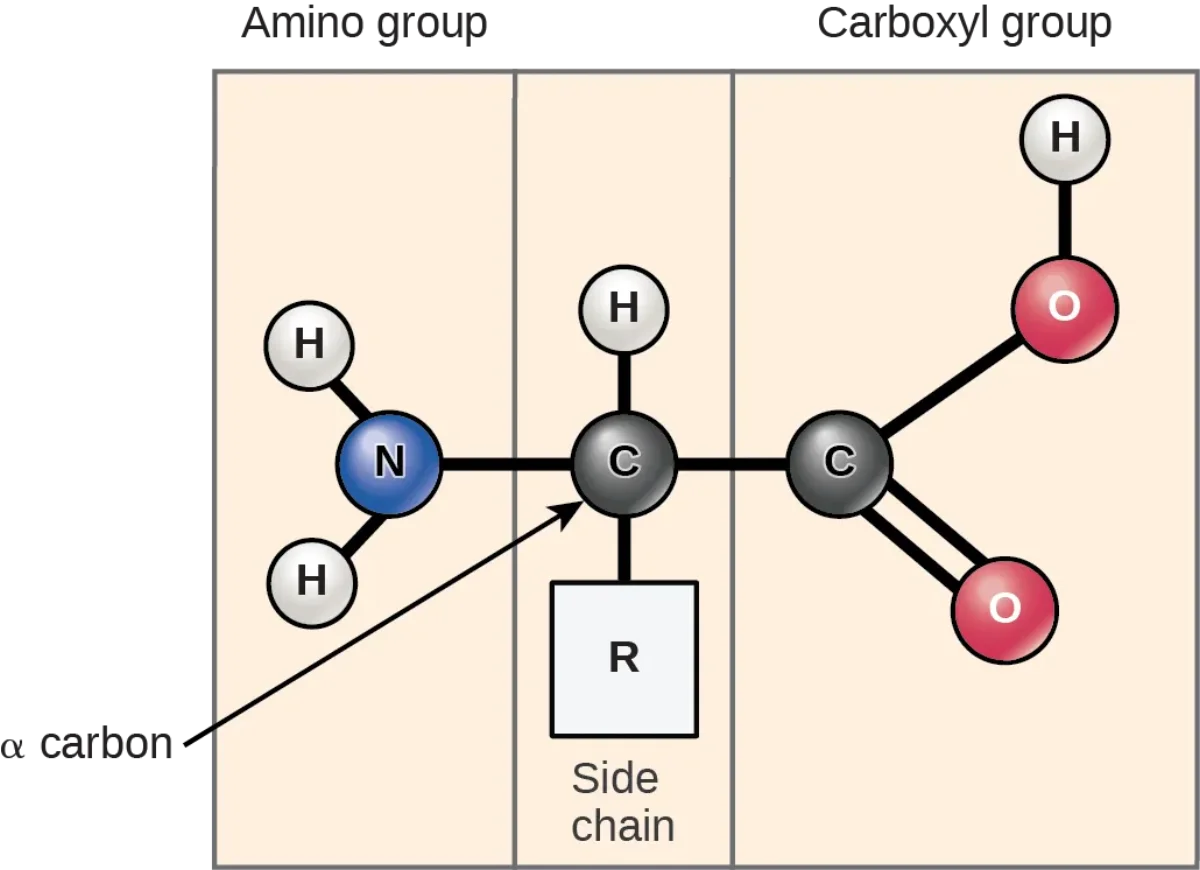
Every amino acid in your body is built on the same four-part chassis. Like a car - wheels, engine, frame, seats - the parts never change. What changes is the paint job. That paint job is the side chain, and it decides whether the amino acid is greasy, charged, acidic, basic, bulky, or tiny.
If you understand one amino acid, you understand the structural skeleton of all 20.
The Four Groups Around the Central Carbon
Every standard amino acid has a central carbon (the alpha carbon, Cα) with four things attached:
An amino group (-NH2 or -NH3+ at physiological pH)
A carboxyl group (-COOH or -COO- at physiological pH)
A hydrogen atom
An R group (the side chain - this is what varies)
The name “amino acid” comes straight from the structure: an “amino” group and a carboxylic “acid” group on the same carbon.
The general amino acid structure. Every standard amino acid has this same four-part chassis around the alpha carbon; only the R group changes. Credit: OpenStax Biology 2e, CC BY 4.0
The Alpha Carbon is Chiral (Except in Glycine)
Because the alpha carbon has four different groups attached in 19 of the 20 standard amino acids, it is a chiral center. That means it has two non-superimposable mirror images: L and D forms.
Biological proteins use L-amino acids almost exclusively. Your ribosomes only build with the L-form. D-amino acids do exist (bacterial cell walls use some, and a few show up in venoms and signaling peptides) but they are passage-peek rare on the MCAT.
Glycine is the exception. Its R group is just a hydrogen atom, so the alpha carbon has two identical hydrogens. No chirality. Glycine is achiral.
Why the Structure Matters
The amino and carboxyl groups on the central carbon are what allow amino acids to link together into chains. The carboxyl of one amino acid reacts with the amino of the next, forming a peptide bond and releasing water. That reaction happens millions of times per second on a ribosome. We cover the mechanism in peptide bond formation.
The R group is what makes each amino acid unique. Some R groups are just plain alkyl chains (greasy). Some have polar OH groups. Some have carboxylic acids (negatively charged) or amines (positively charged) built in. Some have aromatic rings. A tiny few do special tricks (like cysteine forming disulfide bridges). We sort all 20 of them in the next section.
What four groups are attached to the alpha carbon of a standard amino acid?
Click to reveal answer
(1) An amino group (-NH2 / -NH3+), (2) a carboxyl group (-COOH / -COO-), (3) a hydrogen atom, and (4) a side chain (R group). The R group is the only one that varies between the 20 standard amino acids.
Which amino acid is achiral, and why?
Click to reveal answer
Glycine. Its R group is a single hydrogen, so the alpha carbon has two identical hydrogens - only three unique substituents. Four different groups are required for chirality. Glycine is the only standard amino acid without a stereocenter.
Which stereoisomer of amino acids is used to build proteins in eukaryotic cells?
Click to reveal answer
The L-form (L-amino acids). Ribosomes read the genetic code and incorporate only L-amino acids. D-amino acids occur in nature (bacterial cell walls, some peptides) but are not standard in eukaryotic proteins.