Walk into any chemistry classroom in the world and you will see the same chart on the wall. That universality is not an accident. The periodic table is the single most powerful organizational tool in all of science, and its layout is not arbitrary - every row, every column, and every block reflects something real about how electrons fill orbitals. Once you understand the architecture, you can extract an element’s electron configuration, predict its bonding behavior, and estimate its physical properties just from its position on the grid.
On MCAT test day, the periodic table is the only reference you get. No formulas, no constants, no conversion factors. Just the table. That makes this section essential: the better you read the table, the more “free answers” you pick up throughout the exam.
A Brief History: Mendeleev to Moseley
In 1869, Dmitri Mendeleev arranged the known elements in order of increasing atomic weight and noticed that chemical properties repeated at regular intervals. He called this the periodic law. Mendeleev was so confident in the pattern that he left gaps in his table and predicted the properties of elements that had not yet been discovered. When gallium, scandium, and germanium were later found with almost exactly the properties he predicted, the scientific community was convinced.
There was one problem. Arranging by atomic weight occasionally placed elements in groups where they did not belong. In 1913, Henry Moseley used X-ray spectroscopy to measure the nuclear charge (atomic number) of each element. His revision was simple but crucial: arrange the table by atomic number, not atomic weight. The modern periodic law states that the physical and chemical properties of the elements are periodic functions of their atomic numbers.
Periods (Rows)
The rows of the periodic table are called periods. There are seven periods, numbered 1 through 7 from top to bottom.
The period number corresponds to the principal quantum number (n) of the outermost electrons. Elements in Period 2 have their valence electrons in the n = 2 shell. Elements in Period 4 have their valence electrons in the n = 4 shell (though some inner d-orbitals fill during this period as well).
Each period gets longer as you move down because higher energy levels have more subshells available. Period 1 has only 2 elements (1s fills). Period 2 has 8 elements (2s and 2p fill). Period 3 has 8 elements (3s and 3p fill). Periods 4 and 5 each have 18 elements (s, d, and p fill). Periods 6 and 7 each have 32 elements (s, f, d, and p fill), though the f-block elements are traditionally pulled out and shown below the main table to keep it from being absurdly wide.
Groups (Columns)
The columns of the periodic table are called groups (or families). Elements in the same group have the same valence electron configuration, which is why they share similar chemical properties.
There are two numbering systems, and the MCAT may use either:
| System | Description | Example for Carbon’s Group |
|--------|-------------|---------------------------|
| IUPAC (1-18) | Numbers columns 1 through 18 from left to right | Group 14 |
| American (IA-VIIIA, IB-VIIIB) | A groups = representative elements, B groups = transition metals | Group IVA |
For representative elements (the A groups), the group number tells you exactly how many valence electrons the element has. Group 1A (or Group 1) elements have 1 valence electron. Group 6A (or Group 16) elements have 6 valence electrons. This is one of the most useful shortcuts the periodic table gives you.
The s, p, d, and f Blocks
The periodic table can be divided into four blocks based on which subshell is being filled by the element’s highest-energy electron.
The shape of the table, and what the shape means
Periodic table
1
Scroll sideways to see the whole map.
Why the blocks are those widthsA block is exactly as wide as its subshell is deep. s holds 2, p holds 6, d holds 10, f holds 14, and the blocks are 2, 6, 10 and 14 groups across. The table is a map of the filling order laid out sideways.
Reading valence electrons off the tableFor a main-group element, the group number gives the valence count: group 1 has one, group 2 has two, group 13 has three, and so on up to eight in group 18. That is why elements in a column behave alike — same outer configuration, different shell.
The staircaseMetallic character increases down and to the left. The metalloids run along the diagonal staircase from boron to astatine, which is why silicon and germanium sit exactly on the boundary between conducting and insulating and make useful semiconductors.
The table is the filling order, folded. Read left to right along a period and you are reading electrons being added one at a time; drop to the next row and a new shell has opened. Every trend in the next figure follows from that one fact.
The widths of the blocks match the maximum number of electrons each subshell can hold: s holds 2 (2 columns), p holds 6 (6 columns), d holds 10 (10 columns), and f holds 14 (14 columns).
Representative vs. Nonrepresentative Elements
Representative elements (also called main-group elements) are those in the s-block and p-block - the A groups in the American system, or Groups 1-2 and 13-18 in the IUPAC system. Their chemistry is governed primarily by their s and p valence electrons, making their behavior highly predictable from group number alone.
Nonrepresentative elements include the transition metals (d-block) and inner transition metals (f-block). These elements can use d or f electrons in bonding, giving them variable oxidation states and more complex chemistry. You cannot simply read off the number of “active” electrons from the group number the way you can with representative elements.
Valence Electrons and Group Number
For representative elements, the connection between group number and valence electrons is your most valuable shortcut:
This is why elements in the same group behave similarly. Sodium (Group 1, Period 3) and potassium (Group 1, Period 4) both have one valence electron. They both form +1 cations, react with water to produce hydrogen gas and a hydroxide, and form white ionic solids with halogens. The underlying electron arrangement drives the chemistry.
Why Same-Group Elements Behave Alike
Chemical reactivity depends overwhelmingly on valence electrons - the electrons in the outermost shell. Core electrons are buried deep, tightly bound, and shielded from the outside world. When two atoms interact, it is their valence electrons that overlap, transfer, or rearrange.
Since all elements in a group share the same valence configuration (just in progressively higher principal energy levels), they undergo the same types of reactions, form compounds with the same formulas, and display similar physical properties. The differences within a group - and there are important ones - come from the fact that atoms get larger as you move down, which changes how tightly the nucleus controls those valence electrons. Those differences are the periodic trends we will build in the rest of this chapter.
What is the key difference between representative (main-group) elements and nonrepresentative (transition) elements?
Click to reveal answer
Representative elements (s- and p-block) have predictable valence electron counts equal to their A-group number and typically show one dominant oxidation state. Nonrepresentative elements (d-block and f-block) can involve d or f electrons in bonding, leading to multiple possible oxidation states and more complex chemistry that cannot be predicted from group number alone.
An element is in Period 3, Group 16 (VIA) of the periodic table. How many valence electrons does it have, and in which subshells are they located?
Click to reveal answer
6 valence electrons, in the 3s and 3p subshells (3s2 3p4). This is sulfur. The period number (3) tells you the principal quantum number of the valence shell. The group number (VIA = 16) tells you there are 6 valence electrons. Since the s-subshell fills first with 2 electrons, the remaining 4 go into the p-subshell.
If you draw a diagonal line from boron (B) down to astatine (At) on the periodic table, you have just divided the elements into two fundamentally different camps. Everything to the left of that line is a metal. Everything to the right is a nonmetal. And the handful of elements that sit right along the line? Those are the metalloids - the elements that can’t quite make up their minds.
This three-way classification is one of the first things you should recognize when you see an element on the MCAT. Knowing whether an element is a metal, nonmetal, or metalloid immediately tells you how it bonds, whether it conducts electricity, and whether it is more likely to lose or gain electrons.
Metals
Metals make up the vast majority of the periodic table - roughly 80% of all known elements. They dominate the left side and center of the table, including all of the s-block (except hydrogen), the entire d-block (transition metals), the f-block (lanthanides and actinides), and the lower-left portion of the p-block.
Malleable - can be hammered into thin sheets without breaking
Ductile - can be drawn into thin wires
Good conductors of heat and electricity (due to the “sea of electrons” in metallic bonding)
High melting and boiling points (generally, with exceptions like mercury)
Solid at room temperature (except mercury, which is a liquid)
Chemical properties of metals:
Low ionization energies - it takes relatively little energy to remove their valence electrons
Low electronegativities - they do not attract electrons strongly
Tend to lose electrons and form cations (positive ions)
Form ionic compounds when they react with nonmetals
Form basic oxides (metal oxides dissolved in water produce bases)
Nonmetals
Nonmetals occupy the upper-right portion of the periodic table. There are only about 17 nonmetals, but they are disproportionately important in chemistry and biology. Carbon, nitrogen, oxygen, hydrogen, phosphorus, and sulfur make up the backbone of every biological molecule you will ever study.
Physical properties of nonmetals:
Dull (not lustrous) - no free electron sea to reflect light
Brittle as solids - they shatter rather than bend
Poor conductors of heat and electricity (they are insulators)
Low melting and boiling points (many are gases at room temperature)
Exist in all three states at room temperature: solids (C, S, P, I2), liquids (Br2), gases (H2, N2, O2, F2, Cl2, noble gases)
Chemical properties of nonmetals:
High ionization energies - they hold onto their electrons tightly
High electronegativities - they attract electrons from other atoms
Tend to gain electrons and form anions (negative ions)
Form covalent compounds when they bond with other nonmetals
Form acidic oxides (nonmetal oxides dissolved in water produce acids)
Metals vs. Nonmetals: A Comparison
| Property | Metals | Nonmetals |
|----------|--------|-----------|
| Appearance | Lustrous (shiny) | Dull |
| Malleability | Malleable (can be hammered) | Brittle |
| Conductivity | Good conductors | Poor conductors (insulators) |
| State at room temp | Mostly solids (except Hg) | Gases, liquids, or solids |
| Ionization energy | Low | High |
| Electronegativity | Low | High |
| Electron behavior | Lose electrons (form cations) | Gain electrons (form anions) |
| Oxide character | Basic oxides | Acidic oxides |
| Bonding with each other | Metallic bonding | Covalent bonding |
| When metal + nonmetal react | Form ionic compounds | Form ionic compounds |
Metalloids (Semimetals)
Metalloids are the elements that lie along the “staircase line” (also called the zigzag line or diagonal line) on the periodic table. They have properties intermediate between metals and nonmetals.
The metalloids you should know are: B, Si, Ge, As, Sb, Te, Po, At.
Key properties of metalloids:
Intermediate conductivity - they are semiconductors, meaning they conduct electricity better than nonmetals but worse than metals
Intermediate appearance - some have metallic luster, some do not
Semiconductor behavior - conductivity increases with temperature (opposite of metals, whose conductivity decreases with temperature)
Can form both covalent and ionic bonds depending on the reaction partner
The semiconductor property of metalloids is their most important practical application. Silicon and germanium are the foundation of the entire electronics industry. Their ability to conduct electricity under controlled conditions makes them essential for computer chips, solar cells, and transistors.
Hydrogen: The Oddball
Hydrogen sits in Group 1 but is not a metal. It has one valence electron like the alkali metals, but it behaves like a nonmetal in most situations. It has high ionization energy, forms covalent bonds (H2, H2O, CH4), and can even gain an electron to form the hydride ion (H-) in compounds like NaH.
The MCAT treats hydrogen as a nonmetal. Do not let its position in Group 1 confuse you.
Predicting Behavior from Position
The real power of this classification is prediction. When you encounter an unfamiliar element on the MCAT:
Locate it on the periodic table - left side, right side, or along the staircase?
Classify it - metal, nonmetal, or metalloid?
Predict its behavior - will it lose or gain electrons? Will it form ionic or covalent bonds? Will it conduct electricity?
For example, if a passage mentions tellurium (Te) and you are unsure of its properties, find it on the table. It sits right on the staircase line - it is a metalloid. You can immediately predict that it has intermediate conductivity, can behave as either an electron donor or acceptor depending on context, and its oxide will have amphoteric (both acidic and basic) character.
The shape of the table, and what the shape means
Periodic table
1
Scroll sideways to see the whole map.
Why the blocks are those widthsA block is exactly as wide as its subshell is deep. s holds 2, p holds 6, d holds 10, f holds 14, and the blocks are 2, 6, 10 and 14 groups across. The table is a map of the filling order laid out sideways.
Reading valence electrons off the tableFor a main-group element, the group number gives the valence count: group 1 has one, group 2 has two, group 13 has three, and so on up to eight in group 18. That is why elements in a column behave alike — same outer configuration, different shell.
The staircaseMetallic character increases down and to the left. The metalloids run along the diagonal staircase from boron to astatine, which is why silicon and germanium sit exactly on the boundary between conducting and insulating and make useful semiconductors.
The table is the filling order, folded. Read left to right along a period and you are reading electrons being added one at a time; drop to the next row and a new shell has opened. Every trend in the next figure follows from that one fact.
An element is a solid at room temperature, conducts electricity poorly, and forms an oxide that produces an acid when dissolved in water. Is it a metal, nonmetal, or metalloid?
Click to reveal answer
Nonmetal. The poor conductivity and acidic oxide are both hallmarks of nonmetals. Being solid at room temperature is consistent with several nonmetals (carbon, sulfur, phosphorus, iodine). Metals would be good conductors with basic oxides. Metalloids would have intermediate conductivity.
Why are metalloids used as semiconductors in electronics rather than metals or nonmetals?
Click to reveal answer
Metalloids have intermediate electrical conductivity that can be precisely controlled. Metals conduct too well (always on), and nonmetals conduct too poorly (always off). Metalloids like silicon and germanium can be “doped” with small amounts of other elements to fine-tune their conductivity, making them ideal for transistors and microchips that need to switch between conducting and insulating states.
Every neighborhood has families with strong reputations. In the periodic table’s neighborhood, five families stand out because their behavior is so distinctive that you can predict what any member will do the moment you identify which family it belongs to. The MCAT expects you to know these families by name, by group number, and by their signature chemical behaviors.
This section covers the four most heavily tested families - alkali metals, alkaline earth metals, halogens, and noble gases - along with the chalcogens, which matter for biology and biochemistry.
Alkali Metals (Group 1 / IA)
The alkali metals - lithium (Li), sodium (Na), potassium (K), rubidium (Rb), cesium (Cs), and francium (Fr) - occupy the far-left column of the periodic table (excluding hydrogen, which is a nonmetal).
Key properties of alkali metals:
1 valence electron (ns1 configuration)
+1 oxidation state in virtually all compounds
Lowest ionization energies of any group - they lose their valence electron very easily
Very reactive - reactivity increases going down the group (Cs > Rb > K > Na > Li)
React violently with water: 2 Na + 2 H2O -> 2 NaOH + H2 (produces a strong base and hydrogen gas)
Soft metals - can be cut with a knife
Low melting points for metals, decreasing down the group
Stored under mineral oil to prevent reaction with moisture and oxygen in the air
Alkaline Earth Metals (Group 2 / IIA)
The alkaline earth metals - beryllium (Be), magnesium (Mg), calcium (Ca), strontium (Sr), barium (Ba), and radium (Ra) - sit in the second column.
Key properties of alkaline earth metals:
2 valence electrons (ns2 configuration)
+2 oxidation state in virtually all compounds
Higher ionization energies than alkali metals but still relatively low
Reactive, but less dramatic than alkali metals - they react with water, but less violently
Harder and denser than alkali metals, with higher melting points
Biologically important: Mg2+ is the central ion in chlorophyll, Ca2+ is critical for bone structure, muscle contraction, and signal transduction
Together, the alkali metals and alkaline earth metals are sometimes called the active metals because of their high reactivity and strong tendency to form cations.
Chalcogens (Group 16 / VIA)
The chalcogens - oxygen (O), sulfur (S), selenium (Se), tellurium (Te), and polonium (Po) - have 6 valence electrons and typically achieve a full octet by gaining 2 electrons.
Key properties of chalcogens:
6 valence electrons (ns2 np4 configuration)
-2 oxidation state is most common for the nonmetals in this group (O2-, S2-)
Sulfur can expand its octet and show oxidation states of -2, +2, +4, and +6
Oxygen and sulfur are biologically essential - oxygen for aerobic respiration, sulfur for disulfide bonds in proteins and in amino acids (cysteine, methionine)
Oxygen is the most electronegative element in this group (second overall after fluorine)
Halogens (Group 17 / VIIA)
The halogens - fluorine (F), chlorine (Cl), bromine (Br), iodine (I), and astatine (At) - are the “one electron short of a full octet” family. They are the mirror image of the alkali metals: instead of desperately giving away one electron, they desperately want to take one.
Key properties of halogens:
7 valence electrons (ns2 np5 configuration)
-1 oxidation state in most compounds (as halide ions: F-, Cl-, Br-, I-)
Highest electronegativities and highest electron affinities of any group
Very reactive nonmetals - reactivity decreases going down the group (F > Cl > Br > I)
Exist as diatomic molecules in their elemental form: F2, Cl2, Br2, I2
Range of physical states at room temperature: F2 and Cl2 are gases, Br2 is a liquid, I2 is a solid
Form strong acids with hydrogen: HF, HCl, HBr, HI (all are strong acids except HF)
Noble Gases (Group 18 / VIIIA)
The noble gases - helium (He), neon (Ne), argon (Ar), krypton (Kr), xenon (Xe), and radon (Rn) - have completely filled valence shells. They are the “gated community” of the periodic table: self-sufficient and uninterested in interacting with anyone.
Key properties of noble gases:
Full valence shell (ns2 np6, except He which is 1s2)
No common oxidation state - they rarely form compounds (though Xe can form XeF2, XeF4, XeF6)
Highest ionization energies of any group - their electrons are extremely difficult to remove
No meaningful electronegativity - they have no tendency to attract additional electrons
Very low boiling points - all are gases at room temperature, held together only by weak London dispersion forces
Colorless, odorless, tasteless, and monatomic (exist as single atoms, not molecules)
Family Summary Table
Family
Group
Valence e-
Common Oxidation State
Reactivity
Key Features
Alkali metals
1 (IA)
1
+1
Very high (increases down group)
Soft, low MP, react with water, stored in oil
Alkaline earth metals
2 (IIA)
2
+2
High (less than Group 1)
Harder, higher MP, Ca2+ and Mg2+ biologically vital
Chalcogens
16 (VIA)
6
-2 (nonmetals)
Moderate to high
O and S essential for life, S has variable oxidation states
Halogens
17 (VIIA)
7
-1
Very high (decreases down group)
Highest EN, diatomic, strong acids with H
Noble gases
18 (VIIIA)
8 (2 for He)
None (inert)
Essentially zero
Full octet, highest IE, monatomic gases
Flame Tests: Seeing Electron Transitions in Action
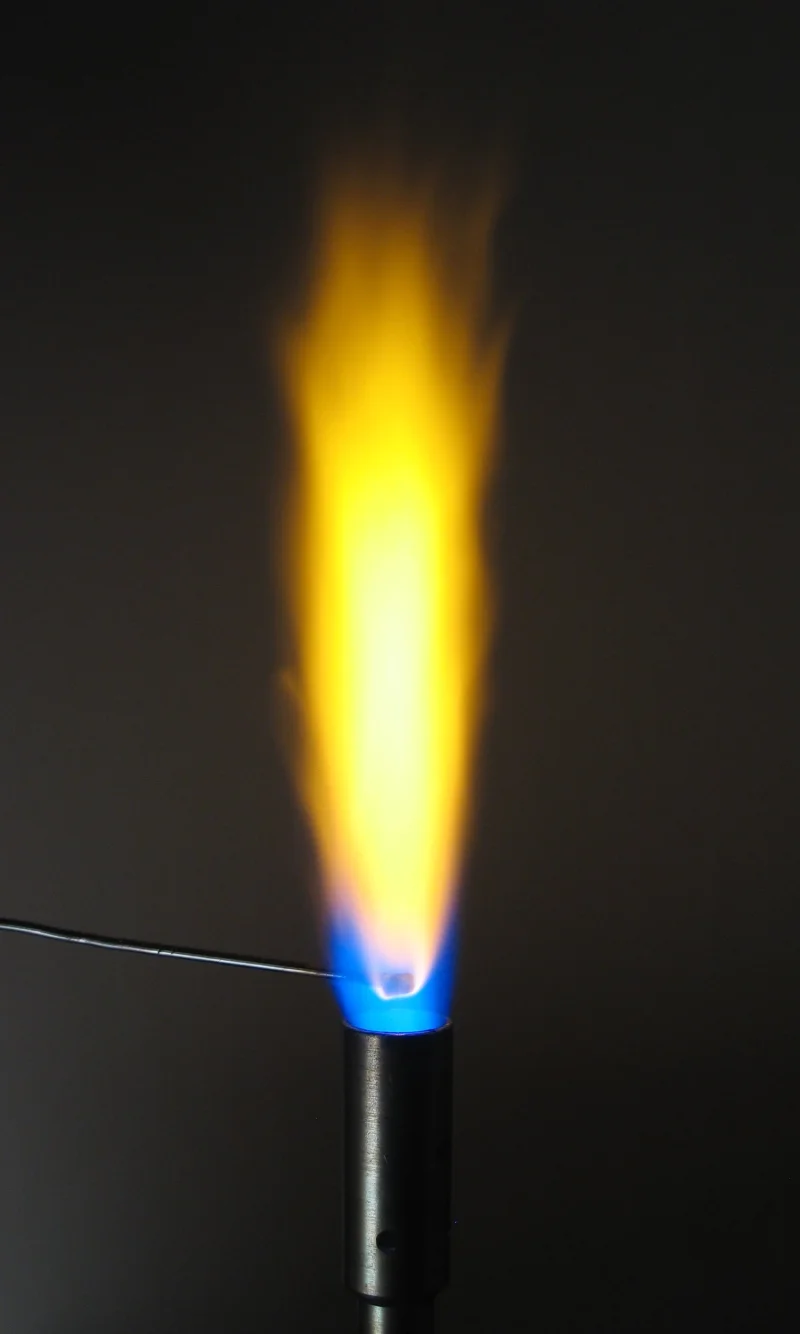
When alkali and alkaline earth metals are heated in a flame, their electrons absorb energy and jump to higher energy levels. When those excited electrons fall back down, they emit photons of visible light at characteristic wavelengths. Each element produces a distinctive flame color - this is the basis of the flame test, a classic qualitative analysis technique.
Sodium produces a brilliant yellow flame (589 nm, the sodium D-line). This color is so intense that even trace sodium contamination can mask other elements' flame colors. Credit: Wikimedia Commons, CC BY-SA 3.0Copper produces a distinctive blue-green flame. Transition metals also produce characteristic flame colors, though their emission spectra are more complex than those of alkali metals. Credit: Wikimedia Commons, CC BY-SA 3.0
Reactivity Trends Within Families
An important distinction: reactivity trends go in opposite directions for metals and nonmetals.
For metals (alkali and alkaline earth): Reactivity increases going down the group. The valence electron is farther from the nucleus and easier to remove. Cesium is more reactive than sodium.
For nonmetals (halogens): Reactivity decreases going down the group. The atom is larger and less effective at attracting an additional electron. Fluorine is more reactive than iodine.
This makes sense when you think about what “reactive” means for each type: metals react by losing electrons (easier when electrons are loosely held), while nonmetals react by gaining electrons (easier when the atom is small and the nucleus pulls strongly).
Why do alkali metals become MORE reactive going down the group, while halogens become LESS reactive going down the group?
Click to reveal answer
Because "reactive" means opposite things for the two families. Alkali metals react by losing electrons - larger atoms have lower ionization energy, so electrons are easier to remove going down the group. Halogens react by gaining electrons - smaller atoms have higher electron affinity and electronegativity, so they are better at attracting electrons going up the group. Reactivity follows whatever makes the characteristic reaction easier.
What products form when sodium metal is dropped into water?
Click to reveal answer
Sodium hydroxide (NaOH) and hydrogen gas (H2). The balanced equation is: 2 Na + 2 H2O -> 2 NaOH + H2. The reaction is highly exothermic and produces a strong base. This is characteristic of all alkali metals reacting with water. The reaction becomes more vigorous going down the group.
Noble gases have full valence shells. Why does this make them chemically inert?
Click to reveal answer
A full valence shell means there is no energetic advantage to gaining, losing, or sharing electrons. Noble gases already have the most stable electron configuration possible. Removing an electron requires enormous energy (highest ionization energies of any group), and adding an electron would place it in a higher, less stable energy level. With no driving force to change their electron count, noble gases have virtually no chemical reactivity.
The transition metals are the workhorses of the periodic table. They fill the wide middle section (Groups 3-12, the d-block), and they include some of the most familiar elements in everyday life: iron in steel and hemoglobin, copper in wiring and enzymes, zinc in sunscreen and carbonic anhydrase, gold in jewelry, and platinum in catalytic converters. What makes these elements special is their versatility - they can exist in multiple oxidation states, form vividly colored compounds, and act as biological catalysts that keep you alive.
For the MCAT, you do not need to memorize every property of every transition metal. But you do need to understand the general patterns that make d-block elements behave differently from main-group elements, and you need to recognize key biologically relevant transition metals when they appear in passages.
Why Transition Metals Are Different
The defining feature of transition metals is their partially filled d-orbitals. In main-group elements, the energy gap between subshells is large, so electrons clearly belong to one shell or another. In transition metals, the 4s and 3d orbitals (or 5s and 4d, etc.) are very close in energy. This small energy gap has several consequences:
Electrons can be removed from either the s or d subshell
Multiple oxidation states become accessible
D-electrons can participate in bonding and absorb visible light
Multiple Oxidation States
Most transition metals can form ions with two or more different charges. This is their most chemically important property and the one most frequently tested on the MCAT.
Common examples:
Element
Common Oxidation States
Example Compounds
Iron (Fe)
+2, +3
FeCl2 (ferrous), FeCl3 (ferric)
Copper (Cu)
+1, +2
Cu2O (cuprous), CuSO4 (cupric)
Manganese (Mn)
+2, +4, +7
MnO2, KMnO4
Chromium (Cr)
+2, +3, +6
Cr2O3, K2Cr2O7
Cobalt (Co)
+2, +3
CoCl2, Co2O3
The ability to switch between oxidation states is what makes transition metals excellent catalysts. A catalyst works by temporarily changing its oxidation state during a reaction - accepting electrons in one step and donating them in another - before returning to its original form.
Colored Compounds
Walk into any chemistry lab and the most visually striking solutions are almost always transition metal compounds. Copper sulfate solutions are brilliant blue. Potassium permanganate is deep purple. Iron(III) chloride is yellow. Nickel salts are green.
The colors arise because d-orbital electrons absorb specific wavelengths of visible light. In an isolated atom, all five d-orbitals have the same energy. But when a transition metal ion is surrounded by ligands (molecules or ions that donate electron pairs to the metal), the d-orbitals split into two groups with slightly different energies. Electrons can jump from the lower-energy set to the higher-energy set by absorbing a photon of visible light.
The color you see is the complementary color of the wavelength absorbed. If a complex absorbs red light, it appears green. If it absorbs blue light, it appears orange.
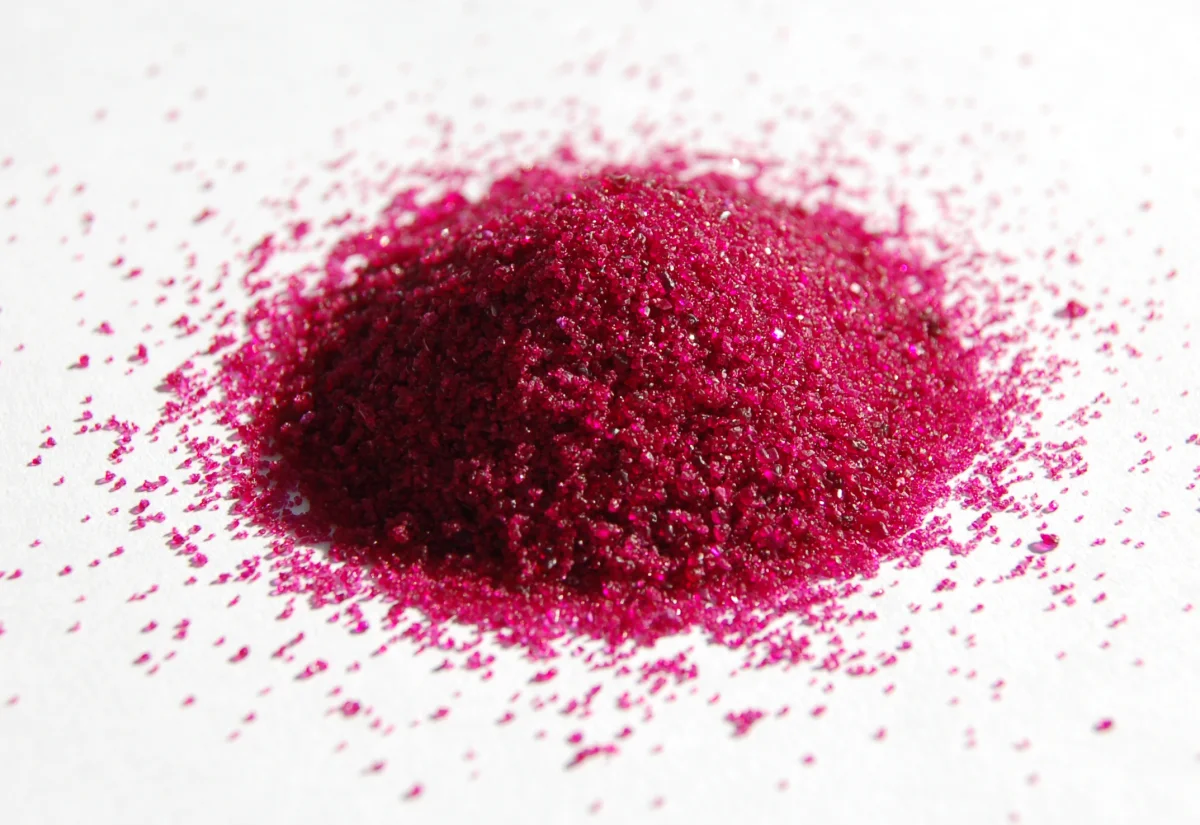
Cobalt(II) chloride hexahydrate (CoCl2 * 6H2O) displays a vivid pink-magenta color due to d-orbital electron transitions in the Co2+ ion. This kind of intense color is a hallmark of transition metal compounds. Credit: Wikimedia Commons, Public Domain
Physical Properties
Transition metals share several physical characteristics that distinguish them from main-group metals:
High melting and boiling points - metallic bonding is strengthened by d-electron participation
High density - atoms are packed tightly with strong metallic bonds
Hard and strong - much harder than alkali or alkaline earth metals
Good conductors of heat and electricity
Often form alloys - steel (Fe + C), bronze (Cu + Sn), brass (Cu + Zn)
Tungsten (W) has the highest melting point of any metal (3,422 degrees C), which is why it is used in light bulb filaments. Mercury (Hg) is the notable exception - it is a liquid at room temperature.
Complex Ions and Coordination Compounds
Transition metal ions have empty or partially filled d-orbitals that can accept electron pairs from other molecules or ions. The species that donate these electron pairs are called ligands, and the resulting structure is a coordination compound or complex ion.
A few terms to know for the MCAT:
Central metal ion: the transition metal at the center of the complex
Ligands: molecules or ions that donate lone pairs to the metal (e.g., H2O, NH3, CN-, Cl-)
Coordination number: the number of ligand attachment points around the metal (commonly 4 or 6)
You do not need to master coordination chemistry for the MCAT, but you should recognize that transition metals form these structures and that ligand identity affects properties like color, magnetic behavior, and reactivity.
Biologically Important Transition Metals
Several transition metals serve as essential cofactors in enzymes and proteins. The MCAT frequently embeds these in biology and biochemistry passages.
Metal
Biological Role
Example
Iron (Fe)
Oxygen transport, electron transport chain
Hemoglobin (Fe2+ in heme), cytochromes
Zinc (Zn)
Enzyme catalysis, gene regulation
Carbonic anhydrase, zinc finger proteins
Copper (Cu)
Electron transport, connective tissue
Cytochrome c oxidase, lysyl oxidase
Cobalt (Co)
Vitamin B12 cofactor
Methylmalonyl-CoA mutase
Manganese (Mn)
Antioxidant defense
Superoxide dismutase (Mn-SOD)
Molybdenum (Mo)
Nitrogen metabolism
Xanthine oxidase, nitrogenase
Transition Metals as Catalysts
The variable oxidation states of transition metals make them superb catalysts, both in biology and in industrial chemistry. A catalyst provides an alternative reaction pathway with a lower activation energy. Transition metals accomplish this by temporarily bonding to reactants (changing their oxidation state in the process), holding them in the right orientation, and then releasing the products while returning to their original state.
Examples you may encounter on the MCAT:
Catalytic converters in cars use platinum (Pt), palladium (Pd), and rhodium (Rh) to convert toxic exhaust gases into less harmful products
Haber process uses iron (Fe) as a catalyst to synthesize ammonia from nitrogen and hydrogen
Enzymes with transition metal cofactors catalyze biological reactions (see the table above)
Why do transition metals exhibit multiple oxidation states, unlike main-group metals such as sodium or calcium?
Click to reveal answer
The s and d subshells in transition metals are very close in energy. This means electrons can be removed from either subshell without a dramatic energy cost. In contrast, main-group metals like sodium have a large energy gap after their valence electrons are removed, so they are locked into a single oxidation state (+1 for Na, +2 for Ca). The closely spaced energy levels of d-block elements allow for variable electron loss and therefore variable oxidation states.
A solution containing a transition metal complex appears blue. What color of light does the complex absorb?
Click to reveal answer
The complex absorbs orange light (the complementary color of blue). When d-electrons absorb light at a specific wavelength, the transmitted/reflected light is the complementary color. Blue and orange are complementary colors. On a color wheel: red absorbs green, blue absorbs orange, yellow absorbs violet, and vice versa.
Atomic radius is the first periodic trend you should master, because once you know it, you essentially know three others for free. Ionization energy, electron affinity, and electronegativity all trend in the opposite direction. Nail atomic radius, and the rest falls into place.
Defining Atomic Radius
Atomic radius is defined as half the distance between the nuclei of two identical bonded atoms. Because electron clouds do not have sharp boundaries, we cannot simply measure where an atom “ends.” Instead, we measure the internuclear distance in a diatomic molecule (or a metallic crystal) and divide by two.
For example, the distance between the two chlorine nuclei in Cl₂ is about 198 pm. The atomic radius of chlorine is therefore approximately 99 pm.
Trend Across a Period: Decreases Left to Right
As you move from left to right across a period, atomic radius decreases. This happens because each step to the right adds one proton to the nucleus and one electron to the same principal energy level. The extra proton increases the effective nuclear charge (Zeff), pulling all the electrons in that shell closer to the nucleus. The added electron does not shield effectively because it sits in the same shell as the others.
The result is a stronger net pull on the electron cloud with no new shell to offset it. The atom gets smaller.
Trend Down a Group: Increases Top to Bottom
As you move down a group, atomic radius increases. Each row adds an entirely new principal energy level (a new electron shell). Even though the nuclear charge also increases, the inner-shell electrons shield the outer electrons from the full nuclear pull. The new valence electrons occupy orbitals that are farther from the nucleus, so the atom is physically larger.
Periodic trends, and the single cause behind them
Periodic table
1
Scroll sideways to see the whole map.
The one cause underneathAcross a period, protons are added but the new electrons go into the same shell, so they shield each other poorly and effective nuclear charge climbs. Down a group, a whole new shell is added and the outer electrons are both further out and screened by everything beneath. Every trend on this page is one of those two sentences.
The two ionisation-energy dipsBe to B falls because boron's outermost electron is in a higher-energy 2p rather than 2s. N to O falls because oxygen is the first period-2 element forced to put two electrons in one 2p orbital, and their mutual repulsion makes one easier to remove. Both dips are on the plot, not smoothed away.
Ionic radiusCations are always smaller than their parent atom, often dramatically so when a whole shell is lost: Na is 186 pm, Na⁺ is 102 pm. Anions are always larger, because added electrons increase repulsion without adding any protons.
Two causes, five trends. Effective nuclear charge rising left to right, and shells being added top to bottom. Work out which of those applies and you can rebuild any of these arrows without memorising them.
This effect dominates over the increase in Z. More shells always means a bigger atom.
Atomic Radius Across Period 3
The following table shows how atomic radius shrinks as you cross Period 3 from sodium to chlorine.
| Element | Symbol | Atomic Number | Atomic Radius (pm) |
|---------|--------|---------------|---------------------|
| Sodium | Na | 11 | 186 |
| Magnesium | Mg | 12 | 160 |
| Aluminum | Al | 13 | 143 |
| Silicon | Si | 14 | 117 |
| Phosphorus | P | 15 | 110 |
| Sulfur | S | 16 | 104 |
| Chlorine | Cl | 17 | 99 |
Every step to the right adds a proton and an electron to the same shell. Zeff climbs, and the radius shrinks.
Atomic Radius Down Group 1
| Element | Symbol | Period | Atomic Radius (pm) |
|---------|--------|--------|---------------------|
| Lithium | Li | 2 | 152 |
| Sodium | Na | 3 | 186 |
| Potassium | K | 4 | 227 |
| Rubidium | Rb | 5 | 248 |
| Cesium | Cs | 6 | 265 |
Each step down adds a new electron shell, and the atom balloons in size. Cesium, at the bottom of Group 1, is the largest non-radioactive atom at approximately 265 pm. At the opposite extreme, helium is the smallest atom at roughly 25 pm.
The Opposite Trend Shortcut
Here is the payoff for learning atomic radius first. Ionization energy, electron affinity, and electronegativity all increase in the opposite direction - they increase going up and to the right on the periodic table.
This makes intuitive sense. Smaller atoms hold their electrons more tightly (higher ionization energy), attract new electrons more strongly (higher electron affinity), and pull on shared bonding electrons more fiercely (higher electronegativity).
Why This Matters on the MCAT
The MCAT rarely asks you to recall a specific atomic radius in picometers. Instead, you will be asked to compare atoms: “Which is larger, Na or Cl?” or “Rank these elements by increasing atomic radius.” The two rules are all you need:
Across a period: radius decreases (higher Zeff, same shell)
Down a group: radius increases (new shell added)
If two atoms are not in the same period or group, use both rules together. For example, comparing Li (Period 2, Group 1) to K (Period 4, Group 1) is straightforward - K is larger because it is lower in the same group. Comparing Na (Period 3, Group 1) to Cl (Period 3, Group 17) is also straightforward - Na is larger because it is farther left in the same period.
In which two directions does atomic radius increase on the periodic table, and what is the underlying reason for each?
Click to reveal answer
Atomic radius increases going down a group (new electron shells are added, placing valence electrons farther from the nucleus) and going left across a period (lower effective nuclear charge means a weaker pull on the outermost electrons). These two rules let you compare the size of any two atoms on the table.
Rank the following atoms from smallest to largest: Na, Mg, K.
Click to reveal answer
Mg < Na < K. Mg and Na are in Period 3, but Mg is farther right (higher Zeff), so Mg is smaller than Na. K is in Period 4, one shell below Na, so K is the largest. The order from smallest to largest is Mg, Na, K.
Atoms rarely exist as isolated, neutral spheres. In chemistry and biology, you encounter ions constantly - sodium and potassium flowing through nerve channels, calcium triggering muscle contraction, chloride balancing fluid osmolarity. Understanding how gaining or losing electrons changes an atom’s size is essential for predicting ionic compound properties, lattice energies, and solubility patterns on the MCAT.
Cations Are Smaller Than Their Parent Atoms
When a neutral atom loses one or more electrons to form a cation, it gets smaller. Two things happen simultaneously. First, losing electrons reduces electron-electron repulsion in the outer shell, allowing the remaining electrons to be pulled closer to the nucleus. Second, the nuclear charge stays the same - you still have the same number of protons pulling on fewer electrons. The effective nuclear charge per electron increases, and the electron cloud contracts.
In many cases, the atom loses its entire outermost shell. Sodium, for example, goes from [Ne]3s¹ to [Ne] when it becomes Na⁺. The valence shell is gone entirely, and the ion now has the compact electron configuration of neon. Na has an atomic radius of 186 pm, but Na⁺ shrinks to just 95 pm - nearly half the size.
Anions Are Larger Than Their Parent Atoms
When a neutral atom gains one or more electrons to form an anion, it gets larger. The added electrons increase electron-electron repulsion in the outer shell, but the nuclear charge has not changed. The same number of protons now must hold onto more electrons, and they cannot do it as tightly. The electron cloud puffs outward.
Periodic trends, and the single cause behind them
Periodic table
1
Scroll sideways to see the whole map.
The one cause underneathAcross a period, protons are added but the new electrons go into the same shell, so they shield each other poorly and effective nuclear charge climbs. Down a group, a whole new shell is added and the outer electrons are both further out and screened by everything beneath. Every trend on this page is one of those two sentences.
The two ionisation-energy dipsBe to B falls because boron's outermost electron is in a higher-energy 2p rather than 2s. N to O falls because oxygen is the first period-2 element forced to put two electrons in one 2p orbital, and their mutual repulsion makes one easier to remove. Both dips are on the plot, not smoothed away.
Ionic radiusCations are always smaller than their parent atom, often dramatically so when a whole shell is lost: Na is 186 pm, Na⁺ is 102 pm. Anions are always larger, because added electrons increase repulsion without adding any protons.
Two causes, five trends. Effective nuclear charge rising left to right, and shells being added top to bottom. Work out which of those applies and you can rebuild any of these arrows without memorising them.
Chlorine, for example, goes from [Ne]3s²3p⁵ to [Ne]3s²3p⁶ (the neon core plus a full third shell) when it becomes Cl⁻. The atomic radius of Cl is 99 pm, but Cl⁻ swells to 181 pm.
Notice the pattern: the more electrons removed, the greater the shrinkage. The more electrons added, the greater the expansion.
Isoelectronic Series
An isoelectronic series is a set of atoms and ions that all have the same number of electrons. Because they share the same electron count, the only variable that differs is the number of protons in the nucleus. This makes isoelectronic series the cleanest possible test of how nuclear charge affects size.
Consider the following species, all of which have 10 electrons:
Within an isoelectronic series, the species with more protons is smaller. This is because more protons means a greater nuclear charge pulling on the same number of electrons, compressing the electron cloud more tightly.
To rank an isoelectronic series from largest to smallest, simply rank by increasing number of protons:
O²⁻ > F⁻ > Ne > Na⁺ > Mg²⁺
The species with the fewest protons (O²⁻, with 8) is the largest. The species with the most protons (Mg²⁺, with 12) is the smallest. Every additional proton tightens the grip on those 10 shared electrons.
How to Approach MCAT Ionic Radius Questions
The MCAT tests ionic radius in two main ways:
Type 1: Compare an atom to its own ion. Apply the simple rule - cations shrink, anions expand. Example: “Is Fe²⁺ larger or smaller than Fe?” Smaller, because it lost electrons.
Type 2: Rank ions in an isoelectronic series. First, confirm all species have the same electron count. Then rank by number of protons - more protons means smaller radius. Example: “Rank N³⁻, O²⁻, F⁻, Ne, Na⁺ from largest to smallest.” All have 10 electrons. Order by increasing protons (7, 8, 9, 10, 11): N³⁻ > O²⁻ > F⁻ > Ne > Na⁺.
Ionic Radius and the Periodic Table
Ionic radii follow the same general periodic trends as atomic radii within the same type of ion. Among cations, radius increases going down a group (more shells) and decreases going across a period (higher charge, often fewer shells). The same applies to anions.
However, be careful when comparing cations to anions. A cation from the left side of a period is often much smaller than an anion from the right side of the same period, even if the cation has a higher atomic number. For example, Na⁺ (95 pm) is far smaller than Cl⁻ (181 pm), even though sodium has a higher atomic number than chlorine. The loss versus gain of electrons creates a stark size difference.
Is a cation larger or smaller than its parent atom? What about an anion?
Click to reveal answer
A cation is smaller than its parent atom (fewer electrons, same nuclear charge, reduced repulsion). An anion is larger than its parent atom (more electrons, same nuclear charge, increased repulsion). This is one of the most commonly tested ionic radius concepts on the MCAT.
Rank these isoelectronic species from largest to smallest: Na⁺, F⁻, Mg²⁺, O²⁻, Ne.
Click to reveal answer
O²⁻ > F⁻ > Ne > Na⁺ > Mg²⁺. All five species have 10 electrons. In an isoelectronic series, the ion with the fewest protons is the largest (weakest nuclear pull on the shared electrons). O²⁻ has 8 protons (largest), while Mg²⁺ has 12 protons (smallest).
Why is Mg²⁺ (65 pm) so much smaller than O²⁻ (140 pm) even though both have 10 electrons?
Click to reveal answer
Mg²⁺ has 12 protons pulling on 10 electrons, while O²⁻ has only 8 protons pulling on 10 electrons. The higher nuclear charge in Mg²⁺ compresses the electron cloud much more tightly. In any isoelectronic series, more protons always means a smaller radius.
Ionization energy tells you how tightly an atom holds onto its outermost electron. It is one of the most frequently tested periodic trends on the MCAT, and understanding it unlocks everything from predicting reactivity to interpreting successive ionization data to spotting common exam traps.
Defining Ionization Energy
The first ionization energy (IE₁) is the energy required to remove the outermost (highest-energy) electron from a neutral, gaseous atom in its ground state:
The second ionization energy (IE₂) is the energy required to remove the next electron from the +1 cation. The third ionization energy (IE₃) removes an electron from the +2 cation, and so on.
Trend Across a Period: Increases Left to Right
As you move left to right across a period, ionization energy increases. The reason is the same pair of factors that drives atomic radius: Zeff increases while electrons are added to the same shell. A higher effective nuclear charge and a smaller atomic radius mean the outermost electron is held more tightly. It takes more energy to remove it.
Periodic trends, and the single cause behind them
Periodic table
1
Scroll sideways to see the whole map.
The one cause underneathAcross a period, protons are added but the new electrons go into the same shell, so they shield each other poorly and effective nuclear charge climbs. Down a group, a whole new shell is added and the outer electrons are both further out and screened by everything beneath. Every trend on this page is one of those two sentences.
The two ionisation-energy dipsBe to B falls because boron's outermost electron is in a higher-energy 2p rather than 2s. N to O falls because oxygen is the first period-2 element forced to put two electrons in one 2p orbital, and their mutual repulsion makes one easier to remove. Both dips are on the plot, not smoothed away.
Ionic radiusCations are always smaller than their parent atom, often dramatically so when a whole shell is lost: Na is 186 pm, Na⁺ is 102 pm. Anions are always larger, because added electrons increase repulsion without adding any protons.
Two causes, five trends. Effective nuclear charge rising left to right, and shells being added top to bottom. Work out which of those applies and you can rebuild any of these arrows without memorising them.
Alkali metals (Group 1) have the lowest IE₁ in each period because they have just one loosely held valence electron far from the nucleus. Noble gases (Group 18) have the highest IE₁ because their full valence shells and high Zeff make every electron hard to remove.
Trend Down a Group: Decreases Top to Bottom
As you move down a group, ionization energy decreases. Each new period adds an electron shell, increasing atomic radius and shielding. The outermost electron is farther from the nucleus and easier to remove despite the higher nuclear charge.
This is the exact opposite of the atomic radius trend, which increases going down. Bigger atom = weaker grip = lower IE.
Successive Ionization Energies: The Core Shell Jump
Successive ionization energies always increase: IE₁ < IE₂ < IE₃ < IE₄ and so on. Each time you remove an electron, the remaining electrons feel a greater Zeff (same nuclear charge, fewer electrons to share it). The next electron is therefore harder to remove.
But the truly critical concept for the MCAT is the enormous jump that occurs when you break into a core electron shell. Consider the successive ionization energies of sodium:
| Ionization | Energy (kJ/mol) | Notes |
|------------|-----------------|-------|
| IE₁ | 496 | Removing the 3s¹ valence electron |
| IE₂ | 4,562 | Breaking into the 2p core shell |
| IE₃ | 6,912 | Still removing from the core |
| IE₄ | 9,544 | Still removing from the core |
The jump from IE₁ to IE₂ is almost ten-fold. That is not a gentle increase - it is a wall. Sodium has one valence electron (Group 1), and removing the second electron means ripping an electron out of the stable, neon-like core. The nucleus has a much stronger grip on core electrons.
Using the Jump to Identify Elements
Here is how a typical MCAT question works. You are given the successive ionization energies (in kJ/mol) of an unknown element:
Look for the biggest jump. It falls between IE₃ (2,745) and IE₄ (11,578) - roughly a four-fold increase. This means the element has 3 valence electrons and belongs to Group 13 (the boron group). The first three electrons are valence electrons, and the fourth comes from the core.
Exceptions to the General Trend
The overall trend across a period is a smooth increase, but there are two well-known dips that the MCAT tests:
Exception 1: IE₁ of B < IE₁ of Be
Beryllium has a filled 2s² subshell, which provides extra stability. Boron’s outermost electron is in a 2p orbital, which is higher in energy and easier to remove. So even though boron is farther right, its IE₁ is slightly lower than beryllium’s.
Exception 2: IE₁ of O < IE₁ of N
Nitrogen has a half-filled 2p³ configuration (one electron in each of the three 2p orbitals), which is especially stable due to exchange energy. Oxygen has a 2p⁴ configuration, which forces two electrons into the same orbital. The electron-electron repulsion in that doubly occupied orbital makes one of oxygen’s electrons easier to remove. So oxygen’s IE₁ is slightly lower than nitrogen’s.
IE Across Period 2
| Element | Configuration | IE₁ (kJ/mol) | Notes |
|---------|--------------|---------------|-------|
| Li | 1s² 2s¹ | 520 | One valence electron, easy to remove |
| Be | 1s² 2s² | 900 | Filled 2s subshell - extra stable |
| B | 1s² 2s² 2p¹ | 801 | Exception: 2p electron easier than 2s |
| C | 1s² 2s² 2p² | 1,086 | Resumes increasing trend |
| N | 1s² 2s² 2p³ | 1,402 | Half-filled 2p - extra stable |
| O | 1s² 2s² 2p⁴ | 1,314 | Exception: paired electron easier to remove |
| F | 1s² 2s² 2p⁵ | 1,681 | High Zeff, small atom |
| Ne | 1s² 2s² 2p⁶ | 2,081 | Full octet, highest IE in period |
The overall trend is upward from Li to Ne, but note the dips at B and O.
Connecting IE to Reactivity
Elements with very low ionization energies (alkali and alkaline earth metals) readily lose electrons to form cations. This is why sodium explodes in water and potassium is even more reactive - their valence electrons are barely held on.
Elements with very high ionization energies (noble gases, halogens) are reluctant to lose electrons. Halogens would rather gain an electron than lose one, which is why they form anions instead.
An unknown element has the following IEs (kJ/mol): IE₁ = 738, IE₂ = 1,451, IE₃ = 7,733. How many valence electrons does it have, and what group is it in?
Click to reveal answer
2 valence electrons, Group 2 (alkaline earth metals). The huge jump occurs between IE₂ and IE₃ (from 1,451 to 7,733 - more than a five-fold increase). This means the first two electrons are valence electrons removed incrementally, and the third electron comes from a core shell. Two valence electrons = Group 2. The values match magnesium.
Why is the first ionization energy of oxygen (1,314 kJ/mol) lower than that of nitrogen (1,402 kJ/mol), even though oxygen is farther to the right?
Click to reveal answer
Nitrogen has a half-filled 2p³ configuration (one electron per orbital), which is extra stable due to exchange energy. Oxygen’s 2p⁴ configuration forces two electrons into the same orbital, creating electron-electron repulsion that makes one electron easier to remove. This subshell stability exception is a classic MCAT trap.
Is ionization energy endothermic or exothermic? What sign does it carry?
Click to reveal answer
Always endothermic, always positive. Energy must be supplied to overcome the attractive force between the nucleus and the electron. There is no such thing as a negative ionization energy. If a process releases energy when an electron is added, that is electron affinity, not ionization energy.
If ionization energy measures how hard it is to take an electron away, electron affinity measures how eagerly an atom accepts one. The two concepts are complementary, and understanding both gives you a complete picture of how elements interact with electrons - the currency of all chemical bonding.
Defining Electron Affinity
Electron affinity (EA) is the energy change that occurs when a neutral, gaseous atom gains one electron:
The Sign Convention Trap
The sign convention for electron affinity confuses many students, and the MCAT knows it. Here is the key distinction:
The thermodynamic enthalpy change (Delta H) for gaining an electron is negative for most nonmetals (energy is released, exothermic).
The electron affinity value reported in tables is usually given as a positive number representing the magnitude of that energy release.
So when someone says “chlorine has a high electron affinity of 349 kJ/mol,” they mean that 349 kJ of energy is released per mole when gaseous chlorine atoms each gain one electron. The process is exothermic (Delta H = -349 kJ/mol), but the EA is reported as positive (349 kJ/mol).
If an MCAT question asks whether the process is exothermic or endothermic, the answer is exothermic for elements with positive EA values. Do not let the positive number fool you into thinking it is endothermic.
Trend Across a Period: Generally Increases Left to Right
As you move left to right across a period, electron affinity generally increases (becomes more exothermic). Elements on the right side of the table are closer to achieving a full octet, so gaining an additional electron is energetically favorable. The increasing Zeff across the period also means the incoming electron is attracted to a stronger nuclear pull.
Halogens (Group 17) have the highest electron affinities of any group. They need just one more electron to complete their octet and achieve noble gas configuration. Chlorine holds the record with an EA of 349 kJ/mol.
Trend Down a Group: Generally Decreases Top to Bottom
As you move down a group, electron affinity generally decreases. The incoming electron enters a shell that is farther from the nucleus, so it feels less nuclear attraction. Even though the nuclear charge increases going down, the added shielding from inner shells more than offsets it.
There is one notable exception: fluorine’s EA (328 kJ/mol) is actually slightly lower than chlorine’s (349 kJ/mol), despite fluorine being higher in the group. This occurs because fluorine’s 2p orbitals are so small and compact that the incoming electron experiences significant repulsion from the electrons already crammed into that tiny space. Chlorine’s larger 3p orbitals accommodate the extra electron more comfortably.
Elements with Very Low or Negative EA
Some elements have electron affinities near zero or are actually endothermic (the atom must absorb energy to accept an electron). These include:
Noble gases (Group 18): Their valence shells are completely full. An added electron would have to enter the next higher energy level, which is energetically unfavorable. Noble gas EA values are effectively zero or slightly positive (endothermic).
Alkaline earth metals (Group 2) and nitrogen: These elements have filled or half-filled subshells (Be: 2s², N: 2p³) that are relatively stable. Adding an electron disrupts that stability, making the process much less favorable.
Electron Affinity of Selected Elements
| Element | Group | EA (kJ/mol) | Notes |
|---------|-------|-------------|-------|
| Na | 1 | 53 | Low - prefers to lose electrons |
| Mg | 2 | ~0 | Filled 2s subshell, very low |
| Al | 13 | 42 | Low, starting to fill 3p |
| Si | 14 | 134 | Moderate |
| P | 15 | 72 | Lower than Si (half-filled 3p stability) |
| S | 16 | 200 | High, one electron short of half-filled plus one |
| Cl | 17 | 349 | Highest of all elements |
| Ar | 18 | ~0 | Full octet, does not want electrons |
Periodic trends, and the single cause behind them
Periodic table
1
Scroll sideways to see the whole map.
The one cause underneathAcross a period, protons are added but the new electrons go into the same shell, so they shield each other poorly and effective nuclear charge climbs. Down a group, a whole new shell is added and the outer electrons are both further out and screened by everything beneath. Every trend on this page is one of those two sentences.
The two ionisation-energy dipsBe to B falls because boron's outermost electron is in a higher-energy 2p rather than 2s. N to O falls because oxygen is the first period-2 element forced to put two electrons in one 2p orbital, and their mutual repulsion makes one easier to remove. Both dips are on the plot, not smoothed away.
Ionic radiusCations are always smaller than their parent atom, often dramatically so when a whole shell is lost: Na is 186 pm, Na⁺ is 102 pm. Anions are always larger, because added electrons increase repulsion without adding any protons.
Two causes, five trends. Effective nuclear charge rising left to right, and shells being added top to bottom. Work out which of those applies and you can rebuild any of these arrows without memorising them.
Notice the irregularities: P has a lower EA than Si because phosphorus has a stable half-filled 3p³ configuration. These exceptions are less predictable than IE exceptions and are tested less frequently, but the overall left-to-right increase is reliable.
Comparing EA, IE, and Atomic Radius
All three trends are driven by the same underlying factors - effective nuclear charge and atomic size - but they point in different directions:
| Property | Across a Period (L → R) | Down a Group (Top → Bottom) |
|----------|------------------------|-----------------------------|
| Atomic Radius | Decreases | Increases |
| Ionization Energy | Increases | Decreases |
| Electron Affinity | Generally Increases | Generally Decreases |
Atomic radius is the odd one out. IE and EA both increase toward the upper right of the periodic table (where atoms are small and Zeff is high). Atomic radius increases toward the lower left (where atoms are large and Zeff is low).
EA vs. Electronegativity
Students sometimes confuse electron affinity with electronegativity. They are related but distinct:
Electron affinity is the energy released when an isolated gaseous atom gains an electron. It is a measurable thermodynamic quantity with units of kJ/mol.
Electronegativity is the tendency of an atom to attract shared electrons toward itself within a chemical bond. It is a relative scale (Pauling scale) with no units.
Both trend in the same direction (increase toward the upper right), and both reflect an atom’s desire for electrons. But EA applies to isolated atoms gaining electrons, while electronegativity applies to bonded atoms pulling on shared electrons.
An element has an electron affinity of 200 kJ/mol. Is the process of this atom gaining an electron exothermic or endothermic?
Click to reveal answer
Exothermic. A positive electron affinity value means energy is released when the atom gains an electron (Delta H is negative). The 200 kJ/mol represents the magnitude of energy released per mole. Do not confuse the positive EA value with a positive Delta H - they have opposite sign conventions.
Why does chlorine have a higher electron affinity than fluorine, even though fluorine is more electronegative?
Click to reveal answer
Fluorine’s 2p orbitals are extremely small and compact, so the incoming electron experiences strong repulsion from the electrons already present. Chlorine’s larger 3p orbitals provide more space, reducing repulsion and allowing the extra electron to be accommodated more favorably. This is a well-known exception to the general trend.
Which group of elements has the highest electron affinities, and why?
Click to reveal answer
The halogens (Group 17). They have seven valence electrons and need only one more to achieve a stable noble gas electron configuration (full octet). Their high effective nuclear charge and small-to-moderate atomic radii make gaining that final electron highly energetically favorable.
Some elements share electrons willingly. Others refuse to share at all. And then there is fluorine, which grabs electrons like a toddler who will not let go of a toy. Electronegativity measures exactly this tendency - how strongly an atom pulls on shared electrons when it is bonded to another atom.
This distinction matters: electron affinity describes an isolated atom gaining an electron, while electronegativity describes a bonded atom competing for electrons already being shared. Both reflect an atom’s appetite for electrons, but electronegativity is the property that governs real chemical bonds.
The Pauling Scale
Linus Pauling developed the most commonly used electronegativity scale. Values range from 0.7 (cesium) to 4.0 (fluorine). These values are dimensionless - they are relative numbers, not measured in any particular unit.
Noble gases are typically not assigned electronegativity values. Since they rarely form bonds, there is no tug-of-war to measure. You will never be asked for the electronegativity of neon or argon.
Electronegativity Values for Common MCAT Elements
| Element | Symbol | EN Value |
|---------|--------|----------|
| Fluorine | F | 4.0 |
| Oxygen | O | 3.5 |
| Nitrogen | N | 3.0 |
| Chlorine | Cl | 3.0 |
| Carbon | C | 2.5 |
| Sulfur | S | 2.5 |
| Hydrogen | H | 2.1 |
| Phosphorus | P | 2.1 |
| Sodium | Na | 0.9 |
| Cesium | Cs | 0.7 |
Periodic trends, and the single cause behind them
Periodic table
1
Scroll sideways to see the whole map.
The one cause underneathAcross a period, protons are added but the new electrons go into the same shell, so they shield each other poorly and effective nuclear charge climbs. Down a group, a whole new shell is added and the outer electrons are both further out and screened by everything beneath. Every trend on this page is one of those two sentences.
The two ionisation-energy dipsBe to B falls because boron's outermost electron is in a higher-energy 2p rather than 2s. N to O falls because oxygen is the first period-2 element forced to put two electrons in one 2p orbital, and their mutual repulsion makes one easier to remove. Both dips are on the plot, not smoothed away.
Ionic radiusCations are always smaller than their parent atom, often dramatically so when a whole shell is lost: Na is 186 pm, Na⁺ is 102 pm. Anions are always larger, because added electrons increase repulsion without adding any protons.
Two causes, five trends. Effective nuclear charge rising left to right, and shells being added top to bottom. Work out which of those applies and you can rebuild any of these arrows without memorising them.
You do not need to memorize every value. Know that F > O > N = Cl > C = S > H, and you will handle most MCAT questions. If the question demands a precise value, the passage will provide it.
The Periodic Trend
Electronegativity follows the same directional trend as ionization energy and electron affinity:
Across a period (left to right): electronegativity increases. Higher effective nuclear charge means the nucleus pulls more strongly on shared electrons.
Down a group (top to bottom): electronegativity decreases. The valence electrons are farther from the nucleus and shielded by more inner electron shells, so the atom’s pull weakens.
Fluorine sits in the upper right corner of the periodic table (excluding noble gases), which is exactly where both trends converge to produce the maximum value. Cesium sits in the lower left corner, where both trends converge to produce the minimum.
Electronegativity Difference and Bond Type
Here is where electronegativity becomes truly powerful on the MCAT. The difference in electronegativity between two bonded atoms tells you what type of bond they form.
| EN Difference | Bond Type | Electron Sharing |
|---------------|-----------|-----------------|
| Less than 0.5 | Nonpolar covalent | Electrons shared equally (or nearly so) |
| 0.5 to 1.7 | Polar covalent | Electrons shared unequally |
| Greater than 1.7 | Ionic | Electrons effectively transferred |
These cutoffs are approximate, not absolute. Some sources use slightly different boundaries. But for the MCAT, this three-tier classification is what you need.
Worked Examples
Example 1: What type of bond forms between H (EN = 2.1) and Cl (EN = 3.0)?
EN difference = 3.0 - 2.1 = 0.9. This falls in the 0.5 to 1.7 range, so HCl has a polar covalent bond. The shared electrons spend more time near chlorine, giving Cl a partial negative charge and H a partial positive charge.
Example 2: What type of bond forms between Na (EN = 0.9) and Cl (EN = 3.0)?
EN difference = 3.0 - 0.9 = 2.1. This exceeds 1.7, so NaCl has an ionic bond. The electrons are not shared at all - they are transferred from sodium to chlorine.
Example 3: What type of bond forms between C (EN = 2.5) and H (EN = 2.1)?
EN difference = 2.5 - 2.1 = 0.4. This falls below 0.5, so C-H bonds are considered nonpolar covalent. This is why hydrocarbons are nonpolar molecules - every C-H bond is essentially nonpolar.
Connecting Electronegativity to Molecular Polarity
Bond polarity and molecular polarity are not the same thing. A molecule can have polar bonds but still be nonpolar overall if the bond dipoles cancel due to symmetry. CO₂ has two polar C=O bonds, but because the molecule is linear and symmetric, the dipoles point in opposite directions and cancel. Water also has two polar O-H bonds, but the bent geometry means the dipoles do not cancel, making water a polar molecule.
The MCAT tests this distinction frequently. Always consider both the EN difference (bond polarity) and the molecular geometry (whether dipoles cancel) when determining if a molecule is polar.
Two atoms form a bond with an electronegativity difference of 1.2. What type of bond is this, and what does it mean for the electrons?
Click to reveal answer
Polar covalent bond. An EN difference of 1.2 falls in the 0.5 to 1.7 range. The electrons are shared but unequally - they spend more time near the more electronegative atom, creating partial charges (delta+ and delta-) on the bonded atoms.
Why are noble gases not assigned electronegativity values?
Click to reveal answer
Noble gases rarely form chemical bonds. Electronegativity measures how strongly an atom attracts shared electrons in a bond. Since noble gases have full valence shells and generally do not participate in bonding, there is no tug-of-war to measure. No bond means no electronegativity.
Which element has the highest electronegativity, and what is its value on the Pauling scale?
Click to reveal answer
Fluorine, with an electronegativity of 4.0. Fluorine sits in the upper right corner of the periodic table (excluding noble gases), where both the across-a-period trend and the down-a-group trend converge to maximize electronegativity.
If electronegativity measures how badly an atom wants to steal electrons, metallic character measures the exact opposite - how eagerly an atom gives them away. The most metallic elements are the ones that toss their valence electrons overboard at the slightest opportunity. The least metallic elements are the ones that cling to electrons and grab more whenever they can.
Metallic character is sometimes called electropositivity, which is a useful name because it tells you exactly what is happening. An element with high metallic character readily forms positive ions (cations). This is the defining behavior of metals: they lose electrons easily, conduct electricity, and form metallic bonds with their sea of delocalized electrons.
The Periodic Trend
Metallic character increases in two directions:
Down a group: Atomic radius increases, shielding increases, and valence electrons are held less tightly. It becomes progressively easier to lose those outer electrons. Potassium is more metallic than sodium, and rubidium is more metallic than potassium.
Left across a period: Elements have fewer valence electrons and lower effective nuclear charge. Sodium (1 valence electron, low Zeff) is far more metallic than chlorine (7 valence electrons, high Zeff).
This means metallic character increases toward the bottom-left corner of the periodic table. Francium, sitting at the very bottom of Group 1, has the highest metallic character of any element. Fluorine, in the upper-right corner, has the lowest metallic character.
The Mirror Image of Electronegativity
Notice that metallic character runs in the exact opposite direction as electronegativity, ionization energy, and electron affinity. This makes intuitive sense. An atom that easily loses electrons (high metallic character) is the same atom that does not attract bonding electrons strongly (low electronegativity) and does not require much energy to ionize (low IE).
Property
Increases Across Period
Increases Down Group
Atomic radius
Left
Down
Metallic character
Left
Down
Ionization energy
Right
Up
Electron affinity
Right
Up
Electronegativity
Right
Up
The pattern is clean: atomic radius and metallic character go in one direction; IE, EA, and EN go in the other.
Fluorine Wins Three, Francium Wins Two
This is a powerful memory shortcut for the MCAT. Among all elements:
Fluorine has the highest ionization energy, electron affinity, and electronegativity. It wins three categories - all the properties associated with wanting and keeping electrons.
Francium has the largest atomic radius and the highest metallic character. It wins two categories - the properties associated with being large and giving electrons away freely.
The Five-Trend Summary
Here is the complete picture for all five major periodic trends. Mastering this table means you can answer any trend-comparison question the MCAT throws at you.
Trend
Across a Period (L to R)
Down a Group
Highest Element
Why
Atomic radius
Decreases
Increases
Francium (Fr)
More protons pull electrons in; new shells push electrons out
Ionization energy
Increases
Decreases
Fluorine (F)*
Tighter grip from higher Zeff; looser grip from distance
Electron affinity
Increases (more negative)
Decreases
Fluorine (F)*
Stronger pull on incoming electron; weaker pull from distance
Electronegativity
Increases
Decreases
Fluorine (F)
Stronger pull on bonding electrons; weaker pull from distance
Metallic character
Decreases
Increases
Francium (Fr)
Harder to lose electrons with higher Zeff; easier with distance
*Helium technically has the highest IE, but among reactive elements, fluorine dominates. Noble gases are excluded from EA and EN.
Connecting Metallic Character to Reactivity
Metallic character predicts how reactive a metal will be. The most metallic elements are the most reactive metals. Francium is so reactive it barely exists in nature - any sample would immediately react with moisture in the air. Cesium and rubidium are similarly violent in their reactivity, famously exploding on contact with water.
Conversely, elements with low metallic character on the left side of the periodic table are the least reactive metals. Gold, platinum, and silver resist corrosion precisely because they do not give up electrons as easily as their Group 1 and Group 2 neighbors.
Which element has the highest metallic character, and which has the lowest? Explain why in terms of periodic trends.
Click to reveal answer
Francium has the highest metallic character; fluorine has the lowest. Metallic character increases going down a group (more shielding, larger radius, easier electron loss) and going left across a period (lower Zeff, fewer valence electrons). Francium sits at the bottom-left extreme, and fluorine sits at the upper-right extreme (excluding noble gases).
Metallic character is the opposite of which other periodic trend?
Click to reveal answer
Electronegativity. Metallic character (electropositivity) measures how readily an atom loses electrons, while electronegativity measures how strongly an atom attracts shared electrons. They trend in exactly opposite directions on the periodic table. An element with high metallic character always has low electronegativity, and vice versa.
Every periodic trend you have studied in this chapter - atomic radius, ionization energy, electron affinity, electronegativity, metallic character - can be explained by a single underlying concept. If you understand effective nuclear charge, you do not need to memorize five separate trends. You can derive all of them from first principles, right there on test day.
Effective nuclear charge (Zeff) is the net positive charge actually felt by a valence electron. The nucleus contains Z protons, each pulling the electron inward. But inner-shell electrons sit between the nucleus and the valence electrons, repelling them outward and partially canceling the nuclear pull. This partial cancellation is called shielding (or screening).
The Formula
The key insight is that S approximately equals the number of core electrons. Electrons in the same shell as the valence electron provide very little shielding because they are at roughly the same distance from the nucleus. Only the electrons in lower energy levels act as effective shields.
Worked Example: Sodium
Sodium (Na) has an atomic number of 11, so Z = 11. Its electron configuration is 1s² 2s² 2p⁶ 3s¹. The single valence electron sits in the 3s orbital, and there are 10 core electrons (the 1s², 2s², and 2p⁶ electrons) between it and the nucleus.
Zeff = Z - S = 11 - 10 = +1
That lone 3s electron feels an effective pull of roughly +1, despite there being 11 protons in the nucleus. The 10 inner electrons shield almost all of the nuclear charge.
Worked Example: Chlorine
Chlorine (Cl) has an atomic number of 17. Its electron configuration is 1s² 2s² 2p⁶ 3s² 3p⁵. The valence electrons are in the n = 3 shell, and there are 10 core electrons (same 1s² 2s² 2p⁶ as sodium).
Zeff = Z - S = 17 - 10 = +7
Chlorine’s valence electrons feel a much stronger pull (+7) than sodium’s (+1), even though both elements are in the same period. This single number explains why chlorine has a smaller atomic radius, higher ionization energy, higher electron affinity, and higher electronegativity than sodium.
Zeff Across a Period
As you move left to right across a period, each element has one more proton (Z increases by 1) and one more electron. But the added electron goes into the same shell - it does not add a new layer of shielding. The shielding constant S stays approximately the same because same-shell electrons are poor shielders.
The result: Zeff increases by roughly +1 for each step across a period. From Na to Cl, Zeff climbs from about +1 to +7. Every periodic trend across a period follows directly from this steady climb.
| Element | Z | Core Electrons (S) | Approximate Zeff | Consequence |
|---------|---|-------------------|------------------|-------------|
| Na | 11 | 10 | +1 | Large radius, low IE, low EN |
| Mg | 12 | 10 | +2 | Slightly smaller, slightly higher IE |
| Al | 13 | 10 | +3 | Smaller still, higher IE |
| Si | 14 | 10 | +4 | Continuing the trend |
| P | 15 | 10 | +5 | Continuing the trend |
| S | 16 | 10 | +6 | Continuing the trend |
| Cl | 17 | 10 | +7 | Small radius, high IE, high EN |
Zeff Down a Group
Moving down a group, each new period adds an entirely new electron shell. Z increases (more protons), but S also increases dramatically because each new inner shell adds a full layer of effective shielding. The net effect is that Zeff felt by valence electrons increases only slightly - or stays roughly flat - as you go down a group.
However, even though Zeff does not change much, the valence electrons are now much farther from the nucleus. They occupy higher energy levels with larger orbital radii. The combination of roughly constant Zeff and increasing distance means the nucleus has a weaker grip on valence electrons as you go down a group.
Consider the Group 1 elements:
| Element | Z | Core Electrons (S) | Approximate Zeff | Valence Shell |
|---------|---|-------------------|------------------|---------------|
| Li | 3 | 2 | +1 | n = 2 |
| Na | 11 | 10 | +1 | n = 3 |
| K | 19 | 18 | +1 | n = 4 |
| Rb | 37 | 36 | +1 | n = 5 |
| Cs | 55 | 54 | +1 | n = 6 |
The Zeff is about +1 for all of them. But lithium’s valence electron is in the second shell, while cesium’s is in the sixth. That enormous distance difference is why cesium has a much larger atomic radius, much lower ionization energy, and much higher metallic character than lithium.
How Zeff Explains Every Periodic Trend
Here is the complete picture. Every trend reduces to two variables: how strongly the nucleus pulls (Zeff) and how far away the valence electrons are (shell number).
Periodic trends, and the single cause behind them
Periodic table
1
Scroll sideways to see the whole map.
The one cause underneathAcross a period, protons are added but the new electrons go into the same shell, so they shield each other poorly and effective nuclear charge climbs. Down a group, a whole new shell is added and the outer electrons are both further out and screened by everything beneath. Every trend on this page is one of those two sentences.
The two ionisation-energy dipsBe to B falls because boron's outermost electron is in a higher-energy 2p rather than 2s. N to O falls because oxygen is the first period-2 element forced to put two electrons in one 2p orbital, and their mutual repulsion makes one easier to remove. Both dips are on the plot, not smoothed away.
Ionic radiusCations are always smaller than their parent atom, often dramatically so when a whole shell is lost: Na is 186 pm, Na⁺ is 102 pm. Anions are always larger, because added electrons increase repulsion without adding any protons.
Two causes, five trends. Effective nuclear charge rising left to right, and shells being added top to bottom. Work out which of those applies and you can rebuild any of these arrows without memorising them.
| Trend | Across a Period (L to R) | Explanation | Down a Group | Explanation |
|-------|--------------------------|-------------|-------------|-------------|
| Atomic radius | Decreases | Zeff increases, pulling electrons closer | Increases | New shells place electrons farther out |
| Ionization energy | Increases | Higher Zeff holds electrons more tightly | Decreases | Greater distance weakens the grip |
| Electron affinity | Increases (more exothermic) | Higher Zeff attracts incoming electrons more | Decreases | Distance reduces attraction for new electrons |
| Electronegativity | Increases | Higher Zeff pulls bonding electrons harder | Decreases | Distance weakens the pull on bonding electrons |
| Metallic character | Decreases | Higher Zeff makes electron loss harder | Increases | Greater distance makes electron loss easier |
A Note on Slater’s Rules
The approximation Zeff = Z - S (where S equals the number of core electrons) is a simplification. The more precise method, called Slater’s rules, assigns different shielding values to electrons depending on their orbital type and relative position. For example, electrons in the same shell provide about 0.35 units of shielding, while electrons one shell below provide about 0.85 units.
The MCAT does not require you to use Slater’s rules. The simplified formula is sufficient for all periodic trend questions. But understanding that same-shell electrons provide some shielding (just much less than inner-shell electrons) helps explain why the Zeff increase across a period is slightly less than +1 per element in reality.
Calculate the approximate effective nuclear charge (Zeff) for a valence electron in phosphorus (Z = 15).
Click to reveal answer
Zeff = +5. Phosphorus has the electron configuration 1s² 2s² 2p⁶ 3s² 3p³. There are 10 core electrons (in shells 1 and 2). Using Zeff = Z - S: Zeff = 15 - 10 = +5. The five valence electrons each feel an effective pull of roughly +5 from the nucleus.
Why does Zeff increase across a period but stay roughly constant down a group?
Click to reveal answer
Across a period, each added electron enters the same shell (poor shielding) while Z increases by 1, so Zeff rises steadily. Down a group, each new element adds a full inner shell of core electrons that effectively shield the additional nuclear charge. Z increases, but S increases by nearly the same amount, keeping Zeff approximately constant.
Using the concept of Zeff, explain why chlorine has a smaller atomic radius than sodium even though it has more electrons.
Click to reveal answer
Chlorine’s valence electrons feel a much higher Zeff (+7) than sodium’s (+1). Both elements have 10 core electrons providing shielding, but chlorine has 17 protons versus sodium’s 11. The stronger net pull in chlorine draws the electron cloud inward, producing a smaller radius despite having more total electrons. More Zeff means a tighter, more compact atom.
The periodic trends you have learned are powerful, but they are not perfectly smooth. If you graph ionization energy across Period 2, you will see two noticeable dips where the general upward trend stumbles. These dips are not random - they have clear explanations rooted in electron configuration. The MCAT loves testing these exceptions because they separate students who memorized a trend arrow from students who actually understand why the trends exist.
The general trend says ionization energy should increase from left to right across a period. Beryllium is to the left of boron, so you would expect Be to have a lower IE. But the opposite is true - removing an electron from beryllium requires more energy than removing one from boron.
The explanation lies in their electron configurations:
Be: 1s² 2s² - the electron being removed comes from a filled 2s subshell
B: 1s² 2s² 2p¹ - the electron being removed comes from a 2p subshell
The 2s orbital is lower in energy and closer to the nucleus than the 2p orbital. Boron’s outermost electron sits in the higher-energy 2p subshell, where it is easier to remove. Additionally, beryllium has a completely filled 2s subshell, which provides a small extra stability. Together, these factors make it easier to ionize boron than beryllium.
Nitrogen sits to the left of oxygen, so the general trend predicts N should have a lower IE. Again, the opposite is true. This exception involves a different principle: the special stability of half-filled subshells.
Compare their electron configurations:
N: 1s² 2s² 2p³ - three 2p electrons, each in its own orbital (one in 2px, one in 2py, one in 2pz). This is a half-filled 2p subshell.
O: 1s² 2s² 2p⁴ - four 2p electrons, which means one orbital must hold two electrons. That paired electron experiences electron-electron repulsion from its orbital partner.
Nitrogen’s half-filled 2p subshell is unusually stable. Every 2p orbital is singly occupied, minimizing electron-electron repulsion and maximizing exchange energy (a quantum mechanical stabilization). Oxygen, by contrast, has one 2p orbital with two electrons crammed together, and the repulsion between them makes it easier to remove one.
The Underlying Principle: Subshell Stability
Both exceptions stem from the same idea: half-filled and fully-filled subshells are extra stable. Disrupting a half-filled or fully-filled subshell costs more energy than disrupting an incompletely filled one.
This principle also explains the anomalous electron configurations of certain transition metals:
Chromium: Expected [Ar] 4s² 3d⁴, actual [Ar] 4s¹ 3d⁵. The atom “borrows” one electron from the 4s to achieve a half-filled 3d subshell.
Copper: Expected [Ar] 4s² 3d⁹, actual [Ar] 4s¹ 3d¹⁰. The atom “borrows” one electron from the 4s to achieve a fully-filled 3d subshell.
Visualizing the IE Dips Across Period 2
Here are the first ionization energies for Period 2 elements:
Element
Configuration
IE₁ (kJ/mol)
Notes
Li
[He] 2s¹
520
Baseline
Be
[He] 2s²
900
Filled 2s - extra stable
B
[He] 2s² 2p¹
801
Dip - 2p electron easier to remove
C
[He] 2s² 2p²
1086
Resume upward trend
N
[He] 2s² 2p³
1402
Half-filled 2p - extra stable
O
[He] 2s² 2p⁴
1314
Dip - paired electron repulsion
F
[He] 2s² 2p⁵
1681
Resume upward trend
Ne
[He] 2s² 2p⁶
2081
Fully filled - maximum IE
The overall trend is still upward from left to right. The two dips at B and O are local exceptions, not reversals of the entire trend.
Electron Affinity Exceptions
Electron affinity trends are less regular than ionization energy trends, which makes them harder to predict - and less frequently tested in precise comparisons. However, there are a few patterns worth knowing:
Noble gases have electron affinities near zero or positive (endothermic). Their valence shells are full, so an incoming electron would have to enter a new, higher-energy shell. There is no energetic benefit.
Group IIA elements (Be, Mg, Ca) have very low or positive electron affinities. Their s subshells are already filled (ns²), so an incoming electron would need to enter the higher-energy p subshell. This is analogous to the Be vs. B IE exception in reverse.
Nitrogen has a near-zero electron affinity despite being a small, high-Zeff atom. Its 2p subshell is half-filled (2p³), and adding a fourth electron would force pairing in one of the 2p orbitals. The electron-electron repulsion offsets the energy gain from the attractive nuclear charge.
The Big Takeaway
The smooth periodic trend lines you see in textbooks are idealized. Real trends have bumps and dips at predictable locations - wherever a half-filled or fully-filled subshell would be disrupted. On the MCAT, these exceptions are tested more often than the smooth trends themselves, because they require real understanding rather than simple memorization.
When comparing two elements and the trend seems to give the wrong answer, ask yourself: Is a half-filled or fully-filled subshell involved? If yes, the stability of that configuration likely explains the exception.
Which has a higher first ionization energy, beryllium or boron? Explain why this violates the general trend.
Click to reveal answer
Beryllium (900 kJ/mol) has a higher IE than boron (801 kJ/mol). The general trend predicts IE should increase left to right, making B higher. However, boron's outermost electron occupies the higher-energy 2p subshell, which is easier to remove than beryllium's 2s electron. Additionally, beryllium's filled 2s² subshell has extra stability that resists ionization.
Why does nitrogen have a higher ionization energy than oxygen, even though oxygen is farther to the right in Period 2?
Click to reveal answer
Nitrogen has a half-filled 2p subshell (2p³) with one electron in each 2p orbital, maximizing exchange energy and minimizing repulsion. Oxygen has a 2p⁴ configuration, forcing two electrons to share one orbital. The electron-electron repulsion from that pairing makes it easier to remove one of oxygen's electrons. Half-filled subshells have extra stability that raises the ionization energy above what the general trend predicts.
Chromium's actual electron configuration is [Ar] 4s¹ 3d⁵ instead of the expected [Ar] 4s² 3d⁴. What principle explains this?
Click to reveal answer
The extra stability of half-filled subshells. By moving one electron from the 4s to the 3d subshell, chromium achieves a half-filled 3d⁵ configuration. The exchange energy stabilization from having five unpaired d electrons outweighs the cost of leaving the 4s subshell only half-filled. The same principle explains copper's [Ar] 4s¹ 3d¹⁰ configuration (fully-filled 3d).