
Element Families
Every neighborhood has families with strong reputations. In the periodic table’s neighborhood, five families stand out because their behavior is so distinctive that you can predict what any member will do the moment you identify which family it belongs to. The MCAT expects you to know these families by name, by group number, and by their signature chemical behaviors.
This section covers the four most heavily tested families - alkali metals, alkaline earth metals, halogens, and noble gases - along with the chalcogens, which matter for biology and biochemistry.
Alkali Metals (Group 1 / IA)
The alkali metals - lithium (Li), sodium (Na), potassium (K), rubidium (Rb), cesium (Cs), and francium (Fr) - occupy the far-left column of the periodic table (excluding hydrogen, which is a nonmetal).
Key properties of alkali metals:
- 1 valence electron (ns1 configuration)
- +1 oxidation state in virtually all compounds
- Lowest ionization energies of any group - they lose their valence electron very easily
- Very reactive - reactivity increases going down the group (Cs > Rb > K > Na > Li)
- React violently with water: 2 Na + 2 H2O -> 2 NaOH + H2 (produces a strong base and hydrogen gas)
- Soft metals - can be cut with a knife
- Low melting points for metals, decreasing down the group
- Stored under mineral oil to prevent reaction with moisture and oxygen in the air
Alkaline Earth Metals (Group 2 / IIA)
The alkaline earth metals - beryllium (Be), magnesium (Mg), calcium (Ca), strontium (Sr), barium (Ba), and radium (Ra) - sit in the second column.
Key properties of alkaline earth metals:
- 2 valence electrons (ns2 configuration)
- +2 oxidation state in virtually all compounds
- Higher ionization energies than alkali metals but still relatively low
- Reactive, but less dramatic than alkali metals - they react with water, but less violently
- Harder and denser than alkali metals, with higher melting points
- Biologically important: Mg2+ is the central ion in chlorophyll, Ca2+ is critical for bone structure, muscle contraction, and signal transduction
Together, the alkali metals and alkaline earth metals are sometimes called the active metals because of their high reactivity and strong tendency to form cations.
Chalcogens (Group 16 / VIA)
The chalcogens - oxygen (O), sulfur (S), selenium (Se), tellurium (Te), and polonium (Po) - have 6 valence electrons and typically achieve a full octet by gaining 2 electrons.
Key properties of chalcogens:
- 6 valence electrons (ns2 np4 configuration)
- -2 oxidation state is most common for the nonmetals in this group (O2-, S2-)
- Sulfur can expand its octet and show oxidation states of -2, +2, +4, and +6
- Oxygen and sulfur are biologically essential - oxygen for aerobic respiration, sulfur for disulfide bonds in proteins and in amino acids (cysteine, methionine)
- Oxygen is the most electronegative element in this group (second overall after fluorine)
Halogens (Group 17 / VIIA)
The halogens - fluorine (F), chlorine (Cl), bromine (Br), iodine (I), and astatine (At) - are the “one electron short of a full octet” family. They are the mirror image of the alkali metals: instead of desperately giving away one electron, they desperately want to take one.
Key properties of halogens:
- 7 valence electrons (ns2 np5 configuration)
- -1 oxidation state in most compounds (as halide ions: F-, Cl-, Br-, I-)
- Highest electronegativities and highest electron affinities of any group
- Very reactive nonmetals - reactivity decreases going down the group (F > Cl > Br > I)
- Exist as diatomic molecules in their elemental form: F2, Cl2, Br2, I2
- Range of physical states at room temperature: F2 and Cl2 are gases, Br2 is a liquid, I2 is a solid
- Form strong acids with hydrogen: HF, HCl, HBr, HI (all are strong acids except HF)
Noble Gases (Group 18 / VIIIA)
The noble gases - helium (He), neon (Ne), argon (Ar), krypton (Kr), xenon (Xe), and radon (Rn) - have completely filled valence shells. They are the “gated community” of the periodic table: self-sufficient and uninterested in interacting with anyone.
Key properties of noble gases:
- Full valence shell (ns2 np6, except He which is 1s2)
- No common oxidation state - they rarely form compounds (though Xe can form XeF2, XeF4, XeF6)
- Highest ionization energies of any group - their electrons are extremely difficult to remove
- No meaningful electronegativity - they have no tendency to attract additional electrons
- Very low boiling points - all are gases at room temperature, held together only by weak London dispersion forces
- Colorless, odorless, tasteless, and monatomic (exist as single atoms, not molecules)
Family Summary Table
| Family | Group | Valence e- | Common Oxidation State | Reactivity | Key Features |
|---|---|---|---|---|---|
| Alkali metals | 1 (IA) | 1 | +1 | Very high (increases down group) | Soft, low MP, react with water, stored in oil |
| Alkaline earth metals | 2 (IIA) | 2 | +2 | High (less than Group 1) | Harder, higher MP, Ca2+ and Mg2+ biologically vital |
| Chalcogens | 16 (VIA) | 6 | -2 (nonmetals) | Moderate to high | O and S essential for life, S has variable oxidation states |
| Halogens | 17 (VIIA) | 7 | -1 | Very high (decreases down group) | Highest EN, diatomic, strong acids with H |
| Noble gases | 18 (VIIIA) | 8 (2 for He) | None (inert) | Essentially zero | Full octet, highest IE, monatomic gases |
Flame Tests: Seeing Electron Transitions in Action
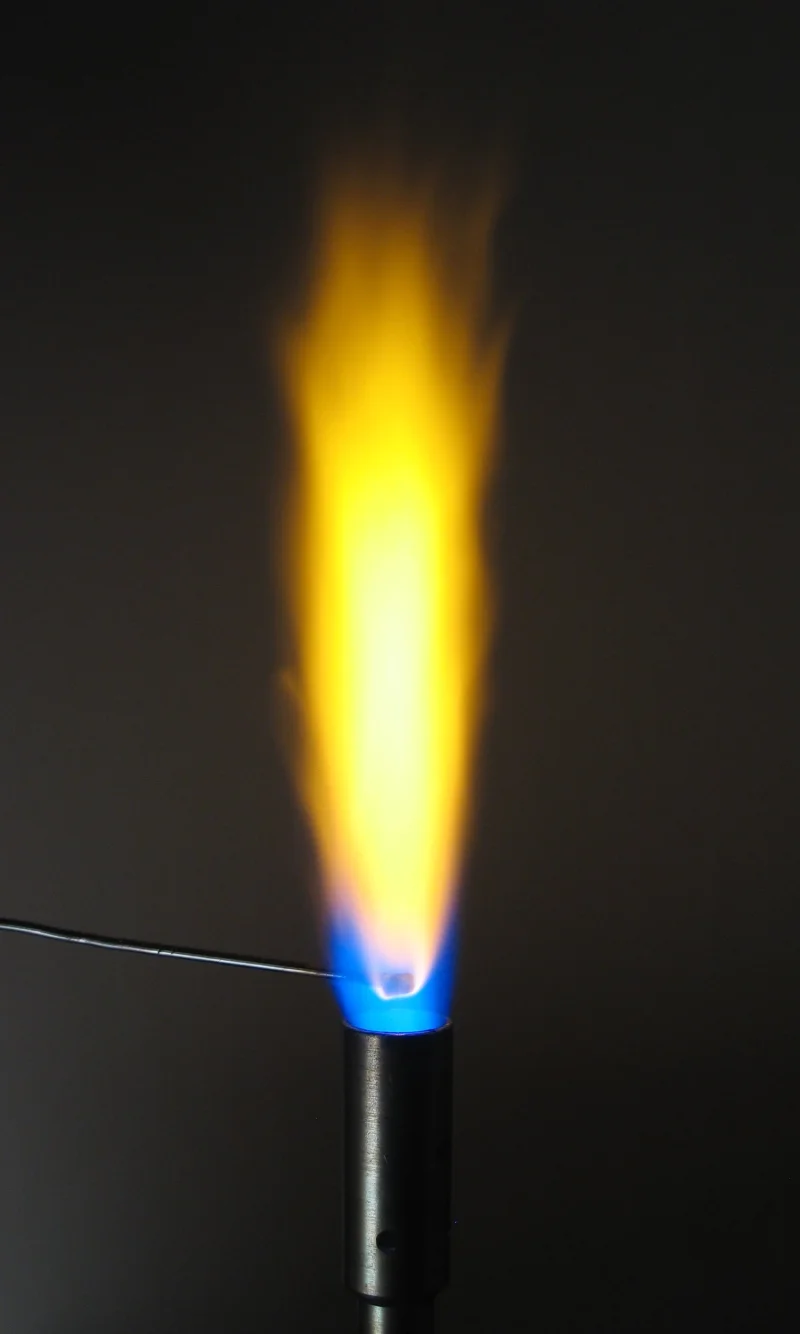
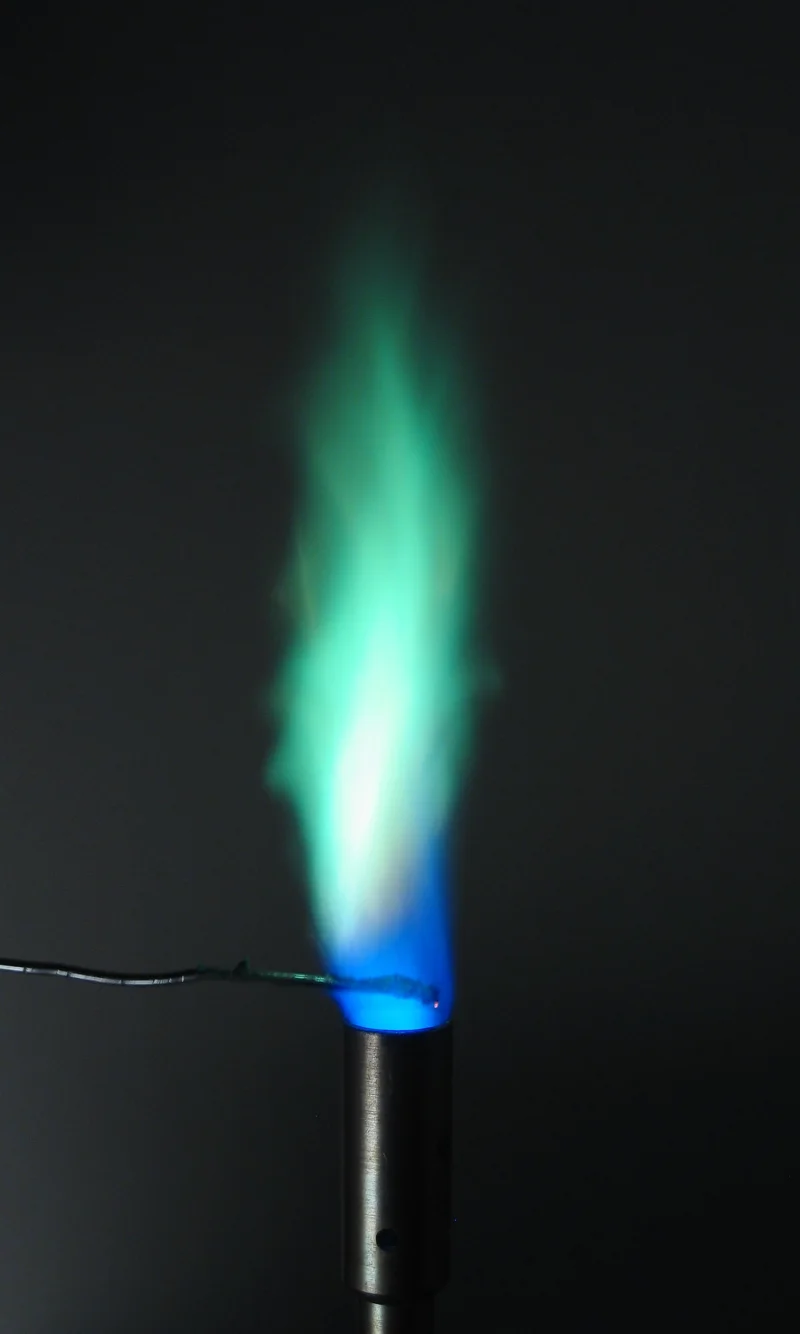
When alkali and alkaline earth metals are heated in a flame, their electrons absorb energy and jump to higher energy levels. When those excited electrons fall back down, they emit photons of visible light at characteristic wavelengths. Each element produces a distinctive flame color - this is the basis of the flame test, a classic qualitative analysis technique.
Reactivity Trends Within Families
An important distinction: reactivity trends go in opposite directions for metals and nonmetals.
For metals (alkali and alkaline earth): Reactivity increases going down the group. The valence electron is farther from the nucleus and easier to remove. Cesium is more reactive than sodium.
For nonmetals (halogens): Reactivity decreases going down the group. The atom is larger and less effective at attracting an additional electron. Fluorine is more reactive than iodine.
This makes sense when you think about what “reactive” means for each type: metals react by losing electrons (easier when electrons are loosely held), while nonmetals react by gaining electrons (easier when the atom is small and the nucleus pulls strongly).