
Transition Metals
The transition metals are the workhorses of the periodic table. They fill the wide middle section (Groups 3-12, the d-block), and they include some of the most familiar elements in everyday life: iron in steel and hemoglobin, copper in wiring and enzymes, zinc in sunscreen and carbonic anhydrase, gold in jewelry, and platinum in catalytic converters. What makes these elements special is their versatility - they can exist in multiple oxidation states, form vividly colored compounds, and act as biological catalysts that keep you alive.
For the MCAT, you do not need to memorize every property of every transition metal. But you do need to understand the general patterns that make d-block elements behave differently from main-group elements, and you need to recognize key biologically relevant transition metals when they appear in passages.
Why Transition Metals Are Different
The defining feature of transition metals is their partially filled d-orbitals. In main-group elements, the energy gap between subshells is large, so electrons clearly belong to one shell or another. In transition metals, the 4s and 3d orbitals (or 5s and 4d, etc.) are very close in energy. This small energy gap has several consequences:
- Electrons can be removed from either the s or d subshell
- Multiple oxidation states become accessible
- D-electrons can participate in bonding and absorb visible light
Multiple Oxidation States
Most transition metals can form ions with two or more different charges. This is their most chemically important property and the one most frequently tested on the MCAT.
Common examples:
| Element | Common Oxidation States | Example Compounds |
|---|---|---|
| Iron (Fe) | +2, +3 | FeCl2 (ferrous), FeCl3 (ferric) |
| Copper (Cu) | +1, +2 | Cu2O (cuprous), CuSO4 (cupric) |
| Manganese (Mn) | +2, +4, +7 | MnO2, KMnO4 |
| Chromium (Cr) | +2, +3, +6 | Cr2O3, K2Cr2O7 |
| Cobalt (Co) | +2, +3 | CoCl2, Co2O3 |
The ability to switch between oxidation states is what makes transition metals excellent catalysts. A catalyst works by temporarily changing its oxidation state during a reaction - accepting electrons in one step and donating them in another - before returning to its original form.
Colored Compounds
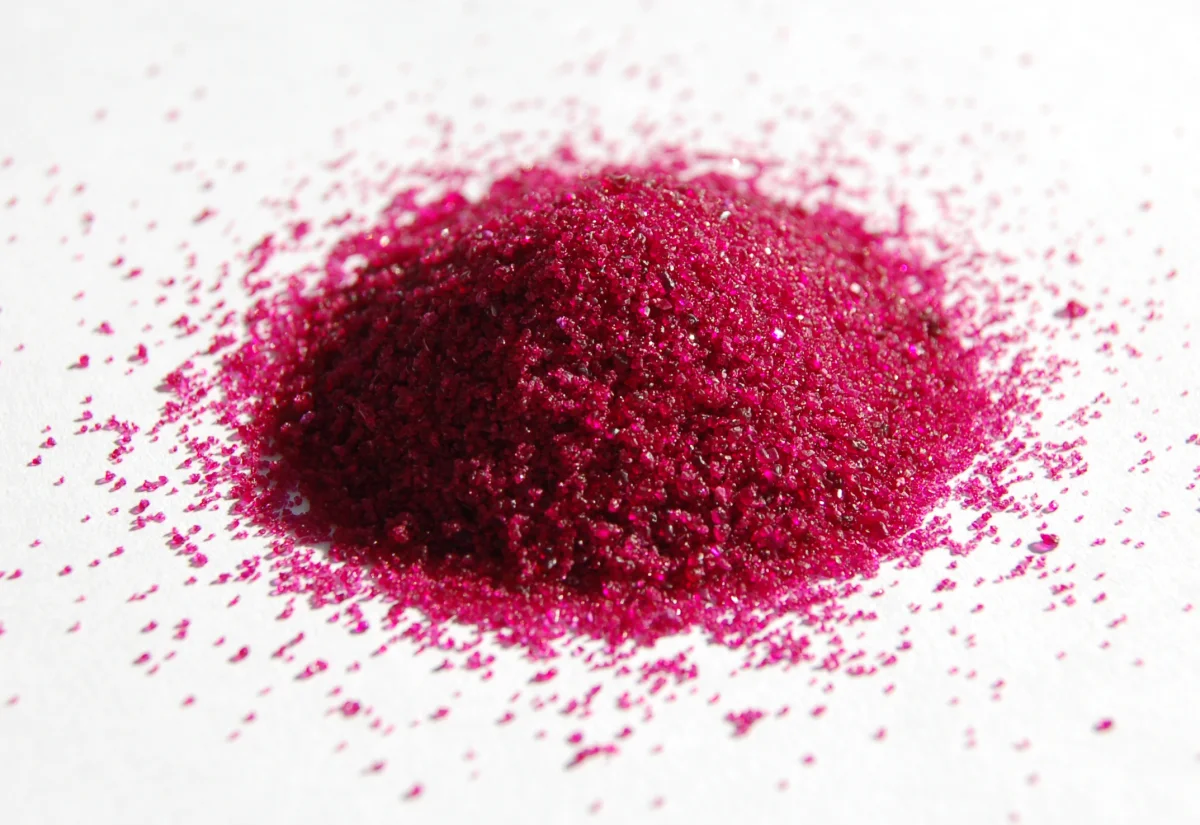
Walk into any chemistry lab and the most visually striking solutions are almost always transition metal compounds. Copper sulfate solutions are brilliant blue. Potassium permanganate is deep purple. Iron(III) chloride is yellow. Nickel salts are green.
The colors arise because d-orbital electrons absorb specific wavelengths of visible light. In an isolated atom, all five d-orbitals have the same energy. But when a transition metal ion is surrounded by ligands (molecules or ions that donate electron pairs to the metal), the d-orbitals split into two groups with slightly different energies. Electrons can jump from the lower-energy set to the higher-energy set by absorbing a photon of visible light.
The color you see is the complementary color of the wavelength absorbed. If a complex absorbs red light, it appears green. If it absorbs blue light, it appears orange.
Physical Properties
Transition metals share several physical characteristics that distinguish them from main-group metals:
- High melting and boiling points - metallic bonding is strengthened by d-electron participation
- High density - atoms are packed tightly with strong metallic bonds
- Hard and strong - much harder than alkali or alkaline earth metals
- Good conductors of heat and electricity
- Often form alloys - steel (Fe + C), bronze (Cu + Sn), brass (Cu + Zn)
Tungsten (W) has the highest melting point of any metal (3,422 degrees C), which is why it is used in light bulb filaments. Mercury (Hg) is the notable exception - it is a liquid at room temperature.
Complex Ions and Coordination Compounds
Transition metal ions have empty or partially filled d-orbitals that can accept electron pairs from other molecules or ions. The species that donate these electron pairs are called ligands, and the resulting structure is a coordination compound or complex ion.
A few terms to know for the MCAT:
- Central metal ion: the transition metal at the center of the complex
- Ligands: molecules or ions that donate lone pairs to the metal (e.g., H2O, NH3, CN-, Cl-)
- Coordination number: the number of ligand attachment points around the metal (commonly 4 or 6)
You do not need to master coordination chemistry for the MCAT, but you should recognize that transition metals form these structures and that ligand identity affects properties like color, magnetic behavior, and reactivity.
Biologically Important Transition Metals
Several transition metals serve as essential cofactors in enzymes and proteins. The MCAT frequently embeds these in biology and biochemistry passages.
| Metal | Biological Role | Example |
|---|---|---|
| Iron (Fe) | Oxygen transport, electron transport chain | Hemoglobin (Fe2+ in heme), cytochromes |
| Zinc (Zn) | Enzyme catalysis, gene regulation | Carbonic anhydrase, zinc finger proteins |
| Copper (Cu) | Electron transport, connective tissue | Cytochrome c oxidase, lysyl oxidase |
| Cobalt (Co) | Vitamin B12 cofactor | Methylmalonyl-CoA mutase |
| Manganese (Mn) | Antioxidant defense | Superoxide dismutase (Mn-SOD) |
| Molybdenum (Mo) | Nitrogen metabolism | Xanthine oxidase, nitrogenase |
Transition Metals as Catalysts
The variable oxidation states of transition metals make them superb catalysts, both in biology and in industrial chemistry. A catalyst provides an alternative reaction pathway with a lower activation energy. Transition metals accomplish this by temporarily bonding to reactants (changing their oxidation state in the process), holding them in the right orientation, and then releasing the products while returning to their original state.
Examples you may encounter on the MCAT:
- Catalytic converters in cars use platinum (Pt), palladium (Pd), and rhodium (Rh) to convert toxic exhaust gases into less harmful products
- Haber process uses iron (Fe) as a catalyst to synthesize ammonia from nitrogen and hydrogen
- Enzymes with transition metal cofactors catalyze biological reactions (see the table above)