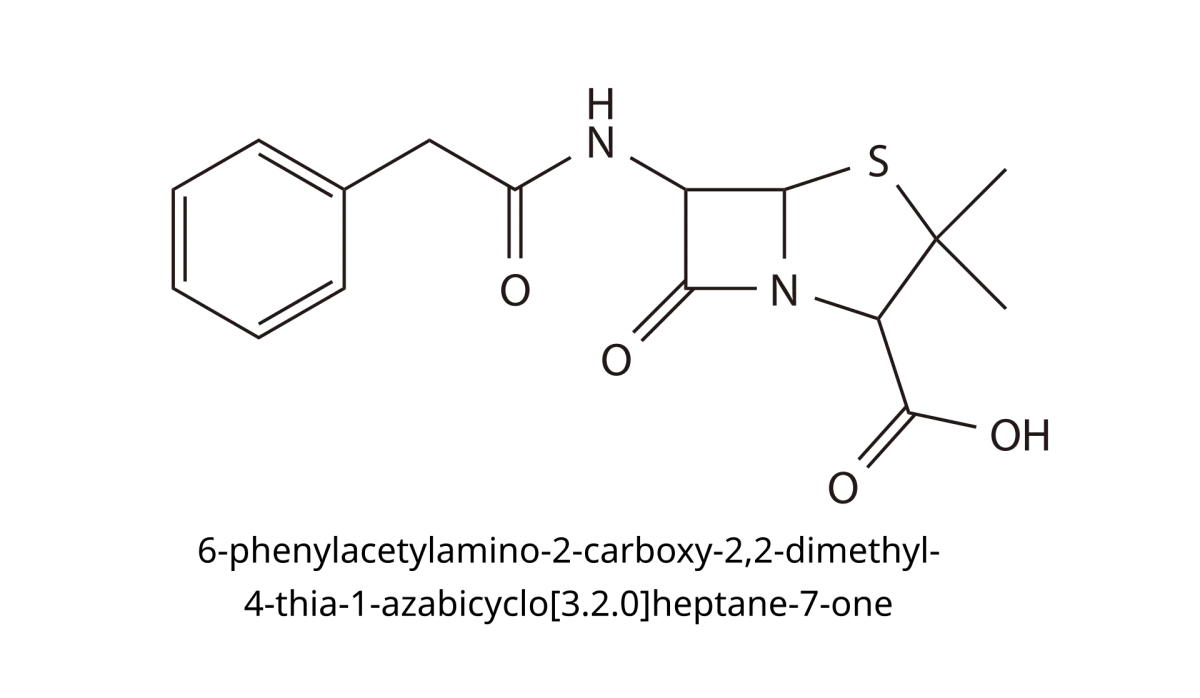
Imagine you are in Tokyo and you need to mail a letter to someone in Buenos Aires. You do not speak Japanese or Spanish, but it does not matter - the postal system uses a universal addressing format that any postal worker on earth can decode. City, street, number. That is exactly what the IUPAC naming system does for organic chemistry. It gives every molecule a unique, unambiguous name that any chemist in any country can read and instantly draw the correct structure.
Before IUPAC naming existed, chemists used “common names” - names that described where a compound came from or how it smelled. Formic acid was named after ants (formica in Latin). Acetic acid came from vinegar (acetum). Butyric acid got its name from rancid butter (butyrum). These names are colorful, but they tell you absolutely nothing about the molecule’s structure. If someone tells you a compound is called “cadaverine,” you know it smells terrible, but you have no idea how many carbons it has or what functional groups are present.
IUPAC naming solves this problem. Every piece of the name encodes structural information. Once you learn the code, you can read any IUPAC name and build the molecule in your mind.
The Three Parts of Every IUPAC Name
Every IUPAC name is built from three components, and they map perfectly to a street address:
1. The parent chain (the “city”) - This is the longest continuous carbon chain in the molecule. It determines the root of the name. A four-carbon chain gives the root “but-.” A six-carbon chain gives “hex-.” The parent chain tells you the size of the backbone.
2. The suffix (the “street”) - This tells you the highest-priority functional group. An alkane gets “-ane.” An alcohol gets “-ol.” A carboxylic acid gets “-oic acid.” The suffix is the most important part because it tells you the molecule’s primary chemical identity.
3. The prefixes and locants (the “house numbers”) - These tell you what else is attached to the parent chain and exactly where. “2-methyl” means a methyl group (-CH3) is attached at carbon 2. “3-bromo” means a bromine atom sits at carbon 3. Locant numbers pin every substituent to a specific position.
The IUPAC Naming Algorithm
Here is the step-by-step process for naming any organic molecule. You will learn each step in detail in the sections that follow, but having the full roadmap now will help you see how the pieces fit together.
Step 1: Identify the longest continuous carbon chain. This becomes the parent chain and determines the root name (meth-, eth-, prop-, but-, pent-, hex-, etc.).
Step 2: Identify the highest-priority functional group. This determines the suffix (-ane, -ol, -al, -one, -oic acid, etc.).
Step 3: Number the chain. Start numbering from the end that gives the principal functional group the lowest possible locant.
Step 4: Name and number each substituent. Identify all branches and additional functional groups that are not the principal group. Assign each one a locant number.
Step 5: Assemble the name. List substituents alphabetically as prefixes, followed by the parent chain root and suffix. Separate numbers from letters with hyphens. Separate numbers from numbers with commas.
Putting It Together - A Quick Example
Consider a five-carbon chain with a methyl group at carbon 3 and no functional groups beyond single bonds.
Step 1: Longest chain = 5 carbons = “pent-”
Step 2: Only single bonds = suffix “-ane”
Step 3: The chain has a methyl at position 3 either way you number it (it is in the middle), so numbering does not change anything here
Step 4: One methyl substituent at carbon 3 = “3-methyl”
Step 5: Assemble = “3-methylpentane”
That name tells any chemist: draw a five-carbon chain, attach a -CH3 at carbon 3, and fill everything else with hydrogens. Done.
Common Naming Pitfalls on the MCAT
Pitfall 1: Picking the wrong parent chain. Students often pick the chain drawn horizontally in a structural formula, but the longest chain may bend or zigzag through the drawing. Always trace every possible path to find the longest continuous chain.
Pitfall 2: Numbering from the wrong end. The principal functional group must receive the lowest possible locant. If you have an alcohol at carbon 2 or carbon 4, you number so it ends up at 2, not 4.
Pitfall 3: Forgetting alphabetical order for substituents. When multiple substituents are present, they are listed alphabetically in the name. Ethyl comes before methyl. Bromo comes before chloro. The multiplying prefixes (di-, tri-, tetra-) are NOT considered when alphabetizing. “Dimethyl” is alphabetized under “m,” not “d.”
Pitfall 4: Confusing hyphens and commas. Hyphens separate numbers from letters (2-methyl). Commas separate numbers from numbers (2,3-dimethyl). Getting this wrong does not change the molecule, but it can make answer choices look unfamiliar.
Formatting Conventions
A few formatting rules keep IUPAC names consistent:
Convention
Example
Numbers and letters separated by hyphens
2-methylpentane
Numbers separated by commas
2,3-dimethylbutane
Multiplying prefixes for identical substituents
di- (2), tri- (3), tetra- (4)
Substituents listed alphabetically
3-ethyl-2-methylhexane
Multiplying prefixes ignored in alphabetical order
”dimethyl” sorted as “m,” not “d”
Why This Matters Beyond Naming
Nomenclature is not a standalone topic on the MCAT. It is the gateway to every other organic chemistry concept. When a passage describes “the reaction of 2-bromo-3-methylpentane with sodium hydroxide,” you need to instantly see the structure to predict whether the reaction follows an SN1, SN2, E1, or E2 pathway. That prediction depends on the substrate’s structure - which you can only determine if you can decode the name.
Similarly, when a passage mentions “cyclohex-2-en-1-one,” you need to recognize that this is a cyclohexane ring with a double bond at C2 and a ketone at C1 - a conjugated enone - and that this structure is an excellent Michael acceptor. The name is not trivia. It is the key that unlocks reactivity.
What are the three components of every IUPAC name, and what structural information does each encode?
Click to reveal answer
Parent chain (root) encodes the number of carbons in the longest chain. Suffix encodes the highest-priority functional group. Prefixes with locants encode the identity and position of substituents and lower-priority functional groups. Together, they act as a complete structural blueprint.
In the name "4-bromo-2-ethylhexanoic acid," which part is the parent chain, which is the suffix, and what are the prefixes?
Click to reveal answer
Parent chain: "hex-" (6 carbons). Suffix: "-anoic acid" (carboxylic acid). Prefixes: "4-bromo" (Br at carbon 4) and "2-ethyl" (-CH2CH3 at carbon 2). The molecule is a six-carbon chain with a carboxylic acid at one end, an ethyl branch at C2, and a bromine at C4.
When assembling an IUPAC name with multiple substituents, how do you determine the order of the prefixes?
Click to reveal answer
Alphabetical order, ignoring multiplying prefixes. "Ethyl" comes before "methyl." If there are two methyl groups (dimethyl), alphabetize under "m," not "d." Similarly, "tribromo" is alphabetized under "b." Multiplying prefixes (di-, tri-, tetra-) are invisible for sorting purposes.
Finding the parent chain is the first and most important step in naming any organic molecule. Get this wrong and every other part of the name falls apart - wrong root, wrong numbering, wrong substituents. The good news is that once you understand the principle, it becomes almost automatic.
Choosing the Main Highway
Think of a road map. When you give someone driving directions, you choose the main highway as your primary route - even if it curves, bends, or makes an L-turn. Side streets branch off the highway, but the highway is the backbone of the trip. The parent chain works the same way.
Rule 1: Find the Longest Continuous Chain of Carbon Atoms
The parent chain is the longest unbroken sequence of carbon atoms in the molecule. “Unbroken” means you can trace from one carbon to the next through single, double, or triple bonds without lifting your pencil.
This sounds simple, but structural drawings can be deceptive. Consider this structure:
CH₃ |CH₃-CH-CH₂-CH₃
A quick glance might suggest the horizontal chain (CH3-CH-CH2-CH3) is four carbons long. But trace the longest path: start at the leftmost CH3, go through the CH, then up to the CH3 branch - that is only three carbons. Start at the leftmost CH3, go through the CH, then right to CH2, then right to CH3 - that is four carbons. So the parent chain is butane (4 carbons), with a methyl substituent at carbon 2.
Rule 2: When Two Chains Tie in Length, Pick the One with More Substituents
If two or more chains have the same number of carbons, choose the one that gives the molecule the greatest number of substituents. More substituents means smaller, simpler branches, which makes the name clearer.
For example, if a molecule has two possible six-carbon parent chains, one giving two methyl substituents and the other giving one ethyl substituent, choose the chain with two methyls.
Rule 3: The Parent Chain Must Include the Principal Functional Group
When the molecule contains a functional group that determines the suffix (like -OH for alcohols or -COOH for carboxylic acids), the parent chain must include the carbon bearing that functional group. Sometimes this means the parent chain is not the absolute longest chain in the molecule - it is the longest chain that passes through the principal functional group.
For example, if a molecule has a seven-carbon continuous chain that does not include a -COOH group, but a six-carbon chain does include it, the parent chain is the six-carbon chain. The carboxylic acid carbon must be in the parent chain because it determines the suffix.
The Carbon Chain Prefixes
Once you know the length of the parent chain, you need to know the prefix that matches. These prefixes are the foundation of all organic nomenclature, and you must know them cold.
Number of Carbons
Prefix
Example Alkane
1
Meth-
Methane (CH4)
2
Eth-
Ethane (C2H6)
3
Prop-
Propane (C3H8)
4
But-
Butane (C4H10)
5
Pent-
Pentane (C5H12)
6
Hex-
Hexane (C6H14)
7
Hept-
Heptane (C7H16)
8
Oct-
Octane (C8H18)
9
Non-
Nonane (C9H20)
10
Dec-
Decane (C10H22)
The first four (meth, eth, prop, but) come from historical names - methanol from wood (Greek methy = wine + hyle = wood), ethanol from ether, propionic acid from the first fatty acid (Greek protos + pion = first fat), and butyric acid from butter. From five onward, the prefixes are simply Greek and Latin number words: pent (5), hex (6), hept (7), oct (8), non (9), dec (10).
Practice: Tracing the Parent Chain
Let’s work through a more complex example. Consider this structure:
CH₃ |CH₃-CH₂-C-CH₂-CH₃ | CH₂ | CH₂ | CH₃
At first glance, you might pick the horizontal chain: CH3-CH2-C-CH2-CH3, which is five carbons. But look again. If you start at the top CH3, go down to the central C, then continue down through CH2-CH2-CH3, that path is also five carbons (counting the central C and the chain going down: C + CH2 + CH2 + CH3 = 4 carbons from the central carbon, plus the top CH3 = 5 total).
Now try: start at CH3-CH2 on the left, go through the central C, then down through CH2-CH2-CH3. That path is: CH3 + CH2 + C + CH2 + CH2 + CH3 = six carbons. That is the longest chain. The parent is hexane.
The top CH3 and the right-side CH2-CH3 become substituents: a methyl at one position and an ethyl at another. Always trace every route before committing.
Numbering the Parent Chain
Once you have identified the parent chain, number it so the principal functional group (the one that determines the suffix) gets the lowest possible locant. If there is no functional group other than single bonds (a plain alkane), number so the substituents get the lowest set of locants.
“Lowest set of locants” means you compare the two possible numbering schemes position by position. For instance, if one direction gives substituents at 2, 3, and 5, and the other gives 2, 4, and 5, choose the first option because at the first point of difference (position 2 vs. position 2 is a tie, then 3 vs. 4), 3 is lower than 4.
Special Case: Chains with Double or Triple Bonds
When the molecule contains a double bond (alkene) or triple bond (alkyne), the parent chain must include the multiple bond, and the chain is numbered so the double or triple bond gets the lowest possible locant. We will cover this in detail in Section 1.4, but the key point here is that the parent chain must pass through the multiple bond even if a longer all-single-bond chain exists.
A molecule has an eight-carbon continuous chain that does not include a -COOH group, and a six-carbon chain that does include it. Which chain is the parent chain?
Click to reveal answer
The six-carbon chain. The parent chain must include the principal functional group (the one that determines the suffix). A carboxylic acid (-COOH) is a suffix-determining group, so the chain passing through it is the parent chain, even though a longer chain exists elsewhere in the molecule.
Two possible parent chains both have seven carbons. Chain A gives one propyl substituent; Chain B gives one methyl and one ethyl substituent. Which do you choose?
Click to reveal answer
Chain B. When two chains are the same length, choose the one that gives the greater number of substituents. Chain B gives two substituents (methyl + ethyl), while Chain A gives only one (propyl). More substituents with simpler names is preferred.
What prefix corresponds to a seven-carbon parent chain?
Click to reveal answer
Hept-. The carbon chain prefixes are: meth (1), eth (2), prop (3), but (4), pent (5), hex (6), hept (7), oct (8), non (9), dec (10). Think of a heptagon - seven sides.
Alkanes are the plain vanilla of organic chemistry - just carbon and hydrogen, no double bonds, no functional groups, no drama. That is exactly why they are the best place to learn the full IUPAC naming process. Every rule you internalize here transfers directly to alkenes, alkynes, alcohols, ketones, and every compound the MCAT can throw at you. Master alkane naming, and half the nomenclature battle is already won.
The goal of this section is simple: given a structure, you should be able to write its IUPAC name in under thirty seconds. Given a name, you should be able to draw the structure in the same time. We build that speed with a five-step recipe that never changes.
IUPAC nomenclature in practice: identify the longest carbon chain (parent), number to give lowest locants, list substituents alphabetically with their locants, and assemble into the full name. The same logic extends to every functional group class. Credit: Wikimedia Commons, CC BY-SA
The Five-Step Recipe
Every alkane name is built the same way. Follow these steps in order, every time:
Find the longest continuous carbon chain - this becomes the parent chain (covered in Section 1.2).
Number the chain from the end nearest the first substituent - to give the lowest set of locants.
Identify and name every substituent - each branch gets its own prefix (methyl, ethyl, propyl, etc.).
Alphabetize the substituents - ignore multiplier prefixes (di, tri) when alphabetizing.
Let us walk through each step with a real example.
Step 1: The Parent Chain Sets the Suffix
Count the carbons in the longest continuous chain. The count gives you the root name, and the suffix -ane confirms it is an alkane (single bonds only).
Carbons
Root
Full alkane name
1
meth-
methane
2
eth-
ethane
3
prop-
propane
4
but-
butane
5
pent-
pentane
6
hex-
hexane
7
hept-
heptane
8
oct-
octane
9
non-
nonane
10
dec-
decane
Step 2: Number to Give Lowest Locants
Always number the chain so the substituents get the lowest possible set of numbers. If both directions give the same first locant, compare the second locant, then the third, and so on. This is called the first point of difference rule.
Example: a six-carbon chain with methyl groups on carbons 2 and 4 (numbered from the left) would be numbered 3 and 5 from the right. The set {2, 4} beats {3, 5} at the first point of difference, so we number from the left.
If the numbering is a tie at every locant, alphabetical order of the substituents breaks the tie - the substituent that comes first alphabetically gets the lower number.
Step 3: Name the Substituents
Every branch off the parent chain is a substituent. Name each substituent by counting its carbons and changing the alkane ending from -ane to -yl.
-CH₃ = methyl (from methane)
-CH₂CH₃ = ethyl (from ethane)
-CH₂CH₂CH₃ = propyl (from propane)
-CH(CH₃)₂ = isopropyl (common) or propan-2-yl (IUPAC)
-C(CH₃)₃ = tert-butyl (common) or 2-methylpropan-2-yl (IUPAC)
For this chapter, we will use the common names (isopropyl, sec-butyl, tert-butyl) since those are the names the MCAT uses in passages. Full systematic names for branched substituents appear in Section 1.10.
Step 4: Alphabetize, Ignoring Multipliers
When a molecule has multiple types of substituents, they must appear in the name in alphabetical order by substituent name. Importantly, the multiplier prefixes (di-, tri-, tetra-) do NOT count for alphabetization.
“3-ethyl-2,2-dimethylpentane” - ethyl (e) comes before methyl (m), even though “dimethyl” starts with d.
“4-ethyl-3-isopropyloctane” - ethyl (e) comes before isopropyl (i).
Hyphenated prefixes like sec- and tert- are also ignored when alphabetizing, but iso- and neo- are part of the name and DO count for alphabetization order.
A complete worked example for the molecule with structure:
CH₃ CH₃ | |CH₃-CH-CH₂-CH-CH₂-CH₃
Following the recipe:
Longest chain = 6 carbons → hexane.
Number from the left so methyl groups land on C2 and C4 (set {2,4} not {3,5}).
Substituents = two methyl groups → dimethyl.
Only one substituent type, no alphabetization needed.
Assemble: 2,4-dimethylhexane.
Notice the punctuation: numbers are separated from each other by commas, and from letters by hyphens.
Handling Multiple Identical Substituents
When the same substituent appears more than once, use the multiplier prefixes: di- (2), tri- (3), tetra- (4), penta- (5), and so on. Each position still needs its own locant number.
Two methyl groups = “dimethyl” with two locants: “2,3-dimethyl…”
Three chloro groups = “trichloro” with three locants: “1,2,3-trichloro…”
When Substituents Have Substituents (Complex Branches)
If a substituent itself has branches, name the whole branch in parentheses and number its own carbons starting from the point of attachment to the main chain.
Example: a 4-carbon branch with a methyl group on its second carbon is named (2-methylpropyl) - also known by its common name isobutyl. In context, the name might look like “4-(2-methylpropyl)octane.”
This rule keeps long, complex names unambiguous. Section 1.10 drills deeper into these complex substituent names, but most MCAT questions stop at the common-name level (isopropyl, isobutyl, sec-butyl, tert-butyl, neopentyl).
Common Naming Traps
Not finding the longest chain. A 2D structure can hide the longest chain because of how it is drawn. Always count every possible path.
Wrong numbering direction. Students often number from the end closest to the “drawn left side” out of habit. The rule is lowest locants, regardless of visual orientation.
Forgetting to alphabetize. Even if it looks weird (like “ethyl” appearing before “methyl”), alphabetical order is the law.
Miscounting multiplier prefixes. “Trimethyl” needs three locants, not one. Missing a locant is a common error.
Ignoring the parent chain tie-breaker. When two chains are the same length, pick the one with more substituents. If they tie on substituents too, use lowest locants.
Worked Examples
Example 1: A 7-carbon chain with a methyl on C3 and an ethyl on C5.
Alphabetize: ethyl (e) before methyl (m). But check numbering first. Numbered from one end: ethyl-5, methyl-3 (set {3,5}). From the other end: ethyl-3, methyl-5 (set {3,5}). Tie. Go to alphabetical tie-breaker: ethyl should get the lower number, so ethyl at 3 wins. The name is 3-ethyl-5-methylheptane.
Example 2: A 6-carbon chain with two methyls on C2 and one methyl on C4.
Substituents: three methyls at positions 2, 2, and 4 → “2,2,4-trimethyl”. Name: 2,2,4-trimethylhexane (famously the high-octane component of gasoline).
Example 3: A 5-carbon chain with a bromo on C1 and a chloro on C3.
Alphabetize: bromo (b) before chloro (c). Numbering: bromo at 1, chloro at 3 (set {1,3}) or bromo at 5, chloro at 3 (set {3,5}). Set {1,3} wins. Name: 1-bromo-3-chloropentane.
A seven-carbon chain has a methyl group on C3 and an ethyl group on C4. Give the correct IUPAC name.
Click to reveal answer
4-ethyl-3-methylheptane. The parent is heptane (7 carbons). Numbering from either end gives the same set {3,4}, so we use alphabetical order to break the tie - but "ethyl" (e) comes before "methyl" (m) alphabetically, so "ethyl" appears first in the written name while keeping its locant of 4. Do not renumber to put ethyl at the lower number unless the set of locants is unchanged by flipping.
Why do we ignore "di-" and "tri-" when alphabetizing, but include "iso-" and "neo-"?
Click to reveal answer
Because di- and tri- are multipliers that describe quantity, not part of the substituent's identity. Iso- and neo- are structural descriptors that change which substituent you are talking about. "Dimethyl" is still two methyl groups (m). But "isopropyl" is a different substituent than "propyl" - the iso- is intrinsic to the name. Multipliers count; structural prefixes count too.
What the MCAT Actually Asks
You will rarely be asked to name a compound from scratch in an AAMC exam. What you will see is a passage that references compounds by name and expects you to:
Recognize the structural implications of the name (chain length, branches, functional group).
Predict reactivity based on the structure implied by the name.
Compare two similarly named compounds to identify isomerism or polarity differences.
Practice going from name to structure (reverse nomenclature) as much as structure to name. The MCAT rewards the latter skill more than the former.
Alkanes have only single bonds, which makes them saturated - every carbon holds the maximum possible number of hydrogens. But many organic molecules contain double bonds (alkenes) or triple bonds (alkynes), and these “unsaturated” compounds need a way to indicate where the multiple bond is and what kind it is. That is where the suffixes “-ene” and “-yne” come in.
The Dating Analogy
Naming Alkenes
Alkenes contain at least one carbon-carbon double bond (C=C). Naming follows the same IUPAC rules as alkanes, with two modifications:
Modification 1: Replace the “-ane” suffix with “-ene.” Ethane becomes ethene. Propane becomes propene. Hexane becomes hexene.
Modification 2: The double bond gets a locant number. Number the parent chain so the double bond gets the lowest possible position. The locant indicates the first carbon of the double bond.
Example: A five-carbon chain with a double bond between carbons 1 and 2 is pent-1-ene (or 1-pentene in older notation). A double bond between carbons 2 and 3 is pent-2-ene.
General Formula for Alkenes
Acyclic alkenes with one double bond follow the formula CnH2n. Compare this to CnH2n+2 for alkanes - you lose two hydrogens for every double bond you add. This makes sense because forming a double bond requires each carbon to give up one hydrogen.
Naming Alkynes
Alkynes contain at least one carbon-carbon triple bond (C≡C). The suffix is “-yne,” and the locant rules are identical to alkenes.
Example: A four-carbon chain with a triple bond between carbons 1 and 2 is but-1-yne. Between carbons 2 and 3 is but-2-yne.
Acyclic alkynes with one triple bond follow the formula CnH2n-2. You lose four hydrogens compared to the corresponding alkane because a triple bond consists of one sigma bond and two pi bonds, replacing four C-H bonds.
Parent Chain Must Include the Multiple Bond
When a molecule has a double or triple bond, the parent chain must pass through that bond, even if a longer all-single-bond chain exists elsewhere. The multiple bond is more important than maximum chain length for determining the parent chain.
After ensuring the parent chain includes the multiple bond, number the chain so the double or triple bond gets the lowest locant.
Cis/Trans Designation for Alkenes
Because double bonds cannot rotate freely (the pi bond locks the geometry), groups attached to the double-bond carbons can be on the same side or opposite sides. This creates geometric isomers:
Cis = same side. Both substituents of interest are on the same side of the double bond.
Trans = opposite sides. The substituents are on opposite sides.
The cis/trans system works well when each double-bond carbon has one hydrogen and one non-hydrogen group. It becomes ambiguous when both carbons have two non-hydrogen substituents, which is why chemists developed the E/Z system.
E/Z Designation (Replaces Cis/Trans)
The E/Z system uses the Cahn-Ingold-Prelog (CIP) priority rules to assign priorities to the two groups on each carbon of the double bond. The higher-priority group on each carbon is identified, and then:
Z (zusammen, German for “together”): The two higher-priority groups are on the same side of the double bond.
E (entgegen, German for “opposite”): The two higher-priority groups are on opposite sides.
CIP Priority Rules (Brief Overview)
The Cahn-Ingold-Prelog priority system ranks substituents by atomic number:
Higher atomic number = higher priority. Br (35) > Cl (17) > O (8) > N (7) > C (6) > H (1).
If the atoms directly attached are the same, move outward and compare the next set of atoms along each branch until you find a difference.
Double and triple bonds are treated as if each bond were two or three single bonds to duplicate atoms. A C=O double bond treats the carbon as if it were bonded to two separate oxygen atoms.
You will study these rules in much greater depth in the Isomers chapter. For now, the key point is that E/Z assignments always use CIP priorities, not just “which group is bigger.”
Degree of Unsaturation (Index of Hydrogen Deficiency)
The degree of unsaturation (also called the index of hydrogen deficiency, IHD) tells you how many double bonds, triple bonds, or rings a molecule has compared to a fully saturated acyclic molecule with the same formula.
Example: C6H6 (benzene). DoU = (2(6) + 2 - 6) / 2 = (12 + 2 - 6) / 2 = 28 = 4. Benzene has three double bonds and one ring = 4 DoU. Checks out.
Example: C3H6. DoU = (2(3) + 2 - 6) / 2 = (6 + 2 - 6) / 2 = 22 = 1. This molecule has one degree of unsaturation - it could be propene (one double bond) or cyclopropane (one ring).
Naming Molecules with Multiple Double or Triple Bonds
When more than one double bond is present, use the multiplying prefix before “-ene”:
Two double bonds: “-diene” (example: buta-1,3-diene)
Three double bonds: “-triene” (example: hexa-1,3,5-triene)
For multiple triple bonds, use “-diyne,” “-triyne,” etc.
Each multiple bond gets its own locant. Commas separate multiple locants: buta-1,3-diene tells you there are double bonds starting at carbon 1 and carbon 3.
Terminal vs. Internal Alkynes
An important distinction for alkynes:
Terminal alkyne: The triple bond is at the end of the chain (C1). The terminal carbon bears a hydrogen (R-C≡C-H). This hydrogen is slightly acidic (pKa ~ 25) because the sp-hybridized carbon holds the electrons tightly.
Internal alkyne: The triple bond is in the interior of the chain (e.g., between C2 and C3). Both carbons of the triple bond are bonded to other carbons (R-C≡C-R’).
This distinction matters for reactivity. Terminal alkynes can be deprotonated by strong bases (like NaNH2) to form acetylide anions, which are excellent nucleophiles. Internal alkynes cannot.
A compound has the molecular formula C5H8. What is its degree of unsaturation, and what structural features could account for it?
Click to reveal answer
DoU = 2. (2(5) + 2 - 8) / 2 = (12 - 8) / 2 = 24 = 2. Two degrees of unsaturation could be: two double bonds, one triple bond, one double bond plus one ring, or two rings. Possible structures include penta-1,3-diene, pent-1-yne, cyclopentene, or methylcyclobutene.
In (Z)-but-2-ene, are the two methyl groups on the same side or opposite sides of the double bond?
Click to reveal answer
Same side. Z stands for "zusammen" (together), meaning the higher-priority groups on each carbon are on the same side. In but-2-ene, each double-bond carbon has one methyl group and one hydrogen. Methyl is higher priority than hydrogen, so Z means the methyls are on the same side. This is equivalent to cis-but-2-ene.
What suffix indicates a triple bond, and what is the general molecular formula for an acyclic alkyne with one triple bond?
Click to reveal answer
The suffix is "-yne," and the formula is CnH2n-2. Compared to the alkane formula (CnH2n+2), an alkyne loses four hydrogens - two for the second bond of the triple bond and two more for the third bond. Example: propyne is C3H4.
Organic molecules do not always grow in straight lines. Carbon chains can loop back on themselves and form rings, creating cyclic compounds. Rings are everywhere in biology - cholesterol has four fused rings, glucose cyclizes into a six-membered ring, and the amino acid proline contains a five-membered ring. Knowing how to name these structures is essential for decoding MCAT passages.
The “Cyclo-” Prefix
Naming a cyclic compound is straightforward: take the name of the straight-chain alkane with the same number of carbons and add the prefix “cyclo-.”
Three-carbon ring = cyclopropane
Four-carbon ring = cyclobutane
Five-carbon ring = cyclopentane
Six-carbon ring = cyclohexane
That is it. The ring itself is the parent, and you simply count the carbons in the ring to get the root name.
General Formula for Cycloalkanes
Cycloalkanes have the formula CnH2n - the same as acyclic alkenes. This makes sense because forming a ring requires losing two hydrogens (the two end carbons bond to each other instead of to a hydrogen each). A ring counts as one degree of unsaturation, just like a double bond.
This means if you calculate the degree of unsaturation for a molecular formula and get DoU = 1, the compound could be either a cycloalkane or an alkene. The formula alone cannot distinguish them - you need structural information.
Naming Substituted Cycloalkanes
When a cycloalkane has substituents, follow these rules:
Rule 1: Decide whether the ring or the chain is the parent. If the ring has more carbons than any attached chain, the ring is the parent. If a chain has more carbons than the ring, the chain is the parent and the ring becomes a substituent (named as a “cycloalkyl” group).
Example: A cyclopentane ring (5 carbons) with a methyl group attached: the ring is the parent. Name: methylcyclopentane.
Example: A cyclopropane ring (3 carbons) attached to an octane chain (8 carbons): the chain is the parent. The ring is a “cyclopropyl” substituent. Name: cyclopropyloctane (with a locant for the attachment point).
Rule 2: When the ring is the parent with one substituent, no locant is needed. Methylcyclohexane has a methyl group on the ring. Since there is only one substituent, it does not matter where you start numbering - every position is equivalent. No number is needed.
Rule 3: When the ring has two or more substituents, number the ring. Assign locant 1 to the substituent that comes first alphabetically, then number in the direction that gives the other substituents the lowest locants.
Examples of Substituted Cycloalkanes
One substituent:
Ethylcyclopentane (an ethyl group on a five-membered ring)
No number needed
Two substituents:
1-ethyl-3-methylcyclohexane: ethyl at position 1 (alphabetically first), methyl at position 3. You number so the set of locants is as low as possible.
Three substituents:
1,2,4-trimethylcyclohexane: three methyl groups on a six-membered ring at positions 1, 2, and 4.
Naming Cycloalkenes
Cycloalkenes are rings that contain a double bond. The naming rules are:
Step 1: Name the ring with the “cyclo-” prefix and use the “-ene” suffix instead of “-ane.”
Step 2: The double bond always includes carbons 1 and 2. You do not need to specify “1-” for the double bond in simple cycloalkenes because it is implied.
Step 3: Number the ring starting at the double bond, going in the direction that gives substituents the lowest locants.
Example: Cyclohexene - a six-membered ring with one double bond. No locant for the double bond is needed.
Example: 3-methylcyclohexene - a six-membered ring with a double bond (at C1-C2, implied) and a methyl group at C3.
Cycloalkene General Formula
Cycloalkenes with one double bond follow the formula CnH2n-2. They have two degrees of unsaturation: one for the ring and one for the double bond.
Polycyclic Systems (Brief Mention)
Some molecules contain two or more rings that share carbons. These are polycyclic systems. The most common ones you will encounter on the MCAT are:
Bicyclic: Two rings sharing one or two carbons (e.g., bicyclo[2.2.1]heptane, also called norbornane)
Spiro: Two rings sharing exactly one carbon (e.g., spiro[4.5]decane)
Fused: Two rings sharing two adjacent carbons and one bond (e.g., decalin)
You do not need to master the detailed naming of polycyclic systems for the MCAT. But you do need to recognize that fused ring systems like steroids (four fused rings) and decalin are polycyclic. When a passage gives you a polycyclic structure, focus on identifying the functional groups and stereochemistry rather than trying to generate the full IUPAC name.
Ring Strain
Ring size affects stability, and this sometimes appears in MCAT passages:
Ring Size
Name
Stability
3
Cyclopropane
High strain (angle strain + torsional strain)
4
Cyclobutane
Significant strain
5
Cyclopentane
Low strain (nearly strain-free)
6
Cyclohexane
No strain (chair conformation eliminates all strain)
7+
Larger rings
Generally low strain, some transannular strain
Three-membered rings (cyclopropane, epoxides) are highly strained because the internal bond angles are forced to 60° instead of the ideal 109.5° for sp3 carbons. This strain makes them reactive - which is why epoxides are excellent electrophiles in organic reactions.
A cyclobutane ring (4 carbons) is attached to a hexane chain (6 carbons). Is the ring or the chain the parent?
Click to reveal answer
The chain is the parent. The hexane chain has 6 carbons, which is more than the cyclobutane ring's 4 carbons. The chain becomes the parent (hexane), and the ring becomes a substituent named "cyclobutyl." The compound would be named cyclobutylhexane (with a locant for where the ring attaches to the chain).
What is the molecular formula of cyclohexane, and how many degrees of unsaturation does it have?
Click to reveal answer
C6H12 with DoU = 1. Cyclohexane follows the formula CnH2n: C6H12. Degree of unsaturation = (2(6) + 2 - 12) / 2 = (14 - 12) / 2 = 1. The one degree of unsaturation corresponds to the ring. Cyclohexane has the same molecular formula as hexene (C6H12), but the unsaturation is a ring, not a double bond.
Name this compound: a cyclohexane ring with an ethyl group at one position and a methyl group two carbons away.
Click to reveal answer
1-ethyl-3-methylcyclohexane. Ethyl comes before methyl alphabetically, so ethyl gets the locant 1. Number in the direction that gives methyl the lowest locant, which is position 3 (not position 5). The ring is the parent because it has more carbons (6) than either substituent chain.
Benzene is arguably the most important ring in organic chemistry. Its six-carbon aromatic ring appears in amino acids (phenylalanine, tyrosine, tryptophan), neurotransmitters (dopamine, serotonin), drugs (aspirin, ibuprofen), and countless biological molecules. If you can name benzene derivatives, you can decode a huge fraction of the organic molecules that show up on the MCAT.
Benzene as Parent
The simplest aromatic compound is benzene itself: C6H6, a six-membered ring with alternating double bonds (or more accurately, a ring of six sp2-hybridized carbons with fully delocalized pi electrons). Its degree of unsaturation is 4 (three double bonds + one ring).
When benzene is the parent, substituents are simply named as prefixes:
Chlorobenzene (Cl on benzene)
Nitrobenzene (NO2 on benzene)
Bromobenzene (Br on benzene)
For a single substituent, no locant is needed - all positions on an unsubstituted benzene ring are equivalent.
The Ortho/Meta/Para System
When benzene has two substituents, you need to describe their relative positions. The ortho/meta/para (o/m/p) system does this elegantly using relative positions rather than numbers.
The three positions correspond to specific numbering:
Position
Abbreviation
Numbered As
Relationship
Ortho
o-
1,2-disubstituted
Adjacent carbons
Meta
m-
1,3-disubstituted
One carbon apart
Para
p-
1,4-disubstituted
Opposite sides
Examples with Ortho/Meta/Para
ortho-dichlorobenzene (o-dichlorobenzene): two Cl atoms on adjacent carbons (1,2 positions)
meta-dinitrobenzene (m-dinitrobenzene): two NO2 groups separated by one carbon (1,3 positions)
para-bromochlorobenzene (p-bromochlorobenzene): Br and Cl on opposite sides (1,4 positions)
When the two substituents are different, name them alphabetically. For p-bromochlorobenzene, “bromo” comes before “chloro.”
Common Named Benzene Derivatives
Several substituted benzenes have common names that are so widely used that IUPAC has accepted them as parent names. You must know these:
Common Name
Structure
Systematic Name
Toluene
Methylbenzene
Methylbenzene
Phenol
Hydroxybenzene
Hydroxybenzene
Aniline
Aminobenzene
Aminobenzene
Benzoic acid
Carboxybenzene
Benzenecarboxylic acid
Benzaldehyde
Formylbenzene
Benzaldehyde
Anisole
Methoxybenzene
Methoxybenzene
Styrene
Vinylbenzene (ethenylbenzene)
Ethenylbenzene
Acetophenone
Methyl phenyl ketone
1-phenylethan-1-one
Phenyl vs. Benzyl
These two terms confuse students constantly. They describe different things:
Phenyl (C6H5-, abbreviated Ph): The benzene ring itself as a substituent, with the attachment point directly on the ring. When benzene is not the parent, it becomes a “phenyl” substituent. Example: 2-phenylpentane has a benzene ring attached at carbon 2 of a pentane chain.
Benzyl (C6H5CH2-): A benzene ring plus one CH2 group. The attachment point is the CH2 carbon, not the ring. Example: benzyl alcohol is C6H5-CH2-OH. The OH is on the carbon adjacent to the ring, not on the ring itself.
The key difference: phenyl attaches through the ring carbon. Benzyl attaches through a CH2 that is one carbon removed from the ring.
Naming Polysubstituted Benzene Rings
When benzene has three or more substituents, you must use numbered locants (ortho/meta/para only works for two substituents):
Step 1: If the compound has a common parent name (toluene, phenol, aniline, benzoic acid), use it. The named group is at carbon 1.
Step 2: Number the ring to give the lowest set of locants to all substituents.
Step 3: List substituents alphabetically with their locants.
Example: 2,4,6-trinitrotoluene (TNT). Toluene means the methyl group is at C1. Three nitro groups are at positions 2, 4, and 6.
Example: 3,5-dibromo-4-methylphenol. Phenol means OH is at C1. A methyl is at C4. Two bromine atoms are at C3 and C5.
When Is Benzene the Parent vs. a Substituent?
Benzene is the parent when:
The ring has a higher-priority functional group than any attached chain
The attached chains are short (six or fewer carbons)
A common parent name applies (phenol, toluene, aniline, etc.)
Benzene is a substituent (phenyl group) when:
The attached chain is longer than six carbons
The chain contains the principal functional group (not the ring)
Example: C6H5-CH2-CH2-CH2-CH2-CH2-CH2-COOH. The chain has seven carbons including the COOH carbon. The chain is the parent (heptanoic acid), and the ring is a phenyl substituent: 7-phenylheptanoic acid.
The Arene Nomenclature Shorthand
In general organic chemistry, “Ar-” is used as a generic abbreviation for any aromatic (aryl) group, just as “R-” represents any alkyl group. When you see “ArOH” in a reaction mechanism, it means “an aromatic ring with an OH group.” This shorthand appears frequently in MCAT passages describing general reaction patterns.
What is the relationship between substituents in meta-dibromobenzene, and what are their numbered positions?
Click to reveal answer
The two bromine atoms are at the 1,3 positions - separated by one carbon. Meta means the substituents are 1,3-disubstituted on the benzene ring. They are not adjacent (that would be ortho, 1,2) and not opposite (that would be para, 1,4). Meta substituents skip one ring carbon between them.
What is the difference between a phenyl group and a benzyl group?
Click to reveal answer
Phenyl (C6H5-) is the benzene ring itself as a substituent, attaching directly through a ring carbon. Benzyl (C6H5CH2-) includes a CH2 bridge between the ring and the attachment point. Benzyl alcohol is C6H5-CH2-OH (OH on the CH2). If the OH were directly on the ring, that would be phenol, not benzyl alcohol.
What common name corresponds to methylbenzene, and what is the IUPAC name for "4-chlorotoluene"?
Click to reveal answer
Toluene. Toluene is the accepted common name for methylbenzene. "4-chlorotoluene" means the methyl group (which defines toluene) is at C1 and the chlorine is at C4 (para position). The systematic IUPAC name would be 1-chloro-4-methylbenzene, but the MCAT is more likely to use the toluene-based name.
If the carbon skeleton is the backbone of an organic molecule, functional groups are the personality. Two molecules can have the exact same number of carbons but behave in completely different ways because of their functional groups. Ethanol (CH3CH2OH) is the alcohol in your drink. Ethanal (CH3CHO) is a toxic aldehyde your liver must break down. Same two-carbon backbone, different functional group, completely different chemistry.
Functional groups are where reactions happen. The carbon-carbon single bonds in the backbone are relatively inert. But functional groups contain electronegative atoms, multiple bonds, or lone pairs that create regions of electron density that attract reactants. Every reaction mechanism you will study in organic chemistry starts with a functional group doing something.
The Six Functional Groups You Must Know Cold
The MCAT expects you to instantly recognize these functional groups, know their properties, and understand how they affect reactivity. This is not optional - if you cannot identify a functional group at a glance, you will struggle with every chapter that follows.
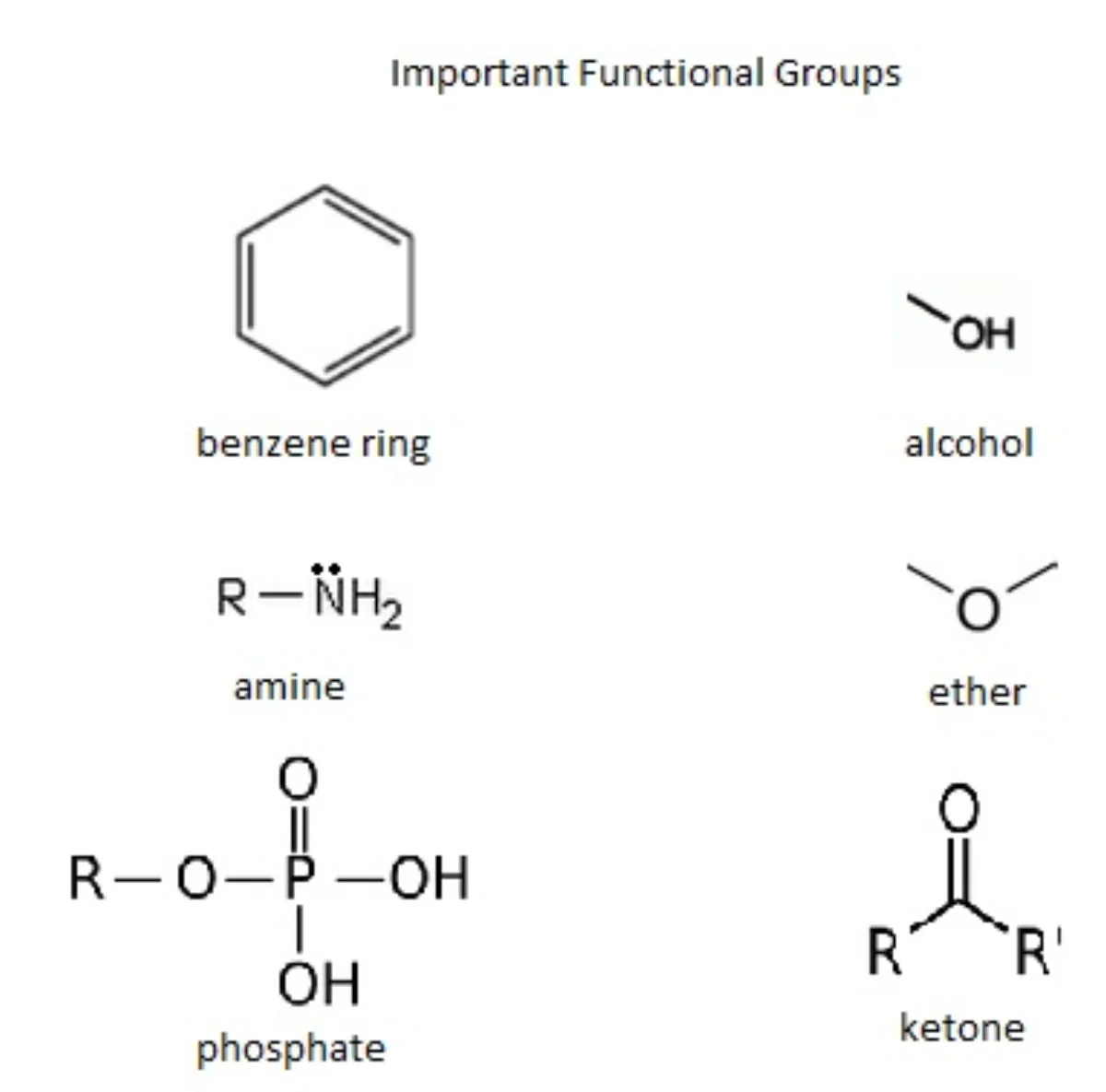
Quick-reference chart of the six most important functional groups in organic chemistry. Memorize these structural patterns - recognizing them at a glance is essential for every subsequent chapter. Credit: Wikimedia Commons, CC BY-SA
1. Hydroxyl Group (-OH)
The hydroxyl group is an oxygen atom bonded to a hydrogen atom, attached to a carbon. Molecules with -OH groups are called alcohols (when attached to an sp3 carbon) or phenols (when attached to an aromatic ring).
Key properties:
Polar and capable of hydrogen bonding (both as donor and acceptor)
Increases water solubility dramatically
Can act as a weak acid (alcohols: pKa ~ 16, phenols: pKa ~ 10)
Can be oxidized to a carbonyl (aldehyde, ketone, or carboxylic acid)
How to spot it in a name: The suffix “-ol” (ethanol, propan-2-ol) or the prefix “hydroxy-” when it is not the principal group (3-hydroxypentanoic acid).
2. Carbonyl Group (C=O)
The carbonyl group is a carbon double-bonded to an oxygen. It is the defining feature of several important compound classes:
Aldehyde: Carbonyl at the end of a chain (R-CHO). Suffix: “-al”
Ketone: Carbonyl in the interior of a chain (R-CO-R’). Suffix: “-one”
Carboxylic acid: Carbonyl bonded to an -OH (R-COOH). Suffix: “-oic acid”
Ester: Carbonyl bonded to an -OR (R-COO-R’). Suffix: “-oate”
Amide: Carbonyl bonded to an -NH2 or NR2 (R-CONH2). Suffix: “-amide”
The carbonyl carbon is electrophilic (electron-poor) because oxygen pulls electron density away through the double bond. This makes carbonyl compounds susceptible to nucleophilic addition and nucleophilic acyl substitution - two of the most important reaction types on the MCAT.
3. Carboxyl Group (-COOH)
The carboxyl group is a carbonyl bonded directly to a hydroxyl group. It defines carboxylic acids - the highest-priority functional group in IUPAC naming.
Key properties:
Acidic (pKa ~ 2-5 for most carboxylic acids)
The conjugate base (carboxylate, -COO-) is stabilized by resonance - the negative charge is delocalized over both oxygens
At physiological pH (7.4), carboxylic acids are almost entirely deprotonated (exist as -COO-)
Forms derivatives: esters, amides, anhydrides, acid halides
How to spot it in a name: The suffix “-oic acid” (ethanoic acid, butanoic acid) or the prefix “carboxy-” when it is not the principal group.
4. Amino Group (-NH2)
The amino group is a nitrogen atom bonded to hydrogen atoms (and/or carbon atoms). It defines amines.
Key properties:
Basic (accepts protons). The lone pair on nitrogen is available for bonding.
At physiological pH, most amines are protonated (-NH3+)
Nucleophilic - the lone pair can attack electrophilic carbons
Can form hydrogen bonds
Classification by substitution:
Primary amine (1°): R-NH2 (one carbon attached to N)
Secondary amine (2°): R2NH (two carbons attached to N)
Tertiary amine (3°): R3N (three carbons attached to N)
How to spot it in a name: The suffix “-amine” (ethanamine, propan-1-amine) or the prefix “amino-” (2-aminoethanol).
5. Phosphate Group (-OPO₃²⁻)
The phosphate group is a phosphorus atom bonded to four oxygen atoms. It is critical in biochemistry:
ATP: Three linked phosphate groups store and release energy
DNA/RNA: The sugar-phosphate backbone uses phosphodiester bonds
Phospholipids: Phosphate head groups make membranes amphipathic
Protein regulation: Phosphorylation (adding -PO4) activates or deactivates enzymes
Key properties:
Strongly acidic (first pKa ~ 2, second pKa ~ 7)
At physiological pH, phosphate groups carry a negative charge
Can form phosphoester and phosphoanhydride bonds
The phosphate group is more of a biochemistry topic than an organic chemistry one, but the MCAT tests it across both subjects. Recognizing the phosphate group in a complex molecule (like a nucleotide or phospholipid) is essential.
6. Sulfhydryl Group (-SH)
The sulfhydryl (or thiol) group is sulfur bonded to hydrogen. It defines thiols.
Key properties:
Weaker hydrogen bonding than -OH (sulfur is larger and less electronegative)
More acidic than alcohols (pKa ~ 8-10 vs. ~ 16 for alcohols)
Can form disulfide bonds (-S-S-) through oxidation
Cysteine’s -SH group forms disulfide bridges that stabilize protein tertiary structure
How to spot it in a name: The suffix “-thiol” (ethanethiol) or the prefix “mercapto-” or “sulfanyl-.”
Summary Table: Key Functional Groups
Functional Group
Structure
Suffix
Prefix
Key Property
Hydroxyl
-OH
-ol
hydroxy-
H-bonding, oxidizable
Carbonyl (aldehyde)
-CHO
-al
oxo- / formyl-
Electrophilic carbon
Carbonyl (ketone)
-CO-
-one
oxo-
Electrophilic carbon
Carboxyl
-COOH
-oic acid
carboxy-
Acidic, highest IUPAC priority
Amino
-NH2
-amine
amino-
Basic, nucleophilic
Phosphate
-OPO₃²⁻
n/a
phospho-
Charged at physiological pH
Sulfhydryl
-SH
-thiol
mercapto-
Forms disulfide bonds
Recognizing Functional Groups in Complex Molecules
On the MCAT, you will not see simple molecules like ethanol in isolation. You will see complex structures with multiple functional groups embedded in a passage about a biological process or drug mechanism. The skill is rapid pattern recognition - scanning a structure and identifying every functional group present.
Practice this by looking at amino acid structures, nucleotides, and drug molecules. For each one, circle every functional group you can find. If you can identify the functional groups, you can predict the molecule’s behavior: where it will be protonated or deprotonated, where it can hydrogen bond, where nucleophilic attack will occur, and where oxidation or reduction is possible.
What is the key structural difference between an aldehyde and a ketone?
Click to reveal answer
An aldehyde has the carbonyl at the end of the chain (bonded to at least one hydrogen: R-CHO), while a ketone has the carbonyl in the interior (bonded to two carbons: R-CO-R'). Remember: "Aunt Alde keeps the door" (terminal), "Keto hides inside" (internal).
At physiological pH (7.4), what is the charge state of a carboxylic acid group (pKa ~ 4) and an amino group (pKa ~ 9)?
Click to reveal answer
The carboxylic acid is deprotonated (-COO-, negative charge) and the amino group is protonated (-NH3+, positive charge). When pH > pKa, the group is deprotonated. When pH < pKa, the group is protonated. At pH 7.4: 7.4 > 4 so -COOH loses its proton; 7.4 < 9 so -NH2 gains a proton.
What functional group in cysteine allows proteins to form disulfide bridges, and what type of reaction creates these bridges?
Click to reveal answer
The sulfhydryl (-SH) group. Disulfide bridges (-S-S-) form through oxidation of two thiol groups. Two cysteine residues each lose a hydrogen, and their sulfur atoms bond to create a covalent cross-link that stabilizes protein tertiary and quaternary structure. The reverse reaction (breaking the disulfide) is a reduction.
Now that you know the major functional groups, it is time to learn how they change the IUPAC name. Each functional group has a specific suffix (when it is the highest-priority group) and a specific prefix (when a higher-priority group takes the suffix instead). This section covers the first five of the most important compound classes: alcohols, ethers, aldehydes, ketones, and carboxylic acids.
Naming Alcohols (-OH)
Alcohols contain a hydroxyl group (-OH) attached to an sp3-hybridized carbon.
IUPAC suffix: “-ol” IUPAC prefix (when not the principal group): “hydroxy-”
Steps:
Find the longest chain that includes the carbon bearing the -OH group
Change the “-e” at the end of the parent alkane to “-ol”
Number the chain so the -OH gets the lowest possible locant
Name and number any substituents as usual
Examples:
Methanol: CH3OH. One carbon + -ol = methanol
Ethanol: CH3CH2OH. Two carbons + -ol = ethanol
Propan-2-ol: CH3CH(OH)CH3. Three carbons, -OH at carbon 2 = propan-2-ol (older format: 2-propanol)
Butan-1-ol: CH3CH2CH2CH2OH. Four carbons, -OH at carbon 1 = butan-1-ol
Classification of alcohols:
Alcohols are classified by the carbon bearing the -OH:
Primary (1°): -OH is on a carbon bonded to one other carbon (e.g., butan-1-ol)
Secondary (2°): -OH is on a carbon bonded to two other carbons (e.g., propan-2-ol)
Tertiary (3°): -OH is on a carbon bonded to three other carbons (e.g., 2-methylpropan-2-ol)
This classification directly affects reactivity. Primary alcohols can be oxidized to aldehydes and then to carboxylic acids. Secondary alcohols are oxidized to ketones. Tertiary alcohols resist oxidation. This pattern is heavily tested on the MCAT.
Naming Ethers (R-O-R’)
Ethers have an oxygen atom bonded to two carbon groups. They are relatively unreactive, which makes them excellent solvents.
Ethers are named in two ways:
Common naming (more common on the MCAT): Name the two alkyl groups on either side of the oxygen, alphabetically, followed by “ether.”
Diethyl ether: CH3CH2-O-CH2CH3 (two ethyl groups)
Methyl tert-butyl ether (MTBE): CH3-O-C(CH3)3
IUPAC naming: The smaller alkyl group + oxygen is treated as an “alkoxy” substituent on the longer chain.
Methoxyethane: CH3-O-CH2CH3 (methoxy group on ethane)
2-methoxypropane: CH3-O-CH(CH3)2
The “alkoxy” names are formed by replacing “-yl” with “-oxy”: methyl becomes methoxy, ethyl becomes ethoxy, propyl becomes propoxy.
Naming Aldehydes (-CHO)
Aldehydes have a carbonyl group (C=O) at the terminal position of a chain. The carbonyl carbon is always carbon 1.
IUPAC suffix: “-al” IUPAC prefix (when not the principal group): “oxo-” or “formyl-”
Steps:
Find the longest chain that includes the carbonyl carbon
Replace “-e” with “-al”
The carbonyl carbon is automatically carbon 1 (no locant needed for the -CHO group itself)
Propanal: CH3CH2CHO. Three carbons + -al = propanal
3-methylbutanal: (CH3)2CHCH2CHO. Four carbons + -al with methyl at C3 = 3-methylbutanal
Since the aldehyde carbon is always at the end of the chain (carbon 1), you never need to specify its position - the “-al” suffix already tells you it is terminal.
Naming Ketones (C=O, internal)
Ketones have a carbonyl group in the interior of the chain, bonded to two carbon groups.
IUPAC suffix: “-one” IUPAC prefix (when not the principal group): “oxo-”
Steps:
Find the longest chain that includes the carbonyl carbon
Replace “-e” with “-one”
Number the chain so the carbonyl gets the lowest possible locant
Name and number substituents
Examples:
Propan-2-one: CH3COCH3. Three carbons, carbonyl at C2 = propan-2-one (common name: acetone)
Butan-2-one: CH3COCH2CH3. Four carbons, carbonyl at C2 = butan-2-one (common name: methyl ethyl ketone)
Pentan-3-one: CH3CH2COCH2CH3. Five carbons, carbonyl at C3 = pentan-3-one
Naming Carboxylic Acids (-COOH)
Carboxylic acids have both a carbonyl (C=O) and a hydroxyl (-OH) on the same carbon, at the end of the chain. They are the highest-priority functional group in IUPAC naming.
IUPAC suffix: “-oic acid” IUPAC prefix (when not the principal group): “carboxy-”
Steps:
Find the longest chain that includes the carboxyl carbon
2-methylpropanoic acid: (CH3)2CHCOOH. Three carbons + -oic acid with methyl at C2 = 2-methylpropanoic acid
Like aldehydes, the carboxyl carbon is always at the terminal position, so no locant is needed for the -COOH group.
Dicarboxylic Acids
When a molecule has a -COOH group on both ends, it is a dicarboxylic acid. The suffix becomes “-dioic acid.”
Carbons
IUPAC Name
Common Name
2
Ethanedioic acid
Oxalic acid
3
Propanedioic acid
Malonic acid
4
Butanedioic acid
Succinic acid
5
Pentanedioic acid
Glutaric acid
6
Hexanedioic acid
Adipic acid
Several of these common names appear in the Krebs cycle: succinic acid (succinate) and oxalic acid (oxalate) are Krebs cycle intermediates. The MCAT will use these common names in biochemistry passages.
Summary: Suffixes for This Section
Compound Class
General Structure
Suffix
Prefix
Example
Alcohol
R-OH
-ol
hydroxy-
Ethanol
Ether
R-O-R’
(none; alkoxy prefix)
alkoxy-
Methoxyethane
Aldehyde
R-CHO
-al
oxo- / formyl-
Propanal
Ketone
R-CO-R’
-one
oxo-
Propan-2-one
Carboxylic acid
R-COOH
-oic acid
carboxy-
Ethanoic acid
Name this compound: CH3CH(OH)CH2CH2CH3
Click to reveal answer
Pentan-2-ol. The longest chain including the -OH is five carbons (pentane). The -OH is on carbon 2. Replace "-e" with "-ol" and add the locant: pentan-2-ol. It is a secondary alcohol because the carbon bearing the -OH is bonded to two other carbons.
What is the common name for methanal (HCHO), and why is no locant needed for the carbonyl?
Click to reveal answer
Formaldehyde. No locant is needed because the aldehyde carbonyl is always at carbon 1 (the terminal position) by definition. The "-al" suffix already tells you the carbonyl is at the end of the chain. Specifying "1-" would be redundant.
Name this ether using both the common and IUPAC systems: CH3CH2-O-CH3
Click to reveal answer
Common name: ethyl methyl ether (alkyl groups listed alphabetically + "ether"). IUPAC name: methoxyethane (the smaller group + O = methoxy, attached to the larger chain = ethane). Both names are acceptable, but common names are used more frequently on the MCAT for simple ethers.
This section covers the remaining major compound classes you need for the MCAT: amines, amides, esters, and acid halides. These four groups are especially important because amides and esters form the backbone of proteins (peptide bonds are amide linkages) and lipids (triglycerides are triesters), while amines and acid halides appear throughout biochemical and synthetic pathways.
Naming Amines (-NH2, -NHR, -NR2)
Amines contain a nitrogen atom bonded to one, two, or three carbon groups (plus enough hydrogens to complete nitrogen’s three bonds).
IUPAC suffix: “-amine” IUPAC prefix (when not the principal group): “amino-”
Steps:
Find the longest chain that includes the carbon bonded to nitrogen
Replace “-e” with “-amine”
Number the chain so the nitrogen-bearing carbon gets the lowest locant
When nitrogen has two or three carbon groups, the additional groups are named with the prefix “N-” (capital N, to distinguish them from carbon-chain locants):
N-methylethanamine: CH3NHCH2CH3. The parent chain is ethane with an -amine. The second group on nitrogen is a methyl, designated “N-methyl.”
N,N-dimethylmethanamine: (CH3)3N. The parent is methanamine. Two additional methyl groups on nitrogen: “N,N-dimethyl.” (Common name: trimethylamine.)
Common Naming for Amines
In the common naming system, name all alkyl groups attached to nitrogen in alphabetical order, then add “-amine”:
Diethylamine = (CH3CH2)2NH
Triethylamine = (CH3CH2)3N
Ethylmethylamine = CH3CH2NHCH3
Naming Amides (-CONH2)
Amides have a carbonyl group bonded directly to a nitrogen. They are carboxylic acid derivatives - formed when the -OH of a carboxylic acid is replaced by -NH2 (or -NHR or -NR2).
IUPAC suffix: “-amide” IUPAC prefix (when not the principal group): “carbamoyl-”
Steps:
Name the parent carboxylic acid
Drop “-oic acid” (or “-ic acid” for common names) and add “-amide”
Examples:
Methanamide: HCONH2. From methanoic acid, drop “-oic acid,” add “-amide” = methanamide (common name: formamide)
Ethanamide: CH3CONH2. From ethanoic acid = ethanamide (common name: acetamide)
Propanamide: CH3CH2CONH2
For N-substituted amides, use the “N-” prefix just as with amines:
N-methylethanamide: CH3CONHCH3
N,N-dimethylmethanamide: HCON(CH3)2 (common name: DMF, dimethylformamide - a very common solvent)
Naming Esters (-COOR)
Esters have a carbonyl bonded to an oxygen that is itself bonded to a carbon group. They are formed from a carboxylic acid and an alcohol.
IUPAC suffix: “-oate” (as part of a two-word name)
Steps:
Name the alkyl group attached to the oxygen (the “alcohol” part)
Name the parent carboxylic acid, dropping “-ic acid” and adding “-ate”
Write as two words: [alkyl group] [parent acid-ate]
Examples:
Methyl ethanoate: CH3COOCH3. The oxygen-attached group is methyl. The acid parent is ethanoic acid, so the ester is methyl ethanoate (common name: methyl acetate).
Ethyl methanoate: HCOOCH2CH3. The oxygen-attached group is ethyl. The acid parent is methanoic acid = ethyl methanoate (common name: ethyl formate).
Ethyl propanoate: CH3CH2COOCH2CH3.
Esters in Biology
Esters are everywhere in biochemistry:
Triglycerides (fats and oils): Three fatty acid chains ester-linked to glycerol
Phospholipids: Fatty acids ester-linked to glycerol with a phosphate head group
Aspirin: An ester of salicylic acid and acetic acid
DNA backbone: Phosphodiester bonds link nucleotides
When an MCAT passage mentions “ester hydrolysis” or “saponification,” it is describing the breaking of the ester bond with water (hydrolysis) or base (saponification), regenerating the acid and alcohol components.
Naming Acid Halides (-COX)
Acid halides (also called acyl halides) have a carbonyl bonded to a halogen atom. They are the most reactive carboxylic acid derivatives.
IUPAC naming: Replace “-ic acid” of the parent carboxylic acid with “-yl halide.”
Examples:
Ethanoyl chloride: CH3COCl. From ethanoic acid, replace “-ic acid” with “-yl chloride” = ethanoyl chloride (common name: acetyl chloride)
Propanoyl bromide: CH3CH2COBr
Methanoyl chloride: HCOCl (common name: formyl chloride) - although this compound is unstable
Carboxylic Acid Derivatives - The Big Picture
All four compound classes in this section (amides, esters, acid halides, and anhydrides) are derived from carboxylic acids by replacing the -OH group with something else:
Derivative
-OH Replaced By
Suffix
Reactivity
Acid halide
-X (halogen)
-yl halide
Highest
Anhydride
-OCOR (another acid)
-ic anhydride
High
Ester
-OR (alkoxy)
-oate
Moderate
Amide
-NH2 (or -NHR, -NR2)
-amide
Lowest
This pattern - same core carbonyl, different group attached - is the foundation of nucleophilic acyl substitution reactions, one of the most heavily tested reaction types on the MCAT.
Name this compound: CH3CH2COOCH3
Click to reveal answer
Methyl propanoate. The oxygen-attached group is methyl (from methanol). The acid parent is propanoic acid (3 carbons including the carbonyl). Ester name = [alkyl] [acid-ate] = methyl propanoate. The common name would be methyl propionate.
What does "N,N-dimethyl" mean in N,N-dimethylpropanamide?
Click to reveal answer
Two methyl groups are attached to the nitrogen atom of the amide. The "N,N-" prefix specifies that these substituents are on nitrogen, not on the carbon chain. The parent is propanamide (from propanoic acid + NH2). The nitrogen bears two methyl groups instead of two hydrogens, making it a tertiary amide: CH3CH2CON(CH3)2.
Which carboxylic acid derivative is MOST reactive toward nucleophilic acyl substitution, and which is LEAST reactive?
Click to reveal answer
Most reactive: acid halides. Least reactive: amides. Reactivity order: acid halides > anhydrides > esters > amides. Acid halides have the best leaving group (halide ion). Amides have the worst leaving group (NH2- is a strong base and resists departure). This is why amide bonds (peptide bonds) are stable enough to form the backbone of proteins.
When a molecule has only one functional group, naming is straightforward - that group gets the suffix, and you are done. But most biologically relevant molecules have multiple functional groups. An amino acid has both a carboxylic acid and an amine. A sugar has multiple hydroxyl groups and an aldehyde or ketone. A fatty acid has a carboxylic acid, maybe some double bonds, and possibly a hydroxyl. How do you decide which group “wins” the suffix?
The answer is the IUPAC priority hierarchy - a VIP list that ranks every functional group from most important to least important. The highest-priority group gets the suffix. Every other group becomes a prefix.
The VIP List at a Party
The Priority Table (Highest to Lowest)
This table lists functional groups from highest to lowest IUPAC priority. The group highest on this list that is present in the molecule gets the suffix. Everything below it becomes a prefix.
Priority
Functional Group
Suffix (as principal)
Prefix (as substituent)
1
Carboxylic acid
-oic acid
carboxy-
2
Ester
-oate
(alkoxycarbonyl-)
3
Amide
-amide
carbamoyl-
4
Aldehyde
-al
oxo- / formyl-
5
Ketone
-one
oxo-
6
Alcohol
-ol
hydroxy-
7
Amine
-amine
amino-
8
Alkene
-ene
(indicated in chain name)
9
Alkyne
-yne
(indicated in chain name)
—
Ether
(no suffix; use alkoxy-)
alkoxy-
—
Halide
(no suffix; use halo-)
fluoro- / chloro- / bromo- / iodo-
—
Nitro
(no suffix)
nitro-
How Priority Affects Naming - A Worked Example
Consider a molecule with four carbons, an -OH at carbon 3, and a -COOH at carbon 1.
Step 1: Identify all functional groups: carboxylic acid (-COOH) and alcohol (-OH).
Step 2: Determine which has higher priority. Carboxylic acid (priority 1) beats alcohol (priority 6). Carboxylic acid gets the suffix.
Step 3: The suffix is “-oic acid.” The parent chain is four carbons = butanoic acid.
Step 4: The alcohol group becomes a prefix: “hydroxy-” at carbon 3.
Final name: 3-hydroxybutanoic acid.
Notice that the -OH group does not get the “-ol” suffix. It becomes “hydroxy-” because a higher-priority group (carboxylic acid) has already claimed the suffix.
Numbering Rules in Detail
Once you know which group gets the suffix, numbering follows a clear hierarchy of tie-breaking rules:
Rule 1: Give the principal (suffix-determining) functional group the lowest possible locant. This is the most important rule. If the carboxylic acid can be at C1 or C5, it goes to C1.
Rule 2: Give multiple bonds (C=C or C≡C) the next lowest locant. If the suffix group is already placed, give the double or triple bond the lowest possible number.
Rule 3: Give substituent prefixes the lowest set of locants. Compare the locant sets position by position. At the first point of difference, the lower number wins.
Rule 4: If there is still a tie, give the lower locant to the substituent that comes first alphabetically.
Examples of Priority-Based Naming
Example 1: 5-aminopentan-2-ol
Both -OH and -NH2 are present
Alcohol (-ol) has higher priority than amine (-amine) in the IUPAC system
The suffix is “-ol” (alcohol at C2)
The amine becomes the prefix “amino-” at C5
Wait - actually, let’s check: is alcohol higher priority than amine? Looking at the table: alcohol is priority 6, amine is priority 7. Yes, alcohol outranks amine. So the suffix is “-ol.”
Example 2: 4-oxopentanoic acid
Both a carboxylic acid and a ketone are present
Carboxylic acid has highest priority, so suffix = “-oic acid”
The ketone becomes the prefix “oxo-” at C4
Parent chain is five carbons = pentanoic acid
Full name: 4-oxopentanoic acid
Example 3: 3-hydroxyhexanal
Both an aldehyde and an alcohol are present
Aldehyde has higher priority than alcohol, so suffix = “-al”
The alcohol becomes the prefix “hydroxy-” at C3
Parent chain is six carbons = hexanal
Full name: 3-hydroxyhexanal
The “Lowest Set of Locants” Rule
This rule is often tested on the MCAT because it requires careful comparison. When two numbering schemes give different locant sets, compare them number by number from left to right:
Numbering A: Substituents at 2, 3, 6 Numbering B: Substituents at 2, 4, 5
Compare: 2 vs. 2 (tie) → 3 vs. 4 → Numbering A wins because 3 < 4.
The comparison stops as soon as you find a difference. You do not add up the locants (that is a common misconception). You compare position by position.
Groups That Are Always Prefixes
Some groups never get a suffix because they are never the “principal” group. They always appear as prefixes:
Group
Prefix
Fluorine
fluoro-
Chlorine
chloro-
Bromine
bromo-
Iodine
iodo-
Nitro group (-NO2)
nitro-
Ether (-OR)
alkoxy-
Alkyl groups (-R)
(name of alkyl group)
A molecule has both a -CHO (aldehyde) and an -OH (alcohol) group. Which one gets the suffix, and what prefix does the other become?
Click to reveal answer
The aldehyde gets the suffix (-al). Aldehyde (priority 4) outranks alcohol (priority 6). The alcohol becomes the prefix "hydroxy-." For example, 3-hydroxybutanal has an aldehyde at C1 (suffix) and a hydroxyl at C3 (prefix).
In the IUPAC system, can a halide (-Cl, -Br) ever be the suffix-determining (principal) functional group?
Click to reveal answer
No. Halides are always named as prefixes (fluoro-, chloro-, bromo-, iodo-). They never get a suffix. If a compound contains only a halide and no other functional group, the parent name is the alkane with the halide as a prefix: chloromethane, 2-bromopentane, etc.
Two possible numbering schemes give substituent locants of {2, 4, 5} and {2, 3, 7}. Which numbering is correct?
Click to reveal answer
{2, 3, 7} is correct. Compare position by position: 2 vs. 2 (tie), then 4 vs. 3. Since 3 < 4, the second set wins at the first point of difference. Do not add the numbers up (11 vs. 12) - that is a common mistake. Always compare position by position from lowest to highest.
The IUPAC system can name any organic compound unambiguously. So why do chemists still use common names like “acetone” instead of “propan-2-one”? Because common names are shorter, older, and deeply embedded in chemistry culture. Acetone has been called acetone since the 1830s. No one in a lab says “please pass the propan-2-one.” And the MCAT knows this - passages use common names constantly, especially for well-known compounds.
Your job is to know both naming systems and translate between them instantly. When a passage says “formaldehyde,” you need to see HCHO in your mind. When it says “ethanoic acid,” you need to recognize it as acetic acid (vinegar). This section gives you the definitive list of common names the MCAT expects you to know.
Why Two Systems Exist
Common names predate IUPAC naming by centuries. They came from sources (formic acid from ants), properties (glycerol from the Greek for “sweet”), or discoverers. These names carry no structural information - “acetone” tells you nothing about the three carbons or the carbonyl. But they are so widely used in biology, medicine, and industry that IUPAC officially accepts many of them as alternative names.
The Must-Know Common Names
Here is the definitive table of common names that appear on the MCAT. If you know all of these, you will never be caught off guard by a passage.
Carboxylic Acids and Derivatives
Common Name
IUPAC Name
Formula
Notes
Formic acid
Methanoic acid
HCOOH
From ants (Latin: formica)
Acetic acid
Ethanoic acid
CH3COOH
Vinegar; acetate ion in biology
Propionic acid
Propanoic acid
CH3CH2COOH
”First fat acid” (Greek)
Butyric acid
Butanoic acid
CH3(CH2)2COOH
Rancid butter smell
Oxalic acid
Ethanedioic acid
HOOC-COOH
Krebs cycle; kidney stones
Succinic acid
Butanedioic acid
HOOC(CH2)2COOH
Krebs cycle intermediate
Aldehydes and Ketones
Common Name
IUPAC Name
Formula
Notes
Formaldehyde
Methanal
HCHO
Preservative; smallest aldehyde
Acetaldehyde
Ethanal
CH3CHO
Ethanol metabolism product
Acetone
Propan-2-one
CH3COCH3
Simplest ketone; common solvent
Aromatic Compounds
Common Name
IUPAC Name
Structure
Notes
Toluene
Methylbenzene
C6H5CH3
Common solvent
Phenol
Hydroxybenzene
C6H5OH
Weak acid (pKa ~ 10)
Aniline
Aminobenzene
C6H5NH2
Parent of azo dyes
Benzoic acid
Benzenecarboxylic acid
C6H5COOH
Common preservative
Benzaldehyde
Phenylmethanal
C6H5CHO
Almond smell
Anisole
Methoxybenzene
C6H5OCH3
Ether of phenol
Styrene
Ethenylbenzene
C6H5CH=CH2
Polystyrene monomer
Acetophenone
1-phenylethan-1-one
C6H5COCH3
Aromatic ketone
Alcohols and Ethers
Common Name
IUPAC Name
Formula
Notes
Methanol
Methanol
CH3OH
”Wood alcohol”; toxic
Ethanol
Ethanol
CH3CH2OH
”Grain alcohol”; in beverages
Isopropanol
Propan-2-ol
(CH3)2CHOH
”Rubbing alcohol”
Glycerol (glycerin)
Propane-1,2,3-triol
HOCH2CH(OH)CH2OH
Backbone of triglycerides
Diethyl ether
Ethoxyethane
(CH3CH2)2O
Classic anesthetic
Amines and Amides
Common Name
IUPAC Name
Formula
Notes
Aniline
Aminobenzene
C6H5NH2
Also listed under aromatics
DMF
N,N-dimethylmethanamide
HCON(CH3)2
Polar aprotic solvent
Urea
Diaminomethanal (carbonyl diamide)
H2NCONH2
Nitrogen waste product
Patterns to Notice
Several patterns make common names easier to remember:
The “form-” root comes from formic acid (methanoic acid). Compounds with one carbon in the acyl group use “form-”: formaldehyde (methanal), formamide (methanamide), formate (methanoate).
The “acet-” root comes from acetic acid (ethanoic acid). Compounds with two carbons in the acyl group use “acet-”: acetaldehyde (ethanal), acetone (propan-2-one), acetamide (ethanamide), acetyl chloride (ethanoyl chloride).
What the MCAT Actually Tests
The MCAT uses common names in two main ways:
1. In passage context: A passage might describe “the conversion of acetaldehyde to acetate” and expect you to recognize these as a two-carbon aldehyde being oxidized to a two-carbon carboxylate. If you do not know the common names, you cannot follow the passage.
2. In answer choices: A question might ask you to identify a product and list both common and IUPAC names among the answer choices. “Acetic acid” and “ethanoic acid” are the same compound - do not pick both or neither.
The MCAT rarely asks you to convert between naming systems directly (“What is the IUPAC name for acetone?”). Instead, it uses common names within passages and expects you to understand the structure and reactivity without breaking stride.
Amino Acid Common Names
Every amino acid has a common name (glycine, alanine, valine, etc.) that you must memorize for the MCAT. These are covered in the Biochemistry book, but the naming connection is important: amino acid names are purely common names - they bear no relationship to IUPAC nomenclature. “Glycine” does not tell you about its two-carbon backbone or its amino and carboxyl groups. You simply have to memorize each structure with its name and three-letter/one-letter abbreviations.
Quick Reference: Translating Names
When you encounter an unfamiliar common name on the MCAT, use these clues to decode it:
Clue in the Name
Likely Structure
”-ic acid” ending
Carboxylic acid
”-aldehyde” ending
Aldehyde
”-one” ending
Ketone (already IUPAC)
“-ol” ending
Alcohol (already IUPAC)
“-amine” ending
Amine (already IUPAC)
“-ine” ending
Often an amine (aniline, histamine)
“form-” prefix
One-carbon acyl group
”acet-” prefix
Two-carbon acyl group
What is the IUPAC name for acetone, and what functional group does it contain?
Click to reveal answer
Propan-2-one. It is a ketone. Acetone has three carbons with a carbonyl at carbon 2. The "acet-" prefix tells you the compound is related to the two-carbon acetic acid family, but acetone itself is a three-carbon ketone. It is the simplest ketone and one of the most common solvents in chemistry.
A passage describes "formic acid produced by ant venom." How many carbons does formic acid have, and what is its IUPAC name?
Click to reveal answer
One carbon. IUPAC name: methanoic acid (HCOOH). The "form-" root always indicates a one-carbon acyl group. Formic acid is the simplest carboxylic acid: just a carboxyl group with a hydrogen instead of a carbon chain. Its name comes from the Latin "formica" (ant).
What structure does glycerol (glycerin) have, and why is it important in biochemistry?
Click to reveal answer
Glycerol is propane-1,2,3-triol: a three-carbon chain with an -OH group on each carbon (HOCH2-CHOH-CH2OH). It is the backbone of triglycerides (fats and oils) and phospholipids. Three fatty acid chains attach to glycerol's three -OH groups via ester bonds to form a triglyceride. Understanding glycerol's structure is essential for lipid biochemistry.
Every section up to this point has taught you one piece of the naming puzzle. Now it is time to assemble the full picture. Real MCAT molecules - amino acids, drugs, metabolic intermediates - are not simple one-functional-group compounds. They have two, three, or even four functional groups coexisting on the same carbon skeleton. Naming these polyfunctional compounds requires you to combine every rule you have learned into a systematic, step-by-step process.
The Complete Naming Algorithm
Here is the full process, from start to finish, for naming any organic molecule:
Step 1: Identify every functional group in the molecule. Scan the entire structure and list every functional group you see: -OH, -COOH, -NH2, -CHO, C=O, C=C, halogens, ethers, etc.
Step 2: Determine the principal functional group. Use the priority table from Section 1.10. The highest-priority group in the molecule gets the suffix. Everything else becomes a prefix.
Step 3: Identify the parent chain. Find the longest carbon chain that includes the principal functional group. This chain determines the root name.
Step 4: Number the parent chain. Start numbering from the end that gives the principal functional group the lowest locant. If there is a tie, give the lower locant to the double/triple bond. If there is still a tie, use the lowest set of locants for substituents.
Step 5: Name and number every substituent. Convert each non-principal functional group into its prefix form. Assign a locant to each.
Step 6: Assemble the name. List all prefixes alphabetically, followed by the parent chain root and suffix. Separate numbers from letters with hyphens. Separate numbers from numbers with commas.
Worked Example 1: An Amino Acid
Let’s name 2-aminopropanoic acid (the amino acid alanine).
Structure: CH3-CH(NH2)-COOH
Step 1: Functional groups present: carboxylic acid (-COOH) and amine (-NH2).
Step 3: Longest chain through the -COOH: three carbons = propan-.
Step 4: Number from the -COOH end. The carboxyl carbon is C1 (always terminal for -oic acid).
Step 5: The amine at C2 becomes the prefix “2-amino.”
Step 6: Assemble: 2-aminopropanoic acid.
This is exactly how all amino acids are named systematically. The common name is alanine, but the IUPAC name tells you the structure: three carbons (prop-), a carboxylic acid (-oic acid) at C1, and an amine (amino-) at C2.
Worked Example 2: A Keto Acid
Let’s name 3-oxobutanoic acid (acetoacetic acid, a ketone body).
Structure: CH3-CO-CH2-COOH
Step 1: Functional groups: carboxylic acid (-COOH) and ketone (C=O in the chain interior).
Two amino groups: “diamino-” (e.g., 1,6-diaminohexane)
The Reverse Skill: Name to Structure
As we discussed in Section 1.1, the MCAT tests “reverse nomenclature” - reading a name and building the structure. Let’s practice this with a complex example.
Name: (Z)-2-amino-4-methylhex-4-enoic acid
Decode:
“-oic acid” = carboxylic acid at C1
“hex-” = six-carbon parent chain
“4-en-” = double bond starting at C4
“(Z)-” = higher-priority groups on same side of the double bond
“2-amino” = -NH2 at C2
“4-methyl” = -CH3 branch at C4
Build the structure:
Draw six carbons in a chain
Place -COOH at C1
Place -NH2 at C2
Place C=C between C4 and C5
Place -CH3 at C4 (same carbon where the double bond starts)
Arrange groups around the double bond so higher-priority groups are on the same side (Z)
This compound looks like an unusual amino acid - and indeed, many non-standard amino acids have exactly this kind of structure. The ability to build a structure from a name is the core skill the MCAT is testing.
Common MCAT Traps in Polyfunctional Naming
Trap 1: Confusing “oxo-” with “-one.” If the suffix is already taken (e.g., by -oic acid), a ketone becomes the prefix “oxo-,” not the suffix “-one.” Students who see an MCAT answer choice listing “3-oxopentanoic acid” sometimes don’t recognize that “oxo” means there is a ketone at C3.
Trap 2: Forgetting that double bonds change the parent chain ending. The parent chain is “hexan-” (no double bond) vs. “hex-2-en-” (double bond at C2). That “an” to “en” change is easy to miss in a long name.
Trap 3: Thinking all amino acids use the -amine suffix. In amino acids, the amine is never the principal group because the carboxylic acid always outranks it. The amine appears as the prefix “amino-.” The compound is named as an acid, not an amine.
Trap 4: Misordering prefixes. Prefixes must be in alphabetical order, ignoring di-, tri-, tetra-. “amino-” comes before “bromo-” which comes before “methyl-.” Scrambled prefix order is a common wrong-answer distractor.
Final Practice: Decode This Name
Name: methyl (E)-4-aminopent-2-enoate
Decode:
“-oate” at the end = ester
“methyl” at the beginning = the alkyl group on the oxygen side of the ester (from methanol)
“pent-” = five-carbon acyl chain
“2-en-” = double bond at C2
“(E)-” = higher-priority groups on opposite sides
“4-amino” = -NH2 at C4
This is a methyl ester of a five-carbon unsaturated amino acid. The structure: CH3-OOC-CH=CH-CH(NH2)-CH3 with (E) geometry at the double bond.
A molecule has a -COOH at one end, an -NH2 at C2, and an -OH at C4 on a five-carbon chain. What is its IUPAC name?
Click to reveal answer
2-amino-4-hydroxypentanoic acid. Carboxylic acid is the highest-priority group (suffix = "-oic acid"). The amine becomes the prefix "2-amino" and the alcohol becomes "4-hydroxy." The parent chain is five carbons = pentanoic acid. Alphabetical order: amino before hydroxy.
In the name "3-oxopentanoic acid," what functional group does "oxo-" represent, and why doesn't it get the suffix "-one"?
Click to reveal answer
"Oxo-" represents a ketone (carbonyl) at C3. It does not get the suffix "-one" because a higher-priority group (carboxylic acid, "-oic acid") has already claimed the suffix. When a ketone or aldehyde is outranked, it becomes the prefix "oxo-." The suffix always goes to the highest-priority functional group.
What is the first step when you encounter a complex IUPAC name on the MCAT and need to draw the structure?
Click to reveal answer
Start with the suffix. The suffix tells you the principal functional group and where it sits (usually C1 for -oic acid and -al; a specific locant for -ol and -one). Then read the root to determine the parent chain length. Finally, add prefixes from right to left, placing each at its numbered position. Suffix first, root second, prefixes last.