
Functional Groups
If the carbon skeleton is the backbone of an organic molecule, functional groups are the personality. Two molecules can have the exact same number of carbons but behave in completely different ways because of their functional groups. Ethanol (CH3CH2OH) is the alcohol in your drink. Ethanal (CH3CHO) is a toxic aldehyde your liver must break down. Same two-carbon backbone, different functional group, completely different chemistry.
Functional groups are where reactions happen. The carbon-carbon single bonds in the backbone are relatively inert. But functional groups contain electronegative atoms, multiple bonds, or lone pairs that create regions of electron density that attract reactants. Every reaction mechanism you will study in organic chemistry starts with a functional group doing something.
The Six Functional Groups You Must Know Cold
The MCAT expects you to instantly recognize these functional groups, know their properties, and understand how they affect reactivity. This is not optional - if you cannot identify a functional group at a glance, you will struggle with every chapter that follows.
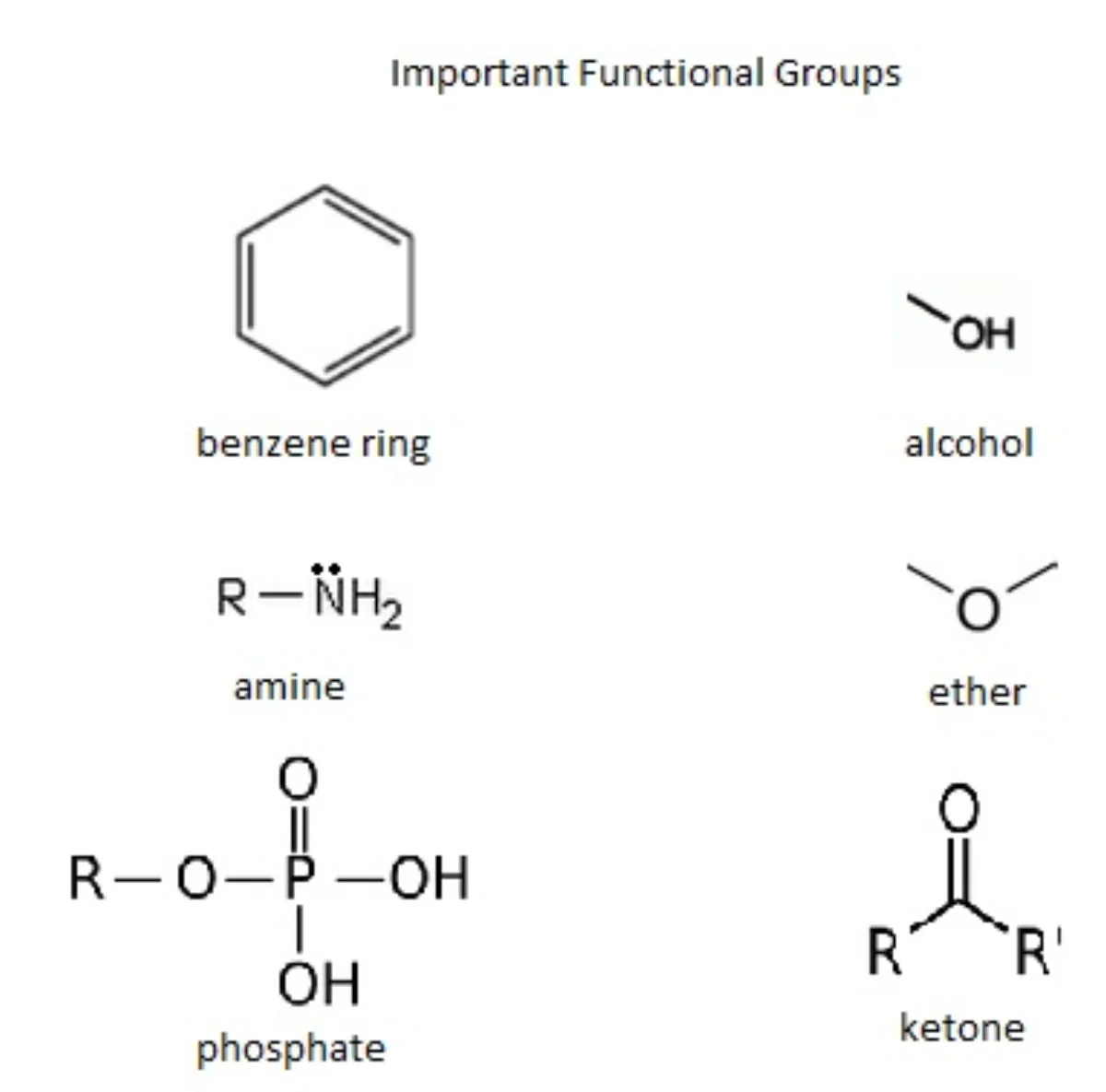
1. Hydroxyl Group (-OH)
The hydroxyl group is an oxygen atom bonded to a hydrogen atom, attached to a carbon. Molecules with -OH groups are called alcohols (when attached to an sp3 carbon) or phenols (when attached to an aromatic ring).
Key properties:
- Polar and capable of hydrogen bonding (both as donor and acceptor)
- Increases water solubility dramatically
- Can act as a weak acid (alcohols: pKa ~ 16, phenols: pKa ~ 10)
- Can be oxidized to a carbonyl (aldehyde, ketone, or carboxylic acid)
How to spot it in a name: The suffix “-ol” (ethanol, propan-2-ol) or the prefix “hydroxy-” when it is not the principal group (3-hydroxypentanoic acid).
2. Carbonyl Group (C=O)
The carbonyl group is a carbon double-bonded to an oxygen. It is the defining feature of several important compound classes:
- Aldehyde: Carbonyl at the end of a chain (R-CHO). Suffix: “-al”
- Ketone: Carbonyl in the interior of a chain (R-CO-R’). Suffix: “-one”
- Carboxylic acid: Carbonyl bonded to an -OH (R-COOH). Suffix: “-oic acid”
- Ester: Carbonyl bonded to an -OR (R-COO-R’). Suffix: “-oate”
- Amide: Carbonyl bonded to an -NH2 or NR2 (R-CONH2). Suffix: “-amide”
The carbonyl carbon is electrophilic (electron-poor) because oxygen pulls electron density away through the double bond. This makes carbonyl compounds susceptible to nucleophilic addition and nucleophilic acyl substitution - two of the most important reaction types on the MCAT.
3. Carboxyl Group (-COOH)
The carboxyl group is a carbonyl bonded directly to a hydroxyl group. It defines carboxylic acids - the highest-priority functional group in IUPAC naming.
Key properties:
- Acidic (pKa ~ 2-5 for most carboxylic acids)
- The conjugate base (carboxylate, -COO-) is stabilized by resonance - the negative charge is delocalized over both oxygens
- At physiological pH (7.4), carboxylic acids are almost entirely deprotonated (exist as -COO-)
- Forms derivatives: esters, amides, anhydrides, acid halides
How to spot it in a name: The suffix “-oic acid” (ethanoic acid, butanoic acid) or the prefix “carboxy-” when it is not the principal group.
4. Amino Group (-NH2)
The amino group is a nitrogen atom bonded to hydrogen atoms (and/or carbon atoms). It defines amines.
Key properties:
- Basic (accepts protons). The lone pair on nitrogen is available for bonding.
- At physiological pH, most amines are protonated (-NH3+)
- Nucleophilic - the lone pair can attack electrophilic carbons
- Can form hydrogen bonds
Classification by substitution:
- Primary amine (1°): R-NH2 (one carbon attached to N)
- Secondary amine (2°): R2NH (two carbons attached to N)
- Tertiary amine (3°): R3N (three carbons attached to N)
- Quaternary ammonium (4°): R4N+ (four carbons, permanent positive charge)
How to spot it in a name: The suffix “-amine” (ethanamine, propan-1-amine) or the prefix “amino-” (2-aminoethanol).
5. Phosphate Group (-OPO₃²⁻)
The phosphate group is a phosphorus atom bonded to four oxygen atoms. It is critical in biochemistry:
- ATP: Three linked phosphate groups store and release energy
- DNA/RNA: The sugar-phosphate backbone uses phosphodiester bonds
- Phospholipids: Phosphate head groups make membranes amphipathic
- Protein regulation: Phosphorylation (adding -PO4) activates or deactivates enzymes
Key properties:
- Strongly acidic (first pKa ~ 2, second pKa ~ 7)
- At physiological pH, phosphate groups carry a negative charge
- Can form phosphoester and phosphoanhydride bonds
The phosphate group is more of a biochemistry topic than an organic chemistry one, but the MCAT tests it across both subjects. Recognizing the phosphate group in a complex molecule (like a nucleotide or phospholipid) is essential.
6. Sulfhydryl Group (-SH)
The sulfhydryl (or thiol) group is sulfur bonded to hydrogen. It defines thiols.
Key properties:
- Weaker hydrogen bonding than -OH (sulfur is larger and less electronegative)
- More acidic than alcohols (pKa ~ 8-10 vs. ~ 16 for alcohols)
- Can form disulfide bonds (-S-S-) through oxidation
- Cysteine’s -SH group forms disulfide bridges that stabilize protein tertiary structure
How to spot it in a name: The suffix “-thiol” (ethanethiol) or the prefix “mercapto-” or “sulfanyl-.”
Summary Table: Key Functional Groups
| Functional Group | Structure | Suffix | Prefix | Key Property |
|---|---|---|---|---|
| Hydroxyl | -OH | -ol | hydroxy- | H-bonding, oxidizable |
| Carbonyl (aldehyde) | -CHO | -al | oxo- / formyl- | Electrophilic carbon |
| Carbonyl (ketone) | -CO- | -one | oxo- | Electrophilic carbon |
| Carboxyl | -COOH | -oic acid | carboxy- | Acidic, highest IUPAC priority |
| Amino | -NH2 | -amine | amino- | Basic, nucleophilic |
| Phosphate | -OPO₃²⁻ | n/a | phospho- | Charged at physiological pH |
| Sulfhydryl | -SH | -thiol | mercapto- | Forms disulfide bonds |
Recognizing Functional Groups in Complex Molecules
On the MCAT, you will not see simple molecules like ethanol in isolation. You will see complex structures with multiple functional groups embedded in a passage about a biological process or drug mechanism. The skill is rapid pattern recognition - scanning a structure and identifying every functional group present.
Practice this by looking at amino acid structures, nucleotides, and drug molecules. For each one, circle every functional group you can find. If you can identify the functional groups, you can predict the molecule’s behavior: where it will be protonated or deprotonated, where it can hydrogen bond, where nucleophilic attack will occur, and where oxidation or reduction is possible.