
Test Logistics
How Many Times Should You Take the SAT?
There is no official limit on SAT attempts, but most students test two to three times. Here is how superscoring and Score Choice work, and when retaking stops paying off.
There is no official cap on how many times you can take the SAT. College Board does not limit your attempts, so the real question is not how many times you are allowed to test, but how many times it actually makes sense to. For most students, the answer is two to three.
Let’s walk through why that range works, how the scoring features change the calculation in your favor, and when one more attempt stops being worth it.
The honest answer: usually two to three times
Most students we work with land on a similar pattern:
- An initial attempt, often in the spring of junior year, after some preparation. This sets a real baseline under test-day conditions, which is more informative than any practice test.
- A retake, after a focused round of study aimed at the specific weaknesses the first attempt exposed. This is usually where the biggest jump happens, because you now know exactly what to fix.
- Sometimes a third sitting, if you were close to a target, had a rough day, or have a specific score goal in reach.
Two to three sittings give you enough chances to account for a bad day and to capitalize on real improvement, without turning the SAT into a part-time job. The reason this range is not “as many as possible” comes down to two scoring features and the reality of diminishing returns.
Superscoring works in your favor
The single most important thing to understand about retaking is superscoring. Many colleges combine your best Reading and Writing score and your best Math score across different test dates into one total. Your strongest sections do not have to come from the same day.
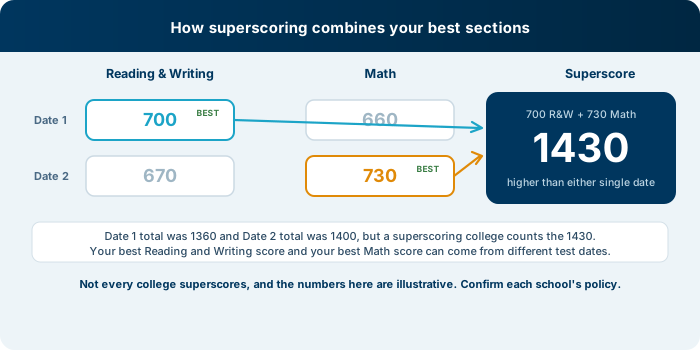
Here is why this matters so much for retake strategy. Suppose on one date you score higher on Reading and Writing but have an off day on Math, and on a later date the reverse happens. A college that superscores takes your best Reading and Writing and your best Math and adds them, giving you a total that is higher than either single sitting produced.
This changes how you should think about a retake. You are not trying to beat your old total all at once. You only need to lift one section on any given date for your superscore to climb. That is a much lower bar, and it is why a focused retake aimed at your weaker section so often pays off.
One caution: not every college superscores, and policies differ. Some take your single best test date, some superscore, and a few consider all scores. Check the policy of each school on your list before you build a plan around it, and verify current details with College Board.
Score Choice lets you control what gets sent
College Board’s Score Choice feature lets you decide which test dates to send to a given college, rather than automatically sending every attempt. If one sitting went poorly, you can generally choose not to send it.
The important asterisk: some colleges require you to send all your scores, and Score Choice does not override that. So before you assume a weak attempt can simply be hidden, confirm whether each target school requires all scores or accepts Score Choice. When a school does accept it, Score Choice removes most of the downside of an extra attempt, because a bad day does not have to follow you.
Between superscoring and Score Choice, the risk of an additional sitting is usually low and the potential upside is real, which is exactly why two to three attempts is the norm rather than one.
When retaking stops paying off
Retaking has diminishing returns. After about three sittings, most students see their scores flatten, and another attempt mostly costs time, money, and energy that would be better spent elsewhere in the application. A retake is worth it when you can answer yes to at least one of these:
- You changed your preparation. You found and fixed a specific weakness, learned a content area you had been guessing on, or finally built the pacing you lacked. A retake reflects new work, not just another roll of the dice.
- Your score is below your target school’s range. If you are sitting under the middle-50% of a school you care about, the points are worth chasing. Our guide to what counts as a good SAT score helps you judge this against your list.
- Test day clearly went wrong. You were ill, rattled, or thrown by the format, and your score came in well below your consistent practice scores.
A retake is usually not worth it when you have already cleared your target schools’ ranges, when you have plateaued across multiple attempts with no change in preparation, or when you are chasing a perfect score for its own sake. Past a certain point, your time produces more value in essays, activities, and the rest of the application than in a few more SAT points.
Make each attempt count
Because two to three well-prepared attempts beat five rushed ones, the goal is to make every sitting a real attempt, not a guess:
- Prepare before the first attempt. Do not “just see how it goes” cold. A diagnostic and a plan make your baseline meaningful. Our study plan lays out how.
- Target your retake. Between attempts, drill the specific section and domains that cost you points. Because superscoring rewards lifting a single section, focused work pays off fast.
- Practice in the real environment. Use full-length Bluebook tests so test day holds no surprises. Knowing the digital, adaptive format cold removes a whole category of avoidable mistakes.
Plan your test dates with these features in mind, leaving enough time between sittings to actually improve, and you will usually reach your target within two or three attempts. Between sittings, drill the domains that leaked points, free during early access, and join the early-access list so our SAT instructors can help you build a targeted retake strategy.
Frequently asked questions
How many times can you take the SAT?
There is no official limit on how many times you can take the SAT. You can register for as many administrations as you want, though in practice most students take it two to three times.
How many times should I take the SAT?
Most students do best taking the SAT two to three times: an initial attempt, a retake after focused study, and sometimes one more. Returns tend to shrink after about three sittings unless something specific changed in your preparation.
What is SAT superscoring?
Superscoring is when a college combines your best Reading and Writing score and your best Math score across different test dates into one higher total. Many colleges superscore, but policies vary, so confirm with each school.
What is Score Choice?
Score Choice is a College Board feature that lets you choose which test dates' scores to send to colleges, rather than sending every attempt. Some colleges require all scores, so check each school's policy before relying on it.
Does taking the SAT multiple times look bad?
No. Taking the SAT a few times is normal and expected, and most colleges focus on your best scores. Repeated attempts only become a concern in the rare case where a school asks for every score and there are many low ones.
Prepping for the SAT?
Start with the SAT prep options available today, or join the update list for new releases.