
Scores
What Is a Good SAT Score?
A good SAT score is the one that clears your target colleges' ranges. Here is how the 400 to 1600 scale maps to percentiles, the average score, what counts as good by college tier, and how to set a realistic target.
Asking what counts as a good SAT score is the right instinct pointed at the wrong target. No single number flips an application from weak to strong, because colleges read your score against the students they usually admit, not against a national pass mark. A 1280 can be a strong result for one student and a reason to sit the test again for another. The number that matters is the range published by the colleges you actually want to attend.
You still need somewhere to start, though. So let’s walk through how the scale is built, how to read it in percentiles, and how to turn that into a target you can aim at.
How the SAT scale works
The SAT is scored on a total scale from 400 to 1600. That total is the sum of two section scores, each running from 200 to 800: Reading and Writing, and Math. Nothing is deducted for a wrong answer, so a blank and a wrong guess cost exactly the same. Answer every question, even the ones you are guessing on.
Those numbers only become meaningful once you convert them into percentiles, which tell you where you landed against everyone else who sat the test.
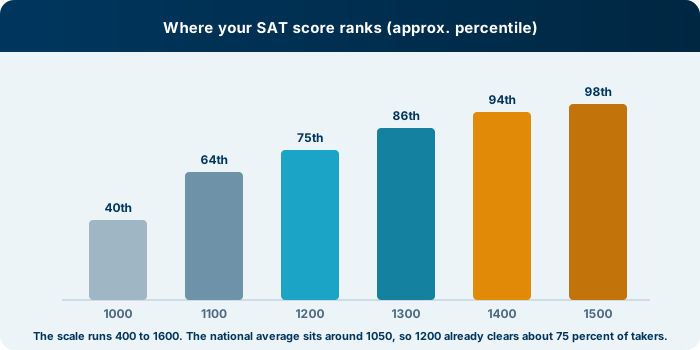
SAT score to percentile
Here is how total scores map to approximate percentiles. A percentile tells you the share of test-takers you scored at or above, so the 75th percentile means you did as well as or better than about 75 percent of students. These figures are approximate and shift slightly year to year, so verify current details with College Board.
| SAT total score | Approximate percentile | What it means |
|---|---|---|
| 1600 | 99+ | Essentially a perfect score |
| 1500 | ~98th | Top 2 percent of test-takers |
| 1400 | ~94th | Top 6 percent |
| 1350 | ~90th | Top 10 percent |
| 1300 | ~86th | Roughly top 1 in 7 |
| 1200 | ~75th | Beats about three-quarters of takers |
| 1100 | ~64th | Above the middle of the pack |
| 1050 | ~50th | Right around the national average |
| 1000 | ~40th | Below the median |
| 900 | ~23rd | Bottom quarter |
A few anchor points worth knowing:
- About 1050 is the rough national average. Score here and you are right around the middle of the pack, meaning roughly half of test-takers scored lower.
- 1200 clears about 75 percent of test-takers. This is where a score stops being background information and starts helping your application.
- 1350 reaches roughly the 90th percentile.
- 1400 sits near the 94th percentile.
- 1500 is near the 98th percentile. Only about 2 in 100 test-takers score this high or higher.
Notice how compressed the top is. The jump from 1200 to 1350 moves you from the 75th to the 90th percentile, but the jump from 1400 to 1500 moves you from the 94th to the 98th. Near the top of the scale, every additional 10 points represents a much smaller slice of test-takers, which is exactly why those points are so hard to earn and so valuable in admissions.
What is the average SAT score?
The national average total score is roughly 1050 out of 1600, which places the average test-taker right around the 50th percentile. Because the total is the sum of two equally weighted sections, an average section score is about 520 to 530 on each of Reading and Writing and Math.
This is a useful baseline for reading your own diagnostic. If your first practice test comes in around 1050, you are starting at a national-average level and the question is simply how far above it you want to climb. If you are starting below it, the early gains often come fast once you close content gaps, because below-average scores usually reflect missing fundamentals rather than a low ceiling. We walk through how to read and act on a diagnostic in how to study for the SAT.
One caution: averages move year to year and vary by who is testing, so treat 1050 as a rough anchor, not a precise figure, and confirm current numbers with College Board.
A good score is relative to your college list
Here is the part most “good score” articles skip. The single most useful piece of data you can gather is the middle-50% SAT range of each college on your list, sometimes published as the 25th and 75th percentiles of the admitted class.
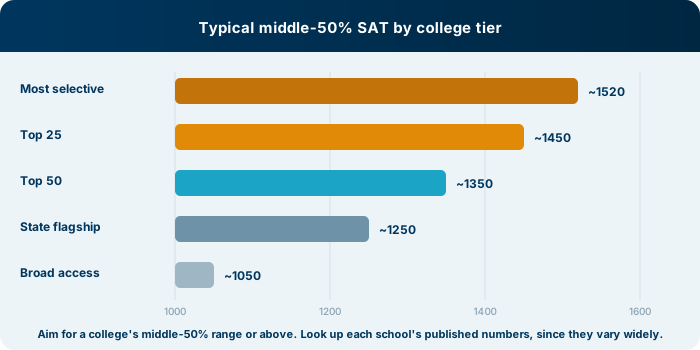
Most colleges that consider test scores publish those percentiles for their entering class. Those numbers tell you almost everything:
- At or above the 75th percentile: your score is a clear asset and helps your application stand out.
- Inside the middle-50% range: you are squarely in range, and your score is neither a red flag nor a standout. Other parts of the application carry more weight.
- Below the 25th percentile: possible, but your score is not helping, so you will need real strength elsewhere in the file.
What counts as a good score by college tier
To make this concrete, here is roughly how good scores break down by the kind of college you are targeting. These are typical middle-50% ranges, and individual schools vary widely, so always look up the specific colleges on your list rather than relying on the tier.
| College tier | Typical middle-50% SAT | A “good” target here |
|---|---|---|
| Most selective (top ~20) | ~1500 to 1570 | 1500+ |
| Highly selective (top ~25 to 50) | ~1400 to 1520 | 1450+ |
| Selective (top ~50 to 100) | ~1300 to 1450 | 1350+ |
| State flagships | ~1150 to 1350 | 1250+ |
| Broad-access colleges | ~950 to 1150 | 1050+ |
So the honest definition of a good SAT score is: a score at or above the middle range of the colleges you want to attend. For a broad-access school that might be around 1050. For the most selective colleges it is likely 1500 or higher. Same student, same effort, completely different “good” depending on the goal.
Test-optional changes the math, but does not erase it
Many colleges are now test-optional, which means you can apply without submitting a score. That does not make the SAT irrelevant. A strong score is still a way to strengthen an application, and at test-optional schools a submitted score that sits above the middle range tends to help. The practical rule most students we work with follow: if your score is at or above a school’s middle-50%, send it; if it is well below, you may be better off applying without it. Check each college’s current policy, since these shift from year to year.
The SAT works alongside the rest of your application
Admissions officers read the SAT alongside your GPA, course rigor, essays, and activities. The two academic numbers, GPA and test score, can partly reinforce each other. A score slightly below a school’s middle range can be offset by a strong transcript, and a high score can help a transcript that has a few soft spots.
This matters for targeting. If your GPA is well above a school’s profile, you have a bit more room on the SAT. If your GPA is below the school’s typical range, you want the SAT to do more of the lifting, which means aiming for the upper half of the range.
What this means for your target
Work backward from your college list:
- List the colleges you genuinely want to attend.
- Look up each one’s middle-50% SAT range (most are public).
- Set your target at or just above the 75th percentile of the realistic part of your list.
- Add a cushion of 20 to 40 points, because test day rarely matches your best practice test exactly.
If you do not have a college list yet, default to building toward 1300 to 1400. That range opens a wide set of solid four-year colleges, including many state flagships, and it is an achievable target for most students who prepare seriously. You can always push higher once you are scoring there consistently.
Can you reach your target?
Almost certainly, with enough runway. The SAT rewards preparation more predictably than students expect, because it tests a fairly stable set of skills rather than an enormous body of content. The Reading and Writing question types repeat. The Math topics are well defined. The trap answers follow patterns. Once you learn to see them, your score climbs. If you are worried about difficulty, our honest take on whether the SAT is hard breaks down what actually makes it challenging and how prep changes that.
Knowing the format helps, too. The current exam is the digital SAT, taken in College Board’s Bluebook app and adaptive by section, which changes how you should pace yourself. And because colleges often combine your best section scores across dates, it is worth understanding how many times to take the SAT and lining up the 2026-2027 test dates before you register. Once you know your target, the next step is a real plan, which we lay out in How to Study for the SAT.
A good SAT score, in the end, is not a trophy number. It is the score that gets you into a college you are excited to attend. Pull the published ranges for your list, pick the number that puts you inside them, and work toward it on purpose.
Want a target set against your specific GPA and college list? Join the early-access list and our SAT instructors will help you map a realistic goal. When you’re ready to build toward it, 2,300+ practice questions are free during early access.
Frequently asked questions
What is a good SAT score?
A good SAT score is one at or above the middle-50% range of the colleges you want to attend. In absolute terms, anything above 1200 clears roughly 75 percent of test-takers, 1350 reaches about the 90th percentile, and 1500 sits near the 98th percentile.
What is the average SAT score?
The national average is roughly 1050 out of 1600, which lands near the middle of the percentile range. The total score is the sum of two sections, Reading and Writing and Math, each scored from 200 to 800, so an average section score is about 520 to 530.
Is a 1200 SAT score good?
A 1200 is a solid score that beats about three-quarters of test-takers and is competitive for many state flagships and selective regional schools. Whether it is good enough depends on your specific college list.
Is a 1400 SAT score good?
Yes. A 1400 sits near the 94th percentile, beating about 94 percent of test-takers, and is competitive at many highly selective colleges. It is at or near the middle-50% range of a lot of top-50 schools, though the most selective colleges have ranges that run higher.
What SAT score do I need for a top college?
The most selective colleges report middle-50% ranges that often run from about 1500 to 1570, so you typically want a score around 1500 or higher to be in range. Always verify current ranges with each college and with College Board.
Do colleges superscore the SAT?
Many colleges superscore, meaning they combine your best Reading and Writing score and your best Math score across different test dates. Policies vary, so confirm each school's approach before deciding how many times to test.
Prepping for the SAT?
Start with the SAT prep options available today, or join the update list for new releases.