
Study Strategy
How to Study for the SAT
A phase-by-phase SAT study plan that moves from content fundamentals to timed Bluebook practice tests, plus the review habit that turns practice into points.
The SAT rewards preparation more predictably than students expect. It is not a measure of raw intelligence. It tests a fairly stable set of skills: a defined body of math, a focused set of grammar rules, and a particular style of close reading. The topics repeat, the question patterns repeat, and the trap answers follow familiar shapes. Once you learn to see them, your score climbs.
That is the good news. The catch is that those skills accumulate rather than switch on, so a weekend of cramming before test day does very little for you. The plan below is built around two ideas instead: work the phases in order, and treat every missed question as information rather than a bruise.
Start with a diagnostic
Before you study anything, take one full-length official practice test under timed conditions. The best place to do this is the Bluebook app from College Board, the same software you will use on test day, so your diagnostic mirrors the real adaptive format. If you have not yet, it is worth reading what is on the digital SAT so the format does not catch you off guard.
Whatever sits between that first score and your target is the work ahead of you, and it is worth measuring honestly before you plan around it. A jump from 1200 to 1300 is a few weeks of focused work. A jump from 1050 to 1400 is a longer, more serious commitment. Most students who reach their target spend two to four months in real preparation, somewhere between 40 and 120 total hours. The range is wide because it depends on where you start and where you want to end up.
Whatever the gap, do not compress the work into a few frantic weekends. The skills do not consolidate that fast.
The three phases
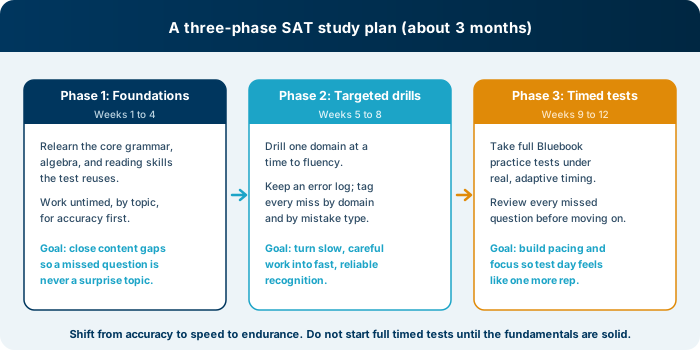
Order matters more than students expect. Full timed tests taken before your content gaps are closed mostly rehearse those gaps at speed, which is why so many students take test after test and watch the score sit still. Close the gaps first.
Phase 1: Foundations (roughly weeks 1 to 4). Close your content gaps before you worry about speed. On the Math side, that means the algebra, functions, data analysis, and geometry the test reuses. On the Reading and Writing side, it means the core grammar rules (punctuation, agreement, sentence boundaries) and the habit of reading a short passage for its main point and structure. Work untimed, by topic. Your only goal in this phase is that no missed question is ever a surprise topic you simply did not know.
Phase 2: Targeted drilling (roughly weeks 5 to 8). Now drill one area at a time until it feels automatic. Spend a few days on linear equations, then on the grammar conventions, then on data interpretation, and so on. Keep an error log and tag every miss by domain and by mistake type. The log is where the real diagnosis happens. After a couple of weeks you will see that most of your lost points are leaking from two or three specific places, and that is where your attention goes.
Phase 3: Timed practice tests (roughly weeks 9 to 12). Only now do you bring in full-length, timed Bluebook tests under realistic conditions. This phase builds what untimed work never can: pacing you can hold into the second module, when the difficulty has already shifted and your focus is starting to fray. The content is there by now; the skill you are adding is applying it at speed. Practicing in Bluebook also gets you used to how that second module adapts based on how you did in the first.
These week ranges are a template, not a law. Compress or stretch them around your test date, but do not reorder them: content gaps first, then speed, then full-length endurance.
The habit that turns practice into points
If you take one thing from this article, take this, because most students skip it: review every missed question until you can explain it.
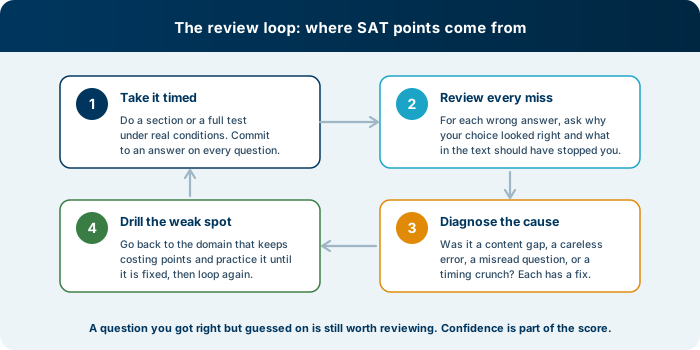
When you check your answers, do not just note the score and move on. For every question you got wrong, or got right by guessing, answer three questions:
- Why did the wrong answer I picked look right to me?
- What specific thing in the passage, the question, or the math should have steered me away?
- What category of mistake was this?
That third question is the one that matters most, because the fix is completely different depending on the answer. Most SAT misses fall into one of four buckets:
- Content gap. You did not know the rule or the math. The fix is going back and learning it, not doing more timed tests.
- Careless error. You knew it but slipped, often in Math by misreading a sign or skipping a step. The fix is a slower, more deliberate process on the questions you rush.
- Misread question. You answered something slightly different from what was asked. The fix is reading the question stem carefully before the answer choices.
- Timing crunch. You rushed or guessed at the end. This is a pacing problem, not a content problem, and the fix is practice under the clock.
If you skip this and just glance at the answer key, every miss looks the same and you cannot tell which fix you need. That is exactly how students grind through practice test after practice test without improving. They are practicing, but they are not diagnosing.
Use official material, and use it carefully
Prep with real College Board material whenever possible. The Bluebook app has full-length adaptive practice tests, and Khan Academy’s Official SAT Practice is free and built in partnership with College Board, with practice tied to the actual question types. Third-party material can be useful for drilling a single concept, but the official questions are written to a standard imitations rarely match, especially in how the wrong answers are constructed.
Be deliberate about how you spend full practice tests. College Board releases a limited number of them, and working through one after another without a proper post-mortem uses up the best material you have for very little gain. One test plus two hours of honest error-logging will do more for your score than three tests you never open again. Keep one or two recent official tests sealed until the end of your prep, so your final scores tell you something real about where you stand.
When to get help
Plenty of students self-study to their target with a good plan and the discipline to review honestly. Instruction pays for itself in one specific case: your score has stalled across several practice tests and you cannot see the pattern in your own mistakes. Careless errors and misread questions are especially hard to catch yourself, because in the moment they felt like understanding. Someone reading your error log usually finds the pattern quickly.
That is the kind of coaching our SAT instructors are being set up to provide. For now, once you know your target you can sanity-check your plan against what counts as a good SAT score, and decide how many times to sit the test. When you are ready to push a specific section, our breakdown of Math versus Reading and Writing shows where the points actually live.
Close the content gaps, drill until the patterns are automatic, then put all of it under the clock in Bluebook. Review honestly at every step and the score follows. The full drill bank and adaptive practice tests are free during early access; join the early-access list and we’ll set you up.
Frequently asked questions
How long should I study for the SAT?
Most students need about two to four months of consistent study, roughly 40 to 120 total hours. The exact number depends on your diagnostic score and your target. A bigger jump needs more runway, because the skills build over time rather than overnight.
How many hours a week should I study for the SAT?
Aim for 5 to 10 focused hours per week. Quality matters more than raw volume. Two deliberate hours with careful review beat four rushed hours of passive practice.
What is the best free SAT practice?
The official Bluebook app from College Board has full-length adaptive practice tests, and Khan Academy's Official SAT Practice is free and built with College Board. Together they cover almost everything you need for a strong plan.
How many practice tests should I take?
Plan for roughly four to eight full practice tests across your prep, concentrated in the final phase. The point is not the number of tests but how carefully you review each one.
Can I study for the SAT on my own?
Yes. Many students self-study successfully with a structured plan, official practice material, and disciplined review. Instruction helps most when you have plateaued and cannot see your own error patterns.
Prepping for the SAT?
Start with the SAT prep options available today, or join the update list for new releases.