
Test Basics
Is the SAT Hard? An Honest Look at the Difficulty
Is the SAT hard? It depends on the section, your timing, and your prep. Here is an honest breakdown of what makes the digital SAT difficult and how preparation changes the answer.
“Is the SAT hard?” is one of the most common questions students ask before they start, and the honest answer is: it depends, and mostly on you. The SAT is not a genius test, and it does not throw exotic content at you. What makes it feel hard is a specific combination of time pressure, an adaptive format, and the need to apply familiar skills quickly and precisely. The good news buried in that sentence is that every one of those factors responds to preparation.
Let’s break down what actually makes the test difficult, where students tend to struggle, and how that difficulty changes once you have put in real work.
What makes the SAT hard (and what does not)
Start with what the SAT is not. It is not a test of advanced or obscure material. The Math tops out around topics most students see by early high school: algebra, functions, data analysis, and some geometry and trigonometry. The Reading and Writing section uses short passages and a finite set of grammar rules. Nothing on the test requires knowledge you cannot learn.
So the difficulty does not come from the content. It comes from four things:
- Time pressure. You have a steady but not generous amount of time per question, and the clock is the single biggest source of difficulty for most students. Questions that feel easy untimed get missed when you are rushing.
- The adaptive format. The digital SAT is section-adaptive. Do well on the first module of a section and the app routes you into a harder second module, which is where the top scores live. That means the test gets harder precisely when you are doing well.
- Precision under pressure. The wrong answers are written to look right. On Reading and Writing, the trap choice often sounds reasonable but is not supported by the passage. On Math, a small misread or skipped step quietly produces a wrong answer that sits right there in the options.
- Stamina and focus. Even at about 2 hours 14 minutes, the test demands sustained concentration. A lapse late in a section costs real points.
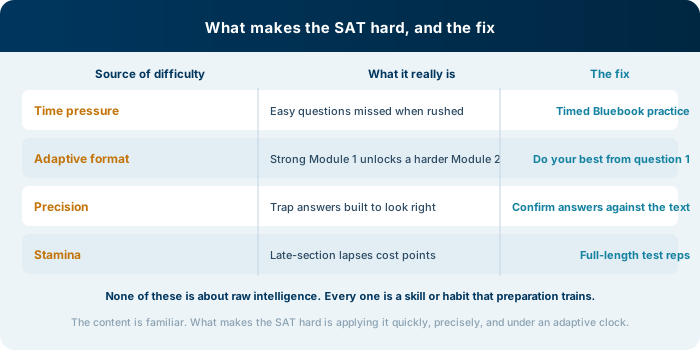
Notice that none of these is “you have to be brilliant.” They are all skills and habits, which is exactly why preparation moves the needle.
How hard is each section?
Difficulty is personal, but here is an honest read on where most students feel the pressure in each section.
| Section | What it tests | Where it gets hard |
|---|---|---|
| Reading and Writing | Close reading, evidence, grammar, and clear expression across many short passages | Pacing across a high volume of short passages, and resisting answers that sound right but lack textual support |
| Math | Algebra, advanced math, problem-solving and data analysis, and geometry and trigonometry | Careless errors from rushed setups, and word problems that hide simple math inside a wordy frame |
Reading and Writing tends to be the pacing challenge. There are many short passages, each with one question, so the difficulty is less about any single hard passage and more about keeping a steady, accurate rhythm without slowing to a crawl. The grammar questions are the most learnable points on the whole test once you know the rules; the reading questions reward a disciplined habit of confirming each answer against the text.
Math tends to be the precision challenge. For most students, the content is familiar, so the points that leak away are usually careless ones: a misread sign, a value copied wrong, a question answered slightly differently from what was asked. The fix is rarely “learn harder math.” It is slowing down on setup and reading the question stem carefully. We go deeper on each section in our Math vs. Reading and Writing breakdown.
Is the digital SAT harder or easier than the old test?
The current SAT is shorter than the old paper exam, allows a calculator on all of Math, and lets you practice in the exact testing app you will use on test day. Those changes make it less of an endurance grind, and many students find it less draining.
But “shorter” is not the same as “easier.” The adaptive format adds a wrinkle the old test did not have: your performance on the first module determines how hard the second module is. You cannot coast through the early questions and make it up later, because coasting routes you into an easier second module that caps your top score. The difficulty did not disappear; it moved.
How preparation changes the answer
Here is the most important thing to understand about SAT difficulty: it is not fixed. The same test that feels hard to an unprepared student feels manageable to a prepared one, and the reason is structural. The SAT reuses a finite set of question types, a defined body of math, and a recurring catalog of trap answers. Once you have seen those patterns enough times, you start to recognize them on sight, and recognition is what beats the clock.
That is why the test rewards preparation so predictably. The path is not mysterious:
- Close your content gaps so no question is a surprise topic.
- Drill the recurring question types until they feel automatic, which is what frees up time.
- Practice under real, adaptive timing in Bluebook so pacing and stamina stop being the limiting factor.
- Review every miss honestly so the same mistake does not keep costing you points.
We lay out that whole sequence in how to study for the SAT. The students who follow it consistently almost always find the test gets easier, not because the questions changed, but because they did.
So, is the SAT hard?
It is challenging, but it is fair, learnable, and far more about preparation than talent. The difficulty is real, but it lives in places you can train: pacing, precision, and pattern recognition, not raw intelligence. Set a clear target against what counts as a good SAT score, and if you are still deciding between exams, our SAT vs. ACT comparison will help you pick the one that fits your strengths.
The students who find the SAT hardest are usually the ones who walked in without a plan. The ones who find it manageable did the unglamorous work of closing gaps and reviewing mistakes. Routine is built through reps: drill every domain free during early access, and join the early-access list so our SAT instructors can help you plan the work.
Frequently asked questions
Is the SAT hard?
The SAT is challenging but learnable. It does not test obscure or advanced content. What makes it hard is the time pressure, the adaptive format, and the need to apply a fairly stable set of skills quickly and accurately. For most students, steady preparation lowers the difficulty significantly because the question types and traps repeat.
What is the hardest part of the SAT?
It varies by student, but the two most common difficulty spots are pacing on Reading and Writing, where you face many short passages under time pressure, and careless errors on Math, where the content is familiar but rushed setups cost points. Your own practice tests will show which one costs you more.
Is the digital SAT easier than the old paper SAT?
The digital SAT is shorter, at about 2 hours 14 minutes, and allows a calculator on all of Math, which many students find less draining. It is not necessarily easier, because it is adaptive, so strong performance on the first module routes you into a harder second module. It is a different kind of challenge, not simply an easier one.
Can an average student do well on the SAT?
Yes. The SAT rewards preparation more predictably than students expect, because it tests a defined body of skills rather than raw talent. Most students who study deliberately for two to four months and review their mistakes honestly raise their scores meaningfully, regardless of their starting point.
Is the SAT Math hard?
SAT Math covers algebra, functions, data analysis, and some geometry and trigonometry, which is content most students have already seen. The difficulty is less about advanced topics and more about reading each question carefully, setting it up correctly, and avoiding careless errors under time pressure.
Prepping for the SAT?
Start with the SAT prep options available today, or join the update list for new releases.