
Comparisons
SAT vs ACT: Which Test Should You Take?
A side-by-side SAT vs ACT comparison of scoring, sections, timing, digital vs paper, calculators, and superscoring, plus a decision guide and a score conversion table to help you choose.
If you are deciding between the SAT and the ACT, here is the short version: both are accepted everywhere that takes test scores, neither carries an admissions advantage, and the right choice is simply the test that fits how you work. The longer version, which actually lets you decide, is a clear look at how the two differ and where your own strengths line up.
This guide puts the current versions of both tests side by side, walks through how to choose, and gives you a conversion table so you can compare scores on the same scale. All of the format details are current as of writing; confirm specifics with College Board and ACT before you register.
SAT vs ACT at a glance
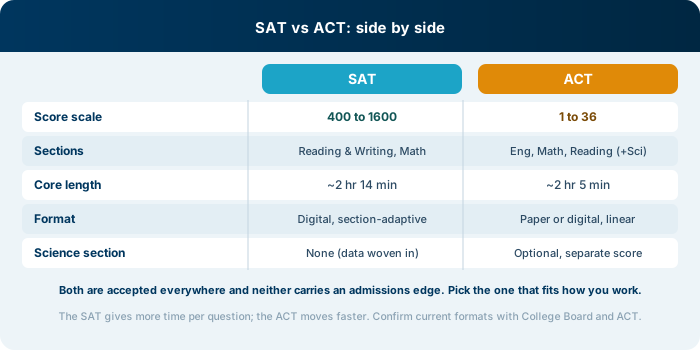
Both tests went through major changes recently. The SAT is now fully digital and adaptive, and the ACT moved to a shorter “enhanced” format in which Science is optional and no longer part of the core score. Here is how the current versions compare.
| Feature | SAT | ACT |
|---|---|---|
| Total score | 400 to 1600 | 1 to 36 (composite) |
| Sections scored | Reading and Writing, Math | English, Math, Reading (Science optional) |
| How the score is built | Sum of two section scores (200 to 800 each) | Average of English, Math, and Reading |
| Core test length | About 2 hr 14 min | About 2 hr 5 min (plus 40 min if you add Science) |
| Format | Fully digital, taken in the Bluebook app | Paper or digital |
| Adaptive? | Yes, section-adaptive (the second module shifts with your first) | No, linear and the same for every student |
| Time per question | More generous (roughly 1 min 10 sec on average) | Faster (roughly 50 sec on average) |
| Calculator | Allowed on all of Math, with Desmos built into Bluebook | Allowed throughout Math |
| Science section | None | Optional add-on, separate score, not in the composite |
| Reading style | Many short passages, one question each | Longer passages with several questions each |
| Superscoring | Many colleges superscore best sections across dates | Many colleges superscore; ACT also reports a superscore |
| Score Choice | Yes, you can choose which dates to send | Yes, you can choose which dates to send |
The headline differences come down to four things: the scale (1600 vs 36), pacing (the SAT gives you more time per question, the ACT moves faster), format (the SAT is digital and adaptive, the ACT is linear), and Science (the ACT has a dedicated Science section, now optional, while the SAT folds data and graph interpretation into its existing sections).
Section by section
English and writing. The SAT blends grammar and rhetoric into its Reading and Writing section as short, single-question passages. The ACT English test is a faster, edit-as-you-go format across longer passages. Both reward knowing a finite set of grammar rules cold; the difference is pace and presentation.
Math. Both allow a calculator throughout. The SAT covers algebra, advanced math, problem-solving and data analysis, and some geometry and trigonometry, and it builds Desmos into the testing app. The ACT Math test reaches a bit further into topics like matrices and logarithms, recently moved to four answer choices instead of five, and gives you less time per question. If you are quick and confident in math, the ACT pace can work in your favor; if you like room to set up each problem, the SAT suits you better.
Reading. This is where pacing differs most. The SAT presents many short passages, each with one question, so you never hold a long text in your head. The ACT gives you longer passages with several questions each and less time overall, which rewards fast, confident reading.
Science. Only the ACT has a distinct Science section, and on the current test it is optional and scored separately, outside the composite. It is less about memorized science content and more about reading charts, graphs, and experiments quickly. The SAT has no separate Science section; instead, it sprinkles data and graph interpretation into Reading and Writing and Math.
Which test should you take?
The honest answer is that you should let a practice test decide, but a few patterns hold for most students we work with.
Lean SAT if you:
- Read carefully and value more time per question.
- Prefer short, self-contained passages over long ones.
- Are comfortable testing on a computer and want to practice in the exact digital, adaptive environment through the Bluebook app.
- Do not want a separate Science section to prepare for.
Lean ACT if you:
- Work quickly and do not mind a faster clock.
- Are strong at reading charts and data under time pressure, which makes the optional Science section an asset rather than a chore.
- Prefer a linear test where the difficulty does not shift mid-section.
- Like the option of paper testing.
Here is the method that beats any checklist: take one official, timed practice test of each, score both, and convert them to the same scale using the table below. Whichever score sits higher relative to its typical range is your test. Then commit. Splitting your prep across both almost always produces two mediocre scores instead of one strong one, and colleges only need one.
SAT to ACT score conversion
To compare your two practice scores fairly, you need them on one scale. College Board and ACT publish an official concordance for exactly this. The table below maps each ACT composite to its corresponding SAT range, based on the official 2018 ACT and College Board concordance, which remains the current standard.
| ACT composite | SAT total (400 to 1600) |
|---|---|
| 36 | 1570 to 1600 |
| 35 | 1530 to 1560 |
| 34 | 1490 to 1520 |
| 33 | 1450 to 1480 |
| 32 | 1420 to 1440 |
| 31 | 1390 to 1410 |
| 30 | 1360 to 1380 |
| 29 | 1330 to 1350 |
| 28 | 1300 to 1320 |
| 27 | 1260 to 1290 |
| 26 | 1230 to 1250 |
| 25 | 1200 to 1220 |
| 24 | 1160 to 1190 |
| 23 | 1130 to 1150 |
| 22 | 1100 to 1120 |
| 21 | 1060 to 1090 |
| 20 | 1030 to 1050 |
| 19 | 990 to 1020 |
| 18 | 960 to 980 |
A concordance does not say the two scores are identical; it says they are comparable, the score a similar student would tend to earn on the other test. Use it to break ties between your practice scores, and to understand a college’s range if it lists one test but not the other.
After you choose
Once you have picked your test, the rest of the work is the same shape regardless of which one you sit: a diagnostic, a phased plan, and honest review of every miss. If you land on the SAT, set a target against what counts as a good SAT score, get familiar with the digital format, and build a real study plan. When you are ready to register, our 2026-2027 SAT test date calendar lays out every date and deadline.
The choice between the SAT and the ACT is not a high-stakes gamble. Pick the test that fits how you read and how you work, then put your energy into preparing for that one. If the SAT is your pick, 2,300+ original practice questions are free during early access; join the early-access list and our SAT instructors will help you compare your scores and choose.
Frequently asked questions
What is the difference between the SAT and the ACT?
The SAT is scored out of 1600 across two sections, Reading and Writing and Math, and is fully digital and section-adaptive. The ACT is scored out of 36 across English, Math, and Reading, with an optional Science section, and is linear rather than adaptive. The ACT moves faster, giving you less time per question, while the SAT allows more time per question.
Is the SAT or ACT easier?
Neither test is objectively easier. The SAT gives you more time per question and is adaptive, which suits careful readers. The ACT is faster and more straightforward, which suits students who work quickly and do not mind a separate Science section. The better test is the one that fits your pacing and strengths, which a practice test of each will reveal.
Do colleges prefer the SAT or the ACT?
No. U.S. colleges that consider test scores accept the SAT and the ACT equally, with no preference between them. You should choose based on which test you score better on relative to its typical range, not on any assumed admissions advantage.
How do SAT and ACT scores compare?
College Board and ACT publish an official concordance that maps the two scales. As rough anchors, an ACT 36 corresponds to about a 1570-1600 SAT, a 30 to about 1360-1380, a 25 to about 1200-1220, and a 20 to about 1030-1050. Use the full concordance table to compare your own scores.
Does the ACT still have a Science section?
Yes, but on the current ACT the Science section is an optional add-on that produces a separate score and does not count toward your composite. As of the September 2025 test, the ACT composite is the average of English, Math, and Reading only.
Should I take both the SAT and the ACT?
Usually not. Most students are better off taking a timed practice test of each, picking the one they score better on relative to its range, and putting all their prep into that test. Splitting your effort across both rarely produces two strong scores.
Prepping for the SAT?
Start with the SAT prep options available today, or join the update list for new releases.