
Section Strategy
Digital SAT: Math vs. Reading and Writing
A domain-by-domain breakdown of the two digital SAT sections, Math and Reading and Writing, and how to raise your score in each one.
The digital SAT splits into two scored sections of equal weight: Reading and Writing, and Math. Each contributes up to 800 points toward your 1600 total, so neither is optional. But the two sections reward very different habits, and the fastest way to raise your total is to know exactly what each one tests and where your own points are leaking.
This guide breaks both sections into their official domains and lays out how to improve each. If you have not yet seen how the sections are structured into modules, start with what is on the digital SAT.
The two sections at a glance
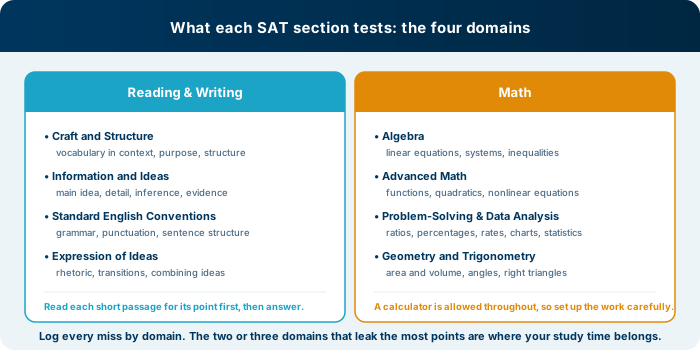
Each section is organized into four domains. On Reading and Writing, every short passage comes with a single question drawn from one of these areas. On Math, the questions are distributed across the four math domains. Knowing the domains turns “I’m bad at the Math section” into something you can actually fix: “I keep missing Problem-Solving and Data Analysis.”
Reading and Writing, domain by domain
The Reading and Writing section blends what used to be separate reading and grammar testing into one section of short passages.
Craft and Structure. These questions test how a text is built and the precise meaning of its words: vocabulary in context, the author’s purpose, the function of a particular sentence, and connections between two related texts. The skill is reading closely enough to catch shades of meaning, not just the gist.
Information and Ideas. This domain is comprehension and reasoning: identifying the main idea, locating a specific detail, drawing a supported inference, and using textual or quantitative evidence (including small graphs and tables) to support a claim. The discipline here is to answer from what the text actually says, not from what sounds reasonable.
Standard English Conventions. This is grammar and mechanics: punctuation, subject-verb and pronoun agreement, verb tense, and sentence boundaries. It is the most learnable part of the section because the rules are finite. Master them and these become near-automatic points.
Expression of Ideas. These questions ask for the most effective way to express or organize an idea: choosing the right transition, combining sentences cleanly, or meeting a stated rhetorical goal. They reward a sense of clear, concise writing.
How to improve Reading and Writing. Start with Standard English Conventions, because the grammar rules are concrete and high-yield: learn them cold and you bank reliable points. For the reading-heavy domains, build a consistent process: read the short passage for its main point first, identify what the question is actually asking, then confirm your answer against specific words in the text. The most common error is picking an answer that sounds plausible but is not supported by the passage, so train yourself to point to the evidence every time.
Math, domain by domain
The Math section spans four domains, and a calculator is allowed on all of them, with Desmos built into Bluebook.
Algebra. Linear equations, systems of equations, and inequalities, in one or more variables. This is the foundation of the section and the highest-frequency domain, so fluency here pays off across many questions.
Advanced Math. Functions, quadratics, exponential relationships, and other nonlinear equations. These questions reward comfort with manipulating and interpreting functions, including reading them off a graph.
Problem-Solving and Data Analysis. Ratios, rates, percentages, proportional reasoning, and interpreting data from tables, charts, and graphs, plus basic statistics. This is the most “real-world” domain, and the questions often hide simple math inside a wordy setup.
Geometry and Trigonometry. Area and volume, lines and angles, right triangles, the Pythagorean theorem, basic trigonometric ratios, and circles. It is typically the smallest domain by question count, but the formulas are worth memorizing so you are not improvising on test day.
How to improve Math. First, close content gaps so no domain is a surprise: if exponential functions or circle geometry are shaky, learn them directly rather than guessing your way through. Then drill the specific domains that keep costing you points, which your error log will reveal. Two habits cut the most avoidable losses: use the built-in Desmos calculator deliberately for graphing and checking, and slow down during setup, since most Math misses for prepared students are careless errors in reading the question or copying a value, not gaps in knowledge.
Which section should you focus on?
It depends entirely on your error log, but a few patterns hold for most students we work with:
- Math points often come faster early on. The content is concrete, and a missing topic can be learned and locked in directly. If you have clear content gaps, Math is usually where a focused week produces the biggest jump.
- Reading and Writing improves more steadily. Once the grammar rules are automatic, the reading domains improve through consistent process and volume rather than one big breakthrough. It is a grind, but a reliable one.
- Lifting your weaker section is the most efficient move. Since your total is just the two sections added together, and many colleges superscore your best section across dates, raising whichever section is lagging usually buys more points per hour than polishing the one you are already strong in.
The honest approach is to let the data decide. Take a full Bluebook practice test, tag every miss by domain, and put your hours where the points actually are. We walk through that whole loop in how to study for the SAT, and you can set your overall goal against what counts as a good SAT score.
Know the domains, find your two or three leak points, and drill them deliberately. That is how a section score moves. The drill builder targets any of the eight domains directly, free during early access. Join the early-access list and our SAT instructors will help you read your error log and pick the right ones.
Frequently asked questions
What does the digital SAT Reading and Writing section test?
Reading and Writing covers four domains: Craft and Structure, Information and Ideas, Standard English Conventions, and Expression of Ideas. Each short passage is paired with a single question drawn from one of these areas.
What does the digital SAT Math section test?
Math covers four domains: Algebra, Advanced Math, Problem-Solving and Data Analysis, and Geometry and Trigonometry. A calculator is allowed on the entire section, with Desmos built into the Bluebook app.
Is SAT Math or Reading and Writing easier to improve?
For most students, Math points come faster early on because the content is concrete and a missing topic can be learned directly. Reading and Writing improves more steadily once you master the grammar rules and a consistent reading approach.
How do I get better at SAT Reading and Writing?
Master the tested grammar rules cold, read each short passage for its main point before looking at the answers, and use evidence in the text to confirm every choice. Then log your misses by domain to find your weak spot.
How do I improve my SAT Math score?
Close content gaps first so no topic is a surprise, then drill the specific domains that cost you points. Use the built-in Desmos calculator deliberately, and slow down on setup to cut careless errors.
Prepping for the SAT?
Start with the SAT prep options available today, or join the update list for new releases.