
Test Basics
What Is the Casper Test? The Format Explained
Casper is a situational judgment test with a video section and a typed section, 11 scenarios in total, and no right or wrong answers. Here is the current format, section by section.
If you have only heard that Casper is “the typing test” or “the ethics test,” you are missing half of it. The current format has two distinct sections that test the same judgment in two different ways, and knowing exactly how it is structured is the first step in preparing for it. Here is what the test actually looks like.
What Casper is and why schools use it
Casper is an online situational judgment test built by Acuity Insights (formerly Altus) and offered as part of the Altus Suite. It is used in admissions for medicine, dentistry, nursing, pharmacy, veterinary medicine, and other health professions.
Its job is to measure the things a transcript and an admissions test cannot: how you communicate, how you handle an ethical bind, how you treat people, how you reason when there is no clean answer. You are shown scenarios, many of them everyday situations rather than dramatic dilemmas, and asked how you would respond. There are no right or wrong answers. Trained human raters evaluate the quality of your reasoning and judgment, and your performance is reported to schools as a quartile relative to other applicants in your profession.
The current format at a glance
Casper is made up of two sections, covering 11 scenarios in total, a mix of word-based and video-based prompts.
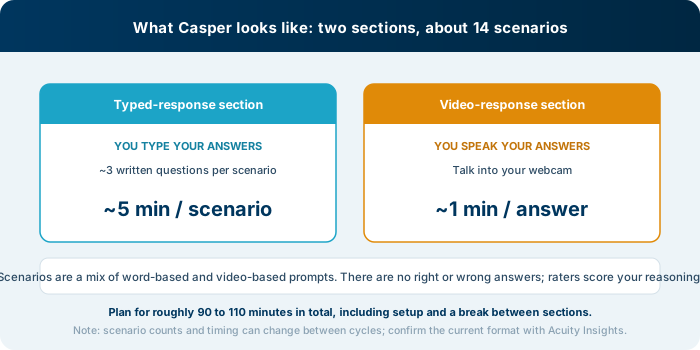
- Typed-response section. You read or watch a scenario, then type your answers to its follow-up questions. You get 3.5 minutes per scenario to answer two written questions shown together. With seven typed scenarios, this is where most of the test’s volume lives, and it is why typing speed quietly matters.
- Video-response section. You respond to scenarios by speaking into your webcam instead of typing. You get roughly one minute to speak each answer. This section trades the keyboard for the spoken word, so the demand shifts toward thinking on your feet and answering concisely out loud.
In total, plan for roughly 65 to 85 minutes, including setup and a break between sections. Because every scenario is individually timed, the overall length is fairly fixed: you cannot bank time from a fast scenario to spend on a slow one within the typed portion the way you might on a section-timed test.
A practical note on accuracy: the exact number of scenarios, the split between typed and video, and the precise timing can change between cycles. Treat the figures here as approximate and confirm the current structure with Acuity Insights before your test date.
The typed section is where most points live
Because the typed section carries the bulk of the scenarios, it deserves the bulk of your preparation. Each scenario gives you a short situation and then two questions that probe how you think about it: what you would do, why, who is affected, how you would handle a complication.
Two things make this section deceptively demanding. The first is the clock. Three and a half minutes for two questions sounds generous until you are reading a scenario, organizing your thoughts, and typing complete answers, all at once. The second is that a thin answer scores worse than a developed one even when your underlying judgment is sound, simply because you gave the rater less reasoning to evaluate. That combination is exactly why building typing speed and a repeatable framework pays off so directly here.
The video section tests the same skill out loud
The video section can feel intimidating because you are on camera with about a minute to speak, but the underlying skill is identical to the typed section: read the situation, find the real issue, and give a clear, reasoned response. The difference is the medium.
Speaking rewards different habits than typing. You cannot edit, so a brief mental beat to organize your answer before you start talking is worth more than rushing into the first sentence. Concision matters because a minute is short. And because raters can see and hear you, a calm, professional delivery supports the content of what you say. None of this requires acting talent. It requires the same judgment, delivered in a different format.
What the scenarios are actually like
A common misconception is that Casper scenarios are all dramatic medical emergencies or wrenching ethical dilemmas. Most are not. Many are ordinary situations: a disagreement with a coworker, a friend who asks you to do something questionable, a group project where someone is not pulling their weight, an awkward interaction with a stranger. The point is not your clinical knowledge. The point is how you reason about people and obligations.
That is why you do not need a healthcare background to do well. The scenarios are written so that any thoughtful applicant can engage with them. Some are presented as a short block of text, and some are presented as a short video clip you watch before the questions appear, which is the “word-based and video-based” mix. Either way, the questions that follow ask you to think through the situation: what you would do, why, who is affected, and how you would handle a wrinkle. You are being assessed on judgment and communication, not on memorized facts or a specialty vocabulary.
What raters are actually looking for
It is easy to overthink Casper. Raters are not hunting for a hidden correct answer or a clever twist. Across both sections, strong responses tend to do the same handful of things, which is the whole basis of a repeatable answering framework:
- Identify the real dilemma and who is affected by it, rather than answering a simpler question than the one asked.
- Consider more than one perspective. Acknowledging the competing interests in a situation signals mature judgment.
- Commit to a defensible action and explain why, instead of describing options without ever deciding.
- Acknowledge consequences and follow-up, showing you have thought past the immediate decision.
Responses that do these things consistently read as thoughtful and professional, which is precisely what the test is designed to surface.
What to expect on test day
Casper is taken online, remotely, on your own computer, which means a few logistical things deserve attention before you ever read a scenario. You will need a reliable internet connection, a working webcam and microphone for the video section, and a quiet, private space where you will not be interrupted for the full sitting. Acuity Insights typically asks you to verify your identity and check your equipment before the test begins, so build in time for setup rather than logging on at the last minute.
Because the whole thing runs roughly 65 to 85 minutes with a break, treat it like any timed exam: clear your schedule, silence your phone, and remove distractions. A dropped connection or a malfunctioning microphone in the middle of the video section is a stressful, avoidable problem. Test your hardware in advance. The exact requirements, scheduling windows, and identity-verification steps can change, so confirm the current details with Acuity Insights when you register. None of this affects how you reason, but getting it wrong can cost you composure at exactly the wrong moment.
How Casper fits with other admissions tests
Casper is one piece of an application, not the whole of it. Schools weight it differently, and it is read alongside your grades, your admissions test, your essays, and your experiences. If you are applying to medical school, you may also encounter AAMC PREview, which assesses similar professional skills but in a completely different format, multiple-choice rather than open-ended, with a scaled score rather than a quartile. We lay out the differences in Casper vs. PREview, and there is a medical-school-specific comparison in AAMC PREview vs. Casper.
Once you understand the format, the path forward is straightforward: learn the two sections, build a framework you can run on any scenario, and practice under realistic timing. Explore Casper prep for current-format scenario drills, full-length exams, and feedback.
Frequently asked questions
What is the Casper test?
Casper is an online situational judgment test built by Acuity Insights, formerly Altus, as part of the Altus Suite. It presents scenarios about ethics, communication, and professionalism and asks you to respond, so schools can assess people skills that grades and admissions tests do not capture. It is used in admissions for medicine, dentistry, nursing, pharmacy, and other health professions.
How long is the Casper test?
Plan for roughly 65 to 85 minutes in total, across a video-response section and a typed-response section, plus setup and a break. Each scenario is time-limited, so the overall length is fairly fixed.
How many scenarios are on Casper?
There are 11 scenarios in total, four in the video-response section and seven in the typed-response section, with prompts that are a mix of word-based and video-based. Exact counts can change between cycles, so confirm the current format with Acuity Insights.
Does Casper have two sections?
Yes. The current Casper format has a video-response section, where you speak your answers, and a typed-response section, where you write them. Together they cover 11 scenarios.
Are there right or wrong answers on Casper?
No. Casper has no correct answers. Trained raters score the quality of your reasoning and judgment, including how you weigh perspectives and justify your decisions, rather than whether you chose a specific option.
Prepping for the Casper?
Start with the Casper prep options available today, or join the update list for new releases.