Amides
Amides (R-CO-NR’₂) are the least reactive of the carboxylic acid derivatives. They are also the most biologically important - every peptide bond in every protein is an amide bond. Their stability and distinctive properties come from strong resonance donation of the nitrogen lone pair into the carbonyl.
Resonance and Planarity
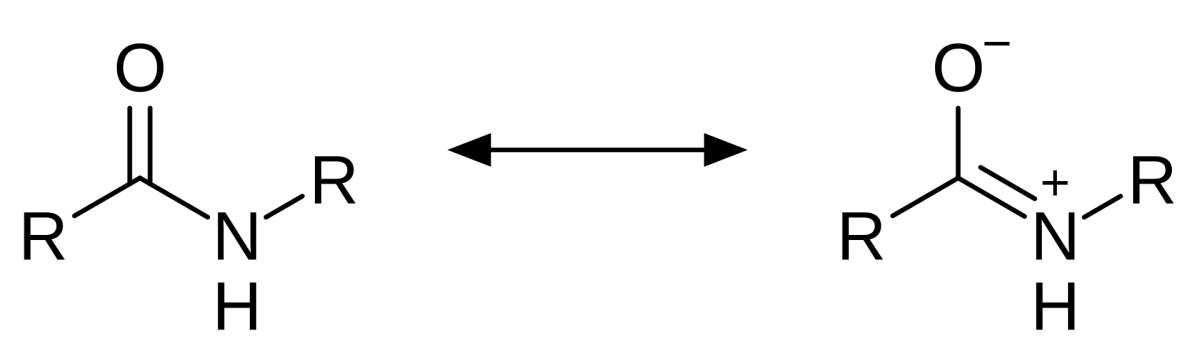
The nitrogen lone pair donates heavily into the carbonyl via resonance. Two contributors:
- Neutral amide (major): R-C(=O)-NR’₂. Lone pair on N; C=O double bond.
- Dipolar contributor (~40%): R-C(-O⁻)=N⁺R’₂. Lone pair on N has moved into a double bond with C; charge is +1 on N, −1 on O.
The dipolar contributor is a significant (~40%) fraction of the true hybrid. This means:
- The C-N bond has substantial (partial) double-bond character.
- Rotation around the C-N bond is restricted (the barrier is ~75 kJ/mol, much higher than ordinary C-N single bonds).
- All six atoms of the amide plane (Cα, C=O, N, R’₂ and the carbonyl oxygen) lie in the same plane.
This planarity is the structural foundation of protein secondary structure (alpha helix, beta sheet). Peptide bonds cannot twist freely, restricting backbone conformations.
Why Amides Are So Unreactive
Two factors:
- Nitrogen donates strongly into the carbonyl by resonance. The carbonyl carbon’s δ⁺ is much reduced. Nucleophilic attack is slow.
- Amide nitrogen is a terrible leaving group. After nucleophile attack, the tetrahedral intermediate would have to eject NR’₂⁻, which is an extremely strong base (pKa of R₂NH is ~38-40). It essentially does not leave under ordinary conditions.
The result: amides resist hydrolysis and other NAS reactions. This stability is why proteins last long enough to fold and function.
Amide Hydrolysis
Amides eventually hydrolyze to carboxylic acid + amine, but only under harsh conditions:
- Acid hydrolysis: 6 M HCl, reflux for hours. Used in traditional protein sequencing (releases amino acids from proteins).
- Base hydrolysis: concentrated NaOH, high temperature. Saponifies the amide bond.
- Enzymatic hydrolysis: proteases (trypsin, chymotrypsin, pepsin) and peptidases catalyze amide hydrolysis at room temperature and physiological pH. Cells rely on these enzymes to turn over proteins.
Even enzyme-free, amide hydrolysis at neutral pH has a half-life of hundreds of years for ordinary peptide bonds. This is why abiotic synthesis of proteins was so difficult in early chemical-evolution experiments.
Peptide Bonds
A peptide bond is an amide bond between two amino acids: the -COOH of one amino acid + the -NH₂ of the next → peptide bond + H₂O.

Each peptide bond is planar (~6 atoms in plane), restricting rotation around the C-N bond. This is the origin of the Ramachandran plot and the alpha helix / beta sheet secondary structures in proteins.
In cells, peptide bonds are formed by the ribosome, which uses activated aminoacyl-tRNAs as reactive intermediates (the amino acid is esterified to the tRNA, making the carbonyl more electrophilic). Water is not released per se - the tRNA is ejected as the product.
Nylon and Synthetic Polyamides
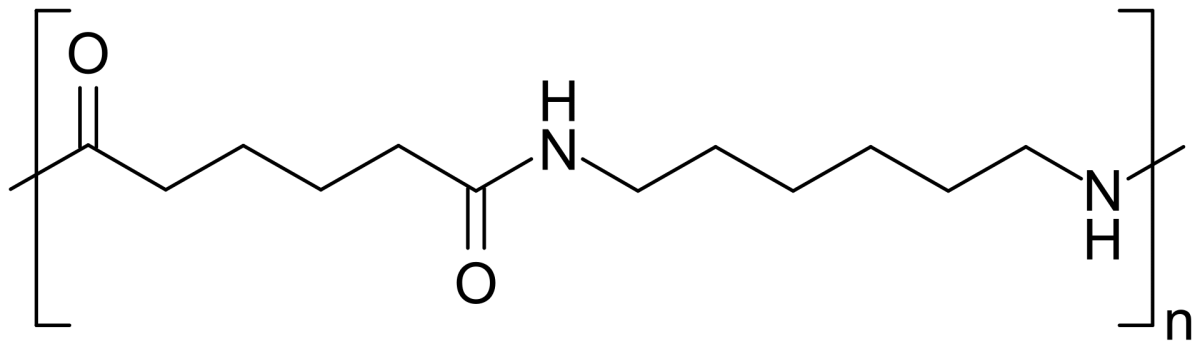
Nylon is a polyamide - a chain of amide bonds repeating with alkyl groups. Nylon 6,6 (most common) is made from adipic acid (HOOC-(CH₂)₄-COOH) and hexamethylenediamine (H₂N-(CH₂)₆-NH₂). Each amide bond connects one monomer to the next, and the resulting polymer has the same planarity and stability as protein backbones (which is why nylon fibers are so strong).