Snap LEGO bricks together. That is peptide bond formation. Take the carboxyl group of one amino acid, the amino group of the next, pop off a water molecule, and you have a covalent amide bond linking the two. Do this 146 times in a row and you have the hemoglobin beta chain. Do it 1,480 times and you have a mid-size enzyme.
This is the reaction that builds every protein in your body, at a rate of about 10 to 20 amino acids per second on a ribosome.
The Mechanism
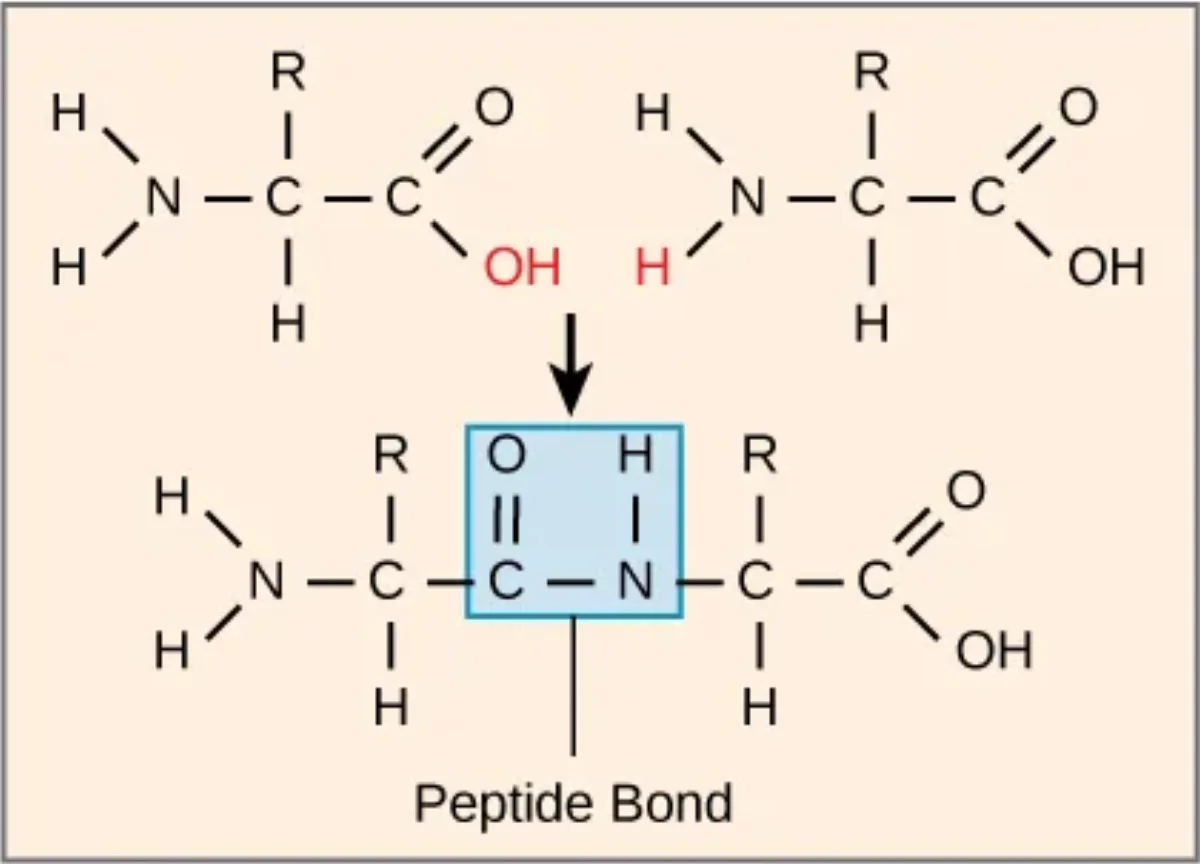
The -COOH of amino acid #1 reacts with the -NH2 of amino acid #2. The -OH of the carboxyl leaves together with one H from the amino group - that is the water molecule released.
What remains is a covalent bond from the carbonyl carbon of amino acid #1 directly to the nitrogen of amino acid #2. The functional group -C(=O)-N(H)- is an amide. A peptide bond is just a specific kind of amide bond that connects two amino acids.
Peptide bond formation is a condensation (dehydration synthesis) reaction. The -OH from the carboxyl group and an -H from the amino group leave as water; a covalent C-N bond forms. Credit: OpenStax Biology 2e, CC BY 4.0
Naming the Ends: N-Terminus and C-Terminus
Every polypeptide has two ends because each peptide bond uses up one -NH2 and one -COOH but leaves the amino group of the first residue and the carboxyl of the last residue free.
The N-terminus has a free alpha amino group. This is where translation starts.
The C-terminus has a free alpha carboxyl group. This is where translation ends.
Peptide sequences are always written N-terminus to C-terminus, left to right. “Ala-Gly-Ser” means alanine at the N-terminus, glycine in the middle, serine at the C-terminus.
Energy Cost
Forming a peptide bond is thermodynamically unfavorable (positive ΔG) under cellular conditions. Your ribosome pays for it: each new amino acid costs 4 high-energy phosphate bonds (1 ATP to charge the tRNA with its amino acid, plus 2 GTP during elongation and 1 GTP during translocation). That is why protein synthesis is among the most energy-expensive processes in the cell.
Breaking Peptide Bonds: Hydrolysis
The reverse reaction breaks a peptide bond by adding water back. Your stomach acid and digestive enzymes (pepsin, trypsin, chymotrypsin) all catalyze peptide bond hydrolysis. Without an enzyme, the reaction is glacially slow - peptide bonds have half-lives of hundreds of years in neutral water. With the right enzyme, it happens in milliseconds.
Specificity: Why Sequencing Works
Not all proteases are created equal. Each one recognizes specific amino acid residues at the cleavage site, which is what makes peptide mapping and sequencing possible. If you already know the cutting rules, you can predict exactly which fragments a protease will generate from a given sequence.
Peptide Length Terminology
Dipeptide: 2 amino acids, 1 peptide bond
Tripeptide: 3 amino acids, 2 peptide bonds
Oligopeptide: a few (usually <10-20) amino acids
Polypeptide: longer chain, but not yet folded or functional
Protein: one or more polypeptide chains folded into a functional 3D shape
Note that for n amino acids, there are always (n - 1) peptide bonds.
What functional group is lost when a peptide bond forms, and what is the byproduct?
Click to reveal answer
The -OH from the carboxyl of one amino acid and one -H from the amino group of the next are lost together as a water molecule (H2O). This is a condensation (dehydration synthesis) reaction. The covalent C-N bond that forms is an amide bond, specifically called a peptide bond.
A peptide is written as "Gly-Trp-Lys-Asp." Which residue is at the N-terminus?
Click to reveal answer
Glycine. Peptide sequences are always written N-terminus to C-terminus, left to right. So Gly is the N-terminus and Asp is the C-terminus. The ribosome also builds the chain in that order - N first, then C last.
How many peptide bonds are in a protein with 150 amino acids?
Click to reveal answer
149. In general, n amino acids in a single chain are connected by (n - 1) peptide bonds, because each new residue added to the chain forms exactly one new bond.