
The Scientific Method
Imagine you’re a detective arriving at a crime scene. You look around and gather clues (observation). You notice the window is broken from the outside: how did the intruder get in? (question). You form a theory about what happened (hypothesis). You dust for fingerprints and check security footage (experiment). You compare the evidence to your theory (analysis). Either the evidence supports your theory or it doesn’t (conclusion).
Science works exactly the same way. Every experiment is a detective story. The scientific method isn’t a rigid checklist — it’s a cycle of asking questions, testing ideas, and revising your understanding based on evidence. The MCAT expects you to recognize these steps, identify where a study sits in the cycle, and judge whether the conclusions follow from the data.
The Steps
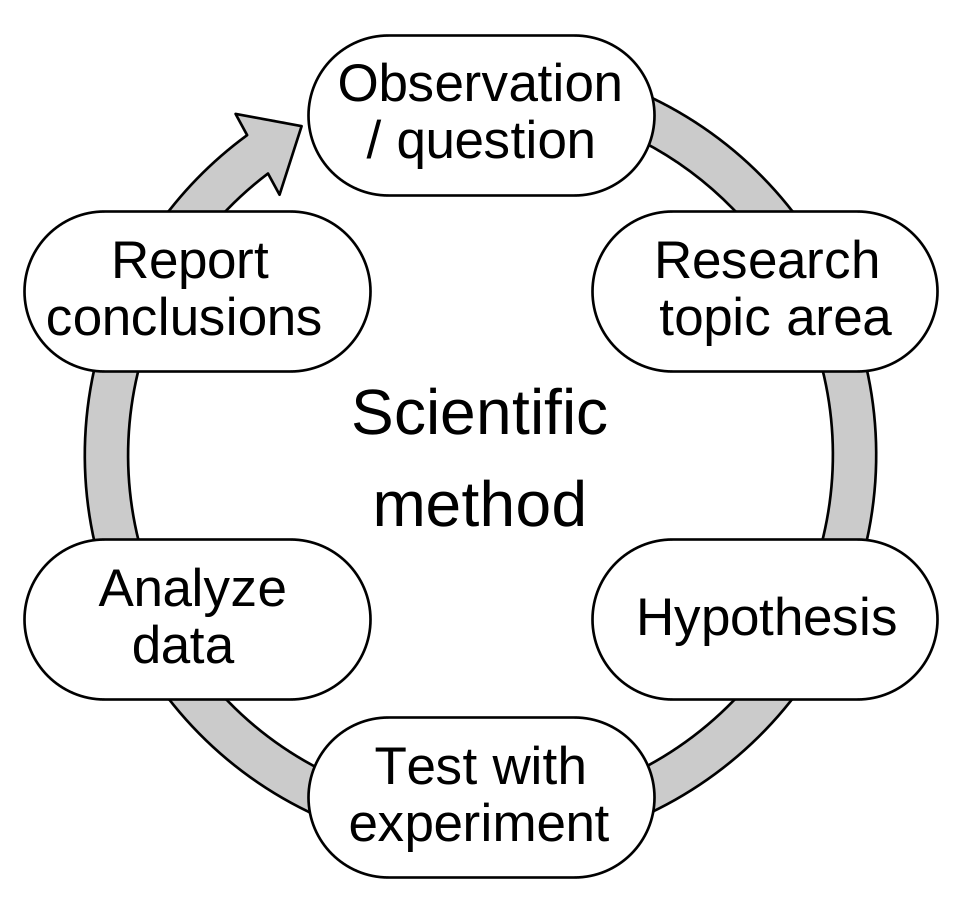
The scientific method follows a general sequence, though in practice scientists often jump between steps or go back to earlier ones.
1. Observation. Something catches your attention. A patient with a rare disease improves after taking an unrelated medication. Cells in a petri dish grow faster at a certain temperature. Data from a survey shows an unexpected pattern.
2. Question. You ask why or how. Why did that patient improve? What is it about that temperature that accelerates cell growth?
3. Hypothesis. You propose a testable, falsifiable explanation. “The medication reduces inflammation by blocking receptor X.” This is not a guess - it is a specific, mechanistic prediction that can be proven wrong.
4. Experiment. You design a study to test the hypothesis. This is where variables, controls, and blinding come in (we will cover those in the next several sections).
5. Data collection and analysis. You gather results and apply statistical methods to see whether the data support or contradict the hypothesis.
6. Conclusion. You interpret the results. Did the data support the hypothesis? If yes, the hypothesis survives (but is not “proven” - more on that below). If no, you revise the hypothesis and start again.
Hypotheses Must Be Testable and Falsifiable
A hypothesis is only scientific if it can, in principle, be shown to be wrong. This is the criterion of falsifiability, introduced by philosopher Karl Popper.
- Testable: You can design an experiment to evaluate it. “Drug X lowers blood pressure” is testable - give the drug to patients and measure their blood pressure.
- Falsifiable: There is a possible outcome that would disprove it. If blood pressure does not drop, the hypothesis is falsified.
A statement like “everything happens for a reason” is not falsifiable because no observation could ever disprove it. It may be a perfectly fine philosophical idea, but it is not a scientific hypothesis.
Hypothesis vs. Theory vs. Law
These three terms are not a hierarchy of certainty. They describe different things entirely.
| Term | What It Is | Example |
|---|---|---|
| Hypothesis | A specific, testable prediction about a single phenomenon | ”This drug lowers blood pressure by blocking ACE” |
| Theory | A broad, well-tested explanation supported by a large body of evidence | Theory of evolution, germ theory of disease |
| Law | A concise mathematical description of a consistent relationship in nature | Newton’s second law (F = ma), Boyle’s law (PV = constant) |
A theory does not “graduate” into a law. Laws describe what happens (the pattern). Theories explain why it happens (the mechanism). Both are supported by extensive evidence, but they serve different purposes.
Inductive vs. Deductive Reasoning
Scientists use two complementary reasoning approaches.
Inductive reasoning moves from specific observations to a general conclusion. You observe that every swan you have ever seen is white, so you conclude “all swans are white.” Inductive conclusions are probable but never certain - a single black swan disproves the rule.
Deductive reasoning moves from a general principle to a specific prediction. If all mammals produce milk, and a whale is a mammal, then a whale produces milk. Deductive conclusions are certain if the premises are true.
The scientific method uses both: inductive reasoning to form hypotheses from observations, and deductive reasoning to generate testable predictions from those hypotheses.
Null and Alternative Hypotheses
In formal research, hypotheses come in pairs.
The null hypothesis () states that there is no effect or no difference. “The drug has no effect on blood pressure compared to placebo.”
The alternative hypothesis ( or Hₐ) states that there is an effect or a difference. “The drug lowers blood pressure compared to placebo.”
Experiments are designed to reject the null hypothesis. If the data show a statistically significant difference, you reject in favor of . If they do not, you fail to reject . Note the language: you never “accept” the null hypothesis - you simply fail to reject it, because absence of evidence is not evidence of absence.