
Clinical Trials
Before a new drug reaches your local pharmacy, it goes through a gauntlet of testing that typically takes 10 to 15 years and costs over a billion dollars. Imagine a funnel: thousands of candidate compounds enter at the top, and only a handful survive to the bottom. Each phase of clinical trials is a progressively stricter filter, designed to catch problems before a drug is released to millions of people.
The MCAT does not expect you to know the regulatory fine print of drug approval. What it does expect is that you can identify which phase a passage is describing, explain why each phase exists, and recognize what a randomized controlled trial (RCT) is and why it is considered the gold standard.
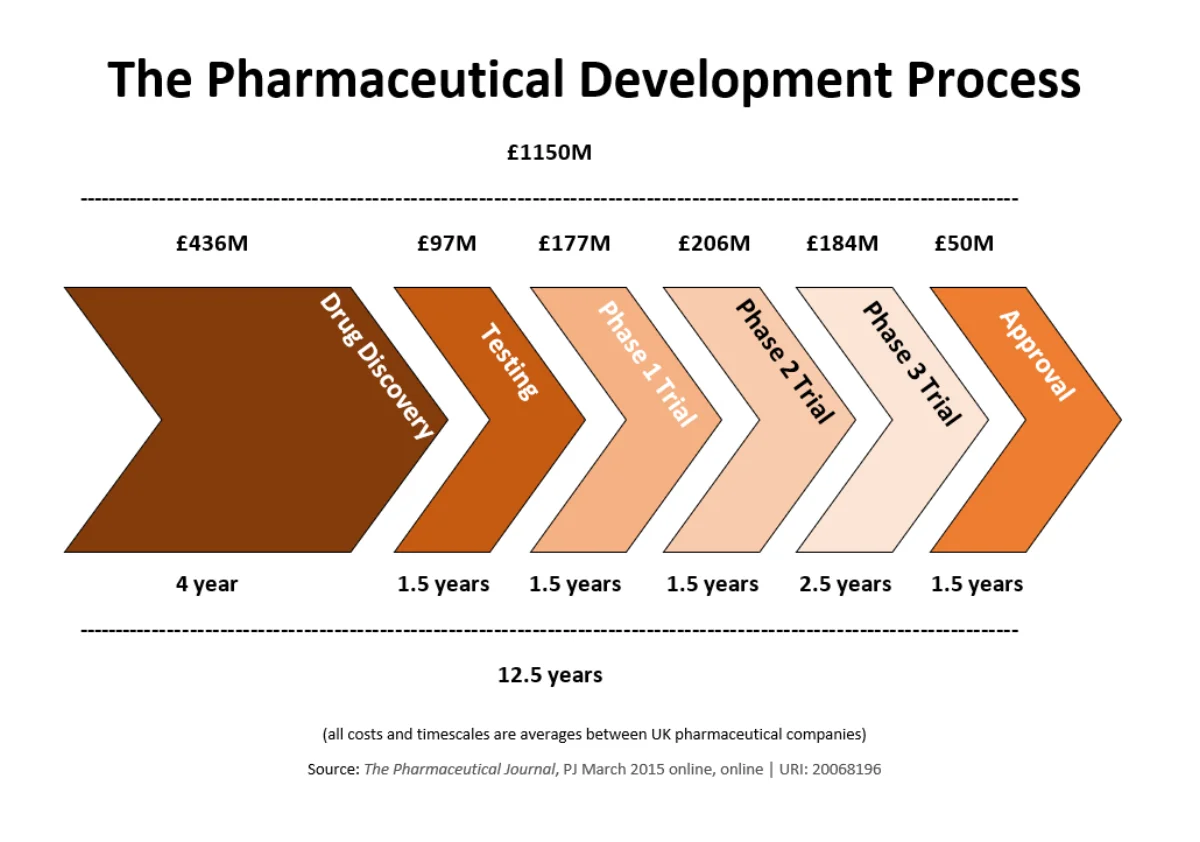
Before Human Trials: Preclinical Testing
Before any drug is tested in humans, it goes through preclinical testing - laboratory studies (in vitro, meaning in test tubes or cell cultures) and animal studies (in vivo). The goal is to spot obvious toxicity, find safe dosing ranges, and understand how the drug is metabolized.
Only if preclinical results are promising does the drug advance to human trials. An Investigational New Drug (IND) application must be approved before Phase I begins.
Phase I: Safety
Goal: Is the drug safe in humans? What dose is tolerable?
Participants: Small group (20-100), usually healthy volunteers (not patients with the disease).
Duration: Months.
Key question: Does this drug cause unacceptable side effects? What is the maximum tolerated dose?
Phase I is not testing whether the drug works - it is testing whether it is safe enough to keep studying.
Phase II: Efficacy
Goal: Does the drug actually work? What is the optimal dose?
Participants: Moderate group (100-300), patients who have the target condition.
Duration: Months to a couple of years.
Key question: Does this drug produce a measurable therapeutic effect? The study starts to assess efficacy while continuing to monitor safety.
Most drugs fail in Phase II. A drug may be safe but simply not effective enough to justify continued development.
Phase III: Large-Scale Confirmation
Goal: Confirm efficacy in a large, diverse population. Compare to existing treatments or placebo.
Participants: Large group (1,000-5,000+), patients from multiple sites (multicenter).
Duration: One to four years.
Design: This is where the randomized controlled trial (RCT) lives. Phase III trials are typically randomized, double-blind, and placebo-controlled or active-comparator-controlled. They are the gold standard for showing whether a treatment works.
Key question: Does the benefit outweigh the risk in a real-world patient population?
Phase IV: Post-Market Surveillance
Goal: Monitor long-term safety and effectiveness after the drug is on the market.
Participants: General population (thousands to millions of patients using the drug).
Duration: Ongoing, indefinitely.
Key question: Are there rare side effects that only appear in larger populations or with longer use? Should the drug be recalled or have its labeling changed?
Phase IV is critical because some adverse effects are too rare to catch even in Phase III trials. A side effect occurring in 1 in 50,000 patients will not show up in a trial of 3,000 people.
Summary Table
| Phase | Goal | Participants | Size | Key Feature |
|---|---|---|---|---|
| Preclinical | Basic safety | Animals/cells | Varies | No humans |
| I | Safety, dosing | Healthy volunteers | 20-100 | First-in-human |
| II | Efficacy, dosing | Patients with disease | 100-300 | First test of effectiveness |
| III | Confirm efficacy | Patients, multicenter | 1,000-5,000+ | RCT, gold standard |
| IV | Long-term safety | General population | Thousands+ | Post-market surveillance |
The Randomized Controlled Trial (RCT)
The RCT deserves special attention because it is the design the MCAT references most often. Its key features:
- Randomization: Participants are randomly assigned to treatment or control groups
- Control group: Receives placebo or standard-of-care treatment
- Blinding: Ideally double-blind (participant and researcher both unaware of assignment)
- Prospective: Follows participants forward in time from treatment to outcome
The RCT is the only study design that can establish causation with high confidence, because randomization and controlled conditions remove most confounders.