
Variables
Think about baking cookies. You want to test whether more sugar makes cookies taste better. The amount of sugar you add is the thing you deliberately change — that’s your independent variable. The taste rating your friends give each batch is the thing you measure — that’s your dependent variable.
But what if you also accidentally used a different oven temperature for each batch? Now you can’t tell whether the taste difference came from the sugar or from the temperature. That uninvited guest is a confounding variable, and it can quietly ruin an otherwise good experiment.
Every experiment boils down to this: change one thing, measure another thing, and make sure nothing else sneaks in to muddy the results. The MCAT tests this concept relentlessly. If you can identify the independent, dependent, and confounding variables in a passage, you can answer most research design questions.
The Three Core Variables
Independent variable (IV): The variable the researcher deliberately manipulates or changes. In a drug trial, the IV is the drug dose. In a psychology study, the IV might be the type of therapy given.
Dependent variable (DV): The variable the researcher measures as an outcome. It “depends” on the IV. In a drug trial, the DV might be blood pressure. In a psychology study, the DV might be depression score.
Confounding variable: Any variable other than the IV that could influence the DV and was not properly controlled. Confounders threaten the validity of the experiment because they provide an alternative explanation for the results.
Graphing Convention
When plotting experimental results, there is a universal convention:
- Independent variable (IV) goes on the x-axis (horizontal)
- Dependent variable (DV) goes on the y-axis (vertical)
This is not arbitrary. The x-axis represents what the researcher controls, and the y-axis represents what responds. If an MCAT passage shows a graph, you can immediately identify the IV and DV by looking at the axis labels.
Extraneous vs. Confounding Variables
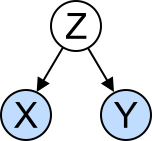
These two terms are related but not identical.
Extraneous variables are any variables other than the IV that could affect the DV. Room temperature, time of day, participant mood - all are extraneous in most studies.
Confounding variables are extraneous variables that actually do vary systematically with the IV, making it impossible to separate their effect from the IV’s. Not every extraneous variable becomes a confounder - only the ones that correlate with the treatment.
Example: A researcher tests whether a new study method improves test scores. The experimental group uses the new method and studies in the morning. The control group uses the old method and studies at night. Time of day is extraneous, but because it varies systematically with the study method (all morning students got the new method), it becomes a confounder.
Controlled (Constant) Variables
Controlled variables are factors the researcher deliberately keeps the same across all groups. If you are testing a drug’s effect on blood pressure, you might control for age, sex, diet, and exercise by matching the groups or holding those factors constant.
Controlling variables is how researchers prevent extraneous variables from becoming confounders. The more variables you control, the more confident you can be that the IV caused the change in the DV.
Operationalization
Operationalization is the process of defining an abstract concept in terms of specific, measurable procedures. This is essential because many variables - especially in psychology and social science - are abstract.
- “Intelligence” is abstract. “Score on a standardized IQ test” is operationalized.
- “Stress” is abstract. “Cortisol level in saliva” is operationalized.
- “Aggression” is abstract. “Number of times a participant presses a button to deliver a loud noise to another person” is operationalized.
Levels of the Independent Variable
The IV often has multiple levels (also called conditions or groups). A drug trial might have three levels: placebo, low dose, and high dose. Each level is a different value of the IV that participants are assigned to.
When there are only two levels, you typically have an experimental group (receives treatment) and a control group (does not). When there are more than two levels, the study can reveal dose-response relationships or compare multiple treatments.