
Study Planning
How Much Does MCAT Tutoring Cost?
MCAT tutoring costs $40 to $480 per hour depending on the company. Full pricing breakdown for Kaplan, Princeton Review, Blueprint, and independent tutors.
MCAT tutoring prices vary enormously. You can pay $40 an hour or $480 an hour depending on who you go with and what’s included. The frustrating part is that most companies don’t make their prices easy to find. You have to request a consultation, sit through a sales pitch, and then find out you can’t afford it.
I’m going to lay out the actual numbers. I run Premier MCAT Prep, so I have a financial interest here, and I’ll be transparent about our pricing too. My goal is to give you enough information to figure out what makes sense for your budget and your situation.
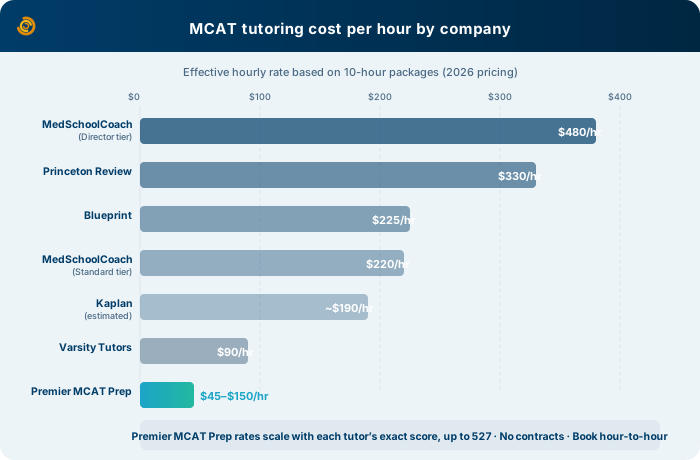
What MCAT tutoring actually costs
Here’s what the major companies charge for private one-on-one MCAT tutoring as of 2026.
Princeton Review is the most transparent about pricing. They list packages on their website:
- 10 hours: $3,299 (~$330/hr)
- 20 hours: $5,200 (~$260/hr)
- 40 hours: $8,800 (~$220/hr)
Blueprint (formerly Next Step) bundles tutoring with their self-paced course:
- 16 hours: $3,599 (~$225/hr)
- 24 hours: $4,499 (~$188/hr)
- 40 hours: $6,499 (~$162/hr)
Their packages include access to Blueprint’s course materials, 15 practice exams, and a question bank, which accounts for some of the cost.
Kaplan doesn’t publicly display tutoring prices, which should tell you something. Based on publicly available information, their packages range from roughly $3,300 for 10 hours to $6,400+ for 40 hours (~$160-$330/hr). They also bundle their on-demand course with tutoring packages.
MedSchoolCoach uses a tiered tutor system. Their Standard tutors start at $220/hr (10-hour package) and drop to $150/hr for 60 hours. Their Master tutors run $250-$350/hr. Their Director tier starts at $480/hr. If you want 25 hours with a Director tutor, that’s $11,400.
Varsity Tutors is more affordable at roughly 100/hr, though tutor credentials and MCAT expertise vary.
Independent tutors on Wyzant and similar platforms range from $50 to $200/hr. Med students and recent test-takers typically charge $50-$80/hr. Experienced tutors with 520+ scores charge $100-$200/hr.
Premier MCAT Prep charges 150/hr, priced by each tutor’s exact MCAT score, with no package minimums and no contracts. I’ll explain our pricing structure later in this post.
The total cost picture
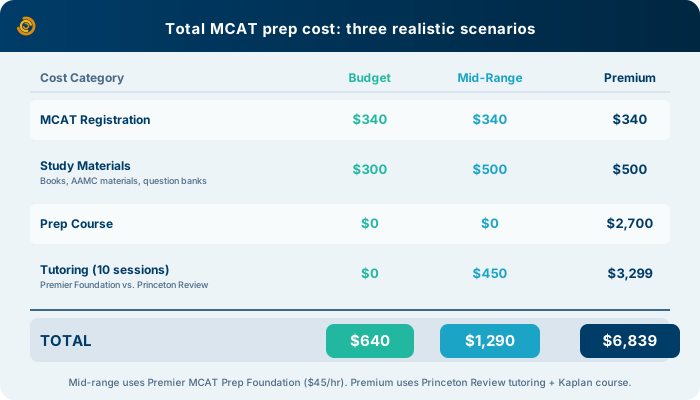
Most students who use tutoring do somewhere between 10 and 25 sessions over the course of their prep. Here’s what that looks like in total dollars:
For 10 sessions, you’re spending $450 (Premier Foundation) to $4,800 (MedSchoolCoach Director). For 20 sessions, you’re spending $900 to $9,000+.
Add that to your other prep costs. AAMC materials run about $300. A question bank is $100-$300. Prep books are $100-$200. The MCAT registration itself is $355 (2026 AAMC fee). On the low end, total MCAT prep costs might be $800-$1,200 including some tutoring. On the high end, students spend $10,000-$15,000.
If budget is a serious concern, look into the AAMC Fee Assistance Program, which covers MCAT registration and AAMC materials.
What you’re actually paying for
Before I get into whether the cost is justified, it helps to understand why pricing varies so much. You’re not just paying for someone to explain biology to you. Here’s what drives the price:
Tutor credentials. A tutor who scored 527 and has coached hundreds of students can diagnose your problems faster than someone who scored 512 and just started tutoring last month. Higher-scoring, more experienced tutors charge more because their time produces better results per hour.
Company overhead. Princeton Review and Kaplan charge $200-$330/hr, but their tutors don’t make $200-$330/hr. A large chunk goes to the company for marketing, course development, platform costs, and profit. When you pay an independent tutor $100/hr, more of your money goes directly to the person helping you.
Bundled materials. Some companies (Blueprint, Kaplan) bundle course access with tutoring packages. If you were already going to buy their course, this adds value. If you weren’t, you’re paying for materials you might not need.
Flexibility. Package-based pricing means committing to 10, 20, or 40 hours upfront. That’s a significant financial commitment before you know whether the tutor is a good fit. Hour-to-hour pricing costs more per session at some companies, but you’re not locked in.
Is MCAT tutoring worth the cost?
I wrote a whole post on whether MCAT tutoring is worth it, but here’s the cost-specific version.
The math depends on what tutoring prevents. Retaking the MCAT costs $355 in registration fees, plus months of additional study, plus potentially delaying your application by a full cycle. A year’s delay to medical school has an opportunity cost of one year of attending physician salary, which is $250,000-$400,000 depending on specialty. Against that number, even expensive tutoring is cheap.
But that framing only works if tutoring actually prevents the retake. On its own it’s not a guarantee, though our score guarantee backs qualifying plans. What tutoring does is make your study time more efficient. If a tutor can identify in one session a reasoning pattern that would take you three weeks to figure out on your own, and you do 10 sessions like that over the course of your prep, that’s 30 weeks of trial-and-error compressed into 10 hours. Whether that efficiency is worth $450 or $3,000 depends on your financial situation and how much time pressure you’re under.
If your score has plateaued and you’ve been stuck for weeks, targeted tutoring is usually the fastest way to break through. If you’re just starting out and need to learn the content, a $50 set of prep books will serve you better than a $300/hr tutor.
How to get the most value per dollar
If you decide tutoring is right for you, here’s how to avoid overspending.
Don’t buy more hours than you need. Companies push 30-40 hour packages because the per-hour rate is lower, but most students benefit most from 8-15 focused sessions. Start with a small commitment, see if it’s working, and add more if needed.
Come prepared to every session. A tutoring session where you show up and say “I’m not sure what I need help with” is a waste of money. Before each session, do a set of practice questions or a practice test, identify specific questions you got wrong and can’t figure out why, and bring those. Your tutor should be diagnosing problems, not teaching content you could learn from a textbook.
Ask about the tutor’s score and experience. You should know your tutor’s MCAT score, how long they’ve been tutoring, and how many students they’ve worked with. A high score alone doesn’t make someone a good teacher, but it’s a baseline. Every one of our tutors lists their exact MCAT score publicly — scores range from 508 to 527, and the hourly rate scales with the score.
Consider timing. If you have six months before your test, you might only need 5-8 sessions spaced throughout your prep at key checkpoints. If your test is in six weeks and you need a significant score improvement, you might need 10-15 sessions concentrated in a short window. More sessions isn’t always better. It’s about having the right sessions at the right time.
Why our pricing is different
I built Premier MCAT Prep’s pricing to fix what I think is broken about how most companies charge for tutoring.
Our pricing is set by each tutor’s exact MCAT score: hourly rates start at $40 for a 508 scorer and rise with every point, up to $150 for our top tutor, who scored a 527. Packages bring the effective rate as low as $45/hr. No minimums. No contracts. You book one session, and if it’s useful, you book another. If it’s not, you stop. Every tutor’s verified score is right on their profile, so you always know exactly what you’re paying for.
The reason we can charge less than companies charging $200-$400/hr isn’t that our tutors are worse. It’s that we don’t bundle in materials you may not need, we don’t have the overhead of a massive marketing operation, and we don’t lock you into large packages to inflate revenue per student.
Ten hours with a 510+ scorer costs about $500 booked hour-to-hour. The same 10 hours at Princeton Review costs $3,299. Our tutors scored higher than most of theirs. You can compare us directly with other companies on our tutoring comparison page.
The bottom line
MCAT tutoring costs anywhere from $45 to $480 per hour. The big prep companies charge $150-$330/hr with package commitments of $3,000-$10,000+. Independent tutors and smaller companies (including us) charge 150/hr with more flexibility.
The right amount to spend depends on where you are in your prep, what specific problems you need help with, and what you can afford without financial stress. If paying for tutoring means you’re prepping on a budget so tight that the stress hurts your studying, it’s not worth it. Find free resources and study groups instead.
If you can afford it and you have a specific problem that self-study hasn’t solved, start with a small number of sessions and see whether it moves your score. That’s the only test that matters.
Related reading:
- Is MCAT Tutoring Worth It? Honest Take — when 1-on-1 help makes sense and when it doesn’t
- MCAT Score Not Improving? Here’s What to Change — diagnose your plateau before spending money
- MCAT Fee Assistance: AAMC FAP Guide — how to cut your total MCAT costs
- MCAT Practice Test Scores vs. Actual — know where you stand before investing in tutoring
- Free MCAT Practice Questions — free resources to try before paying for help
Want to see if tutoring is right for you? Schedule a free 30-minute consultation — we’ll review your practice scores and give you honest advice, even if that advice is “you don’t need a tutor.”