Volume III: Reading Comprehension · Chapter 24
The job: Read the passage once, on purpose. Grasp the main point of the whole passage and build a map of where the details live, so you can find them again when a question asks.
Chapter 23 sold you on the core idea: Reading Comprehension is an open-book test, and you win it by retrieval, not recall. Every correct answer is sitting in the text, and the test is built to punish anyone who answers from memory. This chapter is the other half of that idea. If you are going to go back to the passage for every question, then your single upfront read has exactly one job: to make going back fast and accurate. That is what passage mapping does. Passage mapping is the way you read and mark a passage on your one pass through it, so that the page becomes a map you can scan.
You read the passage one time, straight through, before you look at any question. During that read you are doing two things and only two things:
You are not reading to memorize, and you are not reading to analyze. Say this to yourself until it is reflex: know where things are, not what they say.
This sounds backwards the first time you hear it. Most students read a passage the way they would read a textbook before an exam, trying to absorb and hold every fact. On the LSAT that is a losing strategy for two reasons.
First, you do not have time. The passages are dense and the clock is short. If you try to fully understand and store every detail on the first pass, you will read too slowly and still forget half of it.
Second, most of the details are never asked about. A passage might describe two experiments, name four scholars, and list five objections to a theory. A typical question set will touch only a fraction of that. Poring over the second experiment in detail is wasted effort if no question ever mentions it. You cannot know in advance which details the questions will hit, so the smart move is not to study any detail closely on the first read. You note where each one is, and you let the questions tell you which ones to go back and read carefully. In everyday terms: you skim a long work email for the one line that needs a reply and let the rest go, because rereading every sentence would burn the time you need to actually answer.
There is a deeper danger too. If you read for recall, you train yourself to answer from recall. When a question comes, you will reach for the fuzzy memory in your head instead of the exact words on the page, and that fuzzy memory is exactly what the wrong answers are engineered to match. Reading for location keeps you honest. It forces you back to the text, which is where the points are.
When you read, you mark the page. Marking is not decoration and it is not highlighting everything that looks important. You mark exactly three kinds of things, and you use a consistent symbol for each one so your map is readable at a glance. Pick your three symbols and use them the same way on every passage you ever do. Consistency is what turns a marked-up page into a tool instead of a mess.
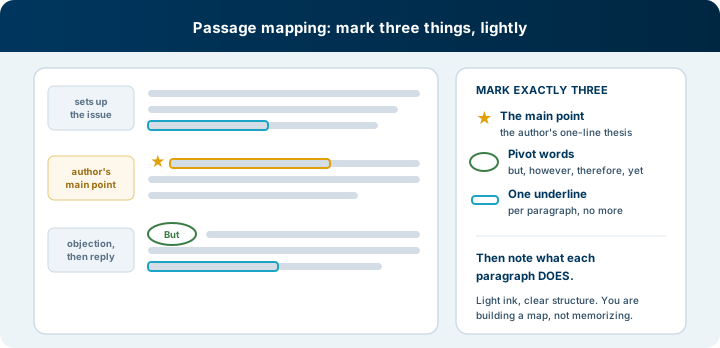
Here are the three things and how to mark them.
Every paragraph is doing something, and usually there is one sentence (or part of one) that carries the load. Put brackets around that sentence and jot a three to five word summary in the margin next to it. That margin note is the heart of your map. When you finish, you should be able to read just the margin notes top to bottom and have the skeleton of the passage.
How do you find a paragraph’s main point? The same way you find an argument’s conclusion in Logical Reasoning. You already learned this in Chapter 2. Look for two signals:
So you are reading for the author’s voice, the moment the paragraph stops reporting and starts claiming.
One caution. Not every paragraph makes a claim. Some paragraphs are pure background: they set up a historical situation, define a term, or describe a process, without arguing anything. When a paragraph is all background, its “main point” is simply the topic the details sit under. Your margin note for that paragraph might just be “background on X” or “history of Y.” That is fine. The note still tells you what lives there, which is all you need.
These are the small words that show how ideas relate. Circle them. There are three kinds worth catching:
Circling these words does more than mark them. It trains your eye to track the logical flow of the passage: where it turns, where it builds, where it stresses. A passage is an argument with moving parts, and the connectors are the joints.
The third thing you mark is the concrete stuff a question might send you back to find. You underline these, and the discipline here is everything. This is light-touch underlining: you underline just enough to find the detail again later, and never a whole sentence. The underline is a pin on a map, not a copy of the text. If you underline two sentences in a row, you have underlined nothing, because nothing stands out anymore.
What counts as a key detail worth underlining:
The test of good underlining is simple. Could you, a minute later, glance at the page and put your finger on “the second objection” or “the name of the chemist” in two seconds? If yes, your map works. If you have to reread paragraphs to find anything, you underlined too much or the wrong things. Over-underlining defeats the entire purpose.
Here is something the marking does that is easy to miss. LSAT passages are dull on purpose. They are written about taxonomy, legal philosophy, art history, and obscure corners of economics, in a flat academic register, and they are designed to make your attention drift. The minute you start skimming, you are reading without absorbing, and you will reach the end of the passage with no idea what it said.
The act of marking forces active focus. You cannot bracket a main point without deciding what the main point is. You cannot circle a contrast word without noticing the argument turned. The annotation keeps your mind on the page through the boring stretches. Even on the rare passage where you barely need the map, the marking earns its keep by keeping you awake and engaged. Treat annotation as the thing that makes you read actively, not as busywork you do on top of reading.
When you finish the passage, you do one more thing before touching the questions. You build the summary by stringing your paragraph main points together with simple conjunctions: and, but, because. Read your margin notes in order and connect them.
Suppose your four margin notes are: “old dating method,” “new method, more accurate,” “but new method has a blind spot,” “author: use both together.” String them: “There was an old dating method, and a new method that is more accurate, but the new method has a blind spot, so the author argues for using both together.” That sentence is your summary. It captures the whole passage, including the background.
Now separate two things that students constantly confuse.
The summary contains the main point. The summary is the whole; the main point is the one load-bearing claim inside it. You build the summary so you can pull the main point out of it, because the main point is usually buried under background and only becomes obvious once you see the whole arc.
Doing this work now pays off immediately. Main Idea and Primary Purpose questions (Chapter 25) are asking, in essence, for your main point and your summary. If you have already built both, those questions are nearly answered before you read the choices. You are not re-reading the passage to find the main idea. You already have it.
Alongside the content, notice the structure: not just what each paragraph says, but what it is doing in the argument. Is this paragraph introducing a theory? Raising an objection? Giving evidence? Qualifying a claim made earlier? Conceding a point before pushing back? Proposing a solution?
Structure is its own kind of map. A surprising number of questions ask about function rather than content: why the author mentions a particular example, what role the second paragraph plays, how the passage is organized. If your margin notes capture the job of each paragraph (your note for paragraph three might be “objection to the theory” rather than just the topic), you have the answer to those questions sitting in the margin already. Try to make at least some of your margin notes verbs: introduces, objects, supports, qualifies, proposes.
Here is a short original passage, marked the way you would mark it. The brackets show bracketed main points, (circled) marks connector words, and underlines show light-touch detail.
For decades, city planners treated street parking as a free public good. [Charging for it, they assumed, would only drive shoppers to suburban malls.] (But) a recent study of one mid-sized city found the opposite. (After) the city introduced demand-based pricing, raising meter rates on the busiest blocks, (crucially) the number of cars circling for spaces fell sharply, (and) foot traffic at downtown shops rose. [The author argues that pricing parking by demand, far from harming local business, can revive it.]
Reading the marks: paragraph one’s setup is the old assumption (charging hurts business). The circled but turns it. The underlined details are the study (one mid-sized city), the term of art (demand-based pricing), and the finding (foot traffic rose). The second bracketed sentence is the author’s claim. Margin notes might read: “old view: charging hurts shops” and “author: demand pricing helps shops.”
String them for the summary: “Planners assumed charging for parking hurts business, but a study found demand pricing cut congestion and raised foot traffic, so the author argues it can revive local business.” Pull out the main point: demand-based parking pricing can help local business rather than harm it. Notice you never memorized the meter rates or the city’s size. You know exactly where they are if a question asks.
Your eventual target is to read and map a passage in about three to four minutes, leaving the rest of your time for the questions. That is the goal, not the starting point.
Early on, ignore the clock entirely. If you race the timer before the method is automatic, you will fall back into passive skimming and reading for recall, which is the exact habit you are trying to break. Read untimed. Mark all three things. Build the summary out loud. Get it right and consistent. Speed comes on its own once the marking is a reflex, because a reflex is fast. A student who maps every passage the same way for a month will hit three to four minutes without trying. A student who rushed from day one will still be reading for recall and wondering why the answers feel like guesses.
Put it to work: practice your passage map on fresh passage sets in the practice platform, free during early access, with every answer choice explained.
