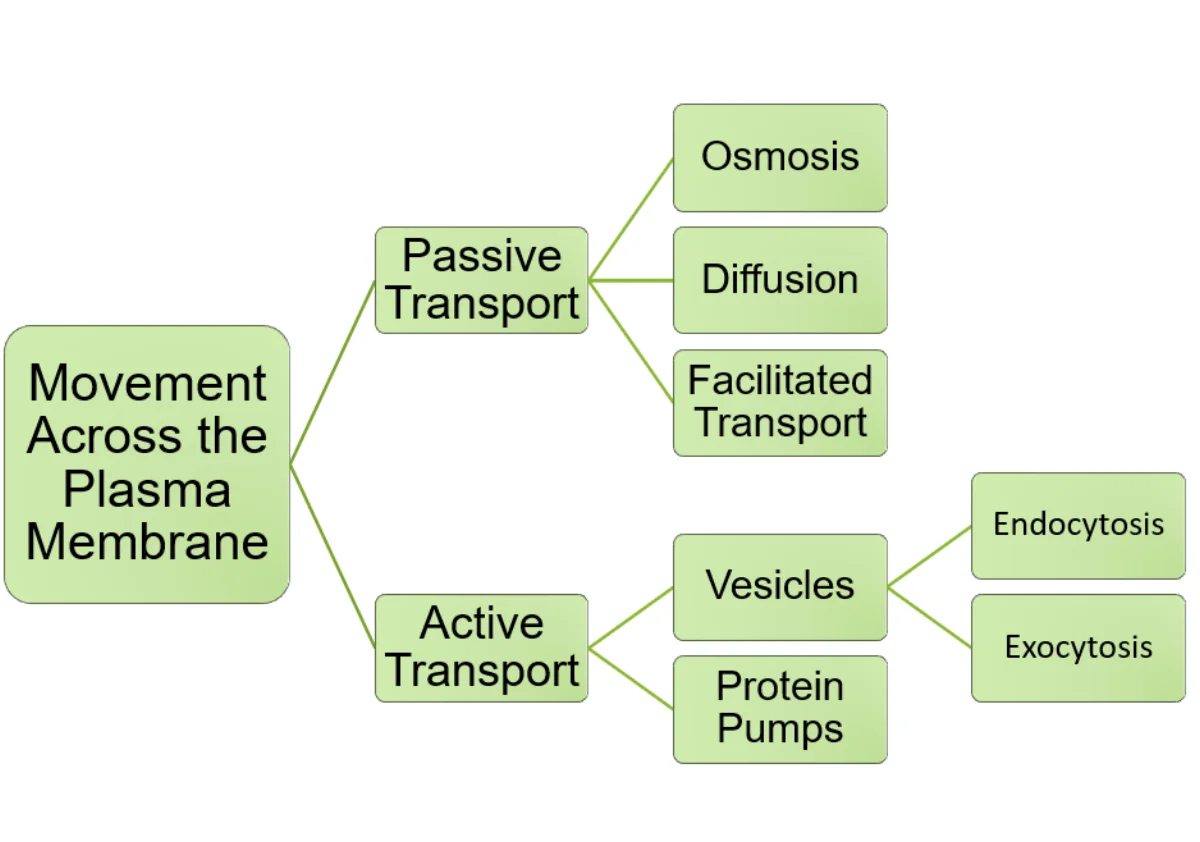
Passive transport moves substances down their concentration or electrochemical gradient without consuming energy. Two varieties: simple diffusion (through the lipid bilayer) and facilitated diffusion (through a protein channel or carrier).
Simple Diffusion
Small, nonpolar molecules cross the bilayer by dissolving through it. O2, CO2, N2, steroid hormones, small uncharged molecules like ethanol - all cross freely. Rate depends on concentration gradient, temperature, and the molecule’s lipid solubility.
Charged molecules and large polar molecules (ions, glucose, amino acids) cannot cross the hydrophobic core effectively. They need a protein to help.
Facilitated Diffusion
Still passive (down the gradient, no ATP), but requires a protein. Two types of proteins:
Channels: hollow tunnels. Ions or small polar molecules flow through. Rate is fast (107-108 per second). Channels can be gated (open/close in response to voltage, ligand, or mechanical stimulus). Examples: voltage-gated Na+ channels, aquaporins for water.
Carriers: bind the substrate, change conformation, release it on the other side. Slower than channels (102-104 per second) but more selective. Examples: GLUT transporters for glucose, GABA transporters.
Transport types across the plasma membrane. Simple diffusion (no protein), facilitated diffusion (channels, carriers - still passive), primary active transport (ATP-driven pumps), and secondary active transport (symporters, antiporters using ion gradients). Credit: Wikimedia Commons, CC BY-SA
Factors Affecting Rate
Gradient: steeper gradient, faster transport.
Temperature: higher T, faster (Arrhenius).
Surface area: more membrane, more transporters, faster.
Molecule properties: for simple diffusion, smaller and more lipophilic = faster. For facilitated diffusion, specificity matters.
Aquaporins
Water can slowly diffuse through the bilayer but much faster through aquaporins - protein channels dedicated to water. Kidneys and some brain regions have high aquaporin expression and can move water rapidly across membranes. Antidiuretic hormone (ADH) inserts aquaporin-2 into collecting duct cells, concentrating urine.
What is the fundamental difference between passive and active transport?
Click to reveal answer
Passive transport moves a substance DOWN its concentration or electrochemical gradient and does not consume energy. Active transport moves a substance AGAINST its gradient and requires energy (typically from ATP hydrolysis or from a coupled ion gradient).
Why do facilitated diffusion carriers show saturation kinetics like enzymes?
Click to reveal answer
A carrier binds its substrate, changes shape, releases it on the other side, and resets. The number of carriers is finite. When substrate is high enough to keep every carrier busy, the rate plateaus at a Vmax. This produces the same Michaelis-Menten-style hyperbolic curve seen with enzymes. Channels, which allow many ions to flow through simultaneously, generally do not show this saturation under physiologic conditions.
Which molecules can cross the lipid bilayer by simple diffusion without protein help?
Click to reveal answer
Small nonpolar molecules (O2, CO2, N2), small uncharged polar molecules at slow rates (water, urea), and lipid-soluble molecules like steroid hormones and ethanol. Ions, large polar molecules (glucose, amino acids), and charged species generally cannot cross without a protein transporter or channel.