
Cell Transport
Now we return to the nightclub bouncer. The cell membrane is selectively permeable - it lets some things through freely, blocks others entirely, and actively drags certain molecules across. Understanding transport is one of the highest-yield topics on the MCAT because it shows up in biology, biochemistry, and even physics passages.
There are two fundamental categories: passive transport (no energy required, molecules move down their concentration gradient) and active transport (energy required, molecules move against their concentration gradient).
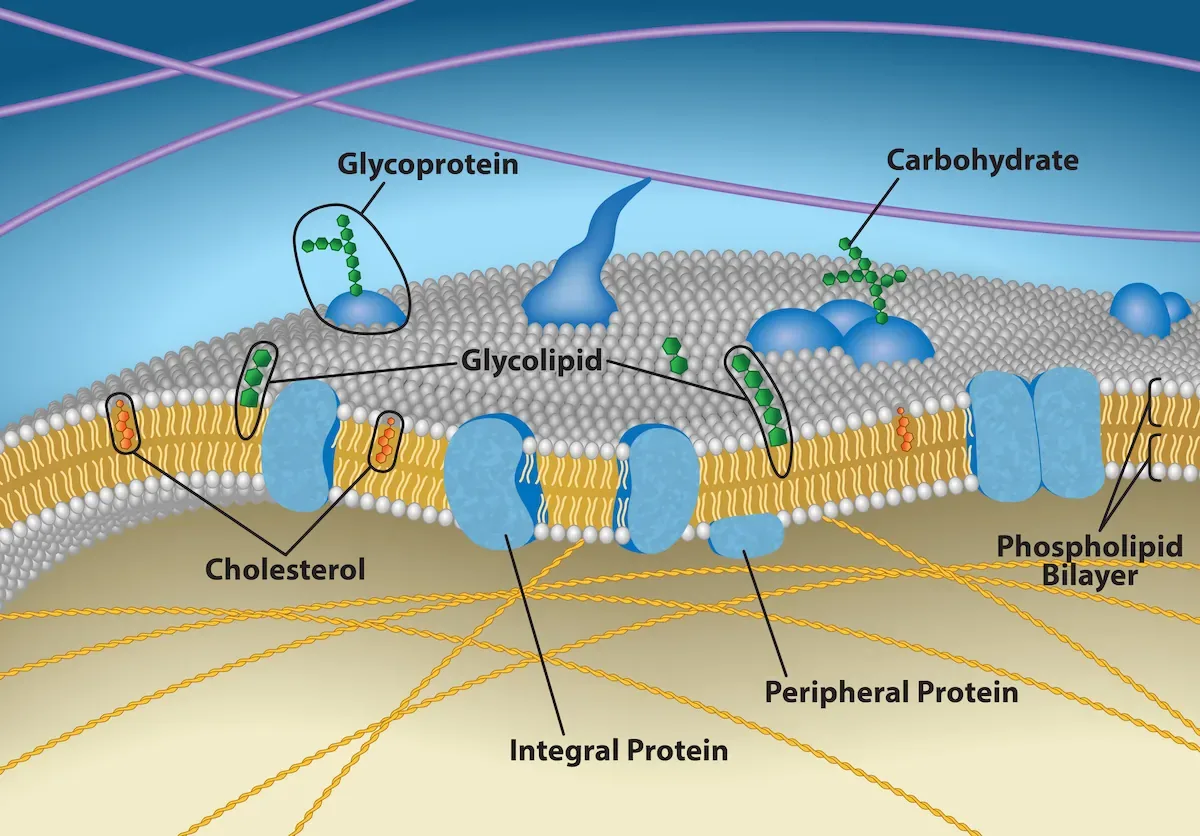
Passive Transport
Passive transport is driven entirely by the concentration gradient - molecules naturally move from areas of high concentration to areas of low concentration. No ATP is spent. No energy is needed. It is as natural as a ball rolling downhill.
Simple Diffusion
The simplest form of transport. Small, nonpolar molecules pass directly through the phospholipid bilayer without any help from proteins. No channel needed, no carrier needed - they just dissolve into the membrane and pass through.
Molecules that cross by simple diffusion:
- O2 and CO2 (small, nonpolar gases)
- Steroid hormones (nonpolar - derived from cholesterol)
- Ethanol and other small, uncharged molecules
Molecules that CANNOT cross by simple diffusion:
- Ions (Na+, K+, Ca2+, Cl-) - too charged
- Glucose, amino acids - too large and polar
- Water - technically polar, but it crosses slowly; most water movement uses aquaporins
Osmosis
Osmosis is the diffusion of water across a selectively permeable membrane, from an area of low solute concentration (high water concentration) to an area of high solute concentration (low water concentration). Water moves to dilute the more concentrated solution. The quantitative treatment of osmotic pressure (π = iMRT) is covered in general chemistry.
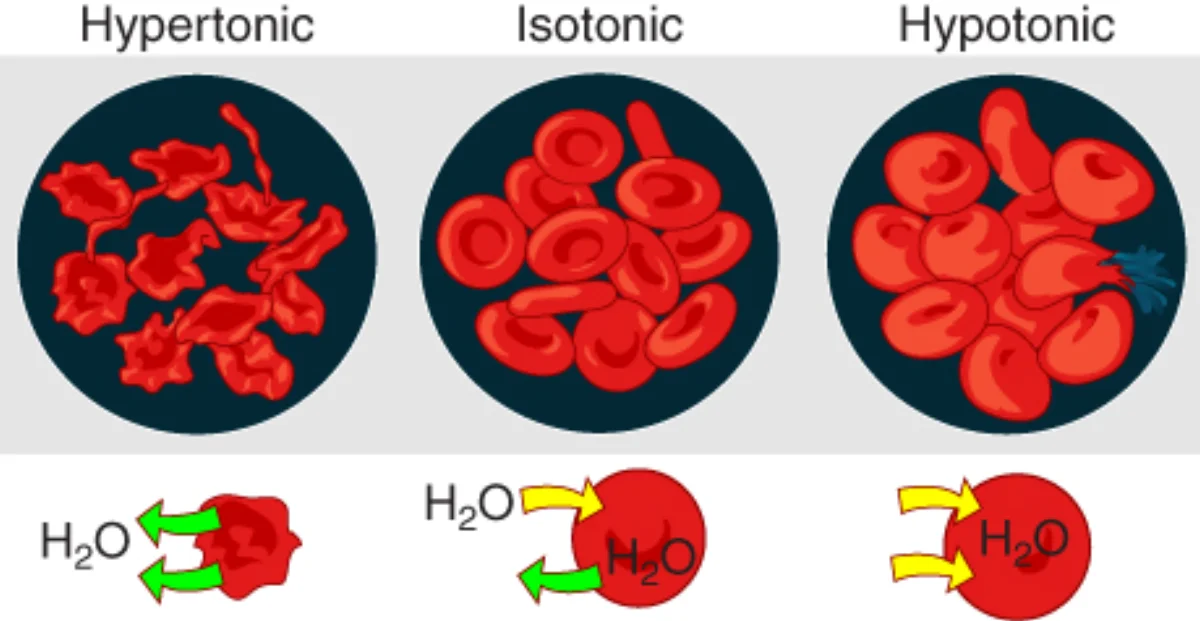
Tonicity describes the effect a solution has on cell volume:
- Hypertonic solution - higher solute concentration outside the cell. Water flows OUT of the cell. The cell shrinks (crenation in animal cells, plasmolysis in plant cells).
- Hypotonic solution - lower solute concentration outside the cell. Water flows INTO the cell. The cell swells (and may lyse in animal cells; plant cells are protected by their cell wall and become turgid).
- Isotonic solution - equal solute concentration inside and outside. No net water movement. Cell volume stays the same.
Facilitated Diffusion
Some molecules are too large, too polar, or too charged to cross the membrane by simple diffusion, but they still move down their concentration gradient (so no energy is needed). They use membrane proteins for help:
- Channel proteins - form a hydrophilic pore through the membrane. They can be gated (opened/closed by a signal) or ungated (always open). Ion channels (Na+, K+, Ca2+, Cl-) are the classic examples. Aquaporins are water channels that speed up osmosis.
- Carrier proteins (transporters) - bind to a specific molecule, change shape, and release it on the other side of the membrane. Glucose enters most cells via the GLUT transporter - a carrier protein that facilitates glucose diffusion down its concentration gradient.
Facilitated diffusion has two important properties:
- Specificity - each channel or carrier is specific for certain molecules
- Saturation - there are a limited number of channels/carriers. At high substrate concentrations, all carriers are occupied, and the transport rate reaches a maximum (Vmax). This is analogous to enzyme saturation.
Active Transport
When a molecule needs to move against its concentration gradient (from low concentration to high concentration), the cell must spend energy. This is active transport - it is like pushing a ball uphill.
Primary Active Transport
Primary active transport uses ATP directly to move molecules against their gradient. The most important example is the Na+/K+ ATPase (sodium-potassium pump):
- Pumps 3 Na+ out of the cell and 2 K+ in per ATP hydrolyzed
- Maintains the electrochemical gradient that is essential for nerve impulse transmission, muscle contraction, and secondary active transport
- Found in virtually every animal cell
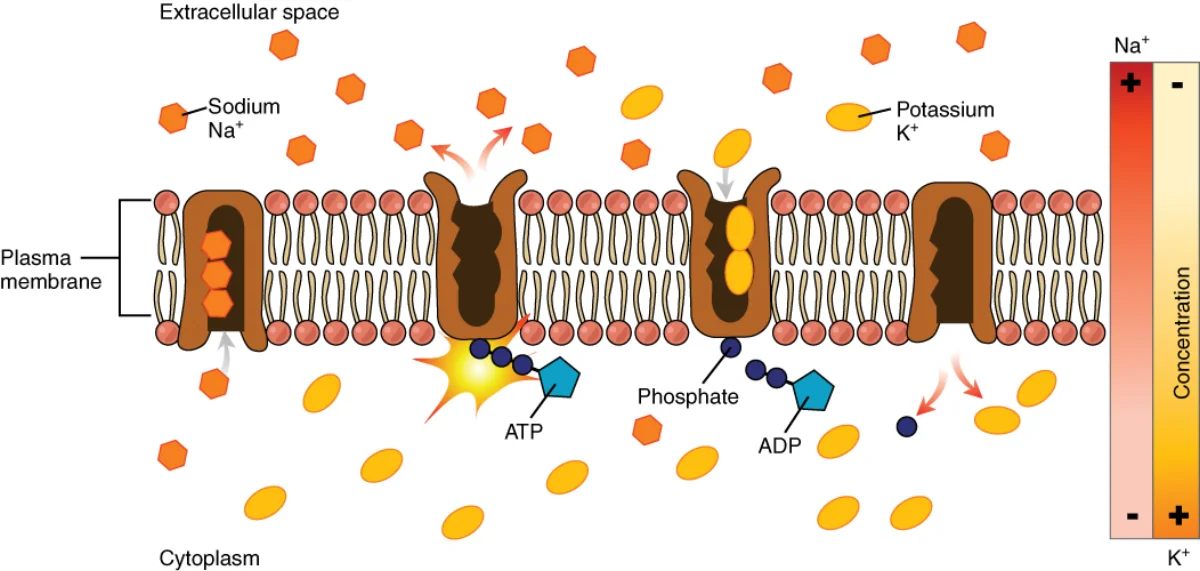
Because 3 positive charges leave and only 2 enter per cycle, the pump is electrogenic - it actively contributes to the negative resting membrane potential, not just the concentration gradient.
Other examples include Ca²⁺ ATPases (pump calcium out of the cytoplasm into the ER or extracellular space) and H⁺/K⁺ ATPase (proton pump in stomach parietal cells that acidifies the stomach).
Secondary Active Transport (Cotransport)
Secondary active transport uses the energy stored in an existing ion gradient (usually the Na+ gradient created by the Na+/K+ ATPase) to drive the transport of another molecule against its gradient. No ATP is directly consumed by the transporter itself, but ATP was used earlier to establish the ion gradient.
- Symport (cotransport) - the ion and the transported molecule move in the same direction. Example: SGLT (sodium-glucose linked transporter) in the intestinal and kidney epithelium - Na⁺ flowing down its gradient drags glucose up its gradient into the cell. The Na⁺/K⁺ ATPase on the basolateral side keeps intracellular Na⁺ low, so SGLT has fuel to run.
- Antiport (exchange) - the ion and the transported molecule move in opposite directions. Example: Na⁺/H⁺ exchanger - sodium flows in while hydrogen is pumped out.
Bulk Transport - Endocytosis and Exocytosis
For very large molecules, particles, or even entire cells, the membrane uses vesicle-mediated transport - wrapping materials in membrane bubbles.
Endocytosis (bringing things in)
Three types:
- Phagocytosis (“cell eating”) - the cell engulfs large particles (bacteria, dead cells) by extending pseudopods around them, forming a phagosome. The phagosome then fuses with a lysosome for digestion. Used by immune cells like macrophages and neutrophils.
- Pinocytosis (“cell drinking”) - the cell takes in small droplets of extracellular fluid along with any dissolved molecules. This is nonspecific - it samples the environment.
- Receptor-mediated endocytosis - the most selective form. Specific molecules (ligands) bind to receptors on the cell surface, causing the membrane to invaginate and form a coated vesicle (often coated with clathrin protein). This is how cells take up LDL cholesterol, transferrin (iron transport), and many hormones.
Exocytosis (pushing things out)
Vesicles inside the cell fuse with the plasma membrane and release their contents to the exterior. This is how:
- Neurotransmitters are released at synapses
- Hormones are secreted by endocrine cells
- Digestive enzymes are released by pancreatic cells
- Antibodies are secreted by plasma cells
Transport Summary Table
| Transport Type | Energy? | Direction | Mechanism | Examples |
|---|---|---|---|---|
| Simple diffusion | No | Down gradient | Directly through bilayer | O2, CO2, steroids |
| Osmosis | No | Down water gradient | Through membrane/aquaporins | Water |
| Facilitated diffusion | No | Down gradient | Via channels or carriers | Glucose (GLUT), ions through channels |
| Primary active transport | Yes (ATP) | Against gradient | ATP-powered pumps | Na+/K+ ATPase, Ca2+ ATPase |
| Secondary active transport | Yes (indirect) | Against gradient | Uses ion gradient energy | Na+-glucose symporter |
| Phagocytosis | Yes | Into cell | Pseudopod engulfment | Macrophage eating bacteria |
| Pinocytosis | Yes | Into cell | Membrane invagination | Nonspecific fluid uptake |
| Receptor-mediated endocytosis | Yes | Into cell | Clathrin-coated vesicles | LDL cholesterol uptake |
| Exocytosis | Yes | Out of cell | Vesicle-membrane fusion | Neurotransmitter release |