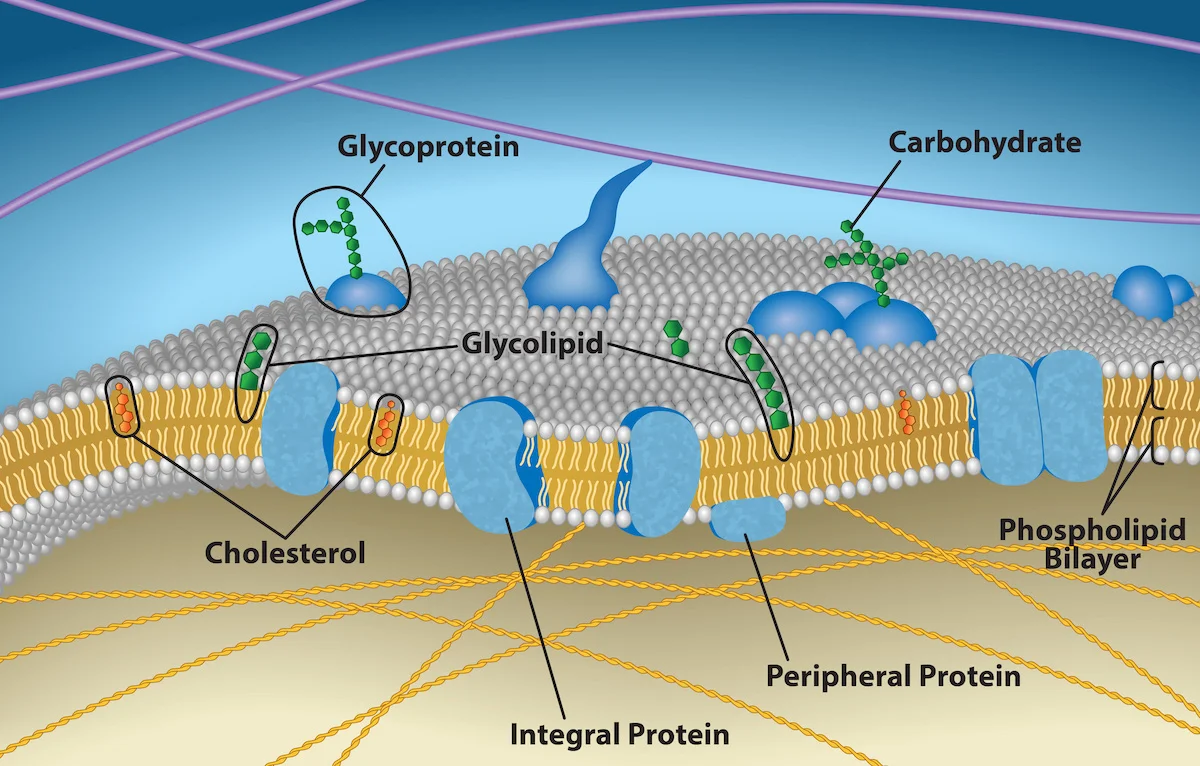
The fluid mosaic model (Singer and Nicolson, 1972) is the standard picture of a cell membrane. Two leaflets of phospholipids with embedded proteins. “Fluid” because lipids and proteins can move laterally; “mosaic” because proteins are scattered throughout the lipid sea.
The fluid mosaic model. Phospholipid bilayer with embedded proteins, cholesterol interleaved between fatty acid tails, and surface glycans facing the extracellular space. Credit: OpenStax Biology 2e, CC BY 4.0
Components
Component
Location
Role
Phospholipids
Both leaflets
Main structural matrix
Cholesterol (animals)
Throughout
Modulates fluidity
Sphingolipids
Mostly outer leaflet
Lipid rafts, signaling
Membrane proteins
Integral, peripheral
Transport, signaling, enzymes, anchors
Glycans on lipids and proteins
Outer leaflet only
Recognition, signaling
Asymmetry
The two leaflets are not identical. Phosphatidylcholine and sphingomyelin are in the outer leaflet. Phosphatidylethanolamine, phosphatidylserine, and phosphatidylinositol are in the inner leaflet. Glycans are always on the outer leaflet. Flippases and floppases (ATP-driven) maintain this asymmetry. Apoptosis flips phosphatidylserine to the outer leaflet as an “eat me” signal.
Membrane Fluidity
Fluidity depends on:
Temperature: higher T → more fluid.
Saturation: more cis double bonds (kinks) → more fluid.
Chain length: shorter tails → more fluid.
Cholesterol: bidirectional buffer - reduces fluidity at high T, prevents gel formation at low T.
Lipid Rafts
Special microdomains enriched in cholesterol, sphingolipids, and certain proteins. Rafts are more ordered than the surrounding membrane. Many signaling receptors cluster in rafts, concentrating their downstream signaling partners together.
Why does increasing the proportion of unsaturated fatty acids increase membrane fluidity?
Click to reveal answer
Cis double bonds create kinks in fatty acid tails. Kinked tails cannot pack as tightly together as straight saturated tails, leaving more space and permitting more lateral movement. The result is a more fluid, less ordered membrane.
How does cholesterol buffer membrane fluidity at both high and low temperatures?
Click to reveal answer
At high temperature, cholesterol's rigid ring restricts the motion of adjacent fatty acid tails, making the membrane less fluid. At low temperature, cholesterol disrupts the tight packing of fatty acid tails, preventing them from freezing into a gel. The net effect is stabilization in both directions.
What determines the asymmetry of the plasma membrane's two leaflets?
Click to reveal answer
ATP-dependent enzymes called flippases and floppases actively move specific lipids between leaflets, maintaining asymmetry. Phosphatidylserine is kept on the inner leaflet normally; scramblases flip it outward during apoptosis as an "eat me" signal for phagocytes. Glycolipids and glycoproteins are always on the outer leaflet with sugars facing the extracellular space.