Some cargoes are too big to cross the membrane. The cell wraps the membrane around them (endocytosis) or wraps the membrane around something inside to release it (exocytosis). Both use vesicles.
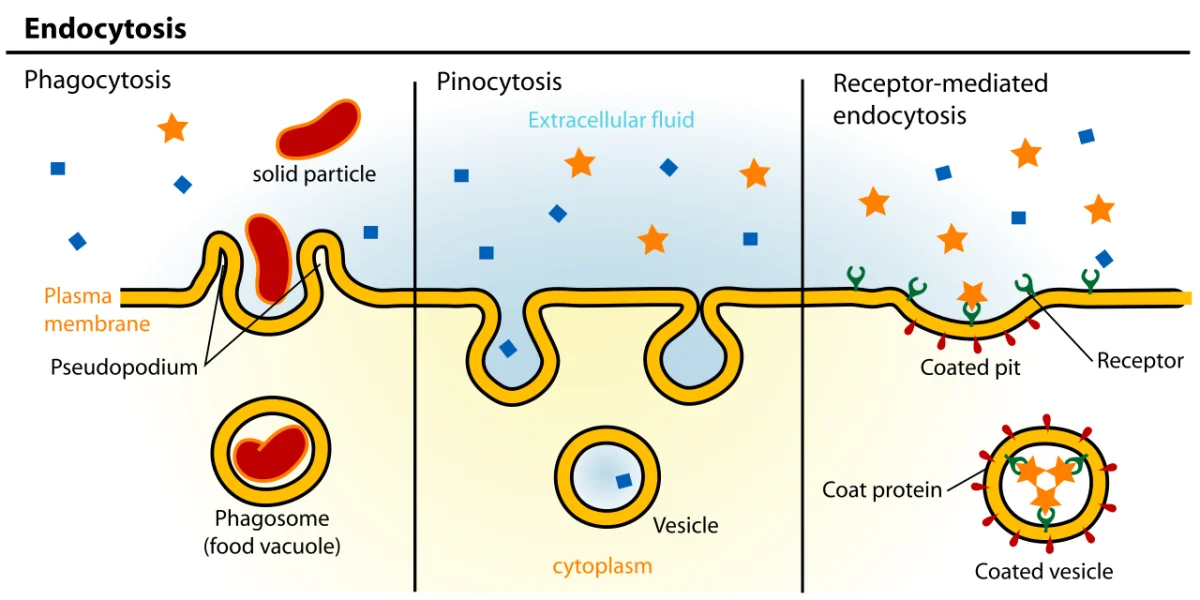
Three endocytosis types. Phagocytosis: engulfing large particles. Pinocytosis: drinking fluid. Receptor-mediated endocytosis: selective uptake via clathrin-coated pits. Credit: Wikimedia Commons, CC BY-SA
Endocytosis Types
Phagocytosis (“cell eating”)
Engulfing solid particles (bacteria, dead cells, debris). Used mostly by specialized immune cells (macrophages, neutrophils). The cell extends pseudopodia around the target, forming a large vesicle (phagosome). The phagosome fuses with a lysosome for degradation.
Pinocytosis (“cell drinking”)
Non-specific uptake of fluid and small dissolved molecules. The cell surface pinches in continuously, engulfing whatever fluid is nearby. No specific receptors involved. Happens constantly in most cells.
Receptor-Mediated Endocytosis
Highly specific. A receptor on the cell surface binds a specific ligand; the receptor-ligand complex clusters in a clathrin-coated pit; the pit pinches off into a vesicle coated with clathrin. The vesicle uncoats and enters the endosomal pathway. This is how cells efficiently import specific cargo (LDL, transferrin, many hormones) even when their blood concentrations are low.
Exocytosis
The reverse of endocytosis. An intracellular vesicle (usually carrying secretory protein cargo, like insulin, a neurotransmitter, or a hormone) fuses with the plasma membrane and releases its contents to the outside. SNARE proteins mediate the fusion. Exocytosis is how cells secrete proteins, discard waste, or deliver new membrane components to the cell surface.
Regulated: vesicles wait near the membrane until a stimulus triggers fusion. Examples: neurotransmitter release at synapses (triggered by Ca2+), insulin release from beta cells (triggered by glucose), hormone secretion.
What distinguishes receptor-mediated endocytosis from pinocytosis?
Click to reveal answer
Receptor-mediated endocytosis requires specific cell-surface receptors that bind specific ligands. Clathrin-coated pits form around clusters of bound receptors and internalize them as vesicles. The result is selective, high-efficiency uptake of specific molecules (e.g., LDL, iron-transferrin). Pinocytosis is non-specific - the cell drinks in whatever fluid and solutes happen to be nearby, without targeting any particular molecule.
How does exocytosis deliver secreted proteins to the outside of the cell?
Click to reveal answer
Proteins destined for secretion are packaged into vesicles (by the Golgi). The vesicle travels to the plasma membrane, where SNARE proteins mediate fusion between the vesicle and the plasma membrane. The fusion event opens the vesicle lumen to the extracellular space, releasing its cargo. The vesicle's membrane is incorporated into the plasma membrane.
Why is familial hypercholesterolemia caused by a defect in endocytosis rather than in LDL production?
Click to reveal answer
LDL is cleared from the blood primarily by receptor-mediated endocytosis. The LDL receptor on hepatocyte surfaces binds LDL particles and internalizes them via clathrin-coated pits. When the LDL receptor is mutated (as in familial hypercholesterolemia), LDL cannot be internalized and accumulates in plasma. The defect is in uptake, not synthesis, of LDL.