Every compound has a chemical formula, but not every formula tells you the same story. There are two types you need to know cold for the MCAT, and confusing them is one of the most common mistakes on test day.
Empirical Formula - The Simplest Ratio
The empirical formula gives you the smallest whole-number ratio of atoms in a compound. It tells you the relative proportions, but not the actual count.
For example, glucose has the empirical formula CH₂O. This tells you that for every carbon atom, there are two hydrogen atoms and one oxygen atom. But it does not tell you how many of each atom are actually in one molecule of glucose.
Molecular Formula - The Actual Count
The molecular formula tells you the exact number of each type of atom in one molecule. Glucose’s molecular formula is C₆H₁₂O₆ - six carbons, twelve hydrogens, six oxygens. That is 6 times the empirical formula (6 x CH₂O).
The molecular formula is always a whole-number multiple of the empirical formula:
Molecular formula = n x (Empirical formula)
where n = molecular weight / empirical formula weight.
How They Connect
Compound
Empirical Formula
Molecular Formula
n
Glucose
CH₂O
C₆H₁₂O₆
6
Acetic acid
CH₂O
C₂H₄O₂
2
Formaldehyde
CH₂O
CH₂O
1
Hydrogen peroxide
HO
H₂O₂
2
Benzene
CH
C₆H₆
6
Notice that glucose, acetic acid, and formaldehyde all share the same empirical formula. The empirical formula alone cannot distinguish between them - you need the molecular weight to determine n and therefore the molecular formula.
Determining the Empirical Formula from Percent Composition
This is a classic MCAT problem type. Here is the step-by-step process:
Assume 100 g of the compound (so percentages become grams directly)
Convert grams to moles for each element (divide by atomic mass)
Divide all mole values by the smallest mole value
Round to the nearest whole number (if you get values like 1.5 or 2.33, multiply all values by 2 or 3 to clear the fraction)
Example: A compound is 40.0% C, 6.7% H, and 53.3% O by mass. Find its empirical formula.
C: 40.0 g / 12.0 g/mol = 3.33 mol
H: 6.7 g / 1.0 g/mol = 6.7 mol
O: 53.3 g / 16.0 g/mol = 3.33 mol
Divide by smallest (3.33): C = 1, H = 2, O = 1
Empirical formula: CH₂O
Determining the Molecular Formula
Once you have the empirical formula and the molecular weight (from mass spectrometry or other data), calculate n:
n = molecular weight / empirical formula weight
For the example above, if the molecular weight is 180 g/mol:
Empirical formula weight of CH₂O = 12 + 2(1) + 16 = 30 g/mol
n = 180 / 30 = 6
Molecular formula: C₆H₁₂O₆ (glucose)
A compound has the empirical formula NO₂ and a molar mass of 92 g/mol. What is its molecular formula?
Click to reveal answer
N₂O₄. Empirical formula weight of NO₂ = 14 + 2(16) = 46 g/mol. n = 4692 = 2. Molecular formula = 2 x NO₂ = N₂O₄ (dinitrogen tetroxide).
Can two different compounds have the same empirical formula?
Click to reveal answer
Yes. Formaldehyde (CH₂O), acetic acid (C₂H₄O₂), and glucose (C₆H₁₂O₆) all share the empirical formula CH₂O. They have the same ratio of atoms but different actual numbers. The molecular weight distinguishes them.
Naming compounds on the MCAT is not about memorizing thousands of names. It is about learning three sets of rules - one for ionic compounds, one for covalent compounds, and one for acids - and applying them consistently.
Ionic Compounds - Metal + Nonmetal
Ionic compounds form when a metal transfers electrons to a nonmetal. The naming rules are straightforward:
Name the cation (metal) first, then the anion (nonmetal) second
The anion gets the suffix -ide
If the metal can form more than one charge (transition metals), use Roman numerals in parentheses to indicate the charge
Formula
Name
NaCl
Sodium chloride
MgO
Magnesium oxide
FeCl₂
Iron(II) chloride
FeCl₃
Iron(III) chloride
CuSO₄
Copper(II) sulfate
Polyatomic Ions - Know the Pattern
You need to recognize common polyatomic ions. Rather than memorizing each one independently, learn the patterns:
The -ate/-ite pattern: For oxyanions (polyatomic ions with oxygen), the -ate form has more oxygen atoms, and the -ite form has fewer:
More O (-ate)
Fewer O (-ite)
NO₃⁻ (nitrate)
NO₂⁻ (nitrite)
SO₄²⁻ (sulfate)
SO₃²⁻ (sulfite)
ClO₃⁻ (chlorate)
ClO₂⁻ (chlorite)
Extended pattern for halogens: When there are four possible oxyanions, add per- (most O) and hypo- (least O):
Ion
Name
Oxygens
ClO₄⁻
Perchlorate
4 (most)
ClO₃⁻
Chlorate
3
ClO₂⁻
Chlorite
2
ClO⁻
Hypochlorite
1 (least)
Other essential polyatomic ions:
Ion
Name
OH⁻
Hydroxide
NH₄⁺
Ammonium
CN⁻
Cyanide
MnO₄⁻
Permanganate
Cr₂O₇²⁻
Dichromate
CrO₄²⁻
Chromate
C₂O₄²⁻
Oxalate
HCO₃⁻
Bicarbonate (hydrogen carbonate)
Covalent Compounds - Nonmetal + Nonmetal
Covalent compounds are named using Greek prefixes to indicate the number of each atom:
Prefix
Number
mono-
1
di-
2
tri-
3
tetra-
4
penta-
5
hexa-
6
Rules:
The first element gets a prefix only if there is more than one atom (never say “monocarbon”)
The second element always gets a prefix AND the -ide suffix
Formula
Name
CO
Carbon monoxide
CO₂
Carbon dioxide
N₂O₄
Dinitrogen tetroxide
PCl₅
Phosphorus pentachloride
SF₆
Sulfur hexafluoride
Naming Acids
Acid naming follows a predictable pattern based on the anion:
If the ion ends in -ate, the acid ends in -ic acid
If the ion ends in -ite, the acid ends in -ous acid
Ion
Acid Formula
Acid Name
SO₄²⁻ (sulfate)
H₂SO₄
Sulfuric acid
SO₃²⁻ (sulfite)
H₂SO₃
Sulfurous acid
NO₃⁻ (nitrate)
HNO₃
Nitric acid
NO₂⁻ (nitrite)
HNO₂
Nitrous acid
ClO₄⁻ (perchlorate)
HClO₄
Perchloric acid
ClO⁻ (hypochlorite)
HClO
Hypochlorous acid
What is the systematic name of Cu₂O?
Click to reveal answer
Copper(I) oxide. The compound has 2 Cu atoms and 1 O²⁻. For the charges to balance: 2(Cu) + (-2) = 0, so each Cu = +1. Therefore, it is copper(I) oxide, not just "copper oxide."
Name the acid HClO₂.
Click to reveal answer
Chlorous acid. ClO₂⁻ is the chlorite ion (-ite ending). Acids from -ite ions get the -ous ending. Therefore HClO₂ is chlorous acid. (Compare: HClO₃, from chlorate, would be chloric acid.)
Atoms are impossibly small. A single carbon atom has a mass of about 2×10⁻²³ grams. You cannot weigh one atom on any balance in any lab. But you can weigh 6.022×10²³ of them - and that clump happens to weigh exactly 12.01 grams, a number you can read right off the periodic table.
That number - 6.022×10²³ - is Avogadro’s number (Nₐ), and it defines the mole.
The Mole - Chemistry’s Counting Word
A “dozen” means 12. A “mole” means 6.022×10²³. That is all it is - a counting word for an absurdly large number.
One mole of any element contains exactly 6.022×10²³ atoms. One mole of any compound contains 6.022×10²³ molecules (or formula units for ionic compounds).
Molar Mass - The Bridge Between Grams and Moles
The molar mass (also called molecular weight or formula weight) is the mass of one mole of a substance, expressed in grams per mole (g/mol). For elements, it is the atomic mass from the periodic table. For compounds, it is the sum of all the atomic masses in the formula.
Examples:
Molar mass of O₂ = 2(16.00) = 32.00 g/mol
Molar mass of H₂O = 2(1.01) + 16.00 = 18.02 g/mol
Molar mass of NaCl = 22.99 + 35.45 = 58.44 g/mol
Molar mass of CaCO₃ = 40.08 + 12.01 + 3(16.00) = 100.09 g/mol
The Mole Map - Your Navigation Tool
Every stoichiometry problem boils down to moving between three quantities: grams, moles, and number of particles. The mole sits at the center of this map.
Start With
Conversion
End With
Grams
Divide by molar mass
Moles
Moles
Multiply by molar mass
Grams
Moles
Multiply by 6.022×10²³
Number of particles
Number of particles
Divide by 6.022×10²³
Moles
Grams of A
Grams → moles → mole ratio → moles
Grams of B
The key insight: you must always pass through moles. You cannot go directly from grams of one substance to grams of another. The route is always grams → moles → ratio → moles → grams.
Working with Avogadro’s Number
Avogadro’s number connects the macroscopic (grams) to the microscopic (atoms, molecules). Here is how it works in practice:
Example: How many water molecules are in 36.04 g of water?
Convert to moles: 36.04 g / 18.02 g/mol = 2.00 mol
Convert to molecules: 2.00 mol×6.022×1023=1.204×1024 molecules
Example: How many oxygen atoms are in 36.04 g of water?
Each water molecule (H₂O) contains 1 oxygen atom. So the number of oxygen atoms equals the number of molecules: 1.204×1024.
But each molecule also has 2 hydrogen atoms: 2×1.204×1024=2.409×1024 hydrogen atoms.
Molar Volume at STP
For gases at standard temperature and pressure (STP: 0°C, 1 atm), one mole of any ideal gas occupies 22.4 liters. This gives you a third conversion pathway:
Liters (at STP) → divide by 22.4 → moles
Moles → multiply by 22.4 → liters (at STP)
This only applies to gases at STP. At other conditions, use the ideal gas law (PV = nRT) from Chapter 8.
How many moles of CO₂ are in 11 grams of carbon dioxide? (C = 12, O = 16)
Click to reveal answer
0.25 mol. Molar mass of CO₂ = 12 + 2(16) = 44 g/mol. Moles = 11 g / 44 g/mol = 0.25 mol. This is a quick mental math example - the MCAT often gives you "friendly" numbers that divide evenly.
At STP, what volume does 0.50 moles of O₂ gas occupy?
Click to reveal answer
11.2 liters. At STP, 1 mole of any ideal gas = 22.4 L. So 0.50 mol x 22.4 L/mol = 11.2 L. This conversion only works at STP (0°C, 1 atm).
Percent composition tells you what fraction of a compound’s mass comes from each element. It is the chemical equivalent of reading a nutrition label - instead of “20% protein, 50% carbohydrate,” you get “40% carbon, 6.7% hydrogen, 53.3% oxygen.”
Calculating Percent Composition
The formula is simple:
Example: Find the percent composition of water (H₂O).
Molar mass of H₂O = 2(1.01) + 16.00 = 18.02 g/mol
% H = [2(1.01) / 18.02] x 100 = 11.2%
% O = [16.00 / 18.02] x 100 = 88.8%
Check: 11.2 + 88.8 = 100.0% ✓
Working Backward - From Percent Composition to Empirical Formula
This is the reverse problem, and the MCAT loves it. Given percent composition data, determine the empirical formula:
Assume 100 g (percentages become grams)
Convert each to moles (divide by atomic mass)
Divide by the smallest mole value
Multiply to clear fractions if needed
Example: A compound is 26.7% C, 2.2% H, and 71.1% O.
C: 26.7 g / 12.01 g/mol = 2.22 mol
H: 2.2 g / 1.008 g/mol = 2.18 mol
O: 71.1 g / 16.00 g/mol = 4.44 mol
Divide by smallest (2.18): C = 1.02, H = 1.00, O = 2.04
Round: C₁H₁O₂ → Empirical formula: CHO₂
Combustion Analysis - The MCAT’s Favorite Method
Combustion analysis is an experimental technique for determining the molecular formula of an unknown organic compound. You burn a sample in excess oxygen and measure the masses of CO₂ and H₂O produced.
The logic is beautifully simple:
All the carbon in the original compound ends up in CO₂
All the hydrogen in the original compound ends up in H₂O
Any remaining mass is oxygen (if the compound contains oxygen)
Combustion Analysis Step-by-Step
Example: 0.255 g of an unknown compound containing only C, H, and O is burned. The combustion produces 0.561 g CO₂ and 0.306 g H₂O. The molecular weight is 180 g/mol. Find the molecular formula.
Step 1: Find moles of C from CO₂.
Moles of CO₂ = 0.561 g / 44.01 g/mol = 0.01275 mol
Moles of C = 0.01275 mol (1:1 ratio in CO₂)
Mass of C = 0.01275 mol x 12.01 g/mol = 0.153 g
Step 2: Find moles of H from H₂O.
Moles of H₂O = 0.306 g / 18.02 g/mol = 0.01698 mol
Moles of H = 2 x 0.01698 = 0.03396 mol (2 H per H₂O)
Mass of H = 0.03396 mol x 1.008 g/mol = 0.0342 g
Step 3: Find mass and moles of O by difference.
Mass of O = 0.255 - 0.153 - 0.0342 = 0.0678 g
Moles of O = 0.0678 g / 16.00 g/mol = 0.00424 mol
Step 4: Find the mole ratio.
Divide by smallest (0.00424): C = 3.01, H = 8.01, O = 1.00
In a combustion analysis, 0.500 g of a compound produced 1.10 g CO₂ and 0.450 g H₂O. Does the compound contain oxygen?
Click to reveal answer
Yes. Mass of C = (441.10) x 12 = 0.300 g. Mass of H = (180.450) x 2 = 0.050 g. Total C + H = 0.350 g. Sample mass = 0.500 g. Remaining 0.150 g must be oxygen (or another element). Since the problem says it is a combustion analysis of a C/H/O compound, the remainder is oxygen.
What is the percent by mass of nitrogen in urea, CO(NH₂)₂? (C = 12, N = 14, O = 16, H = 1)
Click to reveal answer
46.7%. Molar mass of CO(NH₂)₂ = 12 + 16 + 2(14) + 4(1) = 60 g/mol. Mass of N = 2(14) = 28 g/mol. % N = (6028) x 100 = 46.7%. Nearly half of urea's mass is nitrogen, which is why it is used as a nitrogen-rich fertilizer.
A chemical equation is a sentence written in the language of chemistry. Reactants go on the left, products on the right, and an arrow separates them. But the equation is only valid if it is balanced - meaning the same number of each type of atom appears on both sides.
This is not optional. It is the law of conservation of mass: atoms are neither created nor destroyed in a chemical reaction. What goes in must come out, just rearranged.
Conventions for Writing Chemical Equations
Before balancing, you need to know the notation:
Symbol
Meaning
→
Yields (forward reaction)
⇌
Equilibrium (reversible reaction)
(s)
Solid
(l)
Liquid
(g)
Gas
(aq)
Aqueous (dissolved in water)
Δ
Heat applied
Example: 2 H₂(g) + O₂(g) → 2 H₂O(l)
This tells you: two molecules of hydrogen gas react with one molecule of oxygen gas to produce two molecules of liquid water.
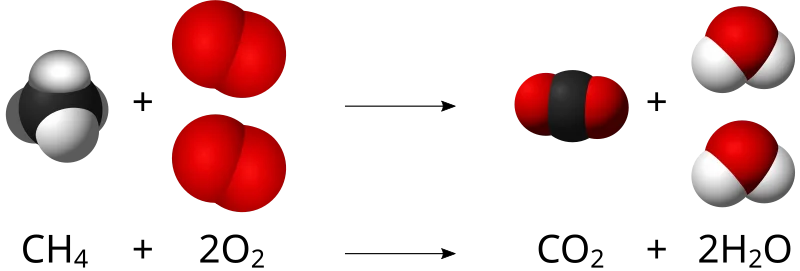
Conservation of mass in action: the balanced combustion of methane. Every atom on the left (1 C, 4 H, 4 O) appears on the right. The coefficients ensure equal atom counts on both sides. Credit: Wikimedia Commons, CC BY-SA 4.0
Stoichiometric Coefficients
The numbers in front of each formula are coefficients. They tell you the mole ratio - the recipe for the reaction.
In the equation above:
2 mol H₂ : 1 mol O₂ : 2 mol H₂O
This ratio is fixed. You always need twice as many moles of H₂ as O₂.
How to Balance Equations - A Systematic Approach
There is no magic formula. But this systematic approach works reliably:
Step 1: Write the unbalanced equation with correct formulas.
Step 2: Balance elements that appear in only one reactant and one product first.
Step 3: Balance hydrogen and oxygen last (they often appear in multiple compounds).
Step 4: Use fractions if needed, then multiply everything by the denominator to clear them.
Step 5: Check your work - count every atom on both sides.
Start with carbon: 3 C on the left → put a 3 in front of CO₂
C₃H₈ + O₂ → 3 CO₂ + H₂O
Balance hydrogen: 8 H on the left → put a 4 in front of H₂O
C₃H₈ + O₂ → 3 CO₂ + 4 H₂O
Balance oxygen: right side has 3(2) + 4(1) = 10 O atoms → put 5 in front of O₂
C₃H₈ + 5 O₂ → 3 CO₂ + 4 H₂O
Check: C: 3 = 3 ✓, H: 8 = 8 ✓, O: 10 = 10 ✓
Common Pitfalls
Never change subscripts to balance an equation. Subscripts define the compound. Changing H₂O to H₂O₂ does not “balance” anything - it changes water into hydrogen peroxide, a completely different substance. Only change coefficients.
Coefficients apply to the entire formula. A coefficient of 2 in front of Ca(OH)₂ means 2 calcium atoms, 4 oxygen atoms, and 4 hydrogen atoms - the coefficient multiplies every subscript in the formula.
Balancing Redox Equations
For redox reactions, balancing can be trickier because you need to balance both mass and charge. The half-reaction method is the most reliable approach (covered in detail in Chapter 11). For now, know the key idea: split the reaction into an oxidation half-reaction and a reduction half-reaction, balance each separately, then combine them so the electrons cancel.
Balance the equation: Al + O₂ → Al₂O₃
Click to reveal answer
4 Al + 3 O₂ → 2 Al₂O₃. Al₂O₃ has 2 Al and 3 O. Put 2 in front of Al₂O₃ to make 4 Al and 6 O on the right. Then 4 Al on the left, and 3 O₂ to get 6 O. Check: 4 Al = 4 Al ✓, 6 O = 6 O ✓.
In the balanced equation 2 C₂H₆ + 7 O₂ → 4 CO₂ + 6 H₂O, what is the mole ratio of O₂ to CO₂?
Click to reveal answer
7:4. The coefficients directly give the mole ratio. For every 7 moles of O₂ consumed, 4 moles of CO₂ are produced. This ratio is the conversion factor you would use in any stoichiometric calculation between these two substances.
Chemical reactions can be classified into a handful of categories based on the pattern of how reactants rearrange into products. Recognizing these patterns lets you predict products without memorizing every individual reaction.
Combination (Synthesis) Reactions
Two or more simple substances combine to form one more complex substance.
The activity series determines whether a displacement reaction will occur. A more active metal displaces a less active metal from solution. If the incoming element is less active than the element in the compound, no reaction occurs.
Double Displacement (Metathesis) Reactions
Two compounds exchange partners. The cations trade anions.
Double displacement reactions are driven by the formation of:
A precipitate (insoluble solid)
Water (neutralization)
A gas (that escapes the solution)
If none of these forms, no net reaction occurs.
Combustion Reactions
A substance reacts with oxygen, typically producing heat and light. For organic compounds (containing C and H), the products are always CO₂ and H₂O.
Pattern: Hydrocarbon + O₂ → CO₂ + H₂O
Examples:
CH₄ + 2 O₂ → CO₂ + 2 H₂O (methane combustion)
2 C₂H₆ + 7 O₂ → 4 CO₂ + 6 H₂O (ethane combustion)
C₃H₈ + 5 O₂ → 3 CO₂ + 4 H₂O (propane combustion)
If the compound also contains oxygen (like ethanol, C₂H₅OH), the products are still CO₂ and H₂O - the oxygen in the compound just reduces the amount of O₂ needed.
Disproportionation Reactions
In a disproportionation reaction, a single element is simultaneously oxidized and reduced. The same species acts as both the oxidizing agent and the reducing agent.
Example:
2 H₂O₂ → 2 H₂O + O₂
In hydrogen peroxide (H₂O₂), oxygen has an oxidation state of -1. In the products, oxygen in H₂O is -2 (reduced) and oxygen in O₂ is 0 (oxidized). The same element (-1 oxygen) both gained and lost electrons.
Another example:
Cl₂ + 2 NaOH → NaCl + NaClO + H₂O
Chlorine starts at 0 and ends up as -1 (in NaCl, reduced) and +1 (in NaClO, oxidized).
Summary Table
Type
Pattern
Driving Force
Combination
A + B → AB
Energy release (usually exothermic)
Decomposition
AB → A + B
Energy input (heat, light, electrolysis)
Single displacement
A + BC → AC + B
Activity series (more active replaces less active)
Double displacement
AB + CD → AD + CB
Precipitate, water, or gas formation
Combustion
Fuel + O₂ → CO₂ + H₂O
Energy release (strongly exothermic)
Disproportionation
A → A(oxidized) + A(reduced)
Same element changes to two oxidation states
Classify this reaction: 2 KI + Pb(NO₃)₂ → PbI₂(s) + 2 KNO₃
Click to reveal answer
Double displacement (metathesis). The cations (K⁺ and Pb²⁺) swap anions (I⁻ and NO₃⁻). It is driven by the formation of PbI₂, an insoluble precipitate that crashes out of solution. The (s) notation confirms this.
What products form when any hydrocarbon undergoes complete combustion?
Click to reveal answer
CO₂ and H₂O. Complete combustion of any hydrocarbon (CₓHᵧ) in excess oxygen always produces carbon dioxide and water. Incomplete combustion (limited O₂) can produce CO or even carbon soot (C), but the MCAT almost always refers to complete combustion unless stated otherwise.
When you are making sandwiches and you have 10 slices of bread but only 3 slices of cheese, the cheese limits your output. You can only make 3 sandwiches. The extra bread sits unused. That is the limiting reagent concept - and it is the single most tested stoichiometry topic on the MCAT.
The Limiting Reagent Determines the Product
The limiting reagent (or limiting reactant) is the reactant that runs out first. It determines the maximum amount of product that can form.
The excess reagent is whatever is left over after the limiting reagent is completely consumed.
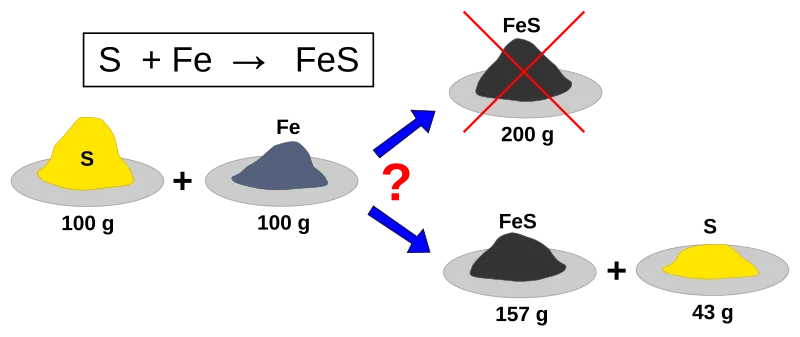
The limiting reagent determines the product. With 100 g each of S and Fe, iron runs out first (it is limiting), producing only 157 g of FeS. The remaining 43 g of sulfur is excess. Credit: Wikimedia Commons, CC BY-SA 4.0
How to Find the Limiting Reagent
There are two reliable methods. Use whichever feels more natural:
Method 1: Compare mole ratios
Convert all reactant amounts to moles
Divide each by its coefficient in the balanced equation
The reactant with the smallest result is the limiting reagent
Method 2: Calculate product from each reactant
Assume each reactant is limiting, one at a time
Calculate the moles of product each would produce
The reactant that produces the least product is the limiting reagent
Worked Example
Problem: Given 10.0 g of N₂ and 10.0 g of H₂, how many grams of NH₃ can be produced?
Balanced equation: N₂ + 3 H₂ → 2 NH₃
Step 1: Convert to moles.
N₂: 10.0 g / 28.0 g/mol = 0.357 mol
H₂: 10.0 g / 2.02 g/mol = 4.95 mol
Step 2: Divide by coefficients.
N₂: 0.357 / 1 = 0.357
H₂: 4.95 / 3 = 1.65
Step 3: Identify limiting reagent.
N₂ gives the smaller value (0.357 < 1.65), so N₂ is limiting
The theoretical yield is the maximum amount of product that can form based on the limiting reagent, assuming the reaction goes to completion with no losses. It is the calculated “perfect” amount.
In the example above, the theoretical yield of NH₃ is 12.1 g. In practice, you would get less than this due to side reactions, incomplete reactions, and mechanical losses during purification.
How Much Excess Reagent Remains?
After the limiting reagent is fully consumed, calculate how much of the excess reagent was actually used, then subtract from the starting amount.
H₂ remaining: 4.95 - 1.071 = 3.88 mol H₂ = 7.83 g H₂ left over
The BCA Table
A BCA table (Before, Change, After) is a systematic way to organize limiting reagent problems. It works identically to an ICE table (which you will use in equilibrium) but for reactions that go to completion.
N₂
3 H₂
2 NH₃
Before
0.357
4.95
0
Change
-0.357
-1.071
+0.714
After
0
3.88
0.714
The limiting reagent is the one that reaches zero in the “After” row.
2 mol of H₂ reacts with 2 mol of O₂ according to 2 H₂ + O₂ → 2 H₂O. What is the limiting reagent and how many moles of water are produced?
Click to reveal answer
H₂ is limiting. 2 mol H₂O produced. Divide by coefficients: H₂ = 22 = 1, O₂ = 12 = 2. H₂ gives the smaller value, so it is limiting. 2 mol H₂ x (2 mol H₂O / 2 mol H₂) = 2 mol H₂O. Only 1 mol O₂ is used; 1 mol O₂ remains in excess.
Why does using the excess reagent to calculate yield give a wrong answer?
Click to reveal answer
Because not all of the excess reagent reacts. The excess reagent has more moles than needed. If you calculate from it, you assume all of it reacts - but the limiting reagent runs out before the excess reagent is consumed. You would overestimate the product. Always use the limiting reagent for yield calculations.
In a perfect world, every reaction would produce exactly the amount of product predicted by stoichiometry. In reality, they never do. Some product sticks to the glassware. Some reactant undergoes a side reaction. Some product decomposes before you can collect it. The gap between what you should get and what you actually get is measured by percent yield.
Three Types of Yield
Term
Definition
Theoretical yield
Maximum product possible, calculated from the limiting reagent (the “perfect” amount)
Actual yield
Amount of product you actually isolate in the lab (always measured experimentally)
Percent yield
(Actual yield / Theoretical yield) x 100%
Why Percent Yield is Always Less Than 100%
Several factors reduce actual yield:
Incomplete reactions - not all reactant converts to product (equilibrium is reached before completion)
Side reactions - reactants form unwanted byproducts
Mechanical losses - product left on glassware, lost during filtration or transfer
Purification losses - product lost during recrystallization, distillation, or chromatography
Decomposition - some product breaks down before collection
Worked Example
Problem: A student reacts 5.00 g of zinc with excess hydrochloric acid. The balanced equation is:
Zn + 2 HCl → ZnCl₂ + H₂
The student collects 0.125 g of H₂. What is the percent yield?
Step 1: Calculate theoretical yield.
Moles of Zn = 5.00 g / 65.38 g/mol = 0.0765 mol
HCl is in excess, so Zn is the limiting reagent
Mole ratio: 1 mol Zn → 1 mol H₂
Theoretical moles of H₂ = 0.0765 mol
Theoretical yield = 0.0765 mol x 2.016 g/mol = 0.154 g
Step 2: Calculate percent yield.
% yield = (0.125 g / 0.154 g) x 100% = 81.2%
Working Backward from Percent Yield
The MCAT might give you a percent yield and ask you to find how much reactant you need to produce a desired amount of product.
Example: You need 50.0 g of product. The reaction has a 75% yield. How many grams of theoretical yield do you need?
Theoretical yield = actual yield / (% yield / 100) = 50.0 / 0.75 = 66.7 g
Then calculate the reactant needed for 66.7 g of product using standard stoichiometry.
What Percent Yield Greater Than 100% Means
If your calculated percent yield exceeds 100%, it does not mean you created matter from nothing. It means your product is impure. Common causes:
Product was not fully dried (residual solvent adds mass)
Product is contaminated with unreacted starting material or byproducts
Product absorbed moisture from the air
This is a favorite MCAT distractor. If a question asks “a student obtained a 110% yield, what is the most likely explanation?” the answer is always contamination or incomplete drying - never that the reaction was unusually efficient.
A reaction has a theoretical yield of 25.0 g and a percent yield of 88%. How many grams of product were actually obtained?
Click to reveal answer
22.0 g. Actual yield = theoretical yield x (% yield / 100) = 25.0 x 0.88 = 22.0 g. The student actually collected 22.0 g out of the 25.0 g that was theoretically possible.
A three-step synthesis has yields of 95%, 90%, and 85% for each step. What is the overall percent yield?
Click to reveal answer
72.7%. Overall yield = 0.95 x 0.90 x 0.85 = 0.727 = 72.7%. Each step compounds the losses. This is why shorter synthetic routes are preferred in practice - and why maximizing the yield of each individual step matters so much.
Concentration tells you how much solute is dissolved in a given amount of solution or solvent. There are four concentration units you need for the MCAT, and each is defined slightly differently. Knowing which one to use - and why - is the key.
Molarity (M) - Moles per Liter of Solution
Molarity is the most commonly used concentration unit in chemistry. It measures the number of moles of solute per liter of total solution.
Example: Dissolve 58.44 g of NaCl (1 mole) in enough water to make 500 mL of solution.
M = 1 mol / 0.500 L = 2.0 M NaCl
Key limitation: Molarity changes with temperature because volume expands and contracts when heated or cooled. This is why colligative property equations use molality instead.
Molality (m) - Moles per Kilogram of Solvent
Molality measures the number of moles of solute per kilogram of solvent (not total solution).
Mole Fraction (X) - Ratio of Moles
Mole fraction is the ratio of moles of one component to the total moles of all components.
Example: A solution contains 2 mol of ethanol and 8 mol of water.
Xethanol = 2 / (2 + 8) = 0.20
Xwater = 8 / (2 + 8) = 0.80
Check: 0.20 + 0.80 = 1.00 ✓
Normality (N) - Equivalents per Liter
Normality measures the number of equivalents per liter of solution. An equivalent is the amount of substance that reacts with or supplies one mole of the relevant species (H⁺, OH⁻, or electrons, depending on the reaction type).
Examples:
HCl donates 1 H⁺: N = M x 1 (normality = molarity)
H₂SO₄ donates 2 H⁺: N = M x 2 (1 M H₂SO₄ = 2 N)
H₃PO₄ donates 3 H⁺: N = M x 3 (1 M H₃PO₄ = 3 N)
Comparison Table
Unit
Formula
Denominator
Temperature Dependent?
When to Use
Molarity (M)
mol solute / L solution
Solution volume
Yes
Most lab calculations, dilution, titration
Molality (m)
mol solute / kg solvent
Solvent mass
No
Colligative properties (ΔTb, ΔTf)
Mole fraction (X)
mol A / total mol
Total moles
No
Raoult’s law, Dalton’s law
Normality (N)
equivalents / L solution
Solution volume
Yes
Acid-base titrations, redox
Why do colligative property equations use molality rather than molarity?
Click to reveal answer
Because molality is temperature-independent. Molarity depends on solution volume, which changes with temperature (thermal expansion). Molality depends on solvent mass, which does not change with temperature. Since colligative properties like boiling point elevation depend on temperature, using a temperature-dependent concentration unit would create circular calculations.
What is the normality of a 0.5 M H₂SO₄ solution used as an acid?
Click to reveal answer
1.0 N. H₂SO₄ is a diprotic acid that can donate 2 H⁺ per molecule. N = M x n = 0.5 x 2 = 1.0 N. Each mole of H₂SO₄ provides 2 equivalents of H⁺.
Dilution is simple: you add more solvent to a solution to decrease its concentration. The amount of solute does not change - you are just spreading it through more liquid. This one idea gives you the most useful equation in solution chemistry.
The Dilution Equation
Why it works: Molarity times volume equals moles (mol/L x L = mol). When you dilute, you do not add or remove solute - only solvent. So the moles before dilution equal the moles after dilution.
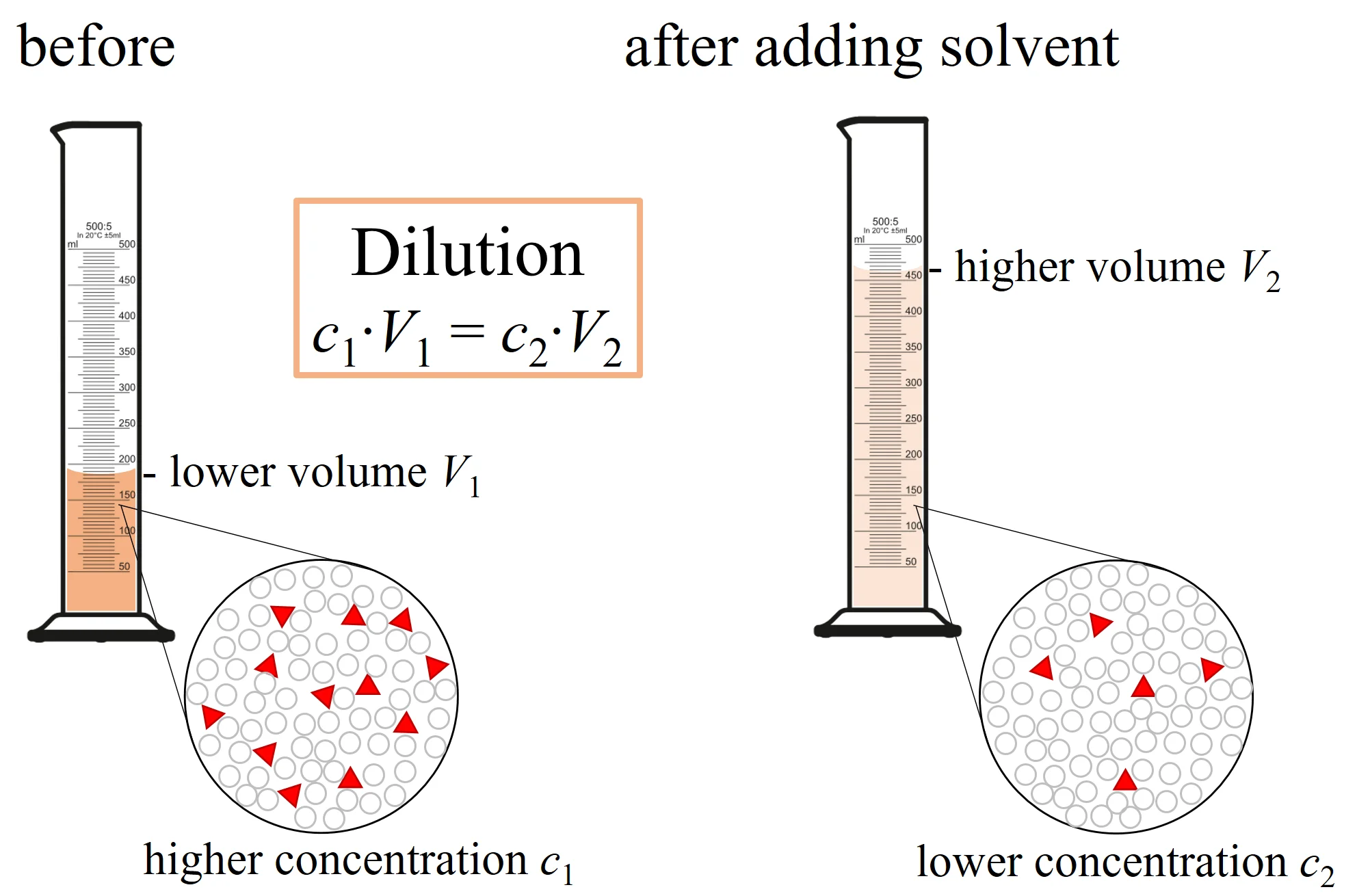
Dilution in action. The same number of solute particles (red triangles) are spread through a larger volume of solvent. Concentration decreases but total moles remain constant: c₁V₁ = c₂V₂. Credit: Wikimedia Commons, CC BY-SA 4.0
Worked Example
Problem: You have 50.0 mL of 6.0 M HCl. How much water must you add to make a 1.0 M solution?
Step 1: Identify variables.
M1 = 6.0 M, V1 = 50.0 mL
M2 = 1.0 M, V2 = ?
Step 2: Solve for V2.
M1V1 = M2V2
(6.0)(50.0) = (1.0)(V2)
V2 = 300 mL
Step 3: Find water added.
Water added = V2 - V1 = 300 - 50.0 = 250 mL
Note the question asked how much water to add, not the final volume. This is a common MCAT trap - read carefully.
When M1V1 = M2V2 Does NOT Apply
This equation only works when the moles of solute stay constant. It does not apply when:
A chemical reaction occurs - if mixing two solutions produces a reaction, you cannot use M1V1 = M2V2 for the reacting species
You mix two solutions of the same solute - this is a mixing problem, not a dilution. Use: Mfinal = (M1V1 + M2V2) / (V1 + V2)
Solute is added or removed - the equation assumes only solvent changes
Serial Dilutions
A serial dilution is a sequence of dilutions, each using the product of the previous step as the starting solution. They are used to achieve very low concentrations efficiently.
Example: Starting with 1.0 M NaCl, perform three consecutive 1:10 dilutions.
After dilution 1: 1.0 / 10 = 0.10 M
After dilution 2: 0.10 / 10 = 0.010 M
After dilution 3: 0.010 / 10 = 0.0010 M = 1.0×10⁻³ M
Each 1:10 dilution divides the concentration by 10. Three such dilutions give a 1:1000 overall dilution factor.
Preparing Standard Solutions
Labs often prepare standard solutions by diluting a concentrated stock solution. The process:
Calculate the volume of stock solution needed using M1V1 = M2V2
Measure that volume with a pipette
Transfer to a volumetric flask
Add solvent until the solution reaches the calibration mark on the flask
Example: Prepare 250 mL of 0.10 M NaOH from a 2.0 M stock solution.
V1 = M2V2 / M1 = (0.10)(250) / (2.0) = 12.5 mL of stock solution
Add 12.5 mL of 2.0 M NaOH to a 250 mL volumetric flask, then fill to the mark with water
You dilute 25 mL of 12 M HCl to a final volume of 300 mL. What is the final concentration?
Click to reveal answer
1.0 M. M2 = M1V1 / V2 = (12)(25) / (300) = 1.0 M. The concentration dropped by a factor of 12 because the volume increased by a factor of 12 (from 25 to 300 mL).
Why can you not use M1V1 = M2V2 when mixing 50 mL of 1.0 M HCl with 50 mL of 1.0 M NaOH?
Click to reveal answer
Because a chemical reaction occurs. HCl and NaOH undergo a neutralization reaction (HCl + NaOH -> NaCl + H2O). The moles of HCl and NaOH are consumed - they do not simply spread through more volume. M1V1 = M2V2 requires that the solute moles remain unchanged, which is not the case when a reaction destroys the solute.
Solution stoichiometry is regular stoichiometry with one extra step: converting between volume and moles using molarity. If you can do grams-to-moles conversions and use mole ratios, you can do solution stoichiometry. The only new tool is the relationship M x V = moles.
The Key Relationship
Worked Example - Precipitation Reaction
Problem: How many mL of 0.200 M AgNO3 are needed to completely react with 35.0 mL of 0.100 M NaCl?
moles NaCl = M x V = (0.100 mol/L)(0.0350 L) = 0.00350 mol
Step 2: Use mole ratio.
1 mol AgNO3 : 1 mol NaCl
moles AgNO3 needed = 0.00350 mol
Step 3: Convert moles to volume.
V = moles / M = 0.00350 / 0.200 = 0.0175 L = 17.5 mL
Titration Calculations
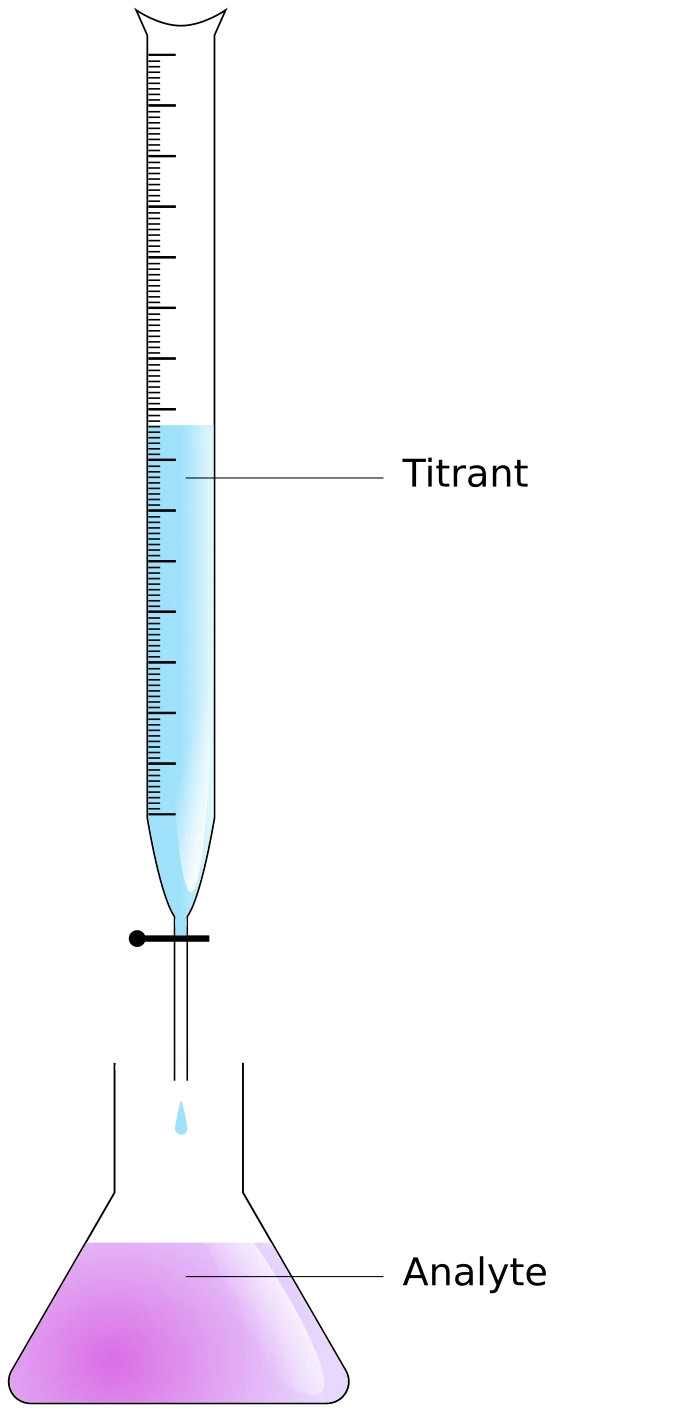
A titration is a controlled reaction between a solution of known concentration (the titrant, in the buret) and a solution of unknown concentration (the analyte, in the flask). The goal is to find the unknown concentration.
A standard titration setup. The titrant (known concentration) is added drop by drop from the buret into the Erlenmeyer flask containing the analyte (unknown concentration). The color change at the equivalence point signals that stoichiometrically equal amounts have reacted. Credit: Wikimedia Commons, CC BY 2.0
At the equivalence point, the titrant has supplied exactly enough moles to react completely with the analyte. No excess of either remains.
Titration Worked Example
Problem: A 25.0 mL sample of HCl of unknown concentration is titrated with 0.150 M NaOH. The equivalence point is reached after 32.0 mL of NaOH is added. What is the concentration of HCl?
Here, 1 mole of H2SO4 reacts with 2 moles of NaOH. At the equivalence point:
moles NaOH = 2 x moles H2SO4
If 20.0 mL of 0.100 M H2SO4 is titrated with 0.100 M NaOH:
moles H2SO4 = (0.100)(0.0200) = 0.00200 mol
moles NaOH needed = 2 x 0.00200 = 0.00400 mol
Volume NaOH = 0.00400 / 0.100 = 0.0400 L = 40.0 mL
Notice it took twice the volume of NaOH even though the molarities were equal - because each H2SO4 molecule requires two NaOH molecules.
Titration vs. Dilution - Do Not Confuse Them
Both use M x V, but for completely different reasons:
Dilution
Titration
What happens
Add solvent to reduce concentration
Add a reactant to consume the analyte
Chemical reaction?
No
Yes
Equation
M1V1 = M2V2 (same solute)
M_aV_a = M_bV_b (different solutes reacting)
What stays constant
Moles of solute
Nothing - moles are consumed
Purpose
Prepare a less concentrated solution
Determine an unknown concentration
Back Titration
Sometimes the analyte does not react cleanly with an indicator or is insoluble. In a back titration, you add a known excess of one reagent, let it react with the analyte, and then titrate the leftover excess with a second standard solution.
Logic:
Moles of reagent added (known)
Moles of reagent that reacted with the analyte = moles added - moles left over
Use stoichiometry to find moles of analyte
This technique appears in MCAT passages about antacids (excess HCl + antacid, then titrate remaining HCl with NaOH) and calcium carbonate analysis.
What volume of 0.250 M KOH is needed to neutralize 40.0 mL of 0.125 M H2SO4?
Click to reveal answer
40.0 mL. H2SO4 + 2 KOH -> K2SO4 + 2 H2O. Moles H2SO4 = (0.125)(0.0400) = 0.00500 mol. Moles KOH needed = 2 x 0.00500 = 0.0100 mol. Volume KOH = 0.0100 / 0.250 = 0.0400 L = 40.0 mL. Even though H2SO4 has a lower molarity, the volumes are equal because each H2SO4 requires 2 KOH - the 2:1 ratio compensates for the concentration difference.
How does a titration calculation differ from a dilution calculation, even though both use M x V?
Click to reveal answer
Dilution preserves moles (no reaction); titration consumes moles (reaction occurs). In dilution, M1V1 = M2V2 because the same solute is simply spread through more volume. In titration, M_aV_a = M_bV_b (for 1:1 reactions) because the moles of acid are consumed by an equal number of moles of base. The equations look similar but describe fundamentally different processes.
Density and dimensional analysis are not glamorous topics, but they are the backbone of MCAT quantitative reasoning. Density connects mass to volume. Dimensional analysis connects everything else. Together, they let you solve multi-step problems by chaining conversion factors until your units work out.
Density
Key density values for the MCAT:
Water: 1.00 g/mL (at 4 degrees C, where water is densest)
Ice: 0.917 g/mL (less dense than liquid water - this is why ice floats)
Most organic liquids: 0.7-0.9 g/mL (less dense than water)
Most metals: much greater than 1.0 g/mL
Density as a Conversion Factor
Density is a fraction (g/mL), so you can use it as a conversion factor in two directions:
Mass to volume: divide by density (or multiply by 1/d)
Volume to mass: multiply by density
Example: What is the mass of 250 mL of ethanol (d = 0.789 g/mL)?
mass = V x d = 250 mL x 0.789 g/mL = 197 g
Example: What volume does 500 g of mercury occupy (d = 13.6 g/mL)?
V = m / d = 500 g / 13.6 g/mL = 36.8 mL
Specific Gravity
Specific gravity is commonly used in clinical settings. Urine specific gravity (normally 1.005-1.030) indicates how concentrated the urine is. Blood has a specific gravity of about 1.06. These values appear in MCAT passages.
Dimensional Analysis (Factor-Label Method)
Dimensional analysis is a systematic method for converting between units by multiplying by conversion factors that equal 1.
The rules:
Write down your starting value with its units
Multiply by conversion factors arranged so that unwanted units cancel
Continue until you reach the desired units
If the units work out, the math is set up correctly
Worked Example - Multi-Step Conversion
Problem: Convert 5.0 kg of aluminum to the number of atoms. (Molar mass of Al = 27.0 g/mol)
Each step converts one unit to the next: mL -> g -> mol -> molecules.
Density of Solutions
For solutions, density connects the total mass of the solution to its volume. This lets you convert between concentration units.
Example: Converting molarity to molality using density.
A 2.00 M NaCl solution has a density of 1.08 g/mL. Find the molality.
Take 1.00 L of solution as a basis
Moles of NaCl = 2.00 mol
Mass of solution = 1000 mL x 1.08 g/mL = 1080 g
Mass of NaCl = 2.00 mol x 58.44 g/mol = 116.9 g
Mass of solvent = 1080 - 116.9 = 963.1 g = 0.9631 kg
Molality = 2.00 mol / 0.9631 kg = 2.08 m
This type of conversion requires density as the bridge between volume-based (molarity) and mass-based (molality) concentration units.
A liquid has a specific gravity of 0.85. What does this tell you about whether it floats or sinks in water, and what is its density?
Click to reveal answer
It floats. Density = 0.85 g/mL. Specific gravity less than 1 means the substance is less dense than water, so it floats. Since the density of water is 1.00 g/mL, the specific gravity equals the density numerically: 0.85 g/mL. This is typical of organic liquids like oils and many organic solvents.
How would you convert 2.5 L of a solution with density 1.20 g/mL and 30% solute by mass into grams of solute?
Click to reveal answer
900 g. Chain the conversions: 2.5 L x (1000 mL / 1 L) x (1.20 g / 1 mL) x (30 g solute / 100 g solution) = 900 g solute. Dimensional analysis makes the path clear: volume -> mass of solution -> mass of solute. Each conversion factor cancels the previous unit and introduces the next.