
Solution Stoichiometry
Solution stoichiometry is regular stoichiometry with one extra step: converting between volume and moles using molarity. If you can do grams-to-moles conversions and use mole ratios, you can do solution stoichiometry. The only new tool is the relationship M x V = moles.
The Key Relationship
Worked Example - Precipitation Reaction
Problem: How many mL of 0.200 M AgNO3 are needed to completely react with 35.0 mL of 0.100 M NaCl?
Balanced equation: AgNO3 + NaCl -> AgCl(s) + NaNO3
Step 1: Find moles of NaCl.
- moles NaCl = M x V = (0.100 mol/L)(0.0350 L) = 0.00350 mol
Step 2: Use mole ratio.
- 1 mol AgNO3 : 1 mol NaCl
- moles AgNO3 needed = 0.00350 mol
Step 3: Convert moles to volume.
- V = moles / M = 0.00350 / 0.200 = 0.0175 L = 17.5 mL
Titration Calculations
A titration is a controlled reaction between a solution of known concentration (the titrant, in the buret) and a solution of unknown concentration (the analyte, in the flask). The goal is to find the unknown concentration.
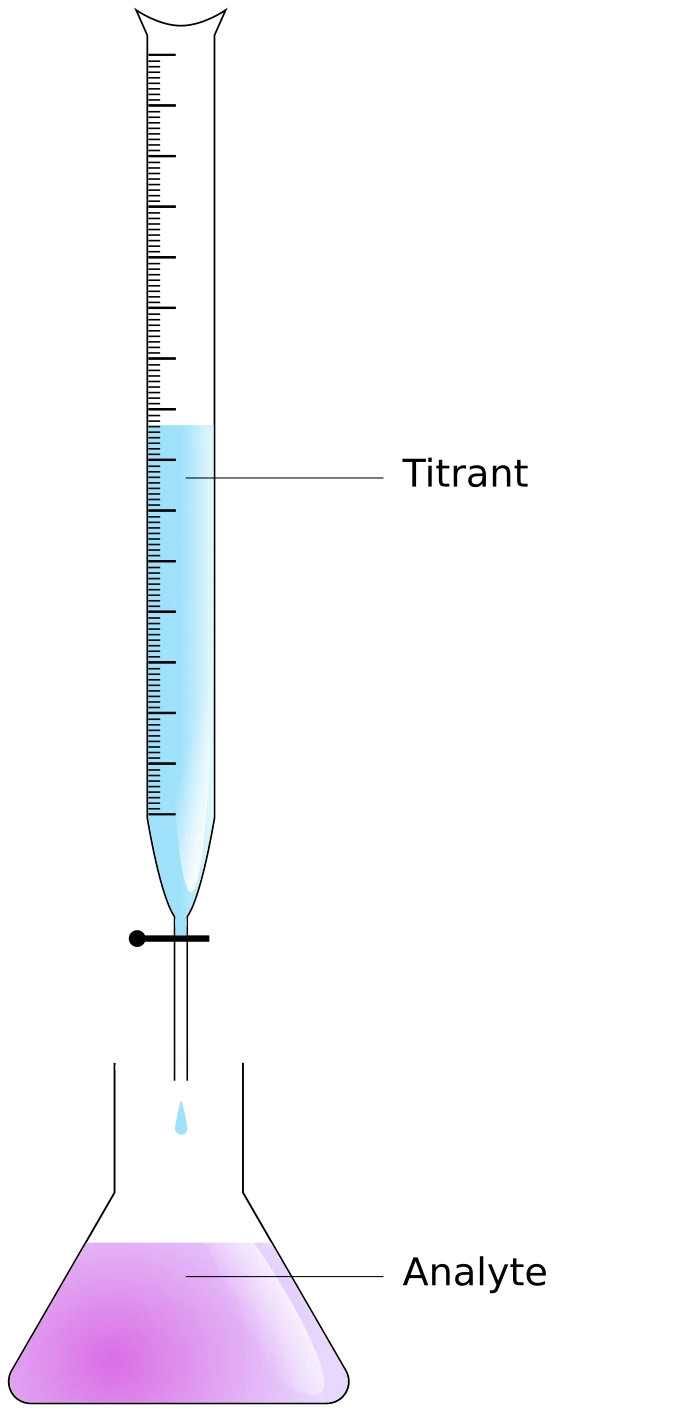
At the equivalence point, the titrant has supplied exactly enough moles to react completely with the analyte. No excess of either remains.
Titration Worked Example
Problem: A 25.0 mL sample of HCl of unknown concentration is titrated with 0.150 M NaOH. The equivalence point is reached after 32.0 mL of NaOH is added. What is the concentration of HCl?
Balanced equation: HCl + NaOH -> NaCl + H2O (1:1 ratio)
Step 1: Find moles of NaOH used.
- moles NaOH = (0.150)(0.0320) = 0.00480 mol
Step 2: Use mole ratio.
- 1 mol HCl : 1 mol NaOH
- moles HCl = 0.00480 mol
Step 3: Find molarity of HCl.
- M = moles / V = 0.00480 / 0.0250 = 0.192 M HCl
Non-1:1 Titrations
When the acid and base react in a ratio other than 1:1, you must account for stoichiometry.
Example: Titrating H2SO4 with NaOH.
Balanced equation: H2SO4 + 2 NaOH -> Na2SO4 + 2 H2O
Here, 1 mole of H2SO4 reacts with 2 moles of NaOH. At the equivalence point:
moles NaOH = 2 x moles H2SO4
If 20.0 mL of 0.100 M H2SO4 is titrated with 0.100 M NaOH:
- moles H2SO4 = (0.100)(0.0200) = 0.00200 mol
- moles NaOH needed = 2 x 0.00200 = 0.00400 mol
- Volume NaOH = 0.00400 / 0.100 = 0.0400 L = 40.0 mL
Notice it took twice the volume of NaOH even though the molarities were equal - because each H2SO4 molecule requires two NaOH molecules.
Titration vs. Dilution - Do Not Confuse Them
Both use M x V, but for completely different reasons:
| Dilution | Titration | |
|---|---|---|
| What happens | Add solvent to reduce concentration | Add a reactant to consume the analyte |
| Chemical reaction? | No | Yes |
| Equation | M1V1 = M2V2 (same solute) | M_aV_a = M_bV_b (different solutes reacting) |
| What stays constant | Moles of solute | Nothing - moles are consumed |
| Purpose | Prepare a less concentrated solution | Determine an unknown concentration |
Back Titration
Sometimes the analyte does not react cleanly with an indicator or is insoluble. In a back titration, you add a known excess of one reagent, let it react with the analyte, and then titrate the leftover excess with a second standard solution.
Logic:
- Moles of reagent added (known)
- Moles of reagent that reacted with the analyte = moles added - moles left over
- Use stoichiometry to find moles of analyte
This technique appears in MCAT passages about antacids (excess HCl + antacid, then titrate remaining HCl with NaOH) and calcium carbonate analysis.