
Dilution Calculations
Dilution is simple: you add more solvent to a solution to decrease its concentration. The amount of solute does not change - you are just spreading it through more liquid. This one idea gives you the most useful equation in solution chemistry.
The Dilution Equation
Why it works: Molarity times volume equals moles (mol/L x L = mol). When you dilute, you do not add or remove solute - only solvent. So the moles before dilution equal the moles after dilution.
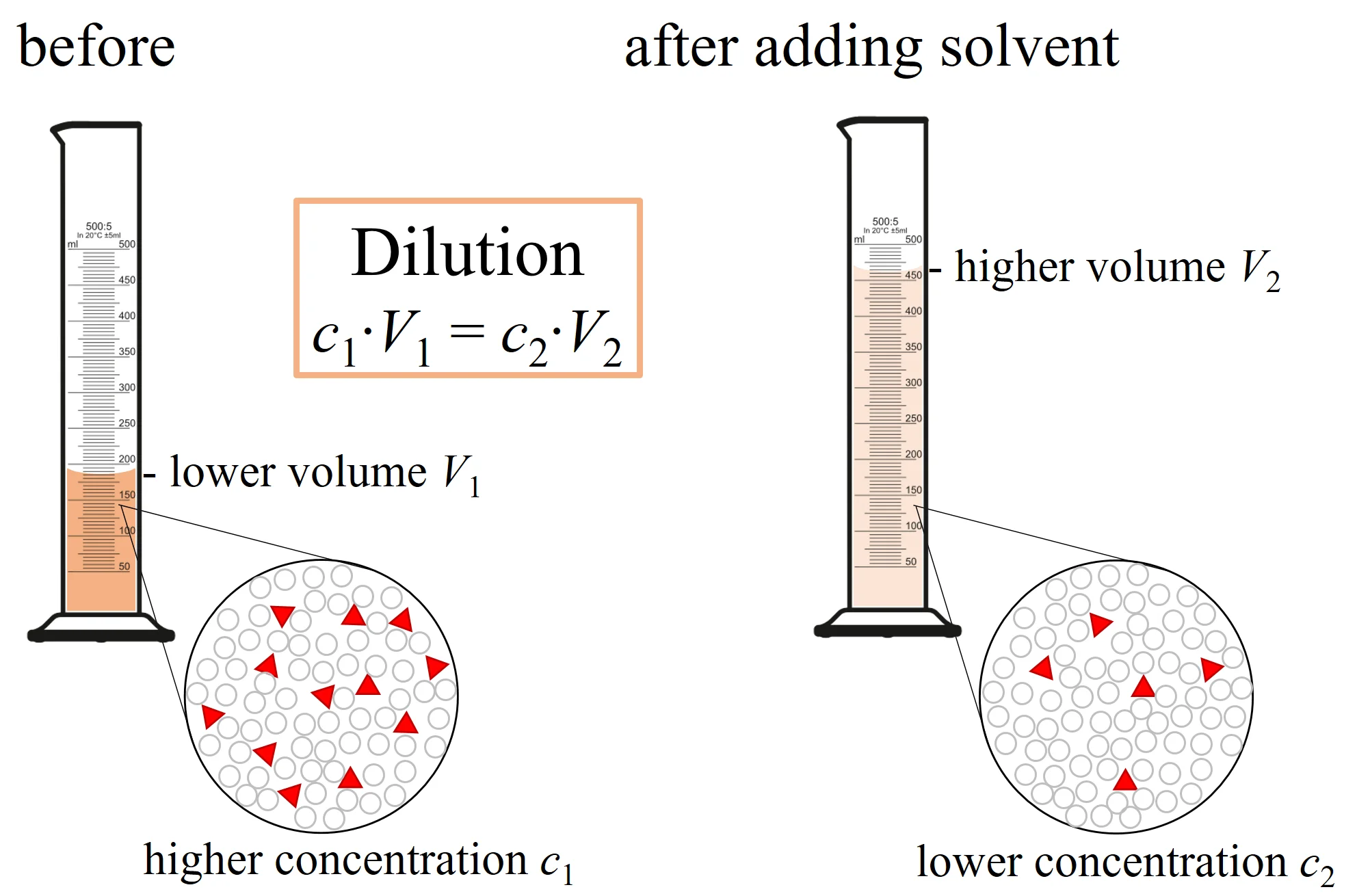
Worked Example
Problem: You have 50.0 mL of 6.0 M HCl. How much water must you add to make a 1.0 M solution?
Step 1: Identify variables.
- M1 = 6.0 M, V1 = 50.0 mL
- M2 = 1.0 M, V2 = ?
Step 2: Solve for V2.
- M1V1 = M2V2
- (6.0)(50.0) = (1.0)(V2)
- V2 = 300 mL
Step 3: Find water added.
- Water added = V2 - V1 = 300 - 50.0 = 250 mL
Note the question asked how much water to add, not the final volume. This is a common MCAT trap - read carefully.
When M1V1 = M2V2 Does NOT Apply
This equation only works when the moles of solute stay constant. It does not apply when:
- A chemical reaction occurs - if mixing two solutions produces a reaction, you cannot use M1V1 = M2V2 for the reacting species
- You mix two solutions of the same solute - this is a mixing problem, not a dilution. Use: = (M1V1 + M2V2) / (V1 + V2)
- Solute is added or removed - the equation assumes only solvent changes
Serial Dilutions
A serial dilution is a sequence of dilutions, each using the product of the previous step as the starting solution. They are used to achieve very low concentrations efficiently.
Example: Starting with 1.0 M NaCl, perform three consecutive 1:10 dilutions.
- After dilution 1: 1.0 / 10 = 0.10 M
- After dilution 2: 0.10 / 10 = 0.010 M
- After dilution 3: 0.010 / 10 = 0.0010 M = M
Each 1:10 dilution divides the concentration by 10. Three such dilutions give a 1:1000 overall dilution factor.
Preparing Standard Solutions
Labs often prepare standard solutions by diluting a concentrated stock solution. The process:
- Calculate the volume of stock solution needed using M1V1 = M2V2
- Measure that volume with a pipette
- Transfer to a volumetric flask
- Add solvent until the solution reaches the calibration mark on the flask
Example: Prepare 250 mL of 0.10 M NaOH from a 2.0 M stock solution.
- V1 = M2V2 / M1 = (0.10)(250) / (2.0) = 12.5 mL of stock solution
- Add 12.5 mL of 2.0 M NaOH to a 250 mL volumetric flask, then fill to the mark with water