
Limiting Reagent
When you are making sandwiches and you have 10 slices of bread but only 3 slices of cheese, the cheese limits your output. You can only make 3 sandwiches. The extra bread sits unused. That is the limiting reagent concept - and it is the single most tested stoichiometry topic on the MCAT.
The Limiting Reagent Determines the Product
The limiting reagent (or limiting reactant) is the reactant that runs out first. It determines the maximum amount of product that can form.
The excess reagent is whatever is left over after the limiting reagent is completely consumed.
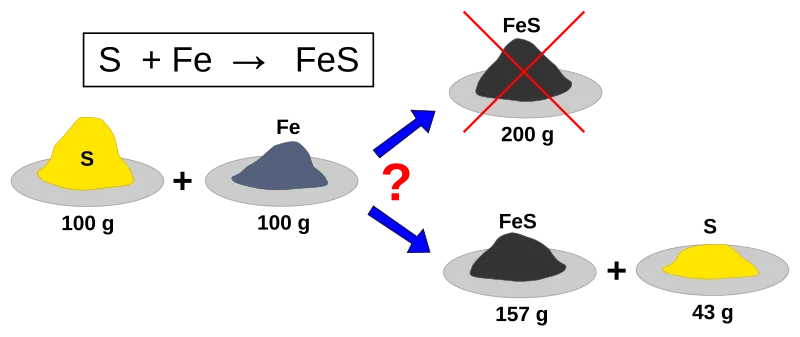
How to Find the Limiting Reagent
There are two reliable methods. Use whichever feels more natural:
Method 1: Compare mole ratios
- Convert all reactant amounts to moles
- Divide each by its coefficient in the balanced equation
- The reactant with the smallest result is the limiting reagent
Method 2: Calculate product from each reactant
- Assume each reactant is limiting, one at a time
- Calculate the moles of product each would produce
- The reactant that produces the least product is the limiting reagent
Worked Example
Problem: Given 10.0 g of N₂ and 10.0 g of H₂, how many grams of NH₃ can be produced?
Balanced equation: N₂ + 3 H₂ → 2 NH₃
Step 1: Convert to moles.
- N₂: 10.0 g / 28.0 g/mol = 0.357 mol
- H₂: 10.0 g / 2.02 g/mol = 4.95 mol
Step 2: Divide by coefficients.
- N₂: 0.357 / 1 = 0.357
- H₂: 4.95 / 3 = 1.65
Step 3: Identify limiting reagent.
- N₂ gives the smaller value (0.357 < 1.65), so N₂ is limiting
Step 4: Calculate product from limiting reagent.
- Mole ratio: 1 mol N₂ → 2 mol NH₃
- 0.357 mol N₂ x (2 mol NH₃ / 1 mol N₂) = 0.714 mol NH₃
- Mass: 0.714 mol x 17.0 g/mol = 12.1 g NH₃
Theoretical Yield
The theoretical yield is the maximum amount of product that can form based on the limiting reagent, assuming the reaction goes to completion with no losses. It is the calculated “perfect” amount.
In the example above, the theoretical yield of NH₃ is 12.1 g. In practice, you would get less than this due to side reactions, incomplete reactions, and mechanical losses during purification.
How Much Excess Reagent Remains?
After the limiting reagent is fully consumed, calculate how much of the excess reagent was actually used, then subtract from the starting amount.
From the example above:
- N₂ used all 0.357 mol
- H₂ needed: 0.357 mol N₂ x (3 mol H₂ / 1 mol N₂) = 1.071 mol H₂
- H₂ remaining: 4.95 - 1.071 = 3.88 mol H₂ = 7.83 g H₂ left over
The BCA Table
A BCA table (Before, Change, After) is a systematic way to organize limiting reagent problems. It works identically to an ICE table (which you will use in equilibrium) but for reactions that go to completion.
| N₂ | 3 H₂ | 2 NH₃ | |
|---|---|---|---|
| Before | 0.357 | 4.95 | 0 |
| Change | -0.357 | -1.071 | +0.714 |
| After | 0 | 3.88 | 0.714 |
The limiting reagent is the one that reaches zero in the “After” row.