
Balancing Equations
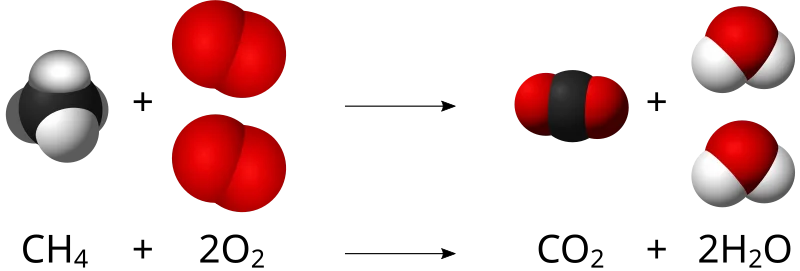
A chemical equation is a sentence written in the language of chemistry. Reactants go on the left, products on the right, and an arrow separates them. But the equation is only valid if it is balanced - meaning the same number of each type of atom appears on both sides.
This is not optional. It is the law of conservation of mass: atoms are neither created nor destroyed in a chemical reaction. What goes in must come out, just rearranged.
Conventions for Writing Chemical Equations
Before balancing, you need to know the notation:
| Symbol | Meaning |
|---|---|
| → | Yields (forward reaction) |
| ⇌ | Equilibrium (reversible reaction) |
| (s) | Solid |
| (l) | Liquid |
| (g) | Gas |
| (aq) | Aqueous (dissolved in water) |
| Δ | Heat applied |
Example: 2 H₂(g) + O₂(g) → 2 H₂O(l)
This tells you: two molecules of hydrogen gas react with one molecule of oxygen gas to produce two molecules of liquid water.
Stoichiometric Coefficients
The numbers in front of each formula are coefficients. They tell you the mole ratio - the recipe for the reaction.
In the equation above:
- 2 mol H₂ : 1 mol O₂ : 2 mol H₂O
- This ratio is fixed. You always need twice as many moles of H₂ as O₂.
How to Balance Equations - A Systematic Approach
There is no magic formula. But this systematic approach works reliably:
Step 1: Write the unbalanced equation with correct formulas.
Step 2: Balance elements that appear in only one reactant and one product first.
Step 3: Balance hydrogen and oxygen last (they often appear in multiple compounds).
Step 4: Use fractions if needed, then multiply everything by the denominator to clear them.
Step 5: Check your work - count every atom on both sides.
Worked Example
Balance: C₃H₈ + O₂ → CO₂ + H₂O (combustion of propane)
-
Start with carbon: 3 C on the left → put a 3 in front of CO₂
- C₃H₈ + O₂ → 3 CO₂ + H₂O
-
Balance hydrogen: 8 H on the left → put a 4 in front of H₂O
- C₃H₈ + O₂ → 3 CO₂ + 4 H₂O
-
Balance oxygen: right side has 3(2) + 4(1) = 10 O atoms → put 5 in front of O₂
- C₃H₈ + 5 O₂ → 3 CO₂ + 4 H₂O
-
Check: C: 3 = 3 ✓, H: 8 = 8 ✓, O: 10 = 10 ✓
Common Pitfalls
Never change subscripts to balance an equation. Subscripts define the compound. Changing H₂O to H₂O₂ does not “balance” anything - it changes water into hydrogen peroxide, a completely different substance. Only change coefficients.
Coefficients apply to the entire formula. A coefficient of 2 in front of Ca(OH)₂ means 2 calcium atoms, 4 oxygen atoms, and 4 hydrogen atoms - the coefficient multiplies every subscript in the formula.
Balancing Redox Equations
For redox reactions, balancing can be trickier because you need to balance both mass and charge. The half-reaction method is the most reliable approach (covered in detail in Chapter 11). For now, know the key idea: split the reaction into an oxidation half-reaction and a reduction half-reaction, balance each separately, then combine them so the electrons cancel.