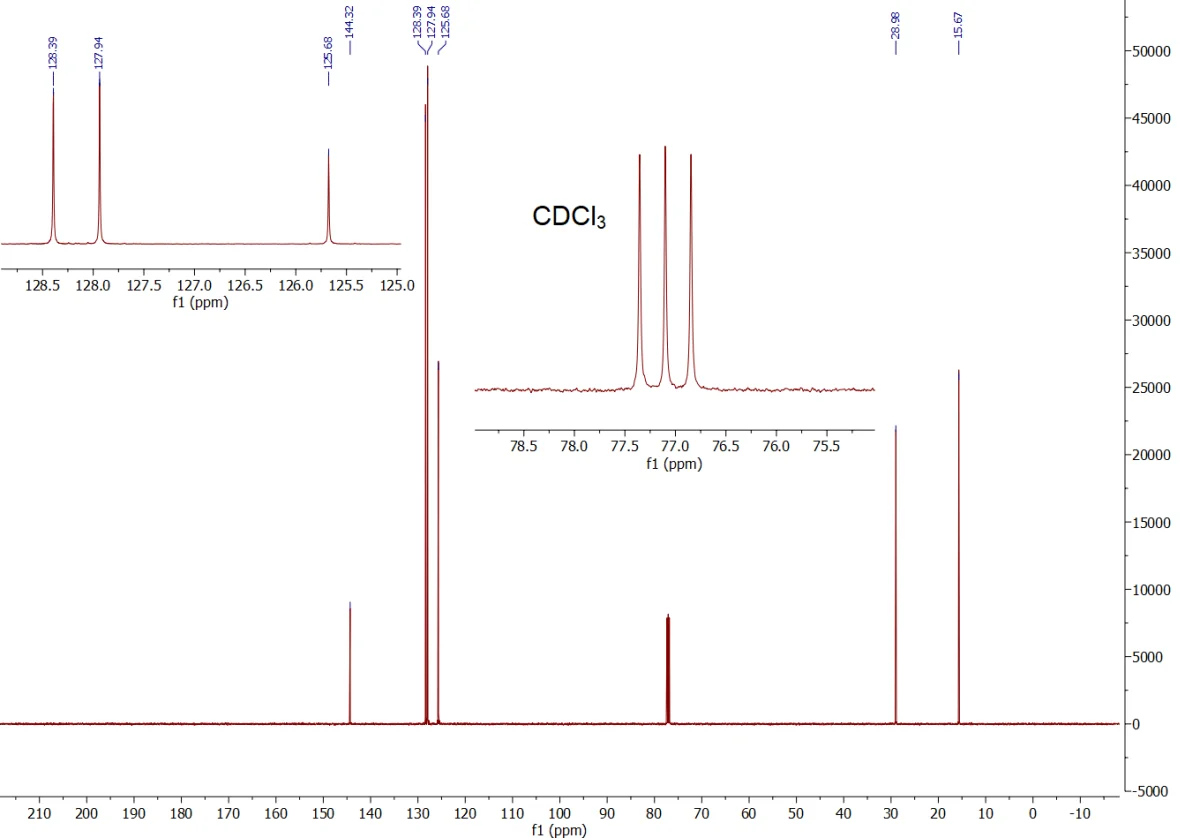
C13 NMR
¹³C NMR shows a peak for each distinct carbon environment in the molecule. It is complementary to ¹H NMR: the same molecular symmetry rules apply (equivalent carbons give one peak), but the chemical shift range is much wider (0-200+ ppm) and there is usually no proton-carbon splitting (due to broadband decoupling).
Chemical Shift Ranges
The chemical shift of ¹³C carbons spans a wide range:
| Environment | ppm | Notes |
|---|---|---|
| Alkyl C (sp³) | 0-50 | |
| C next to O (alcohol, ether) | 50-90 | |
| sp² C (alkene, aromatic) | 100-150 | |
| Aromatic ring C | 120-140 | |
| Conjugated alkene C | 115-140 | |
| Nitrile C≡N | 115-120 | |
| Alkyne C≡C | 65-90 | |
| Carbonyl C (C=O in acid, ester, amide) | 160-180 | Lower for amide |
| Carbonyl C (C=O in ketone, aldehyde) | 190-215 | Higher for unconjugated |
| Carboxylic acid C=O | 170-185 | |
| Quaternary sp³ C | 30-50 |
Why the Shift Range Is Wider
Carbon has more diverse bonding environments than hydrogen (aromatic C, sp, sp², sp³, attached to various heteroatoms). The chemical shift range is 0-200+ ppm for ¹³C vs. 0-12 ppm for ¹H.
Each carbon’s shift is still governed by the same principle: electron-withdrawing neighbors deshield the carbon (higher ppm), and electron-donating neighbors shield it (lower ppm).
No Splitting (Broadband Decoupled)
Modern ¹³C NMR uses broadband proton decoupling, which eliminates ¹H-¹³C coupling. Each carbon peak appears as a singlet regardless of how many H’s are attached. This simplifies the spectrum dramatically.
Why ¹³C NMR Is Less Sensitive
¹³C is the minor isotope (1.1% natural abundance; ¹²C is 98.9%). Only ¹³C is NMR-active (¹²C has zero nuclear spin). So only ~1% of the carbons in a sample contribute to the NMR signal. Combined with the lower gyromagnetic ratio, this makes ¹³C about 6000 times less sensitive than ¹H NMR per unit time.
Modern spectrometers handle this with longer acquisition times (minutes to hours) or higher sample concentrations. MCAT does not test these details.
Counting Distinct Carbons
Each unique carbon environment gives one peak. Equivalent carbons (by symmetry) give the same peak:
- Methanol (CH₃OH): 1 peak.
- Ethanol (CH₃CH₂OH): 2 peaks (CH₃ and CH₂ are different).
- 1,3-dimethylbenzene: 4 peaks (the two methyls are equivalent; the 4 aromatic carbons give 3 distinct environments).
- Benzene: 1 peak (all 6 aromatic C’s equivalent).
Counting peaks helps determine the degree of molecular symmetry.
DEPT (Distortionless Enhancement by Polarization Transfer)
DEPT is a variant of ¹³C NMR that distinguishes between CH, CH₂, and CH₃ groups by their phase in the spectrum:
- DEPT-90: shows only CH (methine) peaks.
- DEPT-135: shows CH₃ and CH as positive peaks; CH₂ as negative. Quaternary C (no H) does not appear.
This helps distinguish which carbons have 0, 1, 2, or 3 hydrogens. MCAT rarely shows DEPT data explicitly, but it is often mentioned in research passages.
Example: ¹³C NMR of Ethyl Acetate
Ethyl acetate (CH₃-CO-O-CH₂-CH₃) has 4 distinct carbons:
- Ester C=O: ~171 ppm.
- OCH₂: ~60 ppm.
- Acetate CH₃: ~21 ppm.
- Ethyl CH₃: ~14 ppm.
Four peaks, each a singlet (after decoupling). Matches the molecular formula C₄H₈O₂.