
NMR Chemical Shift
¹H NMR (proton NMR) shows a peak for every distinct hydrogen environment in a molecule. The position of each peak (chemical shift, ppm) reveals what is near that hydrogen. Shielding and deshielding shift the peak left (downfield) or right (upfield) on the spectrum.
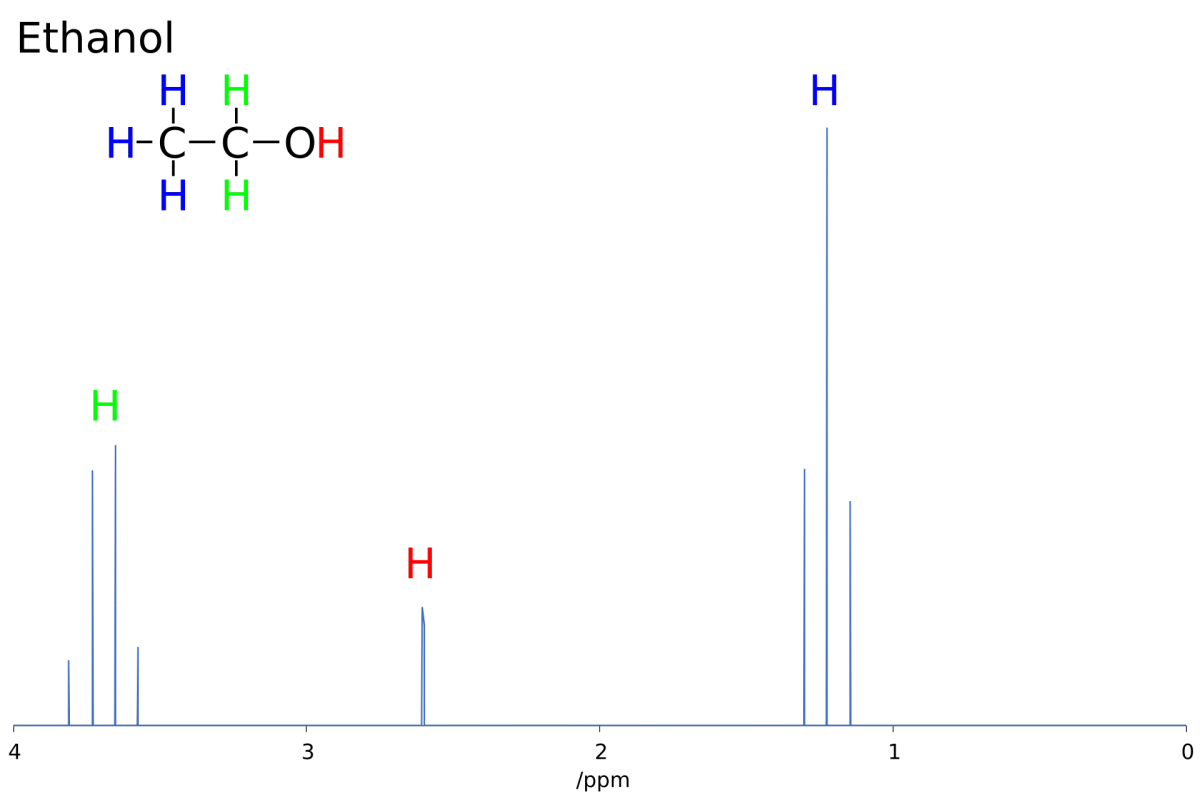
The interactive spectrum below lets you hover over a peak to see which hydrogens it comes from, or hover over a hydrogen in the structure to see which peak it produces. Switch between compounds to build intuition for the canonical MCAT chemical-shift ranges: alkyl CH (0–2 ppm), α-to-carbonyl (2–3), OMe or CH next to heteroatom (3–4), aromatic (6.5–8), aldehyde (9–10).
¹H NMR spectrum interpreter
Ethanol
What Is a Chemical Shift?
A proton’s chemical shift (δ, in ppm) measures how its resonance frequency differs from a reference standard (tetramethylsilane, TMS, set at 0 ppm). More deshielded protons (less electron density around them) resonate at higher frequency → higher ppm → further downfield (left on the spectrum).
Typical range: 0-15 ppm for ¹H NMR.
Shielding and Deshielding
An applied external magnetic field causes the electrons around a hydrogen to circulate, generating a tiny opposing field. This “shields” the proton from the external field. Shielded protons need a slightly higher external field to resonate at the spectrometer’s frequency, so they appear at LOW ppm (right side).
Shielding: more electron density around H → more shielded → lower ppm (upfield).
Deshielding: electron-withdrawing groups remove electron density from near H → less shielded → higher ppm (downfield).
Chemical Shift Regions
Memorize approximate ranges for common environments:
| Environment | ppm | Notes |
|-------------|-----|-------|
| TMS (reference) | 0 | By definition |
| Alkyl (CH₃, CH₂, CH) | 0.5-2.0 | Sat’d sp³ C-H |
| Allylic/benzylic (CH₃ next to C=C or ring) | 1.5-2.5 | Slight deshield from anisotropy |
| Alpha to C=O (R-CO-CH₃) | 2.0-2.5 | |
| Terminal alkyne (≡C-H) | 1.5-3.0 | Anisotropic shielding |
| RCH₂-X (X = Cl, Br, I) | 2.8-4.5 | Deshielding by electronegative atom |
| RCH₂-O (alcohol, ether) | 3.2-4.0 | |
| RCH₂-N | 2.5-3.5 | |
| Aryl/aromatic H | 6.5-8.0 | Ring anisotropy strongly deshields |
| Vinyl (C=CH) | 4.5-6.5 | |
| Alcohol -OH | 0.5-5 | Variable, broad |
| Carboxylic acid -COOH | 10-13 | Extremely deshielded |
| Aldehyde CHO | 9-10 | Very deshielded |
| Amide -NH | 5-9 | Variable |
Why Aldehyde H Is at 9-10 ppm
The aldehyde proton is directly attached to the sp² carbonyl C. The adjacent C=O polarizes electrons toward oxygen, dramatically deshielding the aldehyde H. Its chemical shift of 9-10 ppm is unmistakable. If an MCAT NMR shows a peak at 9-10, suspect aldehyde.
Why Aromatic H Is at 6.5-8.0 ppm
The aromatic ring’s pi system generates a “ring current” that produces a magnetic field. Hydrogens attached to the ring (on the outside of this current) are in a region where the induced field ADDS to the external field, deshielding them. This anisotropic effect shifts aromatic H’s to 6.5-8.0 ppm, much higher than typical sp² vinyl H’s (4.5-6.5).
Benzene itself has all H’s at 7.26 ppm. Substituents slightly shift these: electron donors move H’s upfield (lower ppm); electron withdrawers move them downfield (higher ppm). Ortho and para positions shift more than meta.
Exchangeable Protons: O-H, N-H
Protons on O or N (alcohol, carboxylic acid, amine, amide) are often broad in NMR because they exchange rapidly with other acidic/basic species in the sample:
- Alcohol O-H: broad peak, shift varies with concentration (0.5-5 ppm).
- Carboxylic acid O-H: broad, very downfield (10-13 ppm).
- Amine N-H: broad, 0.5-5 ppm.
- Amide N-H: broad, 5-9 ppm.
Adding D₂O to the NMR sample exchanges these protons with D’s, which do not show in ¹H NMR. The exchangeable peaks disappear after D₂O shake - diagnostic for O-H / N-H.
The TMS Reference
Tetramethylsilane (TMS, (CH₃)₄Si) is the standard reference compound for NMR. Its 12 equivalent H’s are very shielded (silicon is less electronegative than carbon, so TMS’s CH₃ protons are shielded relative to organic CH₃ groups). Defined as 0 ppm by convention. All other protons are measured relative to TMS.
1.2 ppm: alkyl CH (like CH₃ in an ethyl group). 3.7 ppm: CH next to O (like CH₂ in an R-CH₂-O- group). 2.6 ppm: probably an exchangeable -OH proton (broad, variable). This is the classic NMR of ethanol: CH₃ at 1.2, CH₂-O at 3.7, OH at 2.6 (but OH position varies widely with concentration and solvent). The three peaks point to an alcohol with an ethyl group.