You’re at a restaurant and the bill comes to $47.83. You want to leave a 20% tip. You don’t pull out a calculator — you round $47.83 to $48, take 10% ($4.80), double it ($9.60). Done in three seconds.
That same skill — rounding to friendly numbers and building from simple pieces — is exactly what the MCAT rewards. You won’t have a calculator during the physics, chemistry, or biochem sections. Good mental-math habits are worth many minutes over the course of a test. This section teaches the tricks that matter most.
The 10% Trick
The single most useful mental math tool: to find 10% of any number, just move the decimal point one place to the left.
10% of 250 = 25
10% of 7.4 = 0.74
10% of 0.036 = 0.0036
Once you have 10%, you can build any common percentage:
Percentage
How to Get It
10%
Move decimal left once
5%
Take half of 10%
1%
Move decimal left twice
20%
Double 10%
15%
Add 10% + 5%
25%
Take half of 50%, or quarter the number
50%
Halve the number
Example: What is 15% of 320?
10% of 320 = 32
5% of 320 = 16 (half of 32)
15% of 320 = 32 + 16 = 48
Rounding to “Nice” Numbers
When a problem gives you 4.87 x 3.12, do not try to compute this exactly. Round to 5 x 3 = 15. The actual answer is 15.19. You were off by about 1%, and it took you two seconds instead of thirty.
The key principle: round each number to one significant figure (the first non-zero digit), then do simple arithmetic.
6.02 x 10²³ becomes 6 x 10²³
1.38 x 10⁻²³ becomes 1.4 x 10⁻²³
9.8 m/s² becomes 10 m/s²
Multiplication Shortcuts
Multiplying by 0.5 = dividing by 2 (halving). If something costs half as much energy, just divide by 2.
Multiplying by 2 = doubling. Obvious, but students sometimes overcomplicate. If a drug dose doubles, the concentration doubles.
Multiplying by 5 = multiply by 10 then halve. So 5 x 37 = 2370 = 185.
Squaring numbers ending in 5: Take the number before the 5, multiply by the next number up, and tack 25 onto the end. For example, 352 — take 3, multiply by 4 = 12, then tack on 25 → 1225. Or 652 — take 6 × 7 = 42, then 4225.
Division Shortcuts
Dividing by 2 = multiplying by 0.5 (halving).
Dividing by 5 = multiply by 2 then divide by 10. So 5430 = 10860 = 86.
Dividing by 3 - know that 31 = 0.333. So 390 = 30, 3100 = 33.3.
Dividing by large numbers - convert to scientific notation first. For example: 2006000 = (6 x 10³)/(2 x 102) = 3 x 101 = 30.
Common Fractions You Should Know Cold
Fraction
Decimal
Percentage
21
0.5
50%
31
0.33
33%
41
0.25
25%
51
0.2
20%
61
0.167
16.7%
81
0.125
12.5%
101
0.1
10%
32
0.67
67%
43
0.75
75%
Knowing these by heart lets you instantly convert between fractions, decimals, and percentages during a passage.
When to Estimate vs. When to Calculate
Estimate when the answer choices are spread apart (e.g., 12, 24, 48, 96). Calculate more carefully when the choices are close together (e.g., 3.2, 3.6, 4.0, 4.4). On most MCAT questions, estimation is sufficient - the test makers deliberately space answer choices to reward good estimation.
A patient weighs 73 kg and is prescribed a drug at 5 mg/kg. Estimate the total dose without a calculator.
Click to reveal answer
Round 73 to 70 (or 75). 5 x 70 = 350 mg. 5 x 75 = 375 mg. Either way, the dose is roughly 365 mg. The exact answer is 365 mg - both estimates were within 5%. On the MCAT, the answer choices would be far enough apart that either estimate points to the right one.
What is 15% of 840? Solve using the 10% building method.
Click to reveal answer
10% of 840 = 84. 5% = half of 84 = 42. 15% = 84 + 42 = 126. This took about five seconds and required no written multiplication at all.
Think of algebra as a balance scale. Whatever you do to one side, you must do to the other. Add 5 kg to the left pan → add 5 kg to the right. Cut the left side in half → cut the right side in half. That single principle — keep the scale balanced — is all algebra really is.
On the MCAT, you’ll rarely solve algebra for its own sake. Instead you’ll rearrange physics and chemistry formulas to isolate an unknown variable, then plug in values. The faster you can manipulate equations, the more time you have for the actual reasoning — which is what the MCAT is really testing. This section drills the techniques: isolating variables, cross-multiplication, the quadratic formula, and common MCAT rearrangements.
Isolating Variables
The core MCAT algebra skill: given a formula, solve for any variable in it.
Strategy: Undo operations in reverse order of operations (PEMDAS backward). Undo addition/subtraction first, then multiplication/division, then exponents.
Example: Solve KE = (1/2)m$v^2$ for v.
Multiply both sides by 2: 2KE = m$v^2$
Divide both sides by m: 2KE/m = $v^2$
Take the square root: v = sqrt(2KE/m)
Example: Solve PV = nRT for T.
Divide both sides by nR: T = PV/(nR)
That is it. One step. Know which variable you are solving for and systematically peel away everything else.
Cross-Multiplication
When you have a proportion (two fractions set equal), cross-multiplication is the fastest tool.
If a/b = c/d, then ad = bc.
Example: If 5 mL of solution contains 20 mg of drug, how many mg are in 12 mL?
Set up the proportion: 20/5 = x/12
Cross-multiply: 5x = 240
Solve: x = 48 mg
The Quadratic Formula
Most MCAT algebra involves linear equations (no exponents on the variable) or simple rearrangement of squared terms. Occasionally, however, you will encounter a quadratic equation of the form a$x^2$ + bx + c = 0.
In practice, the MCAT usually sets up quadratics where one root is physically meaningless (negative concentration, negative time), so you take the positive root and move on. Also, many MCAT quadratics simplify because one term is negligible - for example, when Ka is very small in a weak acid problem, you can often ignore the x in the denominator.
Substitution
When you have two equations and two unknowns, solve one equation for one variable and substitute into the other.
Example: A passage states that v = v_0 + at and x = v_0 t + (1/2)at$^2$. If you know x and v0 and a but not t, you use the second equation directly. If you know v and v0 and need a, you rearrange the first: a = (v - v_0)/t.
The key is choosing which equation to start with. Pick the one that has fewer unknowns or is simpler to rearrange.
Common Algebraic Moves on the MCAT
Starting Form
Goal
Operation
y = kx + b
Solve for x
Subtract b, divide by k
y = k/x
Solve for x
Multiply both sides by x, divide by y: x = k/y
y = k$x^2$
Solve for x
Divide by k, take square root
1/f = 1/d_o + 1/d_i
Solve for di
Subtract 1/do, take reciprocal
a/b = c/d
Solve for a
Multiply both sides by b: a = bc/d
”What Happens When…” Questions
These are the MCAT’s favorite algebra questions. They do not ask you to calculate - they ask you to reason.
Template: “If variable X is doubled/tripled/halved, what happens to variable Y?”
Strategy:
Write the formula relating X and Y
Replace X with the new value (2X, 3X, X/2)
See what multiplier ends up in front of Y
Example: Kinetic energy is KE = (21)mv2. If velocity triples, what happens to KE?
Replace v with 3v: KE_new = (21)m(3v)² = (21)m(9v2) = 9 x (21)mv2 = 9 KE
Kinetic energy increases by a factor of 9.
Solve the ideal gas law PV = nRT for the pressure P when n = 2 mol, R = 8.3 J/(mol K), T = 300 K, and V = 0.05 m³.
Click to reveal answer
P = nRT/V = (2)(8.3)(300) / 0.05. Numerator: 2 x 8 x 300 = 4800 (rounding 8.3 to 8). Denominator: 0.05. P = 0.054800 = 96,000 Pa. More precisely: 2 x 8.3 x 300 = 4980, so P = 0.054980 = 99,600 Pa, roughly 105 Pa (1 atm). Either estimate works.
In the equation F = kx (Hooke's Law), the spring constant k is tripled and the displacement x is halved. What happens to the force F?
Click to reveal answer
Fnew = (3k)(x/2) = (23)kx = 1.5 F. The force increases by a factor of 23, or 50%. You do not need numbers - just substitute the changes directly into the formula.
Imagine a staircase where each step is ten times higher than the last. Step 1 is 1 meter, step 2 is 10 m, step 3 is 100 m, step 4 is 1000 m. A logarithm simply tells you which step you’re standing on. At 1000 m high? You’re on step 3, because 103=1000.
That’s all a log does: it answers “what power do I raise the base to to get this number?” Once that picture clicks, logs go from scary to simple. And they matter on the MCAT because pH (chemistry) and decibels (physics) are both logarithmic — so every pH or dB problem is secretly a log problem in disguise.
Logarithms appear on the MCAT in two major contexts: pH calculations (general chemistry and biochemistry) and decibel calculations (physics). If you know three key log values and three log rules, you can handle virtually every logarithm problem on test day.
Exponent Rules
Before tackling logarithms, lock down the exponent rules they are built on.
Rule
Example
xa⋅xb=xa+b
102⋅103=105
xa/xb=xa−b
105/102=103
(xa)b=xab
(102)3=106
x0=1
100=1
x−a=1/xa
10−3=1/1000=0.001
x1/n=nx
81/3=2
What Is a Logarithm?
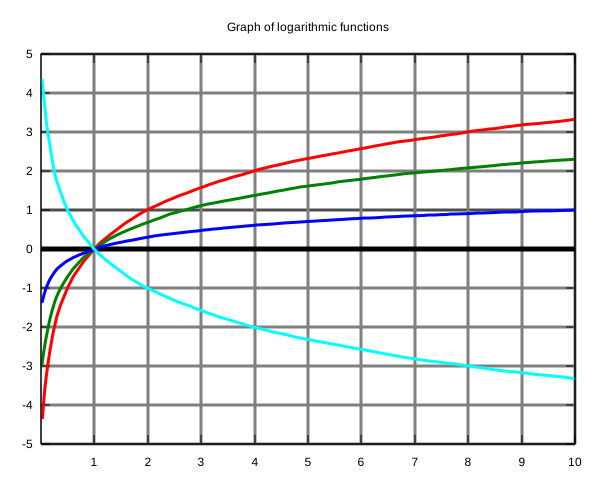
Logarithmic functions for different bases. All logarithmic curves pass through (1, 0) since log of 1 is always 0. Larger bases produce flatter curves. The common log (base 10) and natural log (base e) are the two forms tested on the MCAT. Credit: Wikimedia Commons, CC BY-SA 3.0
A logarithm is the inverse of exponentiation. If b^x = y, then log_b(y) = x.
On the MCAT, you will encounter two bases:
Common log (log or log10): used for pH, pOH, pKa, decibels
Natural log (ln or loge): used for kinetics (ln[A] vs. t), thermodynamics (ΔG = -RT ln K)
The LAP Mnemonic - Three Log Rules
These three rules, combined with a few memorized values, let you compute almost any log the MCAT can throw at you.
Key Log Values to Memorize
Value
log (base 10)
Why It Matters
log 1 = 0
100 = 1
Baseline reference
log 2 = 0.3
100.3 = 2
Most commonly tested
log 3 = 0.48 (use 0.5)
100.5 = 3.16
Useful approximation
log 5 = 0.7
log(210) = 1 - 0.3
Derived from log 2
log 10 = 1
101 = 10
Definition
pH and pOH Calculations
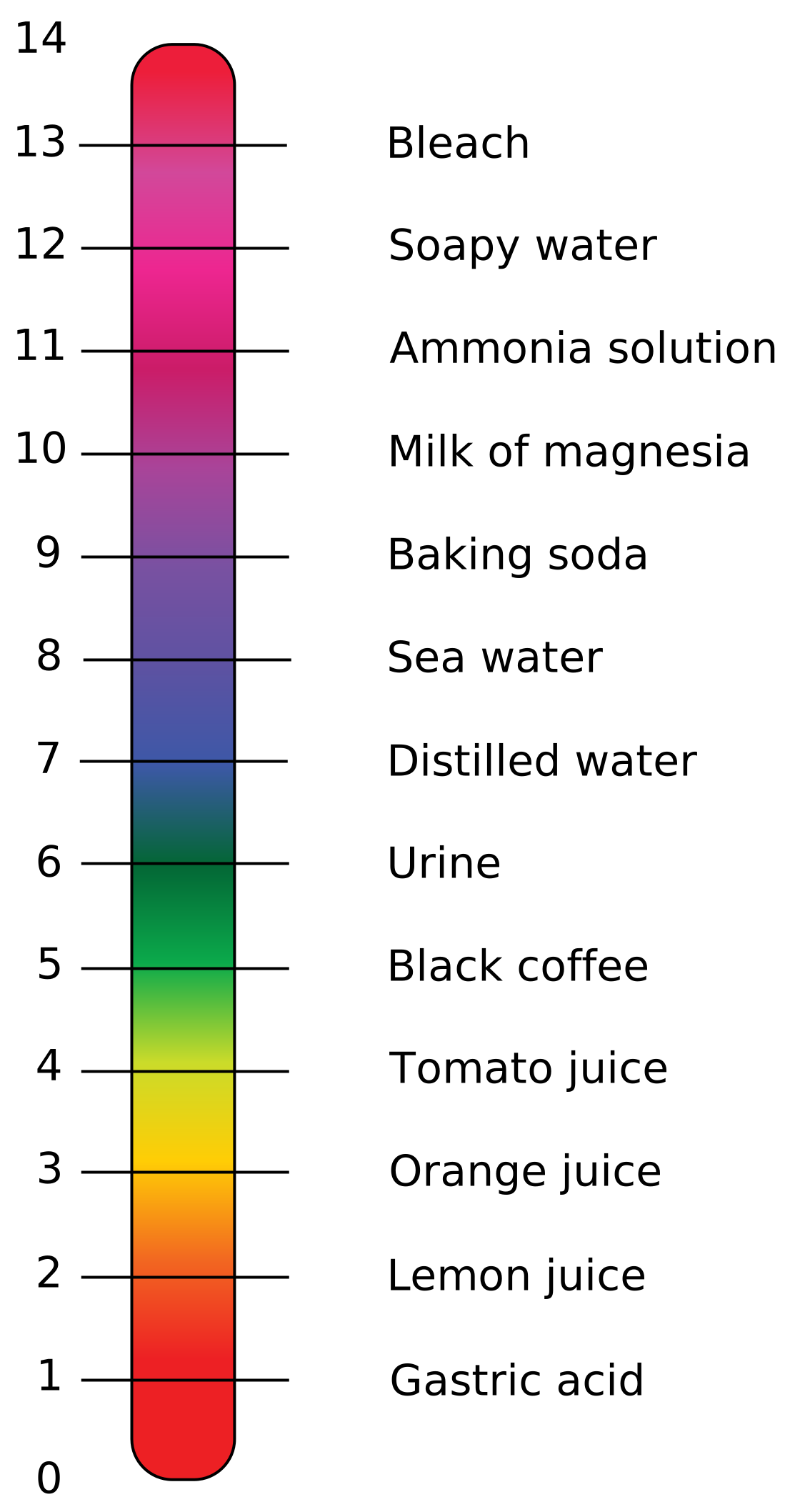
The pH scale ranges from 0 (strongly acidic) to 14 (strongly basic), with 7 being neutral. Each whole number step represents a tenfold change in hydrogen ion concentration, illustrating the logarithmic nature of the scale. Credit: Wikimedia Commons, CC BY-SA 3.0
The pH scale is the most common MCAT application of logarithms.
Example: What is the pH of a solution with [H+] = 4 x 10⁻³ M?
Quick rule: +10 dB means 10x intensity. +20 dB means 100x intensity. +3 dB means about 2x intensity.
Natural Logarithms (ln)
The natural log uses base e (= 2.718). Key relationships:
ln(e) = 1
ln(1) = 0
ln(ex) = x
e^(ln x) = x
The same LAP rules apply to natural logs. The MCAT uses ln in first-order kinetics (ln[A] = -kt + ln[A₀]) and in thermodynamics (ΔG = -RT ln K and ΔG = ΔGstandard + RT ln Q).
To convert between the two: ln x = 2.303 x log x. You rarely need this conversion on the MCAT, but it appears occasionally in derivations.
What is the pH of a solution with [H+] = 5 x 10⁻⁸ M?
Click to reveal answer
pH = -log(5 x 10⁻⁸) = -(log 5 + log 10−8) = -(0.7 + (-8)) = -(0.7 - 8) = -(-7.3) = 7.3. This is a slightly basic solution, which makes sense since pH is above 7.
A sound source increases in intensity from 10−6 W/m² to 10−3 W/m². By how many decibels does the sound level increase?
Click to reveal answer
30 dB. The intensity increased by a factor of 103 (1000-fold). Change in dB = 10 log(Inew/Iold) = 10 log(103) = 10 x 3 = 30 dB. Alternatively: each factor of 10 in intensity adds 10 dB, and 103 is three factors of 10.
A ladder leans against a wall. The ladder is 10 feet long and makes a 60° angle with the ground. How high up the wall does it reach?
You don’t need a tape measure — you need trigonometry. The ladder is the hypotenuse, the wall height is the opposite side, and sine connects them: height = 10sin60°=10×0.87≈8.7 feet. Three seconds, no calculator — because you memorized that sin60°≈0.87.
On the MCAT, trigonometry appears in vector decomposition, inclined plane problems, optics (Snell’s law), and any problem involving angles. The test almost exclusively uses five special angles, so mastering trig is really just memorizing a small table.
SOH CAH TOA
For a right triangle with angle θ:
The Five Special Angles
This is the only trig table you need on the MCAT. Memorize it cold.
Angle
sin
cos
tan
0 degrees
0
1
0
30 degrees
21 = 0.5
sqrt(3)/2 = 0.87
1/sqrt(3) = 0.58
45 degrees
sqrt(2)/2 = 0.71
sqrt(2)/2 = 0.71
1
60 degrees
sqrt(3)/2 = 0.87
21 = 0.5
sqrt(3) = 1.73
90 degrees
1
0
undefined
Reading the Table Efficiently
Notice the sine values follow a clean pattern using square roots:
sin 0 = sqrt(0)/2 = 0
sin 30 = sqrt(1)/2 = 21
sin 45 = sqrt(2)/2
sin 60 = sqrt(3)/2
sin 90 = sqrt(4)/2 = 1
The numerator under the square root just counts: 0, 1, 2, 3, 4. The denominator is always 2. Cosine is the same sequence in reverse order.
The Unit Circle
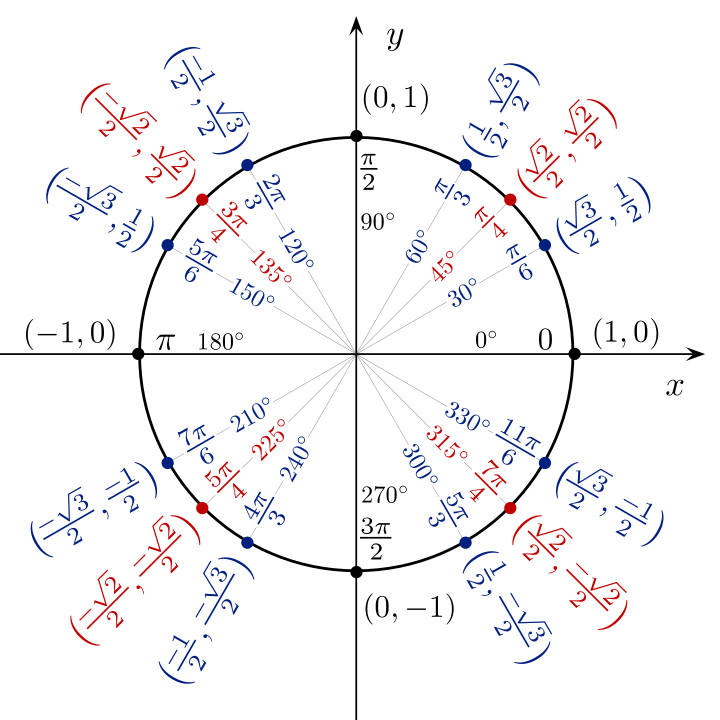
The unit circle. For any angle θ measured counterclockwise from the positive x-axis, the point on the circle has coordinates (cos θ, sin θ). The five special angles (0, 30, 45, 60, 90 degrees) and their symmetry partners in all four quadrants are shown. Credit: Wikimedia Commons, CC BY-SA 3.0
The unit circle extends trig beyond 0-90 degrees to all angles. It is a circle of radius 1 centered at the origin. For any angle θ measured counterclockwise from the positive x-axis, the coordinates of the point on the circle are (cos θ, sin θ).
Key quadrant signs:
Quadrant I (0-90 degrees): sin positive, cos positive
Quadrant II (90-180 degrees): sin positive, cos negative
Quadrant III (180-270 degrees): sin negative, cos negative
Quadrant IV (270-360 degrees): sin negative, cos positive
Inverse Trig Functions
Inverse trig functions answer: “What angle gives this ratio?”
If sin θ = 0.5, then θ = arcsin(0.5) = 30 degrees
If cos θ = 0.71, then θ = arccos(0.71) = 45 degrees
If tan θ = 1, then θ = arctan(1) = 45 degrees
On the MCAT, you will almost always be able to recognize the angle from your memorized table rather than needing to compute an inverse trig function from scratch.
Common MCAT Applications
Vector components: Fx = F cos θ, Fy = F sin θ (where θ is measured from the x-axis)
Inclined planes: Weight components on a ramp at angle θ: parallel = mg sin θ, perpendicular = mg cos θ
Snell’s Law: n1 sin θ_1 = n2 sin θ_2
Projectile motion:vx = v cos θ, vy = v sin θ
A 50 N force is applied at 30 degrees above the horizontal. What are the horizontal and vertical components?
Click to reveal answer
Horizontal = 50 cos 30 = 50 x 0.87 = 43.5 N. Vertical = 50 sin 30 = 50 x 0.5 = 25 N. The horizontal component (adjacent to the angle) uses cosine, and the vertical component (opposite the angle) uses sine.
On an inclined plane at 45 degrees, what fraction of an object's weight acts parallel to the surface?
Click to reveal answer
The parallel component = mg sin 45 = mg x 0.71, so about 71% of the weight. The perpendicular component = mg cos 45 = mg x 0.71 as well. At 45 degrees, the parallel and perpendicular components are equal - the weight is split evenly between the two directions.
You’re lost in the woods and someone radios directions: “Walk 3 miles.” Useless — 3 miles in which direction? Now they say: “Walk 3 miles due north, then 4 miles due east.” That’s useful, because each instruction has both a size (distance) and a direction.
Those instructions are vectors. And by combining them, you can figure out the shortcut home: the straight-line distance is 5 miles (a 3-4-5 right triangle) heading northeast. Vectors are the language of physics — forces, velocities, displacements, electric fields, magnetic fields are all vectors. On the MCAT, you need to add them, break them into components, use dot and cross products, and (for magnetism) apply the right-hand rule. This section is the master reference for all of that.
Magnitude and Direction
Every vector has two properties:
Magnitude - the “size” or “how much” (always positive)
Direction - the “which way” (expressed as an angle or as compass directions)
A vector is often written in bold (A) or with an arrow above it. Its magnitude is written as |A| or simply A (not bold).
Component Form
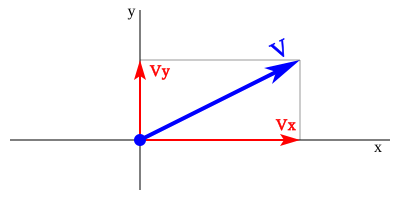
Decomposing a 2D vector into components. The vector A is broken into a horizontal component Ax = A cos θ and a vertical component Ay = A sin θ. The original magnitude is recovered from the Pythagorean theorem: |A| = sqrt(Ax2 + Ay2). Credit: Wikimedia Commons, CC BY-SA 3.0
Any 2D vector can be expressed as components along the x and y axes:
A = (Ax, Ay), where Ax = A cos θ and Ay = A sin θ.
The magnitude is recovered from components using the Pythagorean theorem:
Adding Vectors by Components
This is the most reliable method for vector addition and the one you should default to on the MCAT.
To add A + B:
Break each vector into x and y components
Add x-components: Rx = Ax + Bx
Add y-components: Ry = Ay + By
Find magnitude and direction of the resultant R = (Rx, Ry)
Example: A boat travels 30 m/s east and a current pushes 40 m/s north. What is the boat’s actual velocity?
θ = arctan(3040) = arctan(34) = 53 degrees north of east
Subtracting Vectors
To subtract B from A: reverse the direction of B (flip its sign), then add.
A - B = A + (-B) = (Ax - Bx, Ay - By)
This is important for finding changes in velocity (Δv = vfinal - vinitial) in momentum and circular motion problems.
The Dot Product (Scalar Product)
The dot product takes two vectors and returns a scalar (a number, not a vector).
Physical meaning: The dot product measures how much two vectors point in the same direction. It is maximized when vectors are parallel (cos 0 = 1) and zero when they are perpendicular (cos 90 = 0).
MCAT application: Work. W = F . d = Fd cos θ. The force component parallel to displacement does work. A force perpendicular to motion does zero work.
The Cross Product (Vector Product)
The cross product takes two vectors and returns a new vector perpendicular to both.
Physical meaning: The cross product measures how much two vectors are perpendicular to each other. It is maximized when vectors are perpendicular (sin 90 = 1) and zero when they are parallel (sin 0 = 0).
MCAT applications:
Torque: τ = r x F (force perpendicular to the lever arm produces maximum torque)
Magnetic force: F = qv x B (a charge moving perpendicular to a magnetic field feels maximum force)
The Right-Hand Rule
To find the direction of A x B:
Point your fingers in the direction of A
Curl them toward B (through the smaller angle)
Your thumb points in the direction of A x B
Important: A x B = -(B x A). The cross product is not commutative - order matters. Reversing the order flips the direction.
A 10 N force acts on an object that moves 5 m. The angle between the force and displacement is 60 degrees. How much work is done?
Click to reveal answer
W = Fd cos θ = (10)(5) cos 60 = 50 x 0.5 = 25 J. Only the component of force parallel to displacement (F cos θ) does work. The perpendicular component (F sin θ) does zero work.
Two vectors have magnitudes of 6 and 8 and are perpendicular to each other. What is their dot product? What is the magnitude of their cross product?
Click to reveal answer
Dot product = AB cos 90 = (6)(8)(0) = 0. Perpendicular vectors always have a dot product of zero. Cross product magnitude = AB sin 90 = (6)(8)(1) = 48. Perpendicular vectors produce the maximum cross product.
Your car speedometer shows 60 miles per hour, but the physics problem wants meters per second. A chemistry passage gives concentration in mg/dL, but the formula needs mol/L. A biology question cites a wavelength of 550 nm, but you need meters for the equation. Unit conversions are the unsexy glue that holds MCAT calculations together, and getting them wrong is the number one source of careless errors.
Dimensional Analysis
Dimensional analysis means treating units like algebraic variables. You set up conversion factors as fractions where the unwanted unit cancels and the desired unit remains.
Example: Convert 72 km/h to m/s.
72 km/h x (1000 m / 1 km) x (1 h / 3600 s) = 72,3600000 m/s = 20 m/s
Notice how “km” cancels with “km” and “h” cancels with “h,” leaving only “m/s.”
Metric Prefixes
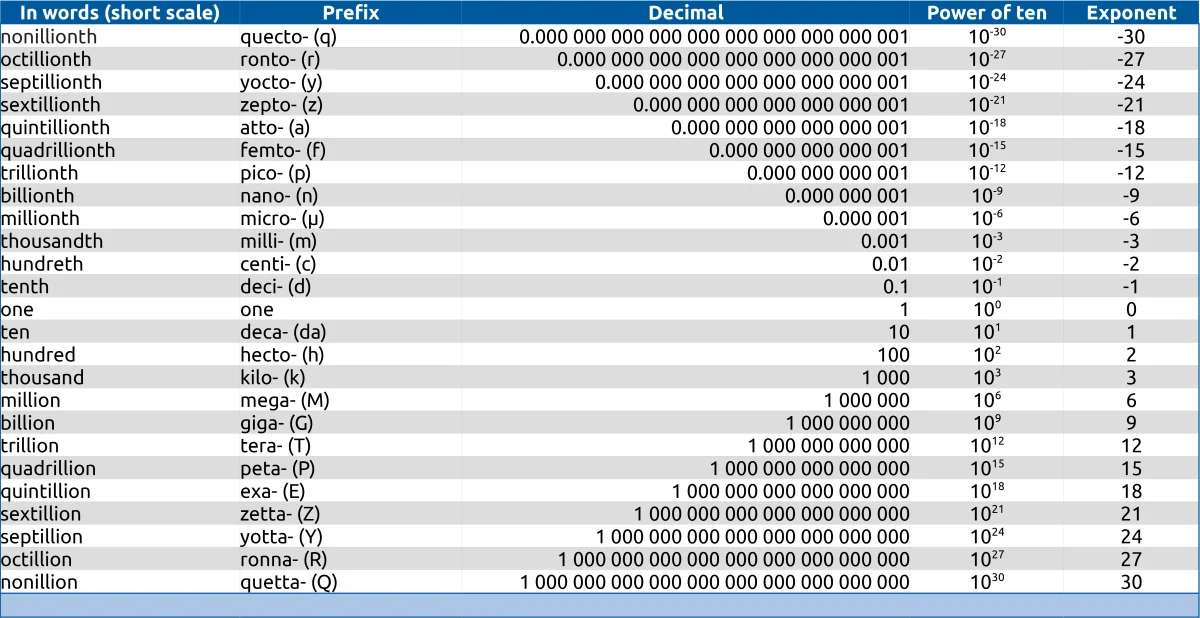
1012) through pico (10−12), showing prefix name, symbol, and power of 10 for each, organized from largest to smallest" loading="lazy" />
The SI metric prefixes. Each prefix represents a specific power of 10. For the MCAT, focus on kilo (103) through pico (10−12), as these appear most frequently in physics, chemistry, and biology calculations. Credit: Wikimedia Commons, CC BY-SA 3.0
Prefix
Symbol
Power of 10
Example
Tera
T
1012
1 THz = 1012 Hz
Giga
G
109
1 GHz = 109 Hz
Mega
M
106
1 MJ = 106 J
Kilo
k
103
1 km = 103 m
(base)
-
100
1 m, 1 g, 1 s
Centi
c
10−2
1 cm = 10−2 m
Milli
m
10−3
1 mL = 10−3 L
Micro
μ
10−6
1 micrometer = 10−6 m
Nano
n
10−9
1 nm = 10−9 m
Pico
p
10−12
1 pF = 10−12 F
Common MCAT Conversions
These come up repeatedly. Know them without thinking:
Conversion
Value
1 m
100 cm = 102 cm
1 cm
10 mm = 10−2 m
1 nm
10−9 m
1 L
1000 mL = 10−3 m³
1 mL
1 cm³ (= 1 cc)
1 atm
101,325 Pa = 760 mmHg
1 eV
1.6 x 10⁻¹⁹ J
1 calorie
4.184 J
1 kg
1000 g
0 degrees C
273 K
Squared and Cubed Unit Conversions
When converting area or volume, the conversion factor must also be squared or cubed.
Area: 1 m² = (100 cm)² = 10,000 cm² = 104 cm². Not 100 cm².
This is where most conversion errors occur. If a problem gives an area in cm² and you need m², divide by 104, not 102.
Example: Convert 5 cm² to m².
5 cm² x (1 m / 100 cm)² = 5 x (10−2)² m² = 5 x 10⁻⁴ m²
Temperature Conversions
Celsius to Kelvin: K = C + 273
Kelvin to Celsius: C = K - 273
The MCAT almost never uses Fahrenheit
Kelvin is the SI unit for temperature and is required for gas law and thermodynamics calculations. Celsius works for temperature changes (ΔT) because a one-degree change in Celsius equals a one-degree change in Kelvin.
Convert 450 nm to meters.
Click to reveal answer
450 nm = 450 x 10−9 m = 4.5 x 10⁻⁷ m. Nano means 10−9, so multiply the number by 10−9 to convert to the base unit (meters). This is in the visible light range (violet-blue).
A physics problem gives a cross-sectional area of 2 cm². What is this in m²?
Click to reveal answer
2 cm² = 2 x (10−2 m)² = 2 x 10⁻⁴ m². The key mistake to avoid: do not just multiply by 10−2. Because it is a squared unit, you must square the conversion factor: (10−2)² = 10−4.
The number of molecules in a single drop of water is roughly 1,670,000,000,000,000,000,000. Writing that out is absurd - and impossible to work with mentally. Scientific notation condenses it to 1.67 x 10²¹: a coefficient between 1 and 10 multiplied by a power of 10. This format makes enormous and minuscule numbers manageable, which is why every MCAT science passage uses it.
Standard Form
A number in scientific notation has the form N x 10n, where:
N (the coefficient) is between 1 and 10
n (the exponent) is a whole number (positive or negative)
Examples:
6,020,000,000,000,000,000,000,000 = 6.02 x 10²³ (Avogadro’s number)
0.000000001 = 1 x 10⁻⁹ (one nanometer in meters)
0.00340 = 3.40 x 10⁻³
To convert a large number: move the decimal left until you have a number between 1 and 10. The number of places you moved is the positive exponent.
To convert a small number: move the decimal right until you have a number between 1 and 10. The number of places you moved is the negative exponent.
Multiplying in Scientific Notation
Multiply the coefficients, add the exponents.
Example: (3 x 104) x (2 x 105) = 6 x 10⁹
Example: (4 x 103) x (5 x 106) = 20 x 109 = 2.0 x 10¹⁰ (adjusted)
Dividing in Scientific Notation
Divide the coefficients, subtract the exponents.
Example: (8 x 10⁷) / (2 x 10³) = 4 x 10⁴
Example: (3 x 10⁵) / (6 x 10⁸) = 0.5 x 10−3 = 5.0 x 10⁻⁴ (adjusted)
Adding and Subtracting in Scientific Notation
You must first make the exponents the same. Then add or subtract the coefficients.
Example: 3.0 x 10⁴ + 5.0 x 10³
Convert to the same exponent: 3.0 x 10⁴ + 0.5 x 104 = 3.5 x 10⁴
Significant Figures
Significant figures indicate the precision of a measurement. The MCAT rarely penalizes for sig figs, but you should understand the basic rules:
Counting sig figs:
All nonzero digits are significant: 345 has 3 sig figs
Zeros between nonzero digits are significant: 305 has 3 sig figs
Leading zeros are not significant: 0.0045 has 2 sig figs
Trailing zeros after a decimal point are significant: 3.40 has 3 sig figs
Operations:
Multiplication/Division: The result has the same number of sig figs as the measurement with the fewest sig figs
Addition/Subtraction: The result has the same number of decimal places as the measurement with the fewest decimal places
In practice, MCAT answer choices are spaced far enough apart that sig figs rarely determine which answer you choose. Focus on getting the right order of magnitude and a close coefficient.
Order of Magnitude
An order of magnitude is the power of 10 closest to a number. This is useful for quick sanity checks.
500 is on the order of 103 (closer to 1000 than to 100… actually closer to 102.7, but we round)
3 x 10⁻⁸ is on the order of 10−7 to 10−8
If your answer is off by an order of magnitude (a factor of 10), something went wrong - usually a unit conversion error or a misplaced decimal.
Calculate (6 x 1023) x (2 x 10−5) without a calculator.
Click to reveal answer
Multiply coefficients: 6 x 2 = 12. Add exponents: 23 + (-5) = 18. Result: 12 x 1018 = 1.2 x 10¹⁹. Adjust the coefficient to be between 1 and 10 by moving the decimal left one place and adding 1 to the exponent.
How many significant figures are in 0.00820?
Click to reveal answer
Three significant figures (8, 2, and the trailing 0). The leading zeros (0.00) are not significant - they are placeholders. The trailing zero after 2 is significant because it comes after the decimal point and after a nonzero digit, indicating the measurement was precise to the hundredths place.
A garden hose is 2 cm in diameter and delivers a steady stream of water. Your neighbor’s hose is 4 cm in diameter - double yours. You might guess their hose delivers twice as much water. But according to Poiseuille’s Law, flow rate is proportional to the fourth power of the radius. Double the radius means 24 = 16 times the flow. Not twice. Sixteen times. If you only thought “double,” you just missed the question.
Proportional reasoning is the single most useful math skill on the MCAT. At least a third of physics and chemistry questions boil down to “if this variable changes, what happens to that variable?” You do not need to calculate anything - you need to see the relationship in the formula and trace the change through.
The Four Fundamental Proportionalities
1. Direct Proportion: y = kx
If x doubles, y doubles. If x triples, y triples. The ratio y/x is constant.
Graph: Straight line through the origin.
MCAT examples:
Ohm’s Law: V = IR (double I at constant R, V doubles)
Hooke’s Law: F = kx (double displacement, double force)
Weight: W = mg (double mass, double weight)
2. Inverse Proportion: y = k/x
If x doubles, y halves. If x triples, y becomes one-third. The product xy is constant.
Graph: Hyperbola (curve that never touches either axis).
MCAT examples:
Boyle’s Law: PV = constant, so P = k/V (double volume, halve pressure)
Frequency and wavelength: c = f x λ, so f = c/λ (double wavelength, halve frequency)
3. Square Proportion: y=kx2
If x doubles, y quadruples (22 = 4). If x triples, y increases 9-fold (32 = 9).
Power dissipated: P=I2R (double current, quadruple power)
Centripetal acceleration: a=v2/r (at constant r, double v, quadruple a)
4. Inverse Square Proportion: y=k/x2
If x doubles, y becomes one-quarter (1/22). If x triples, y becomes one-ninth (1/32).
Graph: Steeper hyperbola that drops off quickly.
MCAT examples:
Gravitational force: F=GMm/r2 (double distance, quarter the force)
Coulomb’s Law: F=kq1q2/r2 (double distance, quarter the force)
Sound intensity: I proportional to 1/r2 (double distance from source, quarter the intensity)
The Substitution Method
For any “what happens when” question:
Write the relevant equation
Identify which variable changes and how
Substitute the change (replace x with 2x, 3x, x/2, etc.)
Simplify and read off the factor
Example: Coulomb’s Law states F=kq1q2/r2. If the distance between two charges is tripled, what happens to the force?
Replace r with 3r: Fnew=kq1q2/(3r)2=kq1q2/(9r2)=F/9
The force decreases to one-ninth of its original value.
High-Yield Proportional Relationships
Formula
Relationship
If variable doubles…
KE=21mv2
KE proportional to v2
KE quadruples
F=GMm/r2
F proportional to 1/r2
F becomes 41
F=kq1q2/r2
F proportional to 1/r2
F becomes 41
Q=πr4ΔP/(8ηL)
Q proportional to r4
Q increases 16-fold
v=2gh
v proportional to h
v increases by 2 = 1.4x
T=2πL/g
T proportional to L
T increases by 2 = 1.4x
E=hf=hc/λ
E proportional to 1/λ
E halves
In the equation KE=21mv2, if the mass is doubled and the velocity is tripled, what happens to the kinetic energy?
Click to reveal answer
KEnew=21(2m)(3v)2=21(2m)(9v2)=18×21mv2=18KE. The kinetic energy increases by a factor of 18. The mass contributes a factor of 2 and the velocity contributes a factor of 32 = 9, and 2 x 9 = 18.
According to Poiseuille's Law, if the radius of an artery decreases to 50% of its original value and all other factors remain constant, by what factor does blood flow change?
Click to reveal answer
Flow decreases to (0.5)⁴ = 161 of the original value. Since Q is proportional to r4, halving the radius means (21)⁴ = 161. The blood flow drops to just 6.25% of what it was. This is why atherosclerosis (narrowing of arteries) has such severe effects on circulation.
A passage shows you a graph with an S-shaped curve. You have never seen this specific experiment before, but the shape tells you everything: something starts slow, accelerates through a rapid transition, then levels off at a new plateau. That is a sigmoidal curve, and on the MCAT it usually means hemoglobin saturation, enzyme kinetics, or population growth. Being able to name the shape and predict the behavior is often worth a full point - no calculation required.
The MCAT is heavily passage-based, and passages love graphs. You will see graphs in physics, chemistry, biology, and psychology. The underlying math is always the same: identify the shape, read the slope, and extract the meaning.
Linear Graphs: y = mx + b
A straight line means a constant rate of change. The slope (m) tells you how much y changes for each unit change in x. The y-intercept (b) is the starting value when x = 0.
Slope = rise / run = Δy / Δx
MCAT examples:
Position vs. time with constant velocity (slope = velocity)
Velocity vs. time with constant acceleration (slope = acceleration)
Beer-Lambert Law: A = ε x b x c (absorbance vs. concentration is linear)
Zero-order kinetics: [A] vs. time is linear with negative slope
Exponential Graphs: y = a x e^(bx)
If b is positive, the curve shoots upward - exponential growth. If b is negative, the curve drops and approaches zero - exponential decay. The hallmark: the rate of change itself changes at the same rate as the current value.
MCAT examples:
Radioactive decay: N = N₀ x e^(-λ t)
First-order kinetics: [A] = [A₀] x e^(-kt)
Bacterial growth (log phase)
Capacitor charging/discharging: V = V0(1 - e^(-t/RC))
Logarithmic Graphs
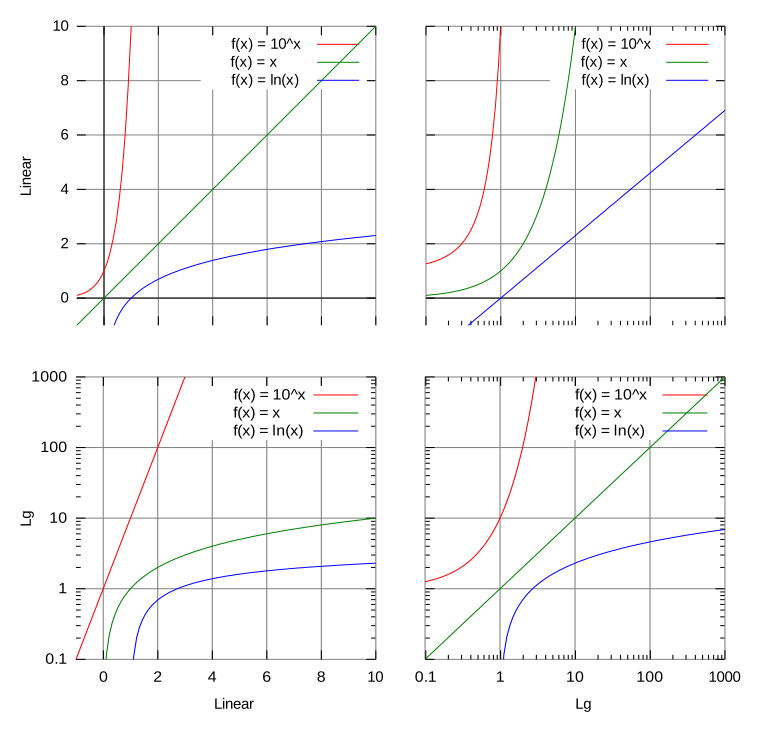
The same data plotted with different axis scales. Logarithmic scales compress large ranges and can make exponential relationships appear linear. On the MCAT, a straight line on a semi-log plot (LinLog) indicates an exponential relationship, while a straight line on a log-log plot indicates a power-law relationship. Credit: Wikimedia Commons, CC BY-SA 3.0
A logarithmic curve rises steeply at first, then levels off and grows very slowly. It is the mirror image of exponential growth reflected across the line y = x.
MCAT examples:
Enzyme kinetics (v vs. [S] at low substrate looks logarithmic before saturating)
Sound perception (perceived loudness vs. actual intensity)
Weber-Fechner Law in psychology (perceived stimulus vs. actual stimulus)
Sigmoidal (S-Shaped) Curves
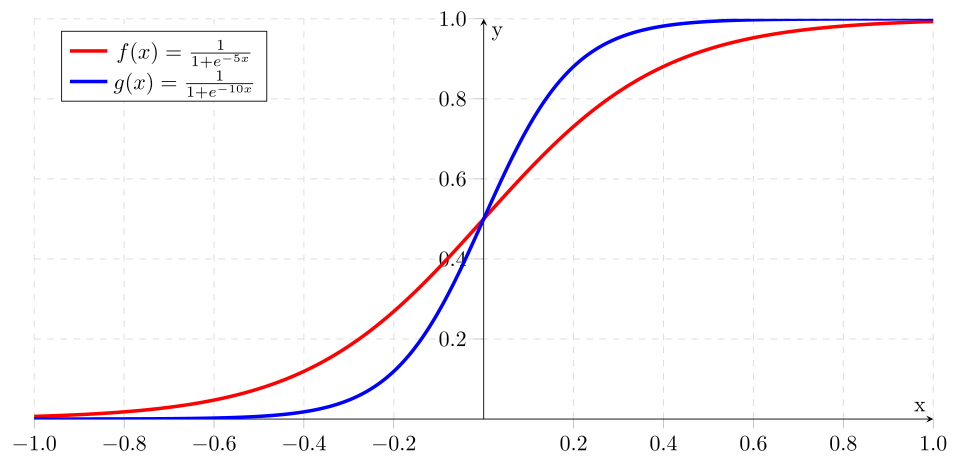
A sigmoidal (S-shaped) curve. The three phases are clearly visible: slow start (lower left), steep transition (center), and plateau (upper right). On the MCAT, this shape appears in hemoglobin-oxygen dissociation curves, logistic growth, drug dose-response curves, and titration curves. Credit: Wikimedia Commons, CC BY-SA 3.0
An S-curve has three phases: a slow start, a steep middle transition, and a plateau.
MCAT examples:
Hemoglobin-oxygen dissociation curve (the most tested graph in MCAT biology)
Logistic population growth
Drug dose-response curves
Titration curves near the equivalence point
The steep middle region indicates high sensitivity - small changes in the x-variable produce large changes in the y-variable. For hemoglobin, this means that in the range of pO2 found in tissues, small drops in oxygen tension cause hemoglobin to release large amounts of oxygen.
Inverse Graphs: y = k/x
A hyperbola that approaches both axes but never touches them. As x increases, y decreases - but never reaches zero.
MCAT examples:
Boyle’s Law: P vs. V at constant T
Michaelis-Menten: plotting 1/v vs. 1/[S] (Lineweaver-Burk) linearizes this
Slope: Rate of Change
The slope at any point on a curve tells you the instantaneous rate of change. For a straight line, slope is constant everywhere. For a curve, slope varies - it is the tangent line at that point.
Key principles:
Positive slope: y increases as x increases
Negative slope: y decreases as x increases
Zero slope: y is not changing (plateau or maximum/minimum)
Steeper slope: faster rate of change
Area Under the Curve: Accumulated Quantity
The area between the curve and the x-axis represents the total accumulated quantity.
MCAT examples:
Area under a velocity-time graph = displacement
Area under a force-displacement graph = work
Area under a power-time graph = energy
Area under a force-time graph = impulse
A velocity vs. time graph shows a straight line starting at 0 m/s and reaching 20 m/s over 5 seconds. What is the total displacement?
Click to reveal answer
Displacement = area under the v-t graph = area of the triangle = (21)(base)(height) = (21)(5 s)(20 m/s) = 50 m. The graph forms a triangle because velocity increases linearly from zero (constant acceleration).
A graph of [A] vs. time shows a straight line with a negative slope. What is the reaction order, and what does the slope represent?
Click to reveal answer
The reaction is zero-order. For a zero-order reaction, [A] = [A₀] - kt, which is a linear equation. The slope of the line equals -k (the negative of the rate constant). A first-order reaction would give a curve (exponential decay) when plotting [A] vs. time; you would need to plot ln[A] vs. time to get a straight line for first-order.
A news report says the average household income in a city is $120,000. You visit and notice most people seem to be earning around $50,000. How can both be true? Because a handful of millionaires are pulling the average (mean) way up, while most people cluster near $50,000. The median income - the value where half earn more and half earn less - would be much closer to $50,000 and would tell a more honest story. Understanding why mean and median can tell different stories is exactly what the MCAT tests.
Measures of Central Tendency
Mean (Average)
Add all values and divide by the number of values. The mean is sensitive to outliers - a single extreme value can shift it substantially.
Formula: mean = (sum of all values) / n
When to use: Symmetric distributions with no extreme outliers.
Median
The middle value when all data points are arranged in order. If there is an even number of values, the median is the average of the two middle values. The median is resistant to outliers.
When to use: Skewed distributions or data with outliers. Household income, hospital stay duration, and reaction times are typically reported as medians.
Mode
The most frequently occurring value. A data set can have no mode, one mode (unimodal), or multiple modes (bimodal, multimodal).
When to use: Categorical data (most common blood type, most popular answer choice) or identifying peaks in a distribution.
Measures of Spread
Range
The difference between the largest and smallest values. Simple but heavily influenced by outliers.
Standard Deviation (SD)
Standard deviation measures how spread out the data points are from the mean. A small SD means data points cluster tightly around the mean. A large SD means they are widely scattered.
You do not need to calculate SD on the MCAT (the formula involves square roots of summed squared deviations). You need to interpret it.
Variance
Variance = SD2. It is the standard deviation before taking the square root. The MCAT occasionally references variance, but standard deviation is far more common.
The Normal Distribution
The normal distribution (bell curve, Gaussian distribution) is symmetric around the mean. It is defined by two parameters: the mean (center) and the standard deviation (width).
Example: MCAT scores have a mean of 500 and an SD of about 10. So:
68% of test-takers score between 490 and 510
95% score between 480 and 520
99.7% score between 470 and 530
Skewed Distributions
Right-skewed (positive skew): The tail extends to the right. Most values cluster on the left. Mean is pulled right. Examples: income, hospital length of stay, reaction times.
Left-skewed (negative skew): The tail extends to the left. Most values cluster on the right. Mean is pulled left. Examples: age at retirement in a healthy population, easy exam scores.
Key relationship for skewed data: The mean is always pulled toward the tail. The median resists the pull. So the median is a better measure of “typical” for skewed data.
Standard Error and Confidence Intervals
Standard error of the mean (SEM) = SD / sqrt(n). It measures how much the sample mean is expected to vary from the true population mean. As sample size increases, SEM decreases - larger samples give more precise estimates.
95% confidence interval = mean +/- 1.96 x SEM (about mean +/- 2 SEM). This means: if you repeated the experiment many times, 95% of the calculated confidence intervals would contain the true population mean.
In a study, the mean blood pressure is 130 mmHg with a standard deviation of 15 mmHg. Assuming a normal distribution, what range contains 95% of the subjects?
Click to reveal answer
95% of subjects fall within 2 SDs of the mean: 130 +/- 2(15) = 130 +/- 30 = 100 to 160 mmHg. This uses the 68-95-99.7 rule. About 2.5% of subjects have blood pressure above 160 mmHg and 2.5% below 100 mmHg.
A data set of patient wait times has a mean of 45 minutes and a median of 20 minutes. Is this distribution skewed, and if so, in which direction? Which measure better represents the typical wait time?
Click to reveal answer
This is right-skewed (positive skew). The mean (45 min) is much larger than the median (20 min), indicating that a few patients with extremely long wait times are pulling the mean to the right. The median (20 min) better represents the typical wait time because it is resistant to these outliers.
You flip a coin and roll a die at the same time. What is the probability of getting heads AND a 6? Your intuition says “pretty low” - and it is: 21 x 61 = 121. Now, what is the probability of getting heads OR a 6 (or both)? That is a different question with a different rule. Confusing “and” with “or” is the most common probability mistake on the MCAT, and it costs easy points.
Basic Probability
The probability of an event is a number between 0 (impossible) and 1 (certain).
P(event) = (number of favorable outcomes) / (total number of possible outcomes)
The probability that an event does NOT happen: P(not A) = 1 - P(A). This complement rule is often the fastest way to solve probability problems.
The AND Rule (Multiplication)
When you want the probability that event A AND event B both occur:
Example: What is the probability that two carrier parents (Aa x Aa) have a child with cystic fibrosis (aa)?
From the Punnett square: P(aa) = 41 for each child.
What is the probability that their first TWO children both have CF? P(aa AND aa) = 41 x 41 = 161. Each birth is independent.
The OR Rule (Addition)
When you want the probability that event A OR event B occurs:
Example: What is the probability of rolling a 2 OR a 5 on a single die? These are mutually exclusive (cannot roll both at once): P = 61 + 61 = 62 = 31.
Example: What is the probability of drawing a heart OR a king from a standard deck? These overlap (king of hearts is both): P = 5213 + 524 - 521 = 5216 = 134.
Independent vs. Dependent Events
Independent events: The outcome of one does not affect the other. Coin flips, separate births, separate dice rolls. Use P(A and B) = P(A) x P(B).
Dependent events: The outcome of one changes the probability of the other. Drawing cards without replacement, selecting people from a small group. For dependent events: P(A and B) = P(A) x P(B given A).
On the MCAT, genetics problems almost always involve independent events (each child is an independent event). Chemistry and physics problems involving sequential draws or measurements may involve dependent events.
Punnett Squares as Probability Tools
A Punnett square is just a visual multiplication table for gamete probabilities.
For a monohybrid cross Aa x Aa:
A (21)
a (21)
A (21)
AA (41)
Aa (41)
a (21)
Aa (41)
aa (41)
Phenotype ratio: 43 dominant, 41 recessive.
For a dihybrid cross (AaBb x AaBb), the probability of any particular combination uses the AND rule across two independent gene loci. P(aabb) = P(aa) x P(bb) = 41 x 41 = 161.
Combinations vs. Permutations
Permutations: Order matters. “How many ways can 3 runners finish a race?” This is nPr = n!/(n-r)!
Combinations: Order does not matter. “How many ways can you choose 3 people from a group of 10?” This is nCr = n!/[r!(n-r)!]
The MCAT rarely requires you to compute factorials. Instead, it tests whether you know which concept to apply. If a genetics problem asks “in how many birth orders can a family of 4 children have exactly 2 boys,” that is a combination: 4C2 = 6 possible orders.
The Complement Shortcut
Sometimes it is easier to calculate the probability of what you do NOT want and subtract from 1.
Example: What is the probability of rolling at least one 6 in four rolls of a die?
Direct calculation is messy (one 6, two 6s, three 6s, four 6s). Instead:
P(no 6 on a single roll) = 65
P(no 6 in four rolls) = (65)⁴ = 1296625 = about 0.48
P(at least one 6) = 1 - 0.48 = 0.52
Two parents are both carriers for sickle cell trait (Aa x Aa). What is the probability that their first child is unaffected (AA or Aa)?
A disease has a prevalence of 10001. A test for this disease has a 5% false positive rate and 0% false negative rate. If a patient tests positive, what is the approximate probability they actually have the disease?
Click to reveal answer
Approximately 2%. Out of 1000 people: 1 has the disease (true positive). 999 are healthy, and 5% of them test positive: 999 x 0.05 = about 50 false positives. Total positives = 51. Of those 51 positives, only 1 actually has the disease: 511 = about 2%. This is Bayes' theorem in action - a low-prevalence disease produces many false positives relative to true positives.
A physics question asks for the kinetic energy of a 68 kg runner moving at 4.7 m/s. You could compute (21)(68)(4.7)² exactly, but that takes forever without a calculator. Instead: round 68 to 70, round 4.7 to 5, and 52 = 25. KE = (21)(70)(25) = 875 J. The answer choices are 400 J, 750 J, 1100 J, and 2200 J. Only 750 J is close, and your rough estimate of 875 J (slightly high because you rounded both numbers up) confirms it. Twelve seconds, no calculator, correct answer.
This section ties together everything in this chapter into a unified estimation strategy. On the MCAT, speed and confidence matter more than precision.
Strategy 1: Round to One Significant Figure
This is your default move. Replace every number with its first non-zero digit.
6.02 x 10²³ becomes 6 x 10²³
4.7 becomes 5
0.082 becomes 0.08
9.8 becomes 10
3.14 becomes 3
Then do the arithmetic with these simpler numbers. You will typically be within 10-20% of the exact answer, which is more than enough given MCAT answer spacing.
Strategy 2: Use Known Approximations
Memorize these common values:
Approximation
Exact Value
Error
sqrt(2) = 1.4
1.414
< 1%
sqrt(3) = 1.7
1.732
< 2%
π = 3
3.14159
< 5%
e = 2.7
2.718
< 1%
g = 10 m/s²
9.8 m/s²
< 3%
log 2 = 0.3
0.301
< 1%
log 3 = 0.5
0.477
< 5%
31 = 0.33
0.333…
< 1%
Strategy 3: Powers-of-10 Reasoning
When the question really just asks “how big is this?” you do not need the coefficient at all. Just track the powers of 10.
Example: Avogadro’s number is about 1023. The mass of a proton is about 10−27 kg. How many protons are in 1 kg?
Number = 1 / 10−27 = 1027. But each mole of protons is about 1 g = 10−3 kg and contains 1023 protons. So 1 kg contains about 103 moles x 1023/mole = 1026 protons. The exact coefficient does not matter - you are on the right order of magnitude.
Strategy 4: Process of Elimination
Even a rough estimate can eliminate 2-3 answer choices. Then, if needed, refine your estimate to choose between the remaining options.
Example: A question asks for the wavelength of light with frequency 5 x 10¹⁴ Hz.
λ = c/f = (3 x 10⁸) / (5 x 10¹⁴) = 0.6 x 10−6 = 6 x 10⁻⁷ m = 600 nm
If the choices are: (A) 6 nm, (B) 60 nm, (C) 600 nm, (D) 6000 nm - you only needed the exponent to eliminate three choices.
Strategy 5: Bracket the Answer
If you are unsure about rounding direction, calculate twice: once rounding up and once rounding down. The correct answer must lie between those two estimates.
Example: What is 67 x 8.3?
Lower bound: 60 x 8 = 480
Upper bound: 70 x 9 = 630
Actual: 556
If the answer choices are 280, 420, 560, and 840 - only 560 falls in the bracket.
Strategy 6: Compensating Rounds
When you round one number up, try to round the other down to partially cancel the error.
Example: 4.2 x 7.8
If you round both up: 5 x 8 = 40 (too high)
If you compensate: round 4.2 up to 4.5 and 7.8 down to 7.5: 4.5 x 7.5. Or simpler: 4 x 8 = 32 (round one down, other up). Actual: 32.76. The compensating round was nearly exact.
Worked Practice Examples
Problem 1: What is the pH of a 0.003 M HCl solution?
HCl is a strong acid, so [H+] = 3 x 10⁻³ M. pH = -log(3 x 10⁻³) = -(log 3 + log 10−3) = -(0.5 - 3) = 2.5.
Problem 2: A sound increases from 40 dB to 70 dB. By what factor did the intensity increase?
Change = 30 dB. Every 10 dB = 10x intensity. 30 dB = 10 x 10 x 10 = 1000x increase.
Problem 3: An electron (m = 9.1 x 10⁻³¹ kg) moves at 2 x 10⁶ m/s. Estimate its kinetic energy.
KE = (21)mv2 = (0.5)(10−30)(2 x 10⁶)² = (0.5)(10−30)(4 x 10¹²) = 2 x 10⁻¹⁸ J. Rounding 9.1 to 10 and doing quick exponent math gets you there in seconds.
Estimate without a calculator: What is (4.8 x 10⁵) / (1.6 x 10⁻²)?
Click to reveal answer
Round to (5 x 10⁵) / (1.6 x 10⁻²). Coefficients: 1.65 = about 3. Exponents: 105 / 10−2 = 107. Answer: approximately 3 x 10⁷. The exact answer is 3.0 x 10⁷. Rounding 4.8 to 5 introduced minimal error because the denominator (1.6) was already clean.
A ball is dropped from a height of 45 m. Estimate the speed just before it hits the ground. Use g = 10 m/s².
Click to reveal answer
v = sqrt(2gh) = sqrt(2 x 10 x 45) = sqrt(900) = 30 m/s. Using g = 10 instead of 9.8 makes the calculation trivial. The exact answer with g = 9.8 is 29.7 m/s - the estimation is off by about 1%.