Imagine a staircase where each step is ten times higher than the last. Step 1 is 1 meter, step 2 is 10 m, step 3 is 100 m, step 4 is 1000 m. A logarithm simply tells you which step you’re standing on. At 1000 m high? You’re on step 3, because 103=1000.
That’s all a log does: it answers “what power do I raise the base to to get this number?” Once that picture clicks, logs go from scary to simple. And they matter on the MCAT because pH (chemistry) and decibels (physics) are both logarithmic — so every pH or dB problem is secretly a log problem in disguise.
Logarithms appear on the MCAT in two major contexts: pH calculations (general chemistry and biochemistry) and decibel calculations (physics). If you know three key log values and three log rules, you can handle virtually every logarithm problem on test day.
Exponent Rules
Before tackling logarithms, lock down the exponent rules they are built on.
Rule
Example
xa⋅xb=xa+b
102⋅103=105
xa/xb=xa−b
105/102=103
(xa)b=xab
(102)3=106
x0=1
100=1
x−a=1/xa
10−3=1/1000=0.001
x1/n=nx
81/3=2
What Is a Logarithm?
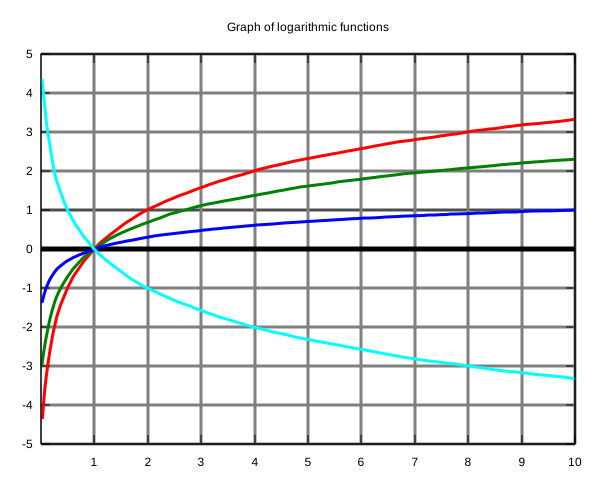
Logarithmic functions for different bases. All logarithmic curves pass through (1, 0) since log of 1 is always 0. Larger bases produce flatter curves. The common log (base 10) and natural log (base e) are the two forms tested on the MCAT. Credit: Wikimedia Commons, CC BY-SA 3.0
A logarithm is the inverse of exponentiation. If b^x = y, then log_b(y) = x.
On the MCAT, you will encounter two bases:
Common log (log or log10): used for pH, pOH, pKa, decibels
Natural log (ln or loge): used for kinetics (ln[A] vs. t), thermodynamics (ΔG = -RT ln K)
The LAP Mnemonic - Three Log Rules
These three rules, combined with a few memorized values, let you compute almost any log the MCAT can throw at you.
Key Log Values to Memorize
Value
log (base 10)
Why It Matters
log 1 = 0
100 = 1
Baseline reference
log 2 = 0.3
100.3 = 2
Most commonly tested
log 3 = 0.48 (use 0.5)
100.5 = 3.16
Useful approximation
log 5 = 0.7
log(210) = 1 - 0.3
Derived from log 2
log 10 = 1
101 = 10
Definition
pH and pOH Calculations
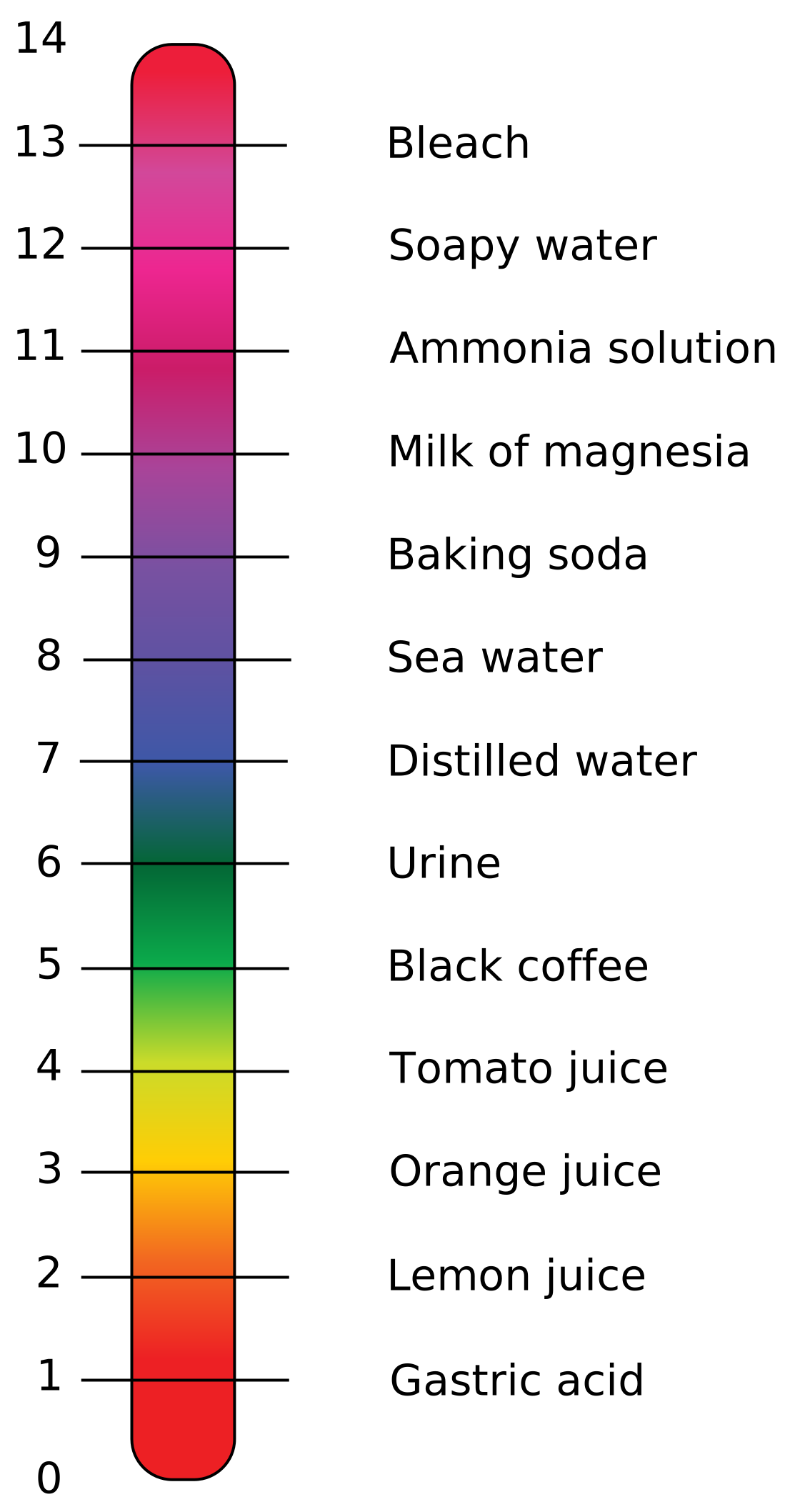
The pH scale ranges from 0 (strongly acidic) to 14 (strongly basic), with 7 being neutral. Each whole number step represents a tenfold change in hydrogen ion concentration, illustrating the logarithmic nature of the scale. Credit: Wikimedia Commons, CC BY-SA 3.0
The pH scale is the most common MCAT application of logarithms.
Example: What is the pH of a solution with [H+] = 4 x 10⁻³ M?
Quick rule: +10 dB means 10x intensity. +20 dB means 100x intensity. +3 dB means about 2x intensity.
Natural Logarithms (ln)
The natural log uses base e (= 2.718). Key relationships:
ln(e) = 1
ln(1) = 0
ln(ex) = x
e^(ln x) = x
The same LAP rules apply to natural logs. The MCAT uses ln in first-order kinetics (ln[A] = -kt + ln[A₀]) and in thermodynamics (ΔG = -RT ln K and ΔG = ΔGstandard + RT ln Q).
To convert between the two: ln x = 2.303 x log x. You rarely need this conversion on the MCAT, but it appears occasionally in derivations.
What is the pH of a solution with [H+] = 5 x 10⁻⁸ M?
Click to reveal answer
pH = -log(5 x 10⁻⁸) = -(log 5 + log 10−8) = -(0.7 + (-8)) = -(0.7 - 8) = -(-7.3) = 7.3. This is a slightly basic solution, which makes sense since pH is above 7.
A sound source increases in intensity from 10−6 W/m² to 10−3 W/m². By how many decibels does the sound level increase?
Click to reveal answer
30 dB. The intensity increased by a factor of 103 (1000-fold). Change in dB = 10 log(Inew/Iold) = 10 log(103) = 10 x 3 = 30 dB. Alternatively: each factor of 10 in intensity adds 10 dB, and 103 is three factors of 10.