
Vectors
You’re lost in the woods and someone radios directions: “Walk 3 miles.” Useless — 3 miles in which direction? Now they say: “Walk 3 miles due north, then 4 miles due east.” That’s useful, because each instruction has both a size (distance) and a direction.
Those instructions are vectors. And by combining them, you can figure out the shortcut home: the straight-line distance is 5 miles (a 3-4-5 right triangle) heading northeast. Vectors are the language of physics — forces, velocities, displacements, electric fields, magnetic fields are all vectors. On the MCAT, you need to add them, break them into components, use dot and cross products, and (for magnetism) apply the right-hand rule. This section is the master reference for all of that.
Magnitude and Direction
Every vector has two properties:
- Magnitude - the “size” or “how much” (always positive)
- Direction - the “which way” (expressed as an angle or as compass directions)
A vector is often written in bold (A) or with an arrow above it. Its magnitude is written as |A| or simply A (not bold).
Component Form
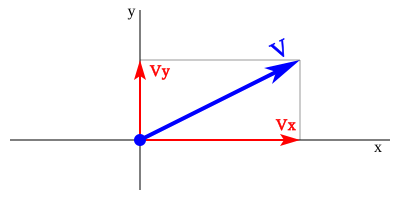
Any 2D vector can be expressed as components along the x and y axes:
A = (Ax, Ay), where Ax = A cos θ and Ay = A sin θ.
The magnitude is recovered from components using the Pythagorean theorem:
Adding Vectors by Components
This is the most reliable method for vector addition and the one you should default to on the MCAT.
To add A + B:
- Break each vector into x and y components
- Add x-components: Rx = Ax + Bx
- Add y-components: Ry = Ay + By
- Find magnitude and direction of the resultant R = (Rx, Ry)
Example: A boat travels 30 m/s east and a current pushes 40 m/s north. What is the boat’s actual velocity?
- Rx = 30 + 0 = 30 m/s (east)
- Ry = 0 + 40 = 40 m/s (north)
- |R| = sqrt( + ) = sqrt(900 + 1600) = sqrt(2500) = 50 m/s
- θ = arctan() = arctan() = 53 degrees north of east
Subtracting Vectors
To subtract B from A: reverse the direction of B (flip its sign), then add.
A - B = A + (-B) = (Ax - Bx, Ay - By)
This is important for finding changes in velocity (Δv = - ) in momentum and circular motion problems.
The Dot Product (Scalar Product)
The dot product takes two vectors and returns a scalar (a number, not a vector).
Physical meaning: The dot product measures how much two vectors point in the same direction. It is maximized when vectors are parallel (cos 0 = 1) and zero when they are perpendicular (cos 90 = 0).
MCAT application: Work. W = F . d = Fd cos θ. The force component parallel to displacement does work. A force perpendicular to motion does zero work.
The Cross Product (Vector Product)
The cross product takes two vectors and returns a new vector perpendicular to both.
Physical meaning: The cross product measures how much two vectors are perpendicular to each other. It is maximized when vectors are perpendicular (sin 90 = 1) and zero when they are parallel (sin 0 = 0).
MCAT applications:
- Torque: τ = r x F (force perpendicular to the lever arm produces maximum torque)
- Magnetic force: F = qv x B (a charge moving perpendicular to a magnetic field feels maximum force)
The Right-Hand Rule
To find the direction of A x B:
- Point your fingers in the direction of A
- Curl them toward B (through the smaller angle)
- Your thumb points in the direction of A x B
Important: A x B = -(B x A). The cross product is not commutative - order matters. Reversing the order flips the direction.