Your car speedometer shows 60 miles per hour, but the physics problem wants meters per second. A chemistry passage gives concentration in mg/dL, but the formula needs mol/L. A biology question cites a wavelength of 550 nm, but you need meters for the equation. Unit conversions are the unsexy glue that holds MCAT calculations together, and getting them wrong is the number one source of careless errors.
Dimensional Analysis
Dimensional analysis means treating units like algebraic variables. You set up conversion factors as fractions where the unwanted unit cancels and the desired unit remains.
Example: Convert 72 km/h to m/s.
72 km/h x (1000 m / 1 km) x (1 h / 3600 s) = 72,3600000 m/s = 20 m/s
Notice how “km” cancels with “km” and “h” cancels with “h,” leaving only “m/s.”
Metric Prefixes
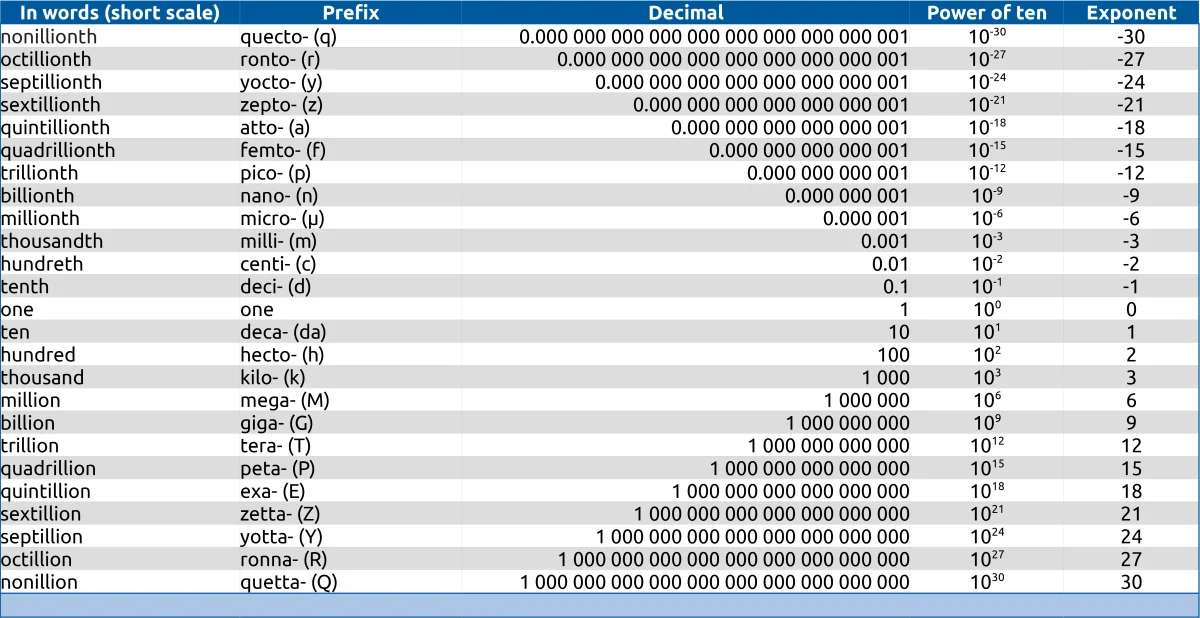
1012) through pico (10−12), showing prefix name, symbol, and power of 10 for each, organized from largest to smallest" loading="lazy" />
The SI metric prefixes. Each prefix represents a specific power of 10. For the MCAT, focus on kilo (103) through pico (10−12), as these appear most frequently in physics, chemistry, and biology calculations. Credit: Wikimedia Commons, CC BY-SA 3.0
Prefix
Symbol
Power of 10
Example
Tera
T
1012
1 THz = 1012 Hz
Giga
G
109
1 GHz = 109 Hz
Mega
M
106
1 MJ = 106 J
Kilo
k
103
1 km = 103 m
(base)
-
100
1 m, 1 g, 1 s
Centi
c
10−2
1 cm = 10−2 m
Milli
m
10−3
1 mL = 10−3 L
Micro
μ
10−6
1 micrometer = 10−6 m
Nano
n
10−9
1 nm = 10−9 m
Pico
p
10−12
1 pF = 10−12 F
Common MCAT Conversions
These come up repeatedly. Know them without thinking:
Conversion
Value
1 m
100 cm = 102 cm
1 cm
10 mm = 10−2 m
1 nm
10−9 m
1 L
1000 mL = 10−3 m³
1 mL
1 cm³ (= 1 cc)
1 atm
101,325 Pa = 760 mmHg
1 eV
1.6 x 10⁻¹⁹ J
1 calorie
4.184 J
1 kg
1000 g
0 degrees C
273 K
Squared and Cubed Unit Conversions
When converting area or volume, the conversion factor must also be squared or cubed.
Area: 1 m² = (100 cm)² = 10,000 cm² = 104 cm². Not 100 cm².
This is where most conversion errors occur. If a problem gives an area in cm² and you need m², divide by 104, not 102.
Example: Convert 5 cm² to m².
5 cm² x (1 m / 100 cm)² = 5 x (10−2)² m² = 5 x 10⁻⁴ m²
Temperature Conversions
Celsius to Kelvin: K = C + 273
Kelvin to Celsius: C = K - 273
The MCAT almost never uses Fahrenheit
Kelvin is the SI unit for temperature and is required for gas law and thermodynamics calculations. Celsius works for temperature changes (ΔT) because a one-degree change in Celsius equals a one-degree change in Kelvin.
Convert 450 nm to meters.
Click to reveal answer
450 nm = 450 x 10−9 m = 4.5 x 10⁻⁷ m. Nano means 10−9, so multiply the number by 10−9 to convert to the base unit (meters). This is in the visible light range (violet-blue).
A physics problem gives a cross-sectional area of 2 cm². What is this in m²?
Click to reveal answer
2 cm² = 2 x (10−2 m)² = 2 x 10⁻⁴ m². The key mistake to avoid: do not just multiply by 10−2. Because it is a squared unit, you must square the conversion factor: (10−2)² = 10−4.

 ) through pico (), showing prefix name, symbol, and power of 10 for each, organized from largest to smallest" loading="lazy" />