A ladder leans against a wall. The ladder is 10 feet long and makes a 60° angle with the ground. How high up the wall does it reach?
You don’t need a tape measure — you need trigonometry. The ladder is the hypotenuse, the wall height is the opposite side, and sine connects them: height = 10sin60°=10×0.87≈8.7 feet. Three seconds, no calculator — because you memorized that sin60°≈0.87.
On the MCAT, trigonometry appears in vector decomposition, inclined plane problems, optics (Snell’s law), and any problem involving angles. The test almost exclusively uses five special angles, so mastering trig is really just memorizing a small table.
SOH CAH TOA
For a right triangle with angle θ:
The Five Special Angles
This is the only trig table you need on the MCAT. Memorize it cold.
Angle
sin
cos
tan
0 degrees
0
1
0
30 degrees
21 = 0.5
sqrt(3)/2 = 0.87
1/sqrt(3) = 0.58
45 degrees
sqrt(2)/2 = 0.71
sqrt(2)/2 = 0.71
1
60 degrees
sqrt(3)/2 = 0.87
21 = 0.5
sqrt(3) = 1.73
90 degrees
1
0
undefined
Reading the Table Efficiently
Notice the sine values follow a clean pattern using square roots:
sin 0 = sqrt(0)/2 = 0
sin 30 = sqrt(1)/2 = 21
sin 45 = sqrt(2)/2
sin 60 = sqrt(3)/2
sin 90 = sqrt(4)/2 = 1
The numerator under the square root just counts: 0, 1, 2, 3, 4. The denominator is always 2. Cosine is the same sequence in reverse order.
The Unit Circle
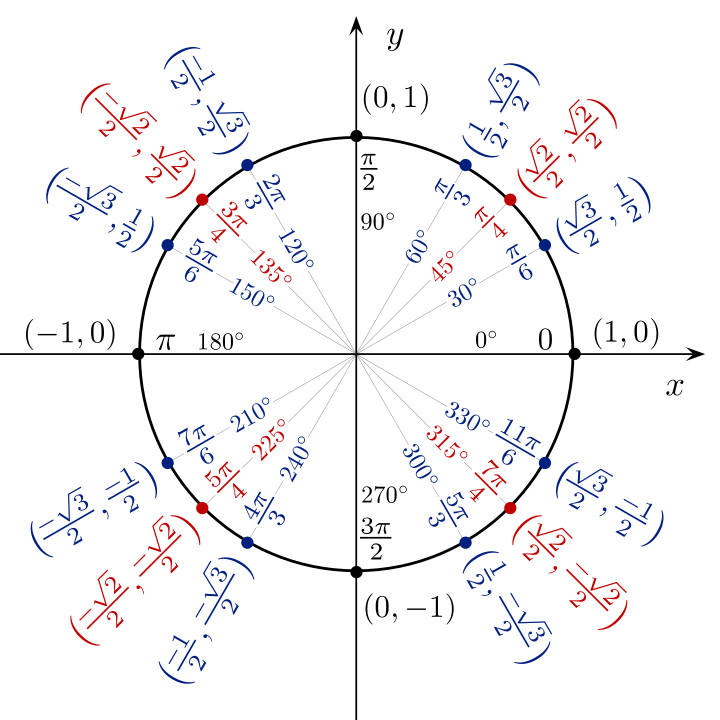
The unit circle. For any angle θ measured counterclockwise from the positive x-axis, the point on the circle has coordinates (cos θ, sin θ). The five special angles (0, 30, 45, 60, 90 degrees) and their symmetry partners in all four quadrants are shown. Credit: Wikimedia Commons, CC BY-SA 3.0
The unit circle extends trig beyond 0-90 degrees to all angles. It is a circle of radius 1 centered at the origin. For any angle θ measured counterclockwise from the positive x-axis, the coordinates of the point on the circle are (cos θ, sin θ).
Key quadrant signs:
Quadrant I (0-90 degrees): sin positive, cos positive
Quadrant II (90-180 degrees): sin positive, cos negative
Quadrant III (180-270 degrees): sin negative, cos negative
Quadrant IV (270-360 degrees): sin negative, cos positive
Inverse Trig Functions
Inverse trig functions answer: “What angle gives this ratio?”
If sin θ = 0.5, then θ = arcsin(0.5) = 30 degrees
If cos θ = 0.71, then θ = arccos(0.71) = 45 degrees
If tan θ = 1, then θ = arctan(1) = 45 degrees
On the MCAT, you will almost always be able to recognize the angle from your memorized table rather than needing to compute an inverse trig function from scratch.
Common MCAT Applications
Vector components: Fx = F cos θ, Fy = F sin θ (where θ is measured from the x-axis)
Inclined planes: Weight components on a ramp at angle θ: parallel = mg sin θ, perpendicular = mg cos θ
Snell’s Law: n1 sin θ_1 = n2 sin θ_2
Projectile motion:vx = v cos θ, vy = v sin θ
A 50 N force is applied at 30 degrees above the horizontal. What are the horizontal and vertical components?
Click to reveal answer
Horizontal = 50 cos 30 = 50 x 0.87 = 43.5 N. Vertical = 50 sin 30 = 50 x 0.5 = 25 N. The horizontal component (adjacent to the angle) uses cosine, and the vertical component (opposite the angle) uses sine.
On an inclined plane at 45 degrees, what fraction of an object's weight acts parallel to the surface?
Click to reveal answer
The parallel component = mg sin 45 = mg x 0.71, so about 71% of the weight. The perpendicular component = mg cos 45 = mg x 0.71 as well. At 45 degrees, the parallel and perpendicular components are equal - the weight is split evenly between the two directions.