Non-associative learning is the simplest kind of learning: a change in response to a single repeated stimulus, with no pairing between that stimulus and anything else. Two flavors matter for the MCAT: habituation and sensitization.
Habituation: Tuning Out
Habituation is a decrease in response to a stimulus that is presented repeatedly and turns out to mean nothing. The stimulus is not rewarding, not threatening - just there. Over time, your brain stops bothering to respond to it.
You move to a house near a train line. For a week, every train jolts you awake. By month two, you sleep through them.
The first click of an AC unit turning on catches your attention; the fifth one does not.
A first-time rollercoaster rider screams through the whole ride; an enthusiast riding the same coaster for the tenth time barely reacts.
Habituation is stimulus-specific and efficient - your brain saves energy by ignoring harmless background noise.
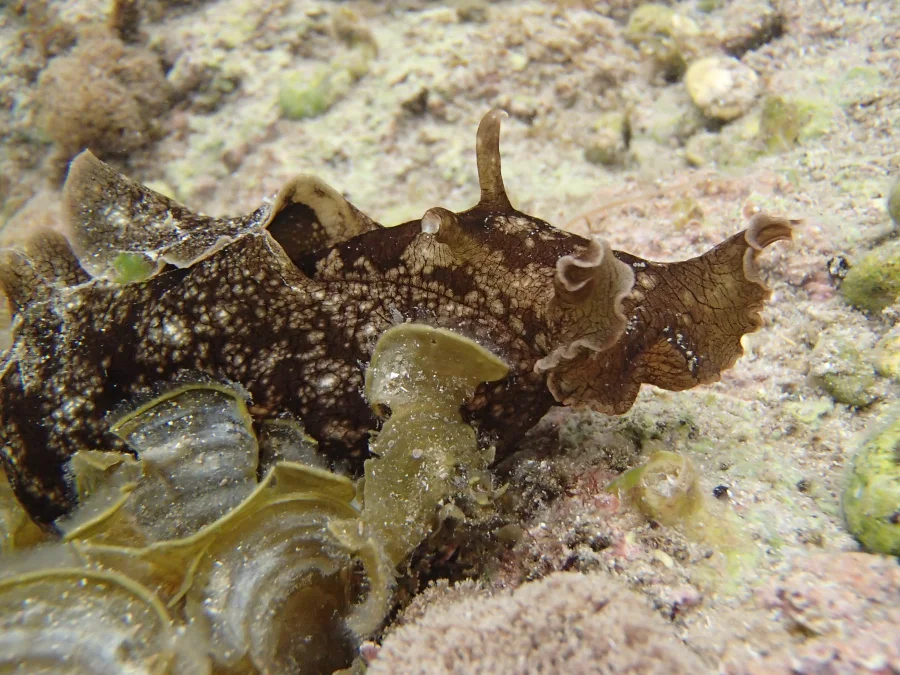
The marine sea slug Aplysia californica. Eric Kandel won the 2000 Nobel Prize for working out the cellular basis of habituation and sensitization in Aplysia's gill-withdrawal reflex — repeated touches to the siphon weaken the synapse onto the motor neuron (habituation); a noxious tail shock strengthens it (sensitization). Credit: Sofia Sadogurska via Wikimedia Commons (CC BY 4.0).
Dishabituation is the sudden return of the original response after the stimulus changes. Imagine you’ve habituated to the hum of your refrigerator, and it suddenly stops. You notice the silence. Or the train line gets a new louder train - back to startle.
Sensitization: Getting Primed
Sensitization is the opposite: an increase in response to a repeated stimulus. It usually follows an intense or threatening stimulus.
After a car accident, every screech of brakes startles you for weeks.
Soldiers returning from combat flinch at loud sounds.
If you touch a hot pan once and get burned, a warm surface afterward feels unusually alarming.
Sensitization is often generalized - a painful stimulus doesn’t just make you hyperreactive to that exact stimulus; it makes you hyperreactive to a whole class of stimuli. This is adaptive: after one dangerous experience, the brain takes no chances.
Habituation vs. Associative Learning
The key distinction: in non-associative learning, only one stimulus is involved. No pairing. The animal (or person) is simply learning how to respond to that single thing across repeated exposures. In associative learning (the rest of this chapter), two events get linked - a stimulus and another stimulus (classical conditioning), or a behavior and a consequence (operant conditioning).
Define habituation and give an everyday example.
Click to reveal answer
Decreased response to a repeated, inconsequential stimulus. Example: you stop noticing the hum of a refrigerator. It is central (not receptor-level) and stimulus-specific.
What is sensitization?
Click to reveal answer
Increased response to a repeated stimulus, usually following an intense or threatening experience. Often generalizes to related stimuli, making the learner hyperreactive.
What distinguishes habituation from sensory adaptation?
Click to reveal answer
Sensory adaptation is receptor-level down-regulation - the receptor literally stops firing. Habituation is a CNS/cognitive reduction in response - the receptor still fires, but the brain filters it out.
In 1903, Ivan Pavlov was studying dog digestion when he noticed something weird. His dogs started drooling before the food even arrived - at the sight of a lab assistant, the clink of a bowl, or eventually a bell. They were learning that one stimulus predicted another. He had stumbled onto what we now call classical conditioning (or Pavlovian or respondent conditioning): an innate reflex comes to be elicited by a previously meaningless stimulus, through repeated pairing.
Classical conditioning explains most of what we call emotional learning. Fears, cravings, and the “gut feelings” you can’t quite justify are often classically conditioned associations your body learned without asking your permission.
The Four-Term Framework
Memorize this vocabulary. The MCAT will hand you a scenario and ask which letter is which.
Unconditioned stimulus (UCS) - something that naturally, without learning, triggers a response. Food for Pavlov’s dogs. A puff of air on the eye. A bee sting.
Unconditioned response (UCR) - the natural, unlearned response to the UCS. Salivation to food. Eye blink to air puff. Pain and recoil to sting.
Neutral stimulus (NS) - a stimulus that, before training, produces no relevant response. The bell, before any pairing.
Conditioned stimulus (CS) - what the neutral stimulus becomes after enough pairings with the UCS. The bell, after it starts predicting food.
Conditioned response (CR) - the learned response to the CS alone. Salivation to the bell. The CR often looks like the UCR but is typically slightly weaker.
The recipe for classical conditioning:
Start with UCS → UCR (food → salivation). Innate.
Pair NS with UCS (bell + food). Multiple trials.
After enough pairings, NS alone becomes CS (bell).
CS → CR (bell → salivation). Learned.
“Unconditioned” = innate. “Conditioned” = learned. That is the single most helpful key to the vocabulary.
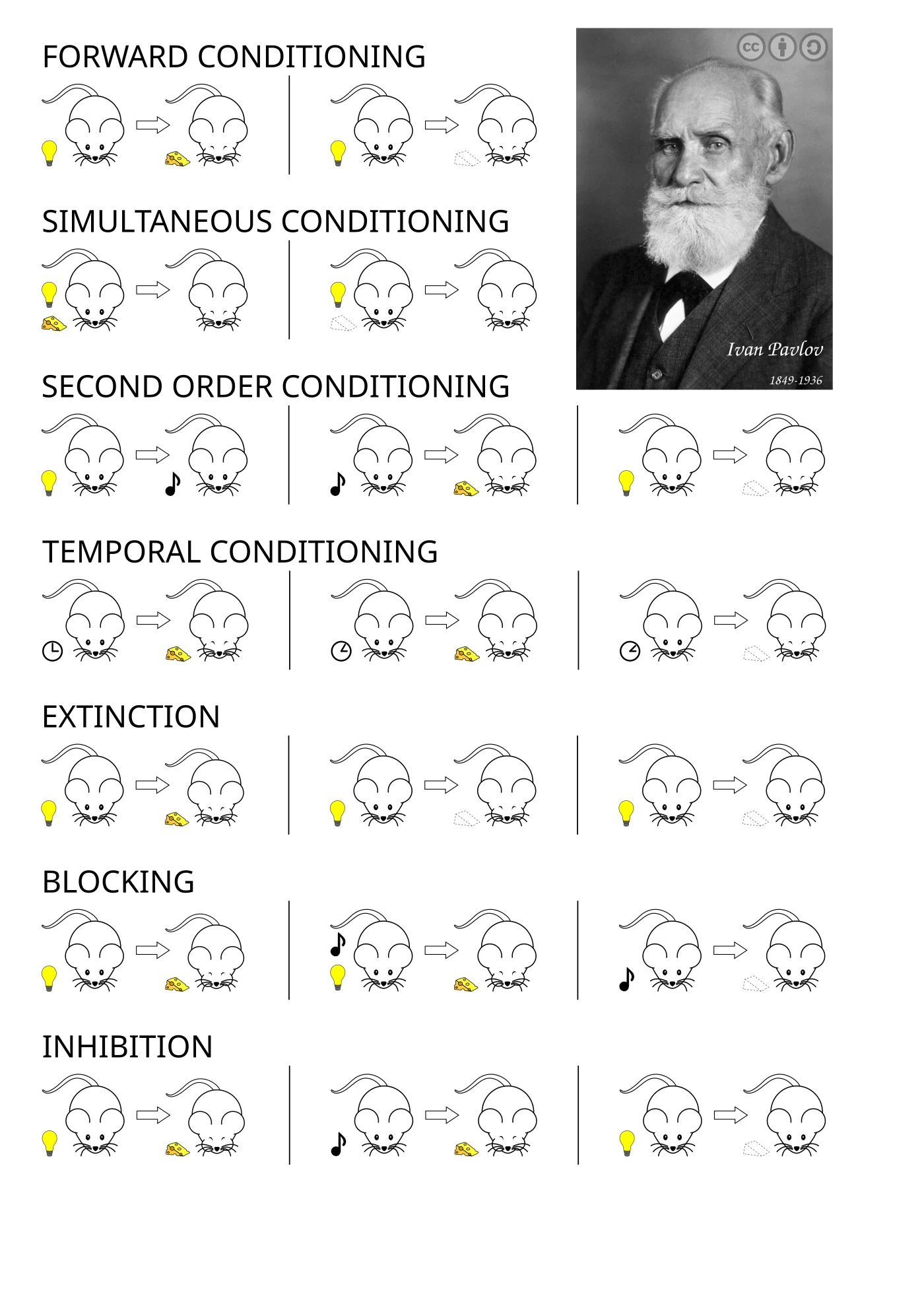
Types of classical-conditioning procedures. Each row shows stimulus (lightbulb, sound, clock) paired with an unconditioned stimulus (cheese) and the resulting conditioned response in the mouse. Credit: Nicolas P. Rougier via Wikimedia Commons, CC BY-SA 3.0.
Acquisition
Acquisition is the phase during which the NS transitions into a CS. The closer in time the NS precedes the UCS, the faster acquisition happens. Presenting the NS after the UCS (backwards conditioning) usually fails - the NS carries no predictive value.
Extinction, Spontaneous Recovery
What if you present the bell over and over without food? The CR weakens and eventually stops. This is extinction. The CS no longer triggers the CR because the pairing has broken down.
But the learning isn’t gone forever. After a rest period, presenting the CS alone can trigger a weak CR again - spontaneous recovery. The original association leaves a trace. This shows up clinically: someone whose phobia appeared “cured” can relapse when they encounter the feared stimulus after months of no exposure.
Extinction of a conditioned response. Left: the CS (light) still predicts the UCS (cheese). Middle: the UCS is withheld and the CR begins to weaken. Right: after enough unreinforced trials, the CS no longer elicits the response. Credit: Nicolas P. Rougier via Wikimedia Commons, CC BY-SA 3.0.
Generalization and Discrimination
Generalization - stimuli similar to the CS also trigger the CR. A child bitten by a Labrador grows fearful of all dogs, even small ones. A bell of a different pitch still makes Pavlov’s dogs salivate, though less strongly.
Discrimination - the learner responds only to the exact CS (or a narrow range) and not to similar stimuli. A dog learns to distinguish the kitchen microwave (food) from the laundry timer (nothing). Discrimination is trained by reinforcing responses to the target CS while withholding reinforcement from similar stimuli.
Both are adaptive. Generalization lets you treat a new growling animal as a threat without having to be bitten first. Discrimination prevents you from reacting to every similar stimulus in the world.
Clinical Applications
Classical conditioning is the scaffolding of several major therapies:
Aversive conditioning. Pair an unwanted behavior with an unpleasant stimulus so the behavior becomes the CS for disgust or pain. Disulfiram (Antabuse) for alcoholism makes the drinker sick whenever they consume alcohol; eventually alcohol itself becomes aversive.
Systematic desensitization. Developed by Joseph Wolpe. Teach the patient a relaxation response, then expose them to a hierarchy of feared stimuli starting mild and getting stronger. Because relaxation and anxiety can’t coexist, the CR (anxiety) weakens as the patient repeatedly practices relaxation in the presence of the CS. Used for phobias.
Counterconditioning. Replace an unwanted CR with a new, wanted one by pairing the CS with a new UCS. Overlaps with systematic desensitization and extinction.
Flooding (implosive therapy). Expose the patient to the feared stimulus at full intensity, with no escape, forcing the extinction of the CR. Effective but anxiety-provoking.
Extinction Burst
Before extinction fully takes hold, behavior often spikes temporarily - an extinction burst. A dog that was reliably reinforced for pressing a button frantically presses it over and over when the reinforcement first stops, before gradually abandoning the behavior. The same shows up in humans: “if I knock on this door one more time, maybe they’ll answer!” Understanding extinction bursts is important clinically - if a parent decides to stop reinforcing tantrums, the tantrums get worse before they get better, and parents who give up during the burst end up reinforcing the escalation.
In Pavlov's bell-and-food experiment, identify each term: bell (before training), food, salivation to food, salivation to bell (after training), bell (after training).
Click to reveal answer
Bell before training: neutral stimulus (NS). Food: unconditioned stimulus (UCS). Salivation to food: unconditioned response (UCR). Bell after training: conditioned stimulus (CS). Salivation to bell: conditioned response (CR).
What is spontaneous recovery?
Click to reveal answer
The return of an extinguished CR after a rest period, when the CS is presented alone. It demonstrates that extinction doesn't erase the original learning - it just suppresses it.
How does systematic desensitization work?
Click to reveal answer
The patient learns relaxation, then is gradually exposed to increasingly intense versions of the feared stimulus while maintaining relaxation. Because relaxation is incompatible with anxiety, the conditioned fear response weakens. Developed by Joseph Wolpe; used for phobias.
What is an extinction burst?
Click to reveal answer
A temporary spike in the conditioned behavior after reinforcement stops, before extinction fully takes hold. Recognizing it is important clinically because parents or therapists who quit during the burst will accidentally reinforce the escalated behavior.
Classical conditioning is about reflexes triggered by paired stimuli. Operant conditioning is about voluntary behavior shaped by consequences. B.F. Skinner built the framework: a behavior followed by a good consequence gets repeated; a behavior followed by a bad consequence tapers off.
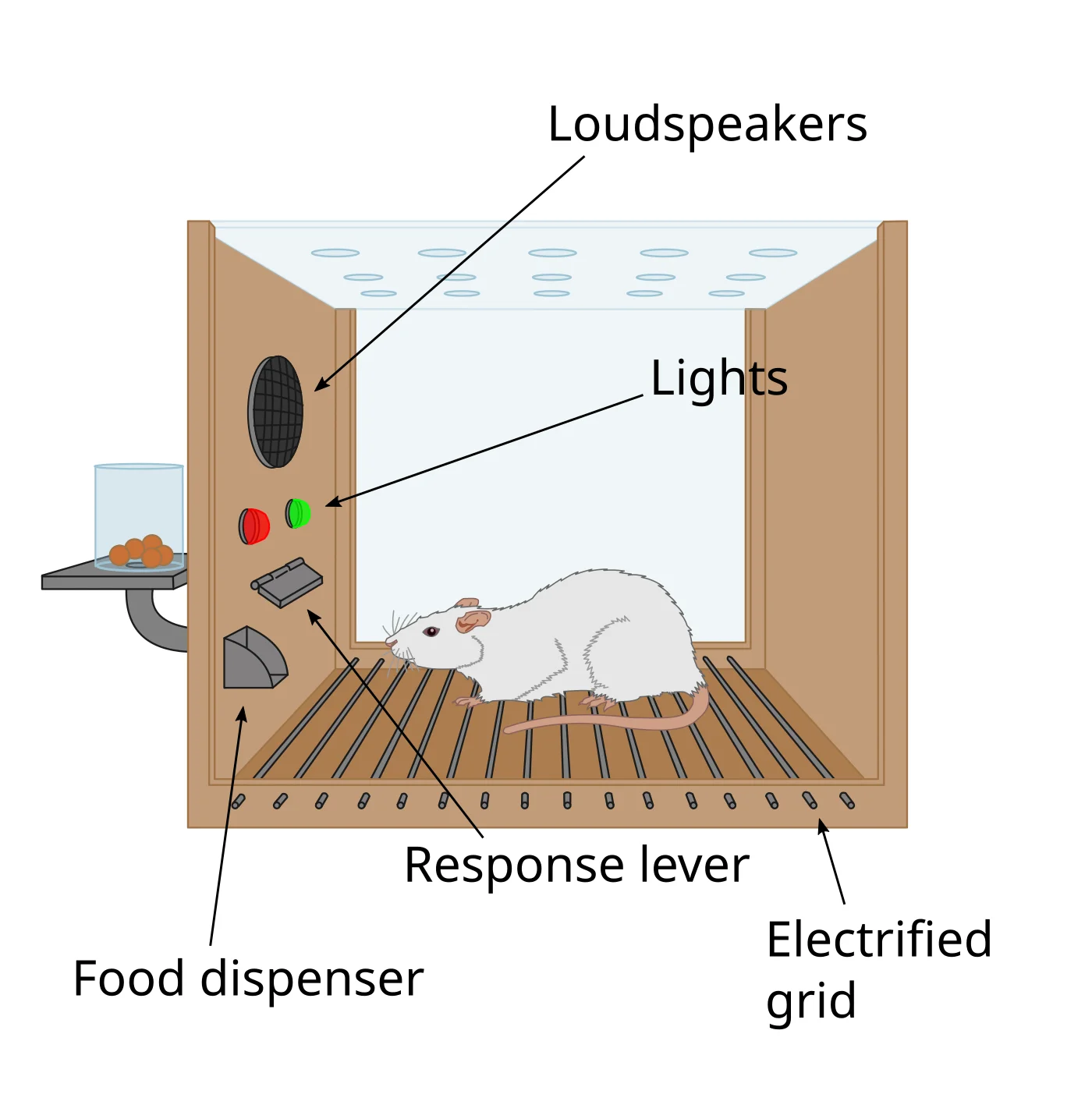
The operant conditioning chamber ("Skinner box"). The animal emits a response (pressing the lever); the apparatus delivers a consequence (food pellet or shock). Varying the schedule and contingency of the consequence is how Skinner built the entire experimental science of operant conditioning. Credit: AndreasJS via Wikimedia Commons, CC BY-SA 3.0.
The Four Quadrants
The single most testable concept in this entire chapter is the 2 × 2 matrix of reinforcement and punishment. Memorize it until you can redraw it in ten seconds.
Adding something
Removing something
Increase behavior
Positive reinforcement
Negative reinforcement
Decrease behavior
Positive punishment
Negative punishment
“Positive” means adding something. It does NOT mean “good.”
“Negative” means removing something. It does NOT mean “bad.”
“Reinforcement” always increases the target behavior.
“Punishment” always decreases the target behavior.
Examples (the MCAT uses scenarios, so practice classifying them):
Positive reinforcement. Give a gas gift card to employees for safe driving. You add a reward to increase safe driving.
Negative reinforcement. Your car’s seatbelt buzzer stops the moment you buckle up. You remove an annoyance to increase seatbelt use.
Positive punishment. A speeding ticket. You add a financial penalty to decrease speeding.
Negative punishment. Taking away a teen’s phone for breaking curfew. You remove a valued object to decrease curfew-breaking.
Primary and Secondary Reinforcers
Primary reinforcers are innately satisfying: food, water, warmth, sex. Useful to animals and infants.
Secondary reinforcers acquire their value through pairing with primary reinforcers. Money is the classic example. Money has no intrinsic value; it works because we learn it can be traded for primary reinforcers.
Token economies are formal systems built on secondary reinforcers. Patients in a psychiatric unit might earn plastic tokens for doing chores or attending therapy; tokens are later exchanged for privileges. Widely used in schools, prisons, and rehab programs.
Immediacy Matters
Reinforcement and punishment work best when delivered immediately after the target behavior. Delayed consequences weaken the association. This is one reason training a dog works best with real-time treats, and why tax penalties (delivered months or years after the behavior) are a surprisingly weak deterrent. The brain learns “what happened right before” caused the outcome - wait too long and the link blurs.
Escape and Avoidance Learning
Both are forms of aversive control - behavior motivated by the threat of something unpleasant. Both are cases of negative reinforcement.
Escape learning. The aversive stimulus is already happening; the organism learns a response that terminates it. A rat learns to jump off an electrified grid to end the shock. “Get me out of here.”
Avoidance learning. A signal precedes the aversive stimulus; the organism learns a response that prevents it from occurring. A warning buzzer sounds before the shock; the rat jumps the barrier at the buzzer and avoids the shock entirely.
Avoidance learning is notoriously durable because the behavior prevents the aversive stimulus from ever happening, which means the learner never finds out whether the stimulus is still present. Phobias have this flavor: someone who avoids flying because of fear never gets to experience a safe flight that would extinguish the fear.
Operant Extinction
If a learned operant behavior stops being reinforced, it gradually stops. A dog trained to sit for treats will stop sitting on command if you never treat again. Like classical extinction, operant extinction is often preceded by an extinction burst - the behavior spikes briefly before fading.
Instinctive Drift
Even well-trained operant behaviors can be overridden by the animal’s species-specific instincts. Instinctive drift, discovered by Breland and Breland (former students of Skinner), is the tendency of trained behaviors to revert to instinctive patterns. They tried to teach a raccoon to deposit tokens in a piggy bank; it started rubbing the tokens together and dunking them - food-washing behavior, not token-depositing. Reinforcement couldn’t override instinct.
A parent takes away their teen's video games when the teen misses chores. Classify this operant technique.
Click to reveal answer
Negative punishment. Something desirable (video games) is removed, to decrease a behavior (missing chores).
What is the difference between negative reinforcement and punishment?
Click to reveal answer
Negative reinforcement INCREASES a behavior by removing something unpleasant (e.g., buckle seatbelt → buzzer stops). Punishment DECREASES a behavior. They are opposites, not synonyms.
Why is avoidance learning so resistant to extinction?
Click to reveal answer
The avoidance response prevents the aversive stimulus, so the learner never discovers whether the stimulus is still present. The behavior is self-reinforcing via relief. Phobic avoidance works this way.
What is instinctive drift?
Click to reveal answer
The tendency of operantly trained behavior to revert to species-specific instinctive behavior. The Brelands showed raccoons reverting to food-washing motions instead of token-depositing, despite reinforcement. Instincts can override learned behavior.
Skinner discovered that when you reward behavior is as important as whether you reward it. Different reinforcement schedules produce dramatically different response patterns and different resistance to extinction. This is why slot machines keep people pulling levers and factory pieceworkers keep producing. Understanding the four partial schedules is worth real MCAT points.
Continuous vs. Partial Reinforcement
Continuous reinforcement. Every instance of the target behavior is reinforced. A vending machine: press the button, get the snack, every time. Continuous reinforcement produces fast initial learning but also fast extinction - if the machine suddenly stops working, you quickly stop pressing.
Partial (intermittent) reinforcement. Only some instances of the behavior are reinforced. Partial schedules produce slower learning but much greater resistance to extinction. Because the learner has already experienced non-reward, they keep going even when rewards stop.
The resistance-to-extinction difference is why occasional reinforcement is often more addictive than constant reinforcement. A gambler who wins every time on a slot machine quits the moment the machine breaks. A gambler who wins sometimes keeps pulling.
The Four Partial Schedules
Two axes: ratio or interval (by behavior count or by time elapsed), and fixed or variable (constant or unpredictable).
Fixed
Variable
Ratio (count-based)
Fixed ratio (FR)
Variable ratio (VR)
Interval (time-based)
Fixed interval (FI)
Variable interval (VI)
Fixed Ratio (FR)
Reinforcement after a fixed number of responses. Example: a factory worker gets paid for every 10 widgets assembled.
Produces a high, steady response rate with a brief pause after each reinforcement (the worker rests briefly after collecting their pay).
Resistance to extinction: moderate.
Variable Ratio (VR)
Reinforcement after an unpredictable number of responses, averaging around some set value. Example: a slot machine pays out on average every 15 pulls, but any specific pull could win or lose.
Produces the highest, most consistent response rate of any schedule.
Most resistant to extinction. The learner never knows if the next response will be the jackpot, so quitting feels costly.
Powers most addictive behavior: gambling, social media (“maybe the next scroll has something good”), fishing, sales cold-calling.
Fixed Interval (FI)
First response after a fixed amount of time earns reinforcement. Example: a salaried employee gets paid every two weeks regardless of effort.
Produces a “scalloped” response pattern - slow responding just after reinforcement, ramping up as the next reinforcement approaches. Think of a student doing no work for the first week after a test, then cramming as the next test nears.
Low overall response rate.
Variable Interval (VI)
Reinforcement after an unpredictable amount of time. Example: checking your email - you don’t know when the next important message will arrive.
Produces a steady, moderate response rate.
High resistance to extinction.
Pop quizzes work on this schedule (reinforce studying by unpredictable testing).
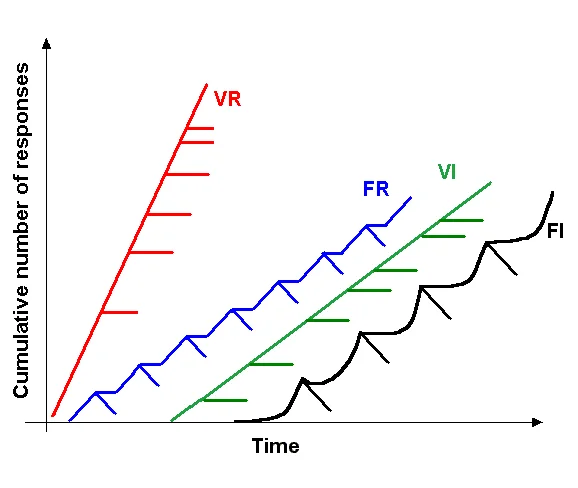
Classic cumulative-response curves for the four partial-reinforcement schedules. Hash marks = reinforcements. VR produces the steepest, most consistent responding and the greatest extinction resistance; FR shows a stair-step with post-reinforcement pauses; VI yields a steady, moderate rate; FI produces the characteristic scalloped pattern. Credit: Wikimedia Commons, Public Domain.
Shaping: Building Complex Behaviors
How do you get an animal to do something it would never do spontaneously? Shaping is the reinforcement of successive approximations - rewarding behaviors that get progressively closer to the target behavior.
To teach a pigeon to peck a specific button:
Reward the pigeon for facing the button.
Once it reliably faces the button, require it to step toward the button before rewarding.
Then require it to touch the button.
Finally, reward only when it pecks the button.
Each step raises the bar slightly. The pigeon learns a complex chain of behavior it could never have guessed from reading the original instructions. Trainers use shaping to teach dogs to skateboard, dolphins to jump through hoops, and humans to do surgery.
Chaining
A related concept: chaining links individual operant responses into a sequence. Each response serves as a cue for the next. Dance routines, driving a stick shift, cooking a complex recipe - all are chains of simpler learned responses that have been stitched together through reinforcement.
Which reinforcement schedule produces the highest response rate and the greatest resistance to extinction?
Click to reveal answer
Variable ratio (VR). Rewards come after an unpredictable number of responses. Slot machines, gambling. "VR = Very Rapid."
What is a fixed interval schedule, and what response pattern does it produce?
Click to reveal answer
Reinforcement after a fixed amount of time (e.g., biweekly paycheck). Produces a scalloped response pattern: responding slows right after reinforcement and ramps up as the next reinforcement approaches.
What is shaping?
Click to reveal answer
Reinforcing successive approximations of a target behavior. Each step gets closer to the final goal. Trainers use shaping to teach complex behaviors (dog tricks, surgery, dance) that the learner would never perform spontaneously.
Why does partial reinforcement produce greater resistance to extinction than continuous reinforcement?
Click to reveal answer
Under partial reinforcement, the learner already experiences stretches with no reward, so the transition to complete nonreinforcement is less discriminable. They keep responding hoping the next response brings reward. Continuous reinforcement makes nonreinforcement an obvious signal to quit.
You do not need to touch a hot stove to learn it is dangerous; you can watch someone else get burned and learn the lesson vicariously. That is observational learning, sometimes called social learning or vicarious learning. Albert Bandura made it a central topic in psychology with his Bobo doll experiments in the early 1960s.
The Bobo Doll Experiment
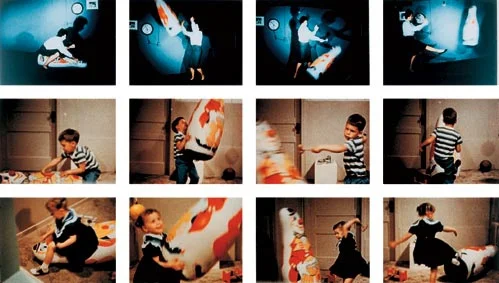
Bandura had adult “models” play in a room with a Bobo doll - a large inflatable clown that rights itself when punched. In the aggressive condition, the adult punched, kicked, and yelled at the doll (“Kick it! Hit it!”) for about ten minutes. In the control condition, the adult played peacefully.
Children watched through an observation window. Then the researchers brought each child into a different room with a Bobo doll and many other toys. The results:
Children who had watched the aggressive model were much more likely to act aggressively toward the doll - and frequently used the same phrases they had heard the model use.
Children who had watched the peaceful model played peacefully.
Aggression was modeled across gender, though boys were more aggressive overall, and same-sex models had a bigger imitative effect.
Key point: none of these children had been rewarded or punished for any behavior. They learned through observation alone.
Film stills from Bandura's Bobo doll experiment. Top: the adult model attacks the doll. Middle and bottom: children who watched the model reproduce the same specific attacks, often with the same phrases. Learning occurred purely through observation, without any reinforcement of the children. Credit: Bandura, Ross, & Ross (1963), via Wikimedia Commons, CC BY-SA 4.0.
Learning vs. Performance: The Follow-Up Experiment
Bandura’s second experiment tested whether children would imitate aggression differently depending on what happened to the model. He showed children videos in which the aggressive model was either:
Rewarded (given candy and praise),
Punished (scolded and spanked), or
Neither.
Children who saw the model rewarded imitated aggressive acts freely. Children who saw the model punished imitated less.
But here comes the twist. Researchers then offered all the children stickers or juice in exchange for imitating the model’s behavior. Children who had seen the model punished - who had previously appeared not to have learned the aggression - performed it accurately and enthusiastically.
They had learned the aggression. They just hadn’t performed it.
This is the learning-performance distinction: observing behavior teaches you the behavior, but whether you perform it depends on motivation and incentives. An MCAT passage on “vicarious punishment” or “vicarious reinforcement” is invoking this principle.
Mirror Neurons
In the 1990s, Italian neuroscientists discovered mirror neurons in macaque premotor cortex: neurons that fire both when the monkey performs an action AND when the monkey watches someone else perform that same action. The existence of analogous systems in humans has been proposed as a neural substrate for observational learning, empathy, and language acquisition, though the details remain debated.
Bandura’s Four Requirements for Observational Learning
For a person to learn by observation, four conditions must be met. The mnemonic is “AM I Motivated?”:
Attention. You have to be paying attention to the model. Distraction blocks the learning.
Memory. You have to be able to encode and retain what you saw.
Imitation. You have to be physically and mentally capable of reproducing the behavior. (A toddler cannot learn to tie a shoe by watching, because their motor skills aren’t ready.)
Motivation. You have to have a reason to perform the behavior. Observing reward or punishment of the model heavily shapes motivation.
Social Cognitive Theory
Bandura’s broader theory, social cognitive theory (originally social learning theory), places observational learning in a larger framework: behavior is influenced by cognition, environment, and other behavior in a web of mutual influence. Called reciprocal determinism - your cognition shapes your environment, your environment shapes your behavior, your behavior feeds back into your cognition. Meg joins a soccer team (environment), plays with soccer players (behavior), develops an interest in soccer (cognition), and that interest reinforces her team membership.
Social cognitive theory differs from pure behaviorism by taking cognition seriously. Skinner treated the mind as a “black box”; Bandura insisted on opening it.
What did the Bobo doll experiment demonstrate about aggression?
Click to reveal answer
Children who watched an adult model act aggressively toward a doll imitated those specific aggressive behaviors - including phrases - even though they were never reinforced themselves. Aggression can be learned through observation alone.
What is the learning-performance distinction?
Click to reveal answer
Observation teaches a behavior (learning). Whether the learner actually does it depends on motivation (performance). Bandura showed that children who had seen a model punished did not spontaneously imitate aggression - but performed it readily when offered incentives, proving they had learned it.
What are Bandura's four conditions for observational learning?
Click to reveal answer
Attention, Memory, Imitation (ability to reproduce), and Motivation. "AM I Motivated?" Remove any one and the learning fails.
What is reciprocal determinism?
Click to reveal answer
Bandura's concept that cognition, environment, and behavior all mutually influence each other in a web of causation. No single direction is primary. It is a cornerstone of social cognitive theory.
Classical and operant conditioning were once thought to be universal rules - any stimulus could be paired with any response in any animal, given enough trials. Then a series of experiments in the 1960s and 70s showed this was wrong. Animals are biologically prepared to learn certain associations far more easily than others. Learning is filtered through evolution.
Conditioned Taste Aversion (The Garcia Effect)
John Garcia showed something remarkable in rats. He paired sweetened water with two kinds of aversive consequence:
In one condition, the water was paired with an illness-inducing drug.
In another, the water was paired with electric shocks.
Separately, he paired a light-and-buzzer cue with the same two consequences.
The results contradicted the prediction that any two stimuli can be associated with any consequence:
Stimulus
Followed by illness
Followed by shock
Sweet water (taste)
Strong aversion
No aversion
Light/buzzer
No aversion
Strong avoidance
Rats easily learned to associate taste with illness, even after a single trial and even when the illness came hours later. They could not easily associate taste with shock, nor light/buzzer with illness. The evolutionary logic is transparent: in nature, food usually causes illness (bad food), and external threats usually cause physical pain (predator attack). Rats are biologically prepared for the associations that matter for survival.
This one-trial learning for taste aversion is why you still hate that specific sushi roll that made you sick five years ago, even though you know intellectually it was the stomach bug. Your limbic system connects “ate sushi” to “got sick” as a one-shot survival rule.
Phobia Preparedness
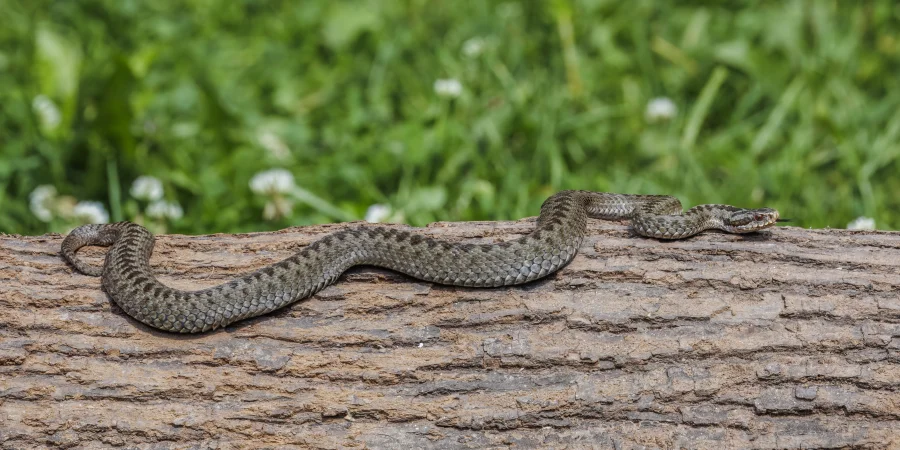
The European adder, an example of an ancestral threat. Snake-, spider-, and height-phobias far outnumber phobias of cars or electrical outlets, even though modern hazards kill more people. Preparedness theory says natural selection tuned us to acquire these specific fears on minimal evidence. Credit: Charles J. Sharp via Wikimedia Commons (CC BY-SA 4.0).
Seligman argued that humans, like rats, are prepared to learn certain fears more readily than others. Most phobias cluster around ancient threats: snakes, spiders, heights, deep water, confined spaces, the dark. You rarely see phobias of electrical outlets or cars, even though modern life makes these far more dangerous than most snakes.
The preparedness theory of phobias says natural selection equipped us to acquire fear of ancestrally dangerous things on minimal evidence. A single bad experience with a spider can create a lifelong phobia; fifty near-misses in traffic leave most people shrugging.
Instinctive Drift (Again)
We saw this briefly in operant conditioning, but it belongs in this chapter too. Keller and Marian Breland set up animal shows at fairs and discovered that even well-trained operant behaviors would drift toward species-specific instincts. A raccoon taught to drop tokens in a slot would begin rubbing and dunking the tokens - food-washing behavior. A chicken trained to stand on a platform would begin scratching at it - ground-scratching foraging behavior. Reinforcement could not override instinct indefinitely.
Instinctive drift shows that operant conditioning works with biology, not independently of it.
Practical Upshot
For the MCAT, remember:
Not all stimulus-response pairs learn at the same rate.
Adaptive pairings (food-illness, predator-pain) learn faster than arbitrary pairings (light-illness).
One-trial learning is possible for biologically prepared associations.
Instincts can override learned behavior.
Learning is filtered through evolution, not a blank-slate algorithm.
What did Garcia's taste-aversion experiments demonstrate?
Click to reveal answer
Rats readily learn to associate taste with illness, but not taste with shock or light with illness. Conditioning is filtered through evolution - organisms are biologically prepared for some pairings but not others. Also: taste aversion can form in ONE trial, even with long delays.
Why are snake and spider phobias more common than phobias of electrical outlets or cars?
Click to reveal answer
Preparedness theory: humans evolved to acquire fears of ancient dangers readily. Snakes and spiders threatened our ancestors; cars did not. We are biologically prepared to develop these fears on minimal evidence.
What does instinctive drift tell us about the limits of operant conditioning?
Click to reveal answer
Even thoroughly trained operant behaviors can be overridden by species-specific instincts. The Brelands' raccoon reverted to food-washing instead of token-depositing despite reinforcement. Reinforcement cannot permanently override strong innate behavior patterns.