
Classical Conditioning
In 1903, Ivan Pavlov was studying dog digestion when he noticed something weird. His dogs started drooling before the food even arrived - at the sight of a lab assistant, the clink of a bowl, or eventually a bell. They were learning that one stimulus predicted another. He had stumbled onto what we now call classical conditioning (or Pavlovian or respondent conditioning): an innate reflex comes to be elicited by a previously meaningless stimulus, through repeated pairing.
Classical conditioning explains most of what we call emotional learning. Fears, cravings, and the “gut feelings” you can’t quite justify are often classically conditioned associations your body learned without asking your permission.
The Four-Term Framework
Memorize this vocabulary. The MCAT will hand you a scenario and ask which letter is which.
- Unconditioned stimulus (UCS) - something that naturally, without learning, triggers a response. Food for Pavlov’s dogs. A puff of air on the eye. A bee sting.
- Unconditioned response (UCR) - the natural, unlearned response to the UCS. Salivation to food. Eye blink to air puff. Pain and recoil to sting.
- Neutral stimulus (NS) - a stimulus that, before training, produces no relevant response. The bell, before any pairing.
- Conditioned stimulus (CS) - what the neutral stimulus becomes after enough pairings with the UCS. The bell, after it starts predicting food.
- Conditioned response (CR) - the learned response to the CS alone. Salivation to the bell. The CR often looks like the UCR but is typically slightly weaker.
The recipe for classical conditioning:
- Start with UCS → UCR (food → salivation). Innate.
- Pair NS with UCS (bell + food). Multiple trials.
- After enough pairings, NS alone becomes CS (bell).
- CS → CR (bell → salivation). Learned.
“Unconditioned” = innate. “Conditioned” = learned. That is the single most helpful key to the vocabulary.
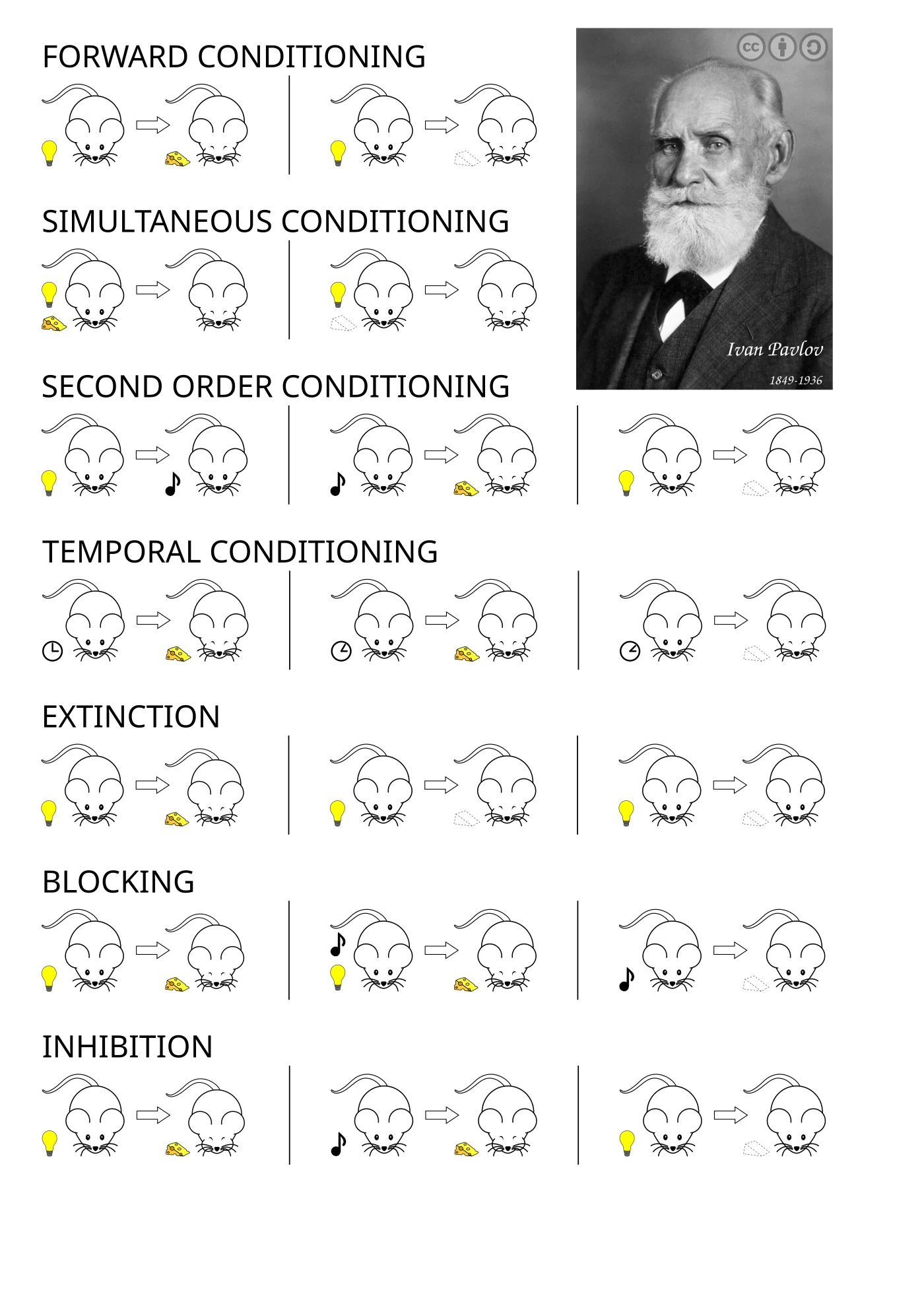
Acquisition
Acquisition is the phase during which the NS transitions into a CS. The closer in time the NS precedes the UCS, the faster acquisition happens. Presenting the NS after the UCS (backwards conditioning) usually fails - the NS carries no predictive value.
Extinction, Spontaneous Recovery
What if you present the bell over and over without food? The CR weakens and eventually stops. This is extinction. The CS no longer triggers the CR because the pairing has broken down.
But the learning isn’t gone forever. After a rest period, presenting the CS alone can trigger a weak CR again - spontaneous recovery. The original association leaves a trace. This shows up clinically: someone whose phobia appeared “cured” can relapse when they encounter the feared stimulus after months of no exposure.

Generalization and Discrimination
- Generalization - stimuli similar to the CS also trigger the CR. A child bitten by a Labrador grows fearful of all dogs, even small ones. A bell of a different pitch still makes Pavlov’s dogs salivate, though less strongly.
- Discrimination - the learner responds only to the exact CS (or a narrow range) and not to similar stimuli. A dog learns to distinguish the kitchen microwave (food) from the laundry timer (nothing). Discrimination is trained by reinforcing responses to the target CS while withholding reinforcement from similar stimuli.
Both are adaptive. Generalization lets you treat a new growling animal as a threat without having to be bitten first. Discrimination prevents you from reacting to every similar stimulus in the world.
Clinical Applications
Classical conditioning is the scaffolding of several major therapies:
- Aversive conditioning. Pair an unwanted behavior with an unpleasant stimulus so the behavior becomes the CS for disgust or pain. Disulfiram (Antabuse) for alcoholism makes the drinker sick whenever they consume alcohol; eventually alcohol itself becomes aversive.
- Systematic desensitization. Developed by Joseph Wolpe. Teach the patient a relaxation response, then expose them to a hierarchy of feared stimuli starting mild and getting stronger. Because relaxation and anxiety can’t coexist, the CR (anxiety) weakens as the patient repeatedly practices relaxation in the presence of the CS. Used for phobias.
- Counterconditioning. Replace an unwanted CR with a new, wanted one by pairing the CS with a new UCS. Overlaps with systematic desensitization and extinction.
- Flooding (implosive therapy). Expose the patient to the feared stimulus at full intensity, with no escape, forcing the extinction of the CR. Effective but anxiety-provoking.
Extinction Burst
Before extinction fully takes hold, behavior often spikes temporarily - an extinction burst. A dog that was reliably reinforced for pressing a button frantically presses it over and over when the reinforcement first stops, before gradually abandoning the behavior. The same shows up in humans: “if I knock on this door one more time, maybe they’ll answer!” Understanding extinction bursts is important clinically - if a parent decides to stop reinforcing tantrums, the tantrums get worse before they get better, and parents who give up during the burst end up reinforcing the escalation.