
Observational Learning
You do not need to touch a hot stove to learn it is dangerous; you can watch someone else get burned and learn the lesson vicariously. That is observational learning, sometimes called social learning or vicarious learning. Albert Bandura made it a central topic in psychology with his Bobo doll experiments in the early 1960s.
The Bobo Doll Experiment
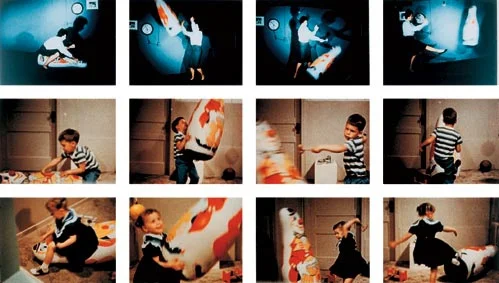
Bandura had adult “models” play in a room with a Bobo doll - a large inflatable clown that rights itself when punched. In the aggressive condition, the adult punched, kicked, and yelled at the doll (“Kick it! Hit it!”) for about ten minutes. In the control condition, the adult played peacefully.
Children watched through an observation window. Then the researchers brought each child into a different room with a Bobo doll and many other toys. The results:
- Children who had watched the aggressive model were much more likely to act aggressively toward the doll - and frequently used the same phrases they had heard the model use.
- Children who had watched the peaceful model played peacefully.
- Aggression was modeled across gender, though boys were more aggressive overall, and same-sex models had a bigger imitative effect.
Key point: none of these children had been rewarded or punished for any behavior. They learned through observation alone.
Learning vs. Performance: The Follow-Up Experiment
Bandura’s second experiment tested whether children would imitate aggression differently depending on what happened to the model. He showed children videos in which the aggressive model was either:
- Rewarded (given candy and praise),
- Punished (scolded and spanked), or
- Neither.
Children who saw the model rewarded imitated aggressive acts freely. Children who saw the model punished imitated less.
But here comes the twist. Researchers then offered all the children stickers or juice in exchange for imitating the model’s behavior. Children who had seen the model punished - who had previously appeared not to have learned the aggression - performed it accurately and enthusiastically.
They had learned the aggression. They just hadn’t performed it.
This is the learning-performance distinction: observing behavior teaches you the behavior, but whether you perform it depends on motivation and incentives. An MCAT passage on “vicarious punishment” or “vicarious reinforcement” is invoking this principle.
Mirror Neurons
In the 1990s, Italian neuroscientists discovered mirror neurons in macaque premotor cortex: neurons that fire both when the monkey performs an action AND when the monkey watches someone else perform that same action. The existence of analogous systems in humans has been proposed as a neural substrate for observational learning, empathy, and language acquisition, though the details remain debated.
Bandura’s Four Requirements for Observational Learning
For a person to learn by observation, four conditions must be met. The mnemonic is “AM I Motivated?”:
- Attention. You have to be paying attention to the model. Distraction blocks the learning.
- Memory. You have to be able to encode and retain what you saw.
- Imitation. You have to be physically and mentally capable of reproducing the behavior. (A toddler cannot learn to tie a shoe by watching, because their motor skills aren’t ready.)
- Motivation. You have to have a reason to perform the behavior. Observing reward or punishment of the model heavily shapes motivation.
Social Cognitive Theory
Bandura’s broader theory, social cognitive theory (originally social learning theory), places observational learning in a larger framework: behavior is influenced by cognition, environment, and other behavior in a web of mutual influence. Called reciprocal determinism - your cognition shapes your environment, your environment shapes your behavior, your behavior feeds back into your cognition. Meg joins a soccer team (environment), plays with soccer players (behavior), develops an interest in soccer (cognition), and that interest reinforces her team membership.
Social cognitive theory differs from pure behaviorism by taking cognition seriously. Skinner treated the mind as a “black box”; Bandura insisted on opening it.