
Reward Pathway, Tolerance, and Withdrawal
Why is quitting nicotine harder than quitting broccoli? Why do cocaine users crave the drug for months after stopping? The answer lives in a single circuit: the mesolimbic dopamine pathway, the brain’s built-in reward system. Addictive drugs hijack it.
The Reward Pathway
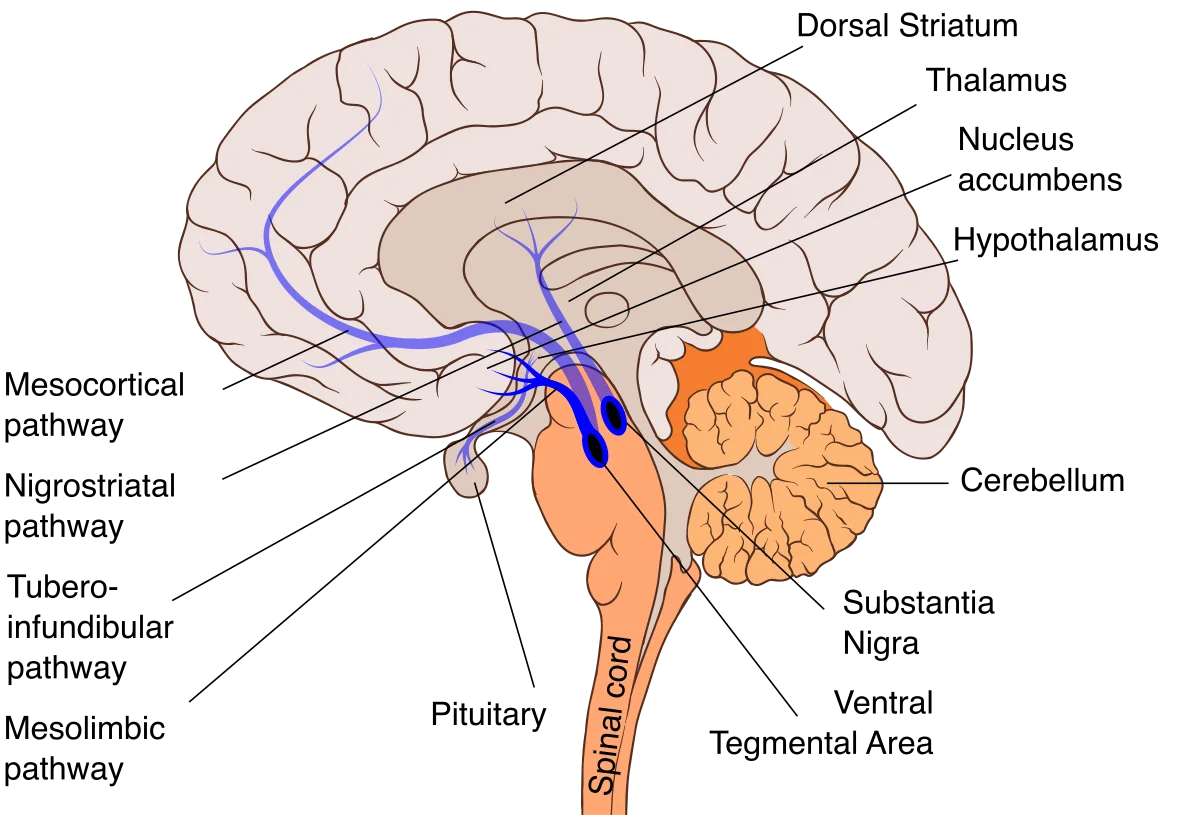
The pathway begins in the ventral tegmental area (VTA), a small cluster of dopamine-producing neurons in the midbrain. VTA dopamine neurons project forward to:
- Nucleus accumbens (NAc) - the central “pleasure” node. Dopamine release here is the direct neural correlate of “this was good.”
- Amygdala - ties the reward to emotion (“this felt great”).
- Hippocampus - encodes context (“I want to remember where and when this happened”).
- Prefrontal cortex - focuses attention and lays down goal-directed plans to seek the reward again.
Together these structures form the mesolimbic pathway. Natural rewards (food, sex, social connection, accomplishment) all activate it modestly. Addictive drugs activate it massively - cocaine spikes dopamine 3–10× higher than a piece of cake. That supernormal signal is what “drives learning” of drug-seeking behavior.
Tolerance
Tolerance is the shift in the dose-response curve such that the same dose produces less effect over time.
Mechanism: repeated drug exposure downregulates receptors or neurotransmitter release. The post-synaptic cell, bombarded with dopamine, removes some of its receptors to protect itself. Now the normal amount of dopamine from food or sex feels underwhelming, and even the old drug dose does not produce the old high.
Cross-tolerance is when tolerance to one drug reduces the effect of a different drug sharing the same mechanism. Alcohol and benzodiazepines show cross-tolerance (both act on GABA-A). A heavy drinker needs more sedative medication than an abstainer would.
Homeostasis and the Setting
The body responds to a drug by pushing against it. If cocaine raises heart rate, the body enacts compensatory reductions in heart rate. This learning is context-dependent.
A regular user who always injects in the same room trains their body to start compensating as soon as they enter that room. Take the same dose in a new, unfamiliar setting and the compensatory response does not kick in - the user overdoses. This “conditioned compensatory response” explains why many fatal overdoses happen in unusual locations.
Dependence vs. Addiction
- Physical dependence - the body has adapted to the drug’s presence. Stopping produces physical withdrawal symptoms. A patient on daily opioids for chronic pain is physically dependent, whether or not they are addicted.
- Psychological dependence - emotional attachment; cravings; the drug has become central to coping and enjoyment.
- Substance use disorder (addiction) - DSM-5 diagnostic category. Key features include: using more than intended, unsuccessful attempts to cut down, excessive time spent on the drug, cravings, failure to meet obligations, continued use despite harm, tolerance, withdrawal, and neglect of activities. Severity graded mild / moderate / severe by number of criteria met.
Caffeine can produce dependence and withdrawal, but cannot meet the full criteria for a substance use disorder in the DSM-5.
Withdrawal
When a physically dependent user stops the drug, withdrawal symptoms emerge - the body’s compensatory machinery is now unopposed. Symptoms are usually opposite to the drug’s effects.
- Opioid withdrawal: diarrhea, cramping, sweating, dilated pupils, anxiety, gooseflesh. Unpleasant, rarely fatal.
- Alcohol withdrawal: tremors, hallucinations, seizures, autonomic hyperactivity. Can be fatal. Severe forms (“delirium tremens”) are medical emergencies treated with benzodiazepines.
- Stimulant withdrawal: profound fatigue, depression, cravings. Psychological more than physical.
- Nicotine withdrawal: irritability, anxiety, difficulty concentrating.
Withdrawal splits into acute (days to weeks, mostly physical) and post-acute (weeks to years; mood swings, low energy, sleep disturbance, vulnerability to relapse).
Treatments
Effective addiction treatment is almost always a combination of:
- Detoxification. Medically supervised withdrawal. For alcohol, benzodiazepines substitute and then taper. For opioids, methadone or buprenorphine substitute.
- Pharmacotherapy. Methadone (long-acting opioid agonist) or buprenorphine (partial agonist) reduce opioid cravings. Naltrexone blocks opioid and alcohol reward. Nicotine replacement (patches, gum, lozenges) tapers nicotine without the reinforcement of smoking.
- Cognitive behavioral therapy (CBT). Helps patients identify triggering situations and develop coping strategies. Evidence base for alcohol, cocaine, methamphetamine, nicotine addiction.
- Motivational interviewing. Short, focused counseling that elicits the patient’s own reasons for change.
- Group support. AA, NA, and 12-step programs. Based on acceptance, surrender, active involvement.
- Relapse prevention. Avoid environmental cues (old haunts, old companions) that trigger craving.