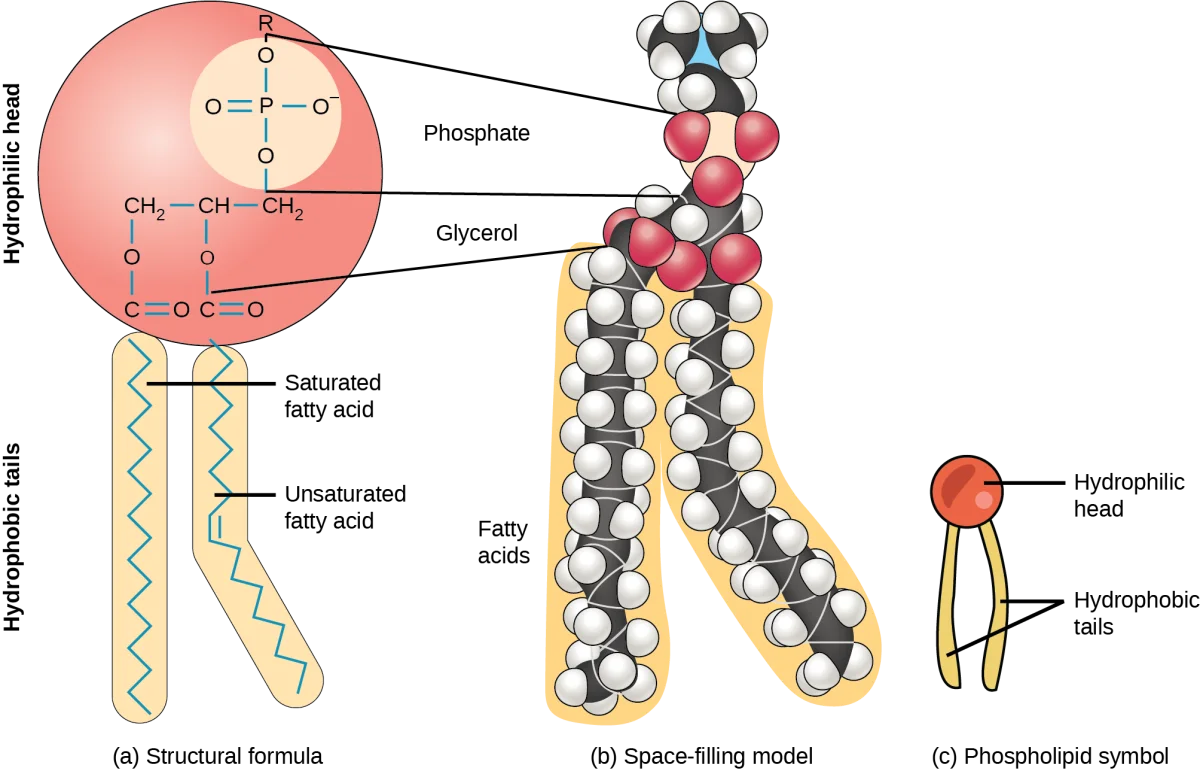
Phospholipids are the main structural lipids of cell membranes. A phospholipid looks like a triglyceride with one modification: instead of a third fatty acid, it has a phosphate group with a polar head group.
Structure
A phospholipid has:
A glycerol backbone.
Two fatty acid tails on C1 and C2 (one saturated, one unsaturated is common).
A phosphate on C3, linked to a polar head group (choline, ethanolamine, serine, inositol, or glycerol).
Phosphatidylcholine, the most abundant phospholipid. Glycerol + 2 fatty acids + phosphate + choline head group. Credit: OpenStax Biology 2e, CC BY 4.0
The phosphate head is hydrophilic (charged). The two fatty acid tails are hydrophobic. That makes phospholipids amphipathic - one end loves water, the other hates it.
The Bilayer
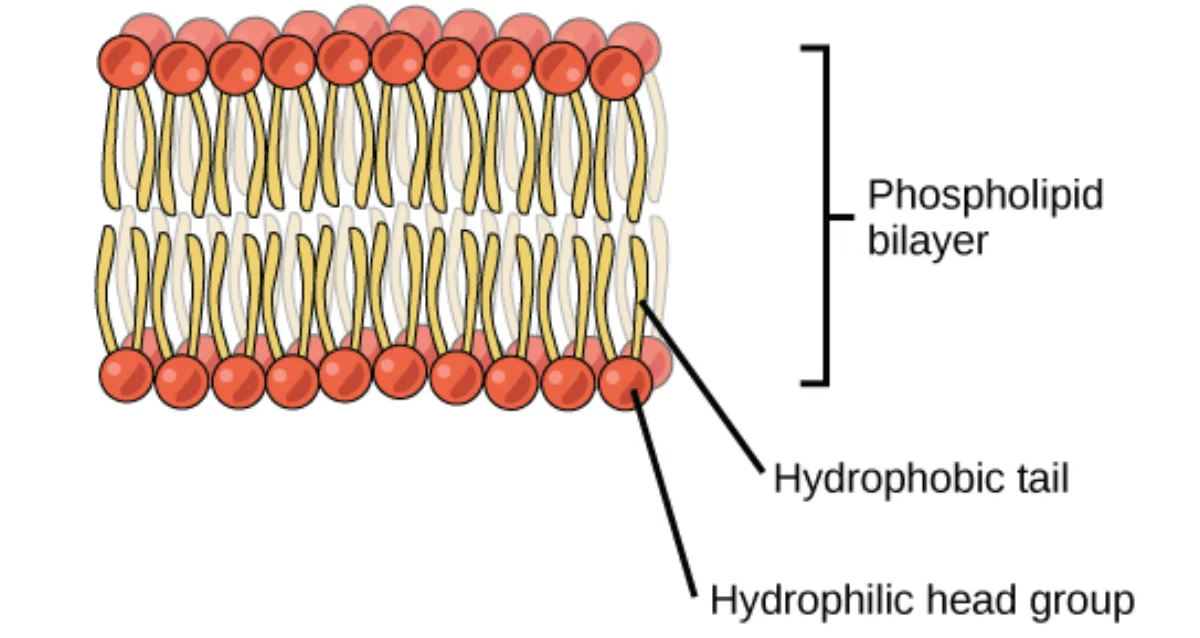
In water, amphipathic molecules assemble to hide their hydrophobic parts from water. For phospholipids, the lowest-energy arrangement is a bilayer: two layers with tails facing inward (touching each other, away from water) and heads facing outward (in contact with water on both sides).
The phospholipid bilayer. Hydrophilic heads face water on both sides; hydrophobic tails meet in the middle. This is the architecture of every cell membrane. Credit: OpenStax Biology 2e, CC BY 4.0
Common Head Groups
Different head groups give phospholipids slightly different properties and locations:
Phospholipid
Head group
Notes
Phosphatidylcholine (lecithin)
Choline
Most abundant; outer leaflet
Phosphatidylethanolamine
Ethanolamine
Abundant; inner leaflet
Phosphatidylserine
Serine
Inner leaflet normally; flipped to outer leaflet in apoptosis as an “eat me” signal
Phosphatidylinositol
Inositol
Inner leaflet; PIP2 is a signaling precursor cleaved to IP3 and DAG
Bilayer Fluidity
Membrane fluidity depends on:
Fatty acid saturation: more unsaturation (kinks) → more fluid. Saturated tails pack tightly → less fluid.
Chain length: longer tails interact more → less fluid.
Cholesterol: at high temperature it reduces fluidity (holds things in place). At low temperature it prevents the bilayer from becoming too rigid (keeps things moving). It is a bidirectional stabilizer.
Temperature: higher temperature → more kinetic motion → more fluid.
Why do phospholipids spontaneously form a bilayer in water?
Click to reveal answer
Phospholipids are amphipathic - they have a hydrophilic phosphate head and two hydrophobic fatty acid tails. To minimize the free energy of the system, they arrange so their tails are hidden from water (facing each other) and their heads are exposed to water (facing both aqueous compartments). The bilayer arrangement satisfies this condition with minimal energy cost.
What signal does phosphatidylserine give when it appears on the outer leaflet of a cell membrane?
Click to reveal answer
"Eat me." Phosphatidylserine is normally confined to the inner leaflet. During apoptosis, flippases and scramblases move PS to the outer leaflet. Macrophages recognize external PS as a signal to phagocytose the dying cell, so the cell is cleared without triggering an inflammatory response.
How does the degree of fatty acid saturation affect membrane fluidity?
Click to reveal answer
More unsaturated fatty acids mean more cis double bonds, which put kinks in the tails. Kinked tails cannot pack tightly, so the membrane is more fluid at a given temperature. Saturated tails pack tightly and produce a more rigid, gel-like membrane. Organisms living in cold environments often incorporate more unsaturated fatty acids into their membranes to stay fluid.